Blatant vs Flagrant can confuse readers because both words describe something obvious or offensive, yet their meanings, usage, and context can differ slightly.
In English, blatant often describes something offensively conspicuous, obvious, or brazen, while flagrant suggests something conspicuously offensive, outrageous, or scandalous. Their meanings can overlap, so many English speakers use them as interchangeable words. However, understanding their subtle differences can improve your writing and word choice.
In real-world usage, both terms commonly describe actions or situations that are clearly visible and objectionable. Reference books may highlight a historical distinction, but modern English language usage often treats them as synonyms. Their similarity in sound, spelling, and meaning can create linguistic issues, making context important when choosing between them.
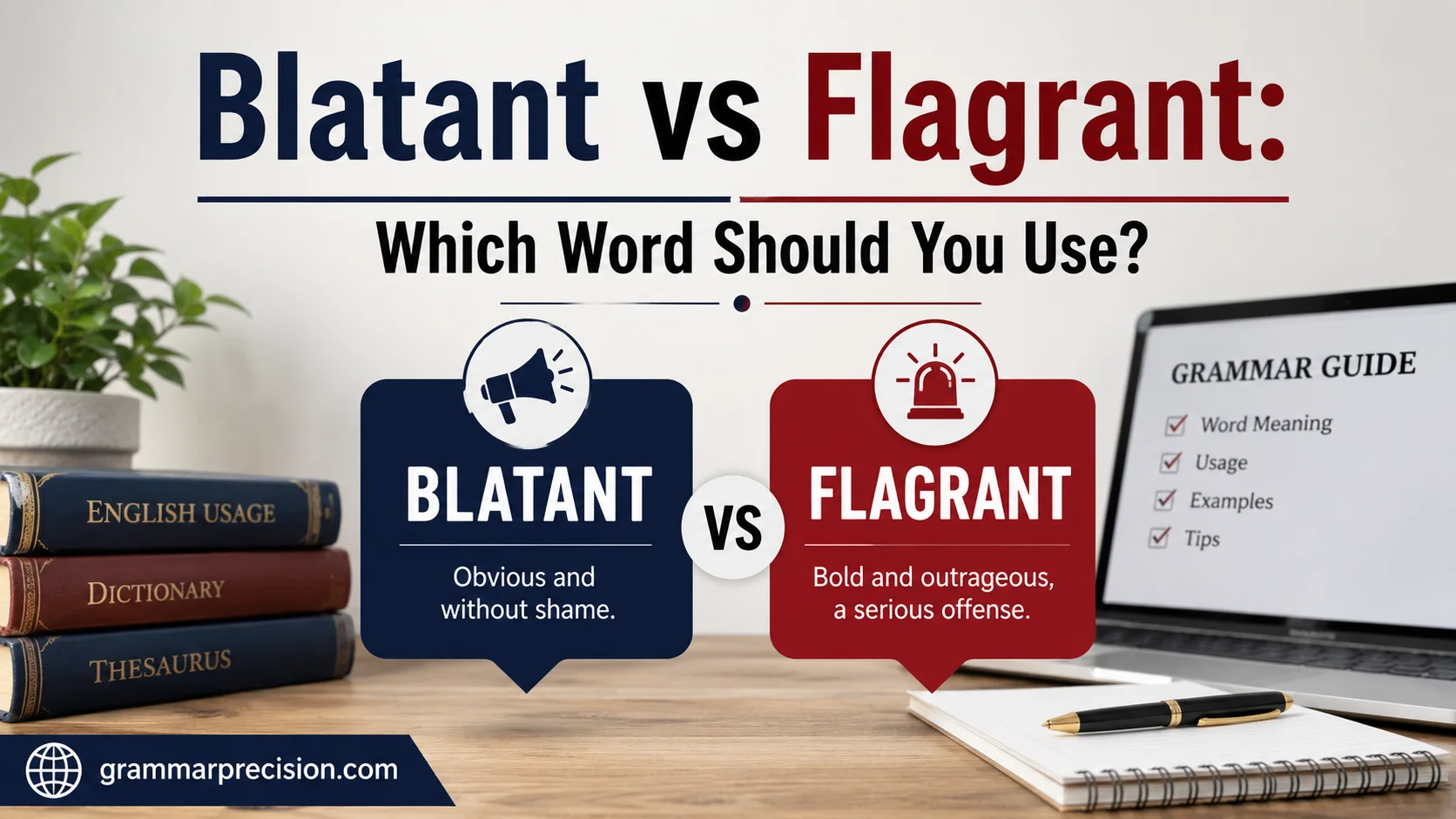
Blatant vs Flagrant: The Short Answer
Here is the simplest distinction:
- Blatant = very obvious, open, and hard to ignore, especially when the behavior is wrong.
- Flagrant = conspicuously and seriously wrong, offensive, or unacceptable.
A useful memory trick is:
Blatant is about being impossible to miss. Flagrant is about being impossible to excuse.
That isn’t a rigid rule. English has plenty of overlap, and dictionaries list the words as related synonyms. Still, the distinction helps you understand why some combinations sound much more natural than others.
For example:
- Blatant lie → the lie is obvious and openly told.
- Flagrant violation → the violation is serious and clearly unacceptable.
- Blatant discrimination → the unfair treatment is open and unmistakable.
- Flagrant abuse → the abuse is severe, conspicuous, and difficult to justify.
Cambridge defines blatant as very obvious and intentional when that is a bad thing. Oxford similarly describes it as something bad done openly without concern about shocking people. Merriam-Webster notes that flagrant tends to carry a heavier sense of offense, especially when a moral or accepted rule has been seriously violated.
What Does Blatant Mean?
Blatant is an adjective used for something that is extremely obvious, open, or conspicuous, usually in a negative situation.
The important idea is visibility. A blatant action isn’t hidden behind a clever disguise. It practically waves a flag and says, “Look at what I’m doing.”
You might describe a person’s blatant lie, blatant bias, blatant attempt, or blatant disregard. In each case, the behavior attracts attention because it is so clear.
For example:
- The advertisement made a blatant attempt to manipulate customers.
- Her blatant lie was easy to disprove.
- The report showed blatant bias against the smaller company.
- His blatant disregard for the rules surprised everyone.
- The referee missed a blatant error during the match.
Notice the pattern. The word often points to something that should have been hidden, subtle, or restrained but wasn’t.
When Blatant Is the Better Choice
Choose blatant when the main point is that something is openly obvious.
It works especially well when you’re describing:
- Lies
- Bias
- Errors
- Attempts
- Discrimination
- Contradictions
- Disregard
- Cheating
- Attempts at deception
- Open violations
Imagine someone copying answers during an exam while sitting directly beside the teacher. The cheating is blatant because the behavior is almost comically obvious.
Oxford lists examples such as a blatant attempt to buy votes and a blatant lie, while its collocation information highlights nouns such as attempt, bias, and contradiction.
What Does Flagrant Mean?
Flagrant describes something that is conspicuously bad, offensive, serious, or wrong.
Here, the spotlight moves from visibility toward the severity of the offense. Something flagrant doesn’t merely stand out. It stands out because it crosses a line.
Common examples include:
- flagrant violation
- flagrant abuse
- flagrant offense
- flagrant breach
- flagrant disregard
- flagrant misconduct
- flagrant foul
Consider the sentence, “The official was accused of a flagrant abuse of power.”
The issue isn’t simply that the abuse was easy to see. The phrase strongly suggests that the misuse of authority was serious and unacceptable.
Merriam-Webster explains that flagrant commonly applies to offenses or errors so bad that they cannot easily escape notice or be condoned. That heavier moral force is one of the clearest ways to separate it from blatant.
When Flagrant Is the Better Choice
Use flagrant when you want to stress serious wrongdoing or a major breach of an accepted standard.
It fits naturally with:
- Serious violations
- Abuse of authority
- Major breaches
- Severe misconduct
- Offensive behavior
- Serious rule-breaking
- Sports fouls
For example:
The company committed a flagrant violation of the safety rules.
This sentence sounds stronger than “The company committed an obvious violation.” It suggests that the conduct was not merely visible. It was seriously unacceptable.
Blatant vs Flagrant: The Core Difference
The easiest way to understand the distinction is to ask what your sentence wants the reader to notice first.
| Feature | Blatant | Flagrant |
| Main emphasis | Obviousness | Serious wrongdoing |
| Visibility | Very high | Very high |
| Negative meaning | Usually | Usually |
| Sense of shamelessness | Strong | Often present |
| Sense of severity | Moderate to strong | Strong |
| Common contexts | Lies, bias, errors, attempts | Violations, abuse, offenses, fouls |
| Tone | Strongly disapproving | Often more forcefully condemnatory |
Think of the difference like a spotlight.
Blatant shines the light on how obvious the action is. Flagrant shines it on how seriously objectionable the action is.
That’s why “blatant lie” feels completely natural. A lie can be obvious without being a major institutional offense.
By contrast, “flagrant abuse of public office” sounds especially fitting because abuse of office involves a serious breach of responsibility.
Blatant Violation vs Flagrant Violation
This is one of the most useful comparisons because both phrases are correct.
A blatant violation emphasizes that the rule was broken openly or unmistakably.
A flagrant violation emphasizes that the breach was serious and offensive.
Compare:
- The company made a blatant violation of the policy.
- The company committed a flagrant violation of the policy.
The first version highlights obviousness. The second carries greater condemnation.
In many contexts, both adjectives can work. The choice depends on the writer’s intended emphasis.
Blatant Disregard vs Flagrant Disregard
The same pattern appears with disregard.
Blatant disregard suggests someone openly ignored a duty, warning, rule, or person’s feelings.
Flagrant disregard suggests that the disregard was especially serious or offensive.
For example:
- His blatant disregard for the warning shocked his coworkers.
- His flagrant disregard for safety rules led to a serious investigation.
The second sentence sounds heavier because flagrant adds moral and practical weight.
Blatant Lie vs Flagrant Lie
Here’s an important usage point: blatant lie is much more natural in everyday English.
A blatant lie is an obvious falsehood. Everyone can see that the statement doesn’t match reality.
For example:
Calling the empty parking lot “completely full” was a blatant lie.
Flagrant lie is grammatically possible, but it isn’t the usual choice. Native speakers generally reach for blatant lie because the central idea is the lie’s obviousness.
That doesn’t mean flagrant can never describe a false statement. Context matters. However, forcing the word into every sentence simply because it sounds stronger can make your writing feel unnatural.
Can Something Be Both Blatant and Flagrant?
Yes. In fact, the two adjectives can sometimes describe different aspects of the same behavior.
Consider:
The company committed a blatant and flagrant violation of the rules.
This combination emphasizes two things:
- The violation was open and obvious.
- The violation was serious and unacceptable.
However, using both words isn’t always necessary. Because they overlap, the combination can sound repetitive if the context doesn’t require both ideas.
A better approach is to ask what you actually want to emphasize. If visibility matters most, use blatant. If severity matters most, use flagrant.
Also Read This: Transition To or Transition Into: Differences, and Correct Usage
Blatant vs Flagrant Examples That Reveal the Difference
| Sentence | Best choice | Why |
| He told a blatant lie. | Blatant | The lie was obvious. |
| The agency committed a flagrant violation. | Flagrant | The violation was seriously wrong. |
| She made a blatant error. | Blatant | The mistake was easy to see. |
| The official showed flagrant disregard for the rules. | Flagrant | The disregard was seriously unacceptable. |
| The company displayed blatant bias. | Blatant | The bias was openly visible. |
| The executive committed flagrant abuse of authority. | Flagrant | The misconduct was severe. |
| The player received a flagrant foul. | Flagrant | This is an established sports term. |
| He made a blatant attempt to deceive voters. | Blatant | The attempt was openly obvious. |
These examples reveal a useful pattern: blatant often works naturally with things that become obvious through observation, while flagrant frequently appears beside words describing offenses or serious breaches.
Blatant vs Flagrant in Sports
Sports provide one of the clearest examples of how flagrant has developed a specialized meaning.
In basketball, a flagrant foul refers to unnecessary or excessive contact. Under current NBA rules, a Flagrant 1 involves unnecessary contact, while a Flagrant 2 involves unnecessary and excessive contact. The NBA’s rules also provide penalties that can include free throws, retained possession, and ejection for a Flagrant 2.
That means “flagrant foul” isn’t merely colorful vocabulary. It has a specific technical role in basketball.
Cambridge likewise defines a flagrant foul as a very bad basketball foul involving unnecessary force.
So if you’re writing about basketball, flagrant foul is the established expression.
You could say:
The referee called a flagrant foul after the unnecessary contact.
You could also describe the foul as blatant in a general sense if you mean that the wrongdoing was obvious. But “blatant foul” doesn’t carry the same technical meaning as “flagrant foul.”
Common Collocations You Should Memorize
Collocations are words that naturally appear together. Learning them can make your English sound much more fluent.
Common Blatant Collocations
- blatant lie
- blatant error
- blatant attempt
- blatant bias
- blatant contradiction
- blatant discrimination
- blatant disregard
- blatant violation
- blatant deception
- blatant cheating
Common Flagrant Collocations
- flagrant violation
- flagrant abuse
- flagrant offense
- flagrant breach
- flagrant disregard
- flagrant misconduct
- flagrant foul
- flagrant injustice
- flagrant disrespect
- flagrant wrongdoing
The lists overlap because the meanings overlap. Still, blatant lie, blatant error, and blatant attempt are especially natural combinations, while flagrant abuse, flagrant violation, and flagrant foul strongly favor flagrant.
Blatantly vs Flagrantly
The adjective forms also have adverbs:
- blatant → blatantly
- flagrant → flagrantly
Blatantly means in an obvious, open, or shameless way.
The company blatantly ignored the warning.
Flagrantly means in a conspicuously wrong, offensive, or unacceptable way.
The official flagrantly violated the rules.
The same core distinction remains. Blatantly emphasizes openness and obviousness, while flagrantly usually adds a stronger sense of serious wrongdoing.
Common Mistakes With Blatant and Flagrant
Treating Them as Perfect Synonyms
They overlap, but they aren’t identical. Replacing one with the other can change the emphasis.
Using Flagrant Whenever Something Is Obvious
Not everything obvious is flagrant. A typo can be obvious, but blatant typo is more natural than flagrant typo in most contexts.
Assuming Blatant Means Illegal
It doesn’t. Something can be blatant without breaking a law.
A blatant attempt to get attention may be annoying or shameless without being illegal.
Assuming Flagrant Only Belongs to Sports
Sports popularized the phrase flagrant foul, but the adjective has a much broader meaning. You can discuss flagrant violations, flagrant abuses, and flagrant breaches outside athletics.
Overusing Strong Language
Precision beats drama. If obvious communicates the idea, you don’t always need blatant. If something is merely questionable, calling it flagrant may overstate the evidence.
A Simple Decision Tree for Choosing the Right Word
When you’re stuck between blatant vs flagrant, use these questions.
Is the main idea that the behavior is extremely obvious or openly done?
→ Choose blatant.
Is the main idea that the behavior is seriously wrong, offensive, or unacceptable?
→ Choose flagrant.
Are you talking about a basketball foul?
→ Choose flagrant foul.
Are both ideas important?
→ You may use both, but check whether the combination adds useful meaning.
This quick test works because it focuses on the difference in emphasis rather than forcing the words into a rigid definition.
Blatant vs Flagrant: Quick Reference
| If you mean… | Use |
| An obvious lie | Blatant |
| An obvious mistake | Blatant |
| Open bias | Blatant |
| An obvious attempt | Blatant |
| Serious misconduct | Flagrant |
| Serious abuse | Flagrant |
| Major rule violation | Flagrant |
| Basketball foul involving unnecessary or excessive contact | Flagrant |
| Something both obvious and seriously wrong | Either may fit, depending on emphasis |
Final Verdict: Blatant or Flagrant?
The difference between blatant vs flagrant becomes much easier once you stop treating them as simple synonyms.
Blatant focuses primarily on obviousness, openness, and shameless visibility. It works naturally with phrases such as blatant lie, blatant error, blatant bias, and blatant attempt.
Flagrant focuses more strongly on serious wrongdoing, offensiveness, or a major breach of standards. It fits phrases such as flagrant violation, flagrant abuse, flagrant breach, and flagrant foul.
When both words seem possible, ask yourself one final question: Am I emphasizing that everyone can see it, or that the conduct is seriously unacceptable? That answer will usually point you toward the right word.
FAQs:
What is the main difference between blatant and flagrant?
Blatant usually means something obvious, open, or hard to ignore, while flagrant often describes something that is clearly offensive, wrong, or outrageous. Their meanings can overlap, so the best choice depends on the context.
Is blatant the same as flagrant?
Not exactly, but the two words are often treated as synonyms in modern English. Blatant emphasizes something that is very obvious, while flagrant often carries a stronger sense of offense, wrongdoing, or serious violation.
When should I use blatant?
Use blatant when something is extremely obvious, especially when it is difficult to hide or ignore. For example, “That was a blatant attempt to deceive the audience” highlights how clear and noticeable the attempt was.
When should I use flagrant?
Use flagrant when describing something noticeably wrong, offensive, or against a rule. For example, “The player committed a flagrant foul” suggests a serious and obvious violation that deserves attention.
Can blatant and flagrant be used interchangeably?
Often, yes. In real-world usage, many English speakers use them interchangeably because their meanings overlap. Still, choosing blatant for obviousness and flagrant for serious wrongdoing can make your writing more precise.
Conclusion:
Blatant and flagrant are closely related words, but they can carry slightly different shades of meaning. Blatant usually focuses on something obvious, while flagrant often suggests something offensive or seriously wrong.
Their meanings frequently overlap, which makes both words acceptable in many contexts. Learning this small distinction can help you choose the more precise word for your writing.