Have you ever seen What Does GSA Stand For and wondered which meaning applies? The abbreviation can represent different terms depending on the context, including government, business communication, scheduling, and project management. Understanding the correct meaning helps you avoid confusion when reading emails, calendars, meeting notes, or formal documents.
In this guide, you’ll discover the different meanings of GSA, where each one appears, and how context determines the intended definition. You’ll also see practical examples involving online booking, broadcasting, meetings, time management, and scheduling, along with useful guidance on English usage, grammar, formal writing, and consistency. Regional preferences can matter, too; US English and UK English sometimes follow different terminology and style-guide conventions.
What Does “Amish Oil Change” Mean?
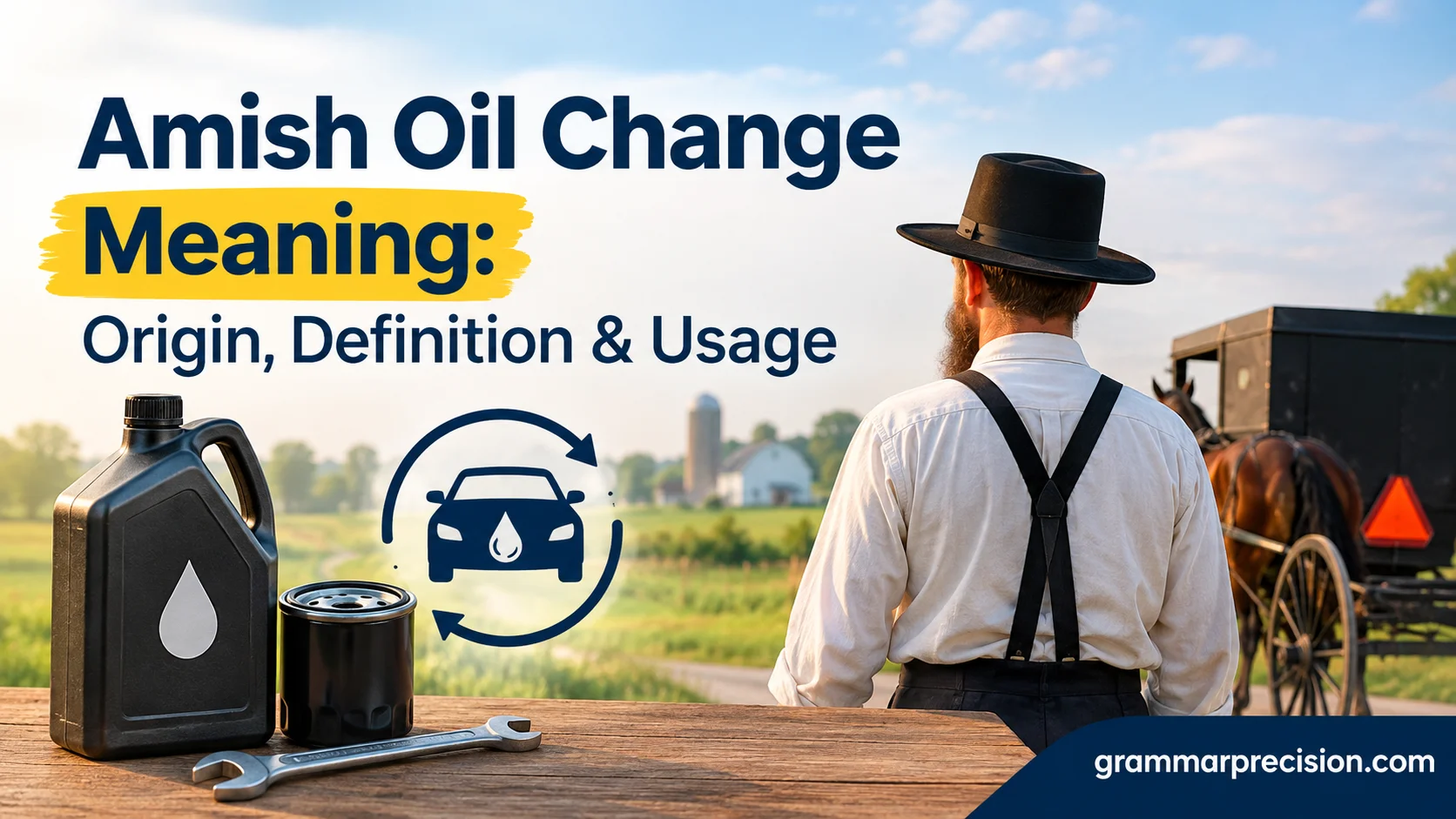
An “Amish oil change” is an informal expression rather than a standardized automotive term. People generally use it humorously to evoke the idea of performing an ordinary task with fewer modern conveniences.
The phrase combines two very different concepts. An oil change is a routine vehicle-maintenance procedure. “Amish” can evoke ideas of traditional living, limited reliance on certain modern technologies, craftsmanship, and self-sufficiency.
Put together, the expression can create a humorous contrast.
“Amish oil change” = an informal phrase suggesting a simple, traditional, or low-tech approach to an oil change.
That interpretation, however, doesn’t mean Amish people have a formally defined method called an “Amish oil change.”
Is “Amish Oil Change” a Real Automotive Term?
No. “Amish oil change” isn’t a standard automotive term.
A conventional oil change involves removing used engine oil, replacing the oil filter when appropriate, installing the drain plug correctly, adding the manufacturer’s specified oil, and checking the final oil level.
Mechanics, vehicle manufacturers, and automotive service organizations generally use terms such as:
- Engine oil change
- Motor oil replacement
- Oil and filter service
- Routine lubrication service
- Scheduled maintenance
You won’t normally see “Amish oil change” on a professional service schedule.
Why Does the Expression Sound Funny?
The humor comes from contrast.
An oil change represents modern machinery, engines, lubricants, tools, garages, and automotive technology. The word “Amish,” meanwhile, can suggest traditional practices and a selective approach to modern technology.
That juxtaposition makes the expression memorable.
It’s similar to creating a humorous phrase by pairing a highly modern activity with something associated with an older way of life. The joke relies on the listener understanding the cultural contrast.
What Does “Amish” Mean in This Expression?
To understand the Amish oil change meaning, you first need to understand why the word “Amish” carries a particular cultural association.
The Amish are a group of traditionalist Anabaptist Christian communities in North America. They are widely known for emphasizing community, modesty, family life, traditional practices, and selective use of modern technology.
However, one important detail often gets lost in casual conversations: there isn’t one universal Amish lifestyle.
Different Amish communities can have different rules regarding transportation, electricity, machinery, clothing, communications, and other technologies.
Amish Technology Isn’t Simply “No Technology”
A common misconception says that Amish people reject every form of technology.
Reality is more nuanced.
Amish communities often evaluate technology according to how it affects community life, independence, family relationships, work, and religious values. Some technologies may be restricted while others may be permitted under specific circumstances.
For example, particular Amish businesses may use equipment that outsiders wouldn’t expect. Some communities also interact with modern infrastructure through work, transportation arrangements, hired services, or carefully defined exceptions.
Therefore, describing the Amish as people who simply “don’t use technology” oversimplifies a complex cultural system.
Why This Matters to the Phrase
This distinction matters because “Amish oil change” is a modern expression about an imagined contrast, not necessarily a factual description of an Amish maintenance routine.
If someone uses the phrase jokingly, they may be thinking about:
- Simple tools
- Manual work
- Self-reliance
- Traditional methods
- Avoiding unnecessary convenience
- Doing a task without sophisticated equipment
Those associations explain the phrase’s humor. They don’t establish an official Amish automotive practice.
Where Did the “Amish Oil Change” Phrase Come From?
The exact origin of “Amish oil change” is difficult to establish from the phrase alone.
Unlike a technical automotive term, it doesn’t have a clearly documented inventor, standardized definition, or universally recognized historical origin. Informal expressions often spread through conversations, jokes, forums, social media, and word-of-mouth before anyone records their first use.
That makes origin stories particularly tricky.
Why Informal Slang Often Has Unclear Origins
Consider how many everyday expressions develop.
Someone makes a joke. A friend repeats it. Another person changes the wording. Eventually, the expression appears online and gets repeated by people who never heard the original version.
The phrase can spread without a dictionary definition or identifiable creator.
“Amish oil change” can be understood in this broader linguistic pattern. Its meaning comes primarily from context and shared associations rather than from an official terminology system.
Don’t Confuse Popular Usage With Historical Proof
A phrase appearing on the internet doesn’t automatically prove that it originated there.
Likewise, an amusing explanation of the expression isn’t necessarily evidence of its historical origin.
For a responsible explanation, it’s better to distinguish between:
| Claim | What can reasonably be said |
| It is an automotive technical term | No |
| It has a standardized industry definition | No |
| It can be used humorously | Yes |
| It may evoke traditional or low-tech methods | Yes |
| It describes one official Amish practice | No |
| Its exact origin is firmly established | Not generally |
This distinction keeps the Amish oil change definition accurate instead of turning an informal expression into a fictional tradition.
Is an Amish Oil Change an Actual Amish Practice?
This is probably the most important question surrounding the phrase.
There is no broadly recognized Amish maintenance procedure officially called an “Amish oil change.” The phrase should therefore not be presented as though Amish communities universally use a special oil-changing technique.
An Amish person who owns, operates, or maintains machinery may still deal with engines, lubricants, filters, tools, and mechanical repairs. Amish businesses can also engage with modern mechanical equipment in ways that vary by community and circumstance.
The key point is simple: mechanical work exists within Amish communities, but “Amish oil change” is not a standard cultural label for it.
Why the Stereotype Can Be Misleading
Imagine saying, “The Amish don’t use any engines.”
That statement would be far too broad.
Now imagine saying, “Every Amish community follows exactly the same technology rules.”
That would also be inaccurate.
Amish communities aren’t a single uniform block. Their rules can differ according to church districts and local traditions.
Therefore, using “Amish” as shorthand for “completely technology-free” creates a caricature rather than an accurate cultural explanation.
Amish Oil Change vs. Conventional Oil Change
The phrase becomes easier to understand when you compare its informal meaning with an actual automotive service.
| Feature | “Amish Oil Change” | Conventional Oil Change |
| Status | Informal expression | Standard automotive service |
| Definition | Context-dependent | Clearly defined |
| Purpose | Often humorous or figurative | Vehicle maintenance |
| Equipment | May imply basic tools | Uses appropriate automotive tools |
| Oil | Depends on the imagined context | Manufacturer-specified lubricant |
| Oil filter | Not necessarily implied | Usually inspected or replaced according to service needs |
| Professional terminology | No | Yes |
| Amish tradition | Not an established universal practice | Not culturally specific |
A real oil change follows the vehicle manufacturer’s requirements. The phrase “Amish oil change” doesn’t replace those requirements.
If you’re maintaining a real vehicle, the owner’s manual matters far more than slang.
How Does an Oil Change Actually Work?
Understanding the ordinary procedure helps explain why the phrase is metaphorical.
Engine oil lubricates moving components inside an internal-combustion engine. It helps reduce friction and carries heat and contaminants away from critical areas.
Over time, oil degrades and accumulates contaminants. The correct maintenance interval depends on the vehicle, engine, oil type, driving conditions, and manufacturer recommendations.
A typical oil service may involve:
- Preparing the vehicle safely.
- Allowing the engine and oil to reach a suitable service condition.
- Positioning an appropriate drain pan.
- Removing the drain plug.
- Allowing the used oil to drain.
- Inspecting or replacing the drain-plug gasket when required.
- Replacing the oil filter when appropriate.
- Reinstalling the drain plug to the correct specification.
- Adding the correct quantity and grade of oil.
- Checking the final oil level.
- Inspecting for leaks.
- Recycling the used oil properly.
That’s a genuine maintenance procedure.
Calling a simplified version an “Amish oil change” adds humor or cultural imagery. It doesn’t create a separate mechanical process.
Also Read This: Insufferable Meaning: Definition, Origin & Synonyms
What Might Someone Mean by “Amish Oil Change”?
Context determines the intended meaning.
A Simple or Low-Tech Approach
Someone might use the expression to joke about completing an automotive task with basic equipment rather than specialized machinery.
For example:
“We don’t need a fancy shop. We’ll give it the Amish oil change.”
Here, the speaker may simply be joking about simplicity and self-reliance.
A DIY Approach
The phrase may also suggest doing the work yourself instead of paying a professional service center.
That interpretation emphasizes independence rather than Amish culture itself.
A person changing oil in their driveway with basic tools could jokingly describe the job that way. Again, that doesn’t make the procedure authentically Amish.
A Joke About Traditional Living
In another context, the phrase can evoke the broader stereotype of choosing a slower, simpler method.
For example:
“Forget the computerized service bay. We’re going old-school today.”
The underlying idea is simplicity versus modern convenience.
“Amish Oil Change” Examples in Everyday Conversation
Seeing the phrase in context makes its meaning easier to understand.
Example One: DIY Maintenance
“I’m doing an Amish oil change this weekend. Just me, my tools, and the driveway.”
Here, the speaker is using the phrase humorously to describe a DIY job.
Example Two: Rejecting Fancy Equipment
“We don’t need an expensive machine for this. Give me an Amish oil change.”
The phrase suggests a basic approach.
Example Three: Online Humor
“That isn’t a shop-grade setup. That’s an Amish oil change.”
In this context, the expression likely functions as a joke about limited equipment.
Example Four: Figurative Simplicity
“We handled the whole repair without fancy gadgets. Basically an Amish oil change.”
The speaker emphasizes self-reliance and simplicity.
Notice the pattern: none of these examples requires a literal Amish maintenance tradition.
What Does the Phrase Reveal About American Slang?
Expressions such as “Amish oil change” demonstrate how slang often works through cultural shorthand.
People frequently borrow recognizable cultural images to communicate an idea quickly. The listener doesn’t need a lengthy explanation because the contrast does the work.
The structure looks something like this:
Modern activity → cultural association → humorous contrast → memorable expression
That’s why unusual phrases can become surprisingly sticky.
The expression also illustrates an important language principle: meaning isn’t always contained inside individual words.
“Amish” has one set of meanings in a historical or cultural discussion. “Oil change” has another meaning in automotive language. When the words combine, context creates an additional informal interpretation.
Common Misunderstandings About Amish Oil Change Meaning
Several misconceptions can make explanations of the phrase unnecessarily confusing.
Misunderstanding: It’s an Official Automotive Service
It isn’t.
Professional mechanics don’t generally use “Amish oil change” as a standardized service category.
Misunderstanding: Every Amish Person Uses the Same Method
Amish communities vary.
Technology rules and practical arrangements can differ between communities. One community’s practice shouldn’t automatically represent every Amish group.
Misunderstanding: Amish Means Completely Technology-Free
That’s an oversimplification.
The Amish generally practice selective technology use rather than following one universal rule that prohibits every modern device or machine.
Misunderstanding: The Phrase Has One Fixed Slang Definition
Informal expressions can shift meaning.
One speaker may use it to mean a DIY oil change. Another may use it to suggest an old-fashioned method. A third person may simply be making a joke.
Context is the deciding factor.
A Simple Case Study: Understanding the Phrase From Context
Imagine two friends working on an older pickup truck.
One friend brings a basic socket set, a drain pan, an oil-filter wrench, and a few quarts of the correct oil. There is no shop lift or automated service equipment.
The friend says:
“Looks like we’re doing an Amish oil change today.”
What does that sentence communicate?
It probably doesn’t claim that an Amish community invented the technique. Instead, the speaker uses “Amish” as humorous shorthand for a simpler, less elaborate approach.
Now change the context.
Suppose someone asks:
“Do the Amish have a special oil-changing tradition called an Amish oil change?”
That’s a factual question. The appropriate answer changes because the speaker is no longer making a joke. They’re asking about a real cultural practice.
This example shows why Amish oil change meaning depends on context, intent, and audience.
Is “Amish Oil Change” Offensive or Disrespectful?
The phrase is generally encountered as informal humor, but context still matters.
Using cultural identity as a joke can become uncomfortable when the joke relies on inaccurate stereotypes or treats an entire community as though everyone behaves identically.
A more thoughtful approach is to recognize the distinction between cultural fact and humorous shorthand.
If the discussion concerns actual Amish communities, use precise language. If someone uses the expression casually, explain its figurative meaning without presenting the joke as historical fact.
A Better Way to Explain It
Instead of saying:
“The Amish change oil this way.”
A more accurate explanation would be:
“The phrase is an informal joke that associates an oil change with a simple or low-tech approach.”
That small wording change prevents a stereotype from becoming a supposed fact.
What Are Better Alternatives to “Amish Oil Change”?
If the goal is simply to describe a basic maintenance job, clearer expressions exist.
Depending on the context, you could say:
- DIY oil change
- Basic oil change
- At-home oil change
- Traditional oil change
- Manual oil change
- Low-tech approach
- Old-school oil change
- Driveway oil change
These terms communicate the intended idea without relying on cultural shorthand.
However, if someone specifically says “Amish oil change,” understanding the expression is useful. You can recognize the joke without assuming it describes an official Amish tradition.
Why the Amish Oil Change Meaning Depends on Context
Language rarely operates like a mathematical formula.
The same phrase can sound literal, humorous, sarcastic, or descriptive depending on the surrounding conversation.
Consider these three situations:
| Context | Likely interpretation |
| Auto repair shop | Unusual or nonstandard terminology |
| Friends working on a car | Humorous reference to a simple DIY method |
| Cultural discussion | A phrase requiring clarification |
| Social media | Informal joke or meme-like expression |
| Search query | Someone looking for the phrase’s definition |
This is why a good Amish oil change meaning explanation should cover both language and culture.
A dictionary-style definition alone misses the real search intent.
FAQs About Amish Oil Change Meaning
What does Amish oil change mean?
“Amish oil change” is an informal expression that can humorously suggest a simple, traditional, manual, or low-tech approach to changing vehicle oil. It isn’t a standardized automotive term.
Is an Amish oil change a real thing?
There isn’t a broadly recognized automotive procedure officially known as an Amish oil change. The phrase is better understood as informal or humorous language.
Why is it called an Amish oil change?
The expression likely draws humor from the perceived contrast between modern automotive technology and associations with traditional or selective technology use. Its exact origin isn’t firmly established simply from the phrase itself.
Do the Amish change oil?
Amish communities can use, maintain, or work with mechanical equipment in various contexts. Practices differ between communities, so it’s inaccurate to assume one universal Amish approach to engine maintenance.
Does “Amish” mean no technology?
No. Amish communities generally have selective approaches to technology, and those approaches can vary. The popular idea that Amish people reject every form of modern technology is too simplistic.
Is “Amish oil change” slang?
It can function as informal slang or humorous wording, particularly when someone uses it to describe a basic, homemade, or low-tech approach. It isn’t recognized as a formal automotive term.
Can I use “Amish oil change” in professional writing?
Usually, clearer wording works better in professional automotive writing. Terms such as DIY oil change, manual oil change, or at-home oil change communicate the idea more precisely.
Conclusion:
The Amish oil change meaning is best understood as an informal expression rather than a genuine automotive service category. It typically uses the cultural image of simplicity, traditional living, or limited modern convenience to create a humorous description of a basic or DIY approach.
The phrase doesn’t establish a universal Amish oil-changing tradition. Amish communities vary in their technology practices, and describing them as completely technology-free oversimplifies their culture.
So, when you encounter “Amish oil change,” look at the context first. In a joke, it may simply mean “old-school” or “low-tech.” In a cultural discussion, however, the phrase deserves a more careful explanation.
Ultimately, the expression is less about a special kind of motor oil service and more about language, humor, cultural imagery, and the contrast between modern convenience and traditional simplicity.