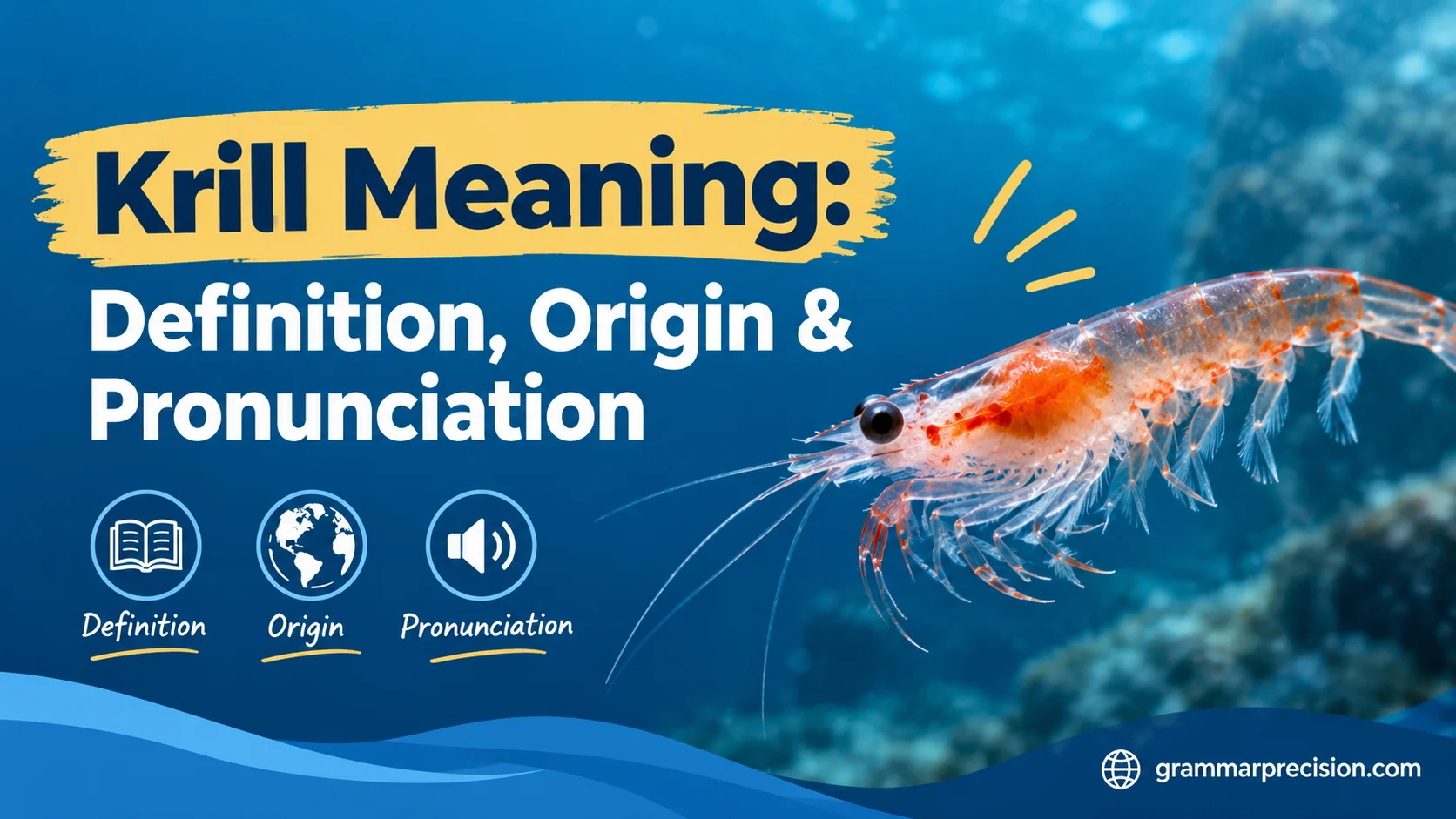
Have you ever come across the word krill and wondered what it means or why it matters? Krill meaning refers to small, shrimp-like marine animals that play a vital role in ocean ecosystems. These tiny creatures feed on microscopic algae and serve as an essential food source for whales, penguins, seals, and many fish. Understanding this term helps you explore marine biology, ocean conservation, and everyday English usage. Although words often create confusion in grammar and formal writing, krill has a clear scientific meaning that makes it easy to recognize in context.
In this guide, you’ll discover the definition, pronunciation, origin, and real-life uses of krill, along with its importance in the marine food chain. We’ll also explore krill oil, common misconceptions, and how context shapes the word’s meaning. Just as consistency matters in business communication, scheduling, time management, online booking, broadcasting, meetings, calendar management, and project management, choosing precise words improves clarity. Whether you follow US or UK English style guides, the spelling of krill remains the same. By the end, you’ll understand how to use this term confidently and accurately.
What Does Krill Mean in English?
The word krill refers to small, shrimp-like crustaceans that live in seawater. These animals usually swim in groups called swarms and feed on microscopic organisms, including phytoplankton. Larger marine animals depend on them as an important food source.
In everyday English, people commonly use krill when discussing ocean animals, marine biology, wildlife documentaries, and environmental issues.
Krill Meaning in Simple English
In simple terms, krill are tiny sea animals that resemble miniature shrimp. Although many species measure only a few centimeters long, they support some of the ocean’s most important food chains.
For example, baleen whales consume enormous quantities of krill during feeding seasons. Penguins, seals, squid, and several fish species also eat them.
Think of krill as small links connecting microscopic ocean life to much larger animals. Without enough krill, many marine species would struggle to find food.
Krill Definition in Biology and Marine Science
Biologically, krill are marine crustaceans belonging to the order Euphausiacea. They have segmented bodies, multiple pairs of legs, and external skeletons. Like other crustaceans, they belong to the larger animal group Arthropoda.
Scientists have described more than 80 recognized krill species. These animals inhabit different ocean regions, from cold polar waters to warmer seas.
Two familiar examples include Antarctic krill (Euphausia superba) and Northern krill (Meganyctiphanes norvegica). Antarctic krill are particularly important because they support major populations of whales, penguins, seals, and fish in the Southern Ocean.
Is Krill Singular or Plural?
One useful feature of the word krill is that its form usually stays the same in both singular and plural contexts. English speakers often use it as a collective or mass noun when discussing these animals generally.
For example:
- Collective usage: Krill provide food for many Antarctic animals.
- Individual reference: A krill swims among the plankton.
- Specific group: The researchers observed a dense swarm of krill.
- Scientific usage: Antarctic krill play a major role in Southern Ocean ecosystems.
You may also encounter krills in some scientific or specialized contexts when writers emphasize distinct species or groups. However, krill remains the standard and most common plural form.
Krill Meaning in Different Contexts
The meaning stays consistent across most contexts, but the focus changes depending on the subject.
| Context | Meaning or use |
| Everyday English | Small, shrimp-like sea animals |
| Marine biology | Crustaceans belonging to the order Euphausiacea |
| Ocean ecology | Important prey for whales, penguins, and fish |
| Nutrition | Animals harvested to produce krill oil |
| Environmental science | Organisms involved in marine food webs and carbon cycling |
Understanding the context helps you interpret the word accurately, especially when it appears in scientific articles or product labels.
How to Pronounce Krill Correctly
The word krill has one syllable, so pronunciation is fairly straightforward. In American English, it rhymes with ill, fill, and spill.
Its pronunciation is commonly represented as /krɪl/ in the International Phonetic Alphabet (IPA).
Start with the consonant sound /k/, move directly into the short vowel /ɪ/, and finish with /l/. Keep the vowel short rather than stretching it into a long sound.
Common Pronunciation Mistakes to Avoid
Some learners may pronounce the vowel like the one in cream or add an extra syllable. Both approaches make the word sound different from its standard English pronunciation.
Remember these simple tips:
- Keep the word to one syllable.
- Use the short vowel sound heard in sit.
- Pronounce the final l clearly.
- Avoid adding an extra vowel before or after the word.
Practice with a simple sentence: “Krill swim in large swarms.” Saying the word in context can make it easier to remember.
Krill Word Origin and Etymology
The English word krill comes from Norwegian, where it refers to small fish or fry. Norwegian sailors and fishing communities used the term before English speakers adopted it.
The word became particularly useful as scientists and explorers studied marine life in northern and southern waters. Today, English speakers use krill as the established name for these small crustaceans.
Although the original Norwegian meaning had a broader connection with small fish, modern English gives the word a specific biological meaning.
How the Word Entered English
English adopted many maritime terms from languages spoken by seafarers, traders, and explorers. Krill became established in marine and scientific writing as knowledge of ocean ecosystems expanded.
Antarctic research helped bring the word into wider public use. Scientists studying whales, penguins, and other wildlife recognized krill as a major food source in the Southern Ocean.
The word now appears in biology textbooks, environmental reports, wildlife documentaries, and discussions about marine conservation.
Is Krill a Slang Word or an Acronym?
No. Krill is an ordinary English noun, not a standard acronym or internet slang expression.
When someone uses the word in a sentence, it generally refers to the marine animal. Its meaning does not usually change between formal and informal conversation.
For example, a student might write about krill in a school report, while a marine biologist might discuss krill populations in a research paper. Both use the same basic meaning.
What Is Krill in Real Life?
What Is Krill in Real Life?
Krill may look like miniature shrimp, but their biology makes them fascinating marine animals. Most species have transparent or translucent bodies, dark eyes, and small appendages that help them swim and collect food.
What Krill Look Like
Krill typically measure between one and six centimeters long, depending on the species. Antarctic krill commonly reach approximately six centimeters as adults.
Their bodies have a head, a segmented thorax, and an abdomen. Several pairs of swimming legs help them move through the water. Some species also have light-producing organs called photophores.
These organs produce a faint glow, although their exact functions can vary. Scientists believe bioluminescence may help krill with communication, camouflage, or other behaviors.
Where Krill Live in the Ocean
Krill inhabit oceans worldwide, including the Atlantic, Pacific, Indian, Arctic, and Southern oceans. Different species prefer different temperatures, depths, and environmental conditions.
Antarctic krill thrive in the cold Southern Ocean surrounding Antarctica. Other species live in temperate waters, where seasonal changes influence their food supply and distribution.
Krill often gather in dense swarms. Some swarms contain thousands of individuals in a relatively small volume of water. Under favorable conditions, these aggregations can extend across large areas.
What Krill Eat
Most krill feed on phytoplankton, microscopic organisms that use sunlight to produce energy. They may also consume other plankton, organic particles, and small marine organisms.
Antarctic krill have an additional food source during winter: algae growing beneath sea ice. This resource helps them survive when open-water phytoplankton becomes scarce.
Their feeding habits connect microscopic producers with larger predators. In other words, krill help transfer energy from tiny organisms to animals that humans can easily recognize.
How Krill Reproduce and Grow
Female Antarctic krill can release thousands of eggs during a spawning period. Their eggs develop into larvae that pass through several stages before reaching adulthood.
Krill grow by molting, which means shedding their external skeleton as their bodies develop. Some Antarctic krill can also shrink during periods of food scarcity.
These adaptations help them cope with harsh seasonal conditions. Depending on the species, their lifespan can range from relatively short periods to several years.
Krill vs. Shrimp: What’s the Difference?
Krill and shrimp look similar because both belong to the crustacean group. However, they differ in classification, body structure, typical behavior, and ecological roles.
| Feature | Krill | Shrimp |
| Scientific classification | Order Euphausiacea | Several groups within Decapoda |
| Typical size | Often about 1–6 cm | Varies widely by species |
| Habitat | Primarily marine | Marine and freshwater |
| Feeding behavior | Often filter-feeds on plankton | Varies by species |
| Social behavior | Frequently forms large swarms | Varies by species |
| Ecological role | Major food source for marine predators | Important consumers and prey |
One important distinction is that krill are not simply baby shrimp. They belong to a separate order of crustaceans and develop into mature krill rather than shrimp.
Their similarities can still make identification difficult. Both have segmented bodies, external skeletons, and multiple legs. However, scientists distinguish them by their anatomy and evolutionary relationships.
Krill vs. Plankton
Plankton refers to organisms that drift with water currents rather than consistently swimming against them. The category includes tiny plants, animals, and other organisms.
Krill are animals that belong to zooplankton, the animal component of plankton. They can swim actively, but currents still influence their movement.
Phytoplankton, by contrast, includes microscopic photosynthetic organisms. These organisms produce much of the organic matter that supports marine food webs.
Here’s an easy way to remember the difference:
- Krill: Small marine crustaceans.
- Zooplankton: Drifting or weakly swimming animals.
- Phytoplankton: Microscopic photosynthetic organisms.
All krill are classified as zooplankton, but not all zooplankton are krill.
How to Use Krill in Sentences
Learning a word becomes easier when you see how people use it naturally. The noun krill appears in everyday descriptions, school assignments, scientific reports, and environmental discussions.
Simple Sentences Using Krill
Here are some practical examples:
- The whale fed on krill during its migration.
- Penguins rely on krill for much of their food.
- Scientists studied krill populations near Antarctica.
- A large swarm of krill appeared beneath the ocean surface.
- Krill oil is used in certain dietary supplements.
- Changes in sea ice can affect Antarctic krill.
- The fish followed a school of krill.
- Marine biologists examined the krill under a microscope.
Each sentence uses the word as a noun. The surrounding words explain whether the writer means individual animals, a group, or krill in general.
Krill in Academic and Scientific Writing
In scientific writing, krill often appears alongside words such as population, biomass, habitat, predator, and ecosystem.
For example:
“Researchers measured krill abundance to understand changes in the Antarctic food web.”
This sentence uses precise language to describe a research activity. The word abundance refers to how many krill occupy a particular area, while food web describes the connected feeding relationships among organisms.
Common Phrases and Related Words
Several expressions frequently appear in discussions about krill.
| Term | Meaning |
| Krill swarm | A large aggregation of krill |
| Krill population | Krill living in a particular region |
| Krill biomass | The combined mass of krill in an area |
| Krill oil | Oil extracted from krill |
| Antarctic krill | A species known scientifically as Euphausia superba |
| Krill fishery | Commercial harvesting of krill |
These expressions help you understand more advanced articles without losing sight of the basic definition.
Why Krill Matter to the Planet
Krill may be small, but their influence reaches far beyond their body size. They help maintain marine food webs and contribute to the movement of carbon through ocean ecosystems.
Krill as Food for Whales, Penguins, and Fish
Many marine animals depend on krill for energy. Baleen whales, including blue whales and humpback whales, consume krill in enormous quantities when food is abundant.
Penguins, seals, seabirds, squid, and several fish species also eat krill. In Antarctic waters, these crustaceans provide a vital link between microscopic algae and larger predators.
For example, a penguin hunting for food may consume krill directly. A larger predator may then eat the penguin, transferring that energy further through the food web.
This chain shows why even a small organism can influence an entire ecosystem.
Krill and the Marine Food Web
A food web describes how organisms obtain energy from one another. Krill occupy an important position because they consume microscopic producers and become prey for larger animals.
Consider this simplified food chain:
Sunlight → Phytoplankton → Krill → Penguins and Fish → Larger Predators
Real marine food webs are more complicated. Krill may eat different organisms, and many predators consume several kinds of prey.
Nevertheless, their role remains important. When krill become scarce in a region, animals that depend heavily on them may need to travel farther or change their feeding behavior.
Krill, Carbon Cycling, and Ocean Health
Krill also contribute to the ocean’s carbon cycle. They eat carbon-containing organic matter and release waste that can sink into deeper water.
Their daily movements between surface waters and deeper layers may help transport carbon through the ocean. Scientists study this process because it contributes to the broader biological carbon pump.
However, krill are only one part of a much larger system. Their contribution depends on feeding rates, migration, waste production, environmental conditions, and interactions with other organisms.
Changes in sea ice, ocean temperature, and phytoplankton availability can affect krill populations. These changes may then influence the predators that depend on them.
Krill Oil and Human Uses
Beyond their ecological importance, krill have commercial value. People harvest certain species for animal feed, aquaculture products, and dietary supplements.
What Is Krill Oil?
Krill oil is an oil extracted from krill. Manufacturers sell it as a dietary supplement because it contains omega-3 fatty acids, including EPA and DHA.
These fatty acids also occur in fish oil and certain other marine products. Krill oil commonly contains them in phospholipid forms, although its exact composition depends on the product.
Some products also contain astaxanthin, a naturally occurring pigment with antioxidant properties.
However, a supplement’s popularity doesn’t automatically prove that it offers superior health benefits. Evidence varies by outcome, and krill oil can interact with certain medications. Anyone considering supplementation should review the product with a qualified healthcare professional, especially when taking blood-thinning medication or managing a medical condition.
Krill Oil vs. Fish Oil
Krill oil and fish oil both provide omega-3 fatty acids, but their sources and compositions differ.
| Feature | Krill oil | Fish oil |
| Source | Small marine crustaceans | Oily fish or processed fish tissues |
| Omega-3 content | Contains EPA and DHA | Contains EPA and DHA |
| Natural pigments | May contain astaxanthin | Depends on processing and formulation |
| Fatty acid forms | Often includes phospholipids | Commonly triglycerides or ethyl esters |
| Product concentration | Varies by supplement | Varies by supplement |
Neither product automatically wins in every situation. Compare the actual EPA and DHA amounts, product quality, cost, and your individual needs rather than relying on marketing claims alone.
Sustainability and Krill Harvesting
Commercial krill fishing raises important environmental questions. Harvesting can affect the availability of prey for penguins, seals, whales, and other marine animals, particularly when fishing overlaps with important feeding areas.
International management measures aim to balance commercial activity with ecosystem protection. Researchers monitor krill populations and environmental conditions to improve decisions about harvesting.
Consumers can consider sustainability information when purchasing krill-derived products. Responsible management matters because these small crustaceans support much larger marine communities.
Common Misconceptions About Krill
Several misunderstandings arise because krill resemble other small sea animals. Understanding the facts helps you use the word accurately.
Is Krill a Fish?
No. Krill are crustaceans, not fish. They belong to the arthropod group, which also includes insects, spiders, and other animals.
Fish belong to a different group of animals with backbones. Krill have external skeletons and segmented bodies instead.
Does Krill Always Refer to Antarctic Species?
No. Although Antarctic krill receive considerable attention, many other species live throughout the world’s oceans.
The intended species usually becomes clear from the surrounding context. An article about Antarctic penguins may refer to Antarctic krill, while a discussion of a temperate marine ecosystem may involve different species.
Is Krill Safe for Everyone to Eat?
Not necessarily. Krill are crustaceans, so people with shellfish allergies should be especially cautious about krill-derived products. Krill oil supplements may also pose concerns for people taking certain medications.
Food safety, product quality, and individual health needs all matter. A product’s natural origin doesn’t guarantee that everyone can use it safely.
FAQs About Krill Meaning
What Does Krill Mean in English?
Krill means small, shrimp-like marine crustaceans that live in oceans. They serve as an important food source for whales, penguins, fish, and other marine animals.
What Is the Plural of Krill?
The usual plural is krill. For example, “Krill provide food for many Antarctic animals.” Some specialized sources also use krills, but the unchanged form is more common.
What Part of Speech Is Krill?
Krill is a noun. It names a type of marine animal and can appear in everyday sentences or scientific writing.
What Is Another Word for Krill?
There isn’t an exact synonym that replaces krill in every context. Related terms include marine crustacean, zooplankton, and small sea animal, although each has a broader or different meaning.
Why Is Krill Important in the Ocean?
Krill transfer energy from microscopic organisms to larger marine animals. They also contribute to nutrient cycling and the movement of carbon through ocean ecosystems.
Is Krill the Same as Shrimp?
No. Both are crustaceans, but krill belong to the order Euphausiacea, while shrimp belong to several groups within Decapoda.
Conclusion:
Krill Meaning refers to tiny marine animals that play an essential role in ocean ecosystems. Understanding their definition, habitat, and importance helps you appreciate marine life and ocean biodiversity.
Krill support marine food chains, feed whales and penguins, and contribute to ocean health. Learning about krill oil, its nutritional value, and environmental importance expands your knowledge. This guide helps you understand krill confidently and explore their fascinating role in nature.