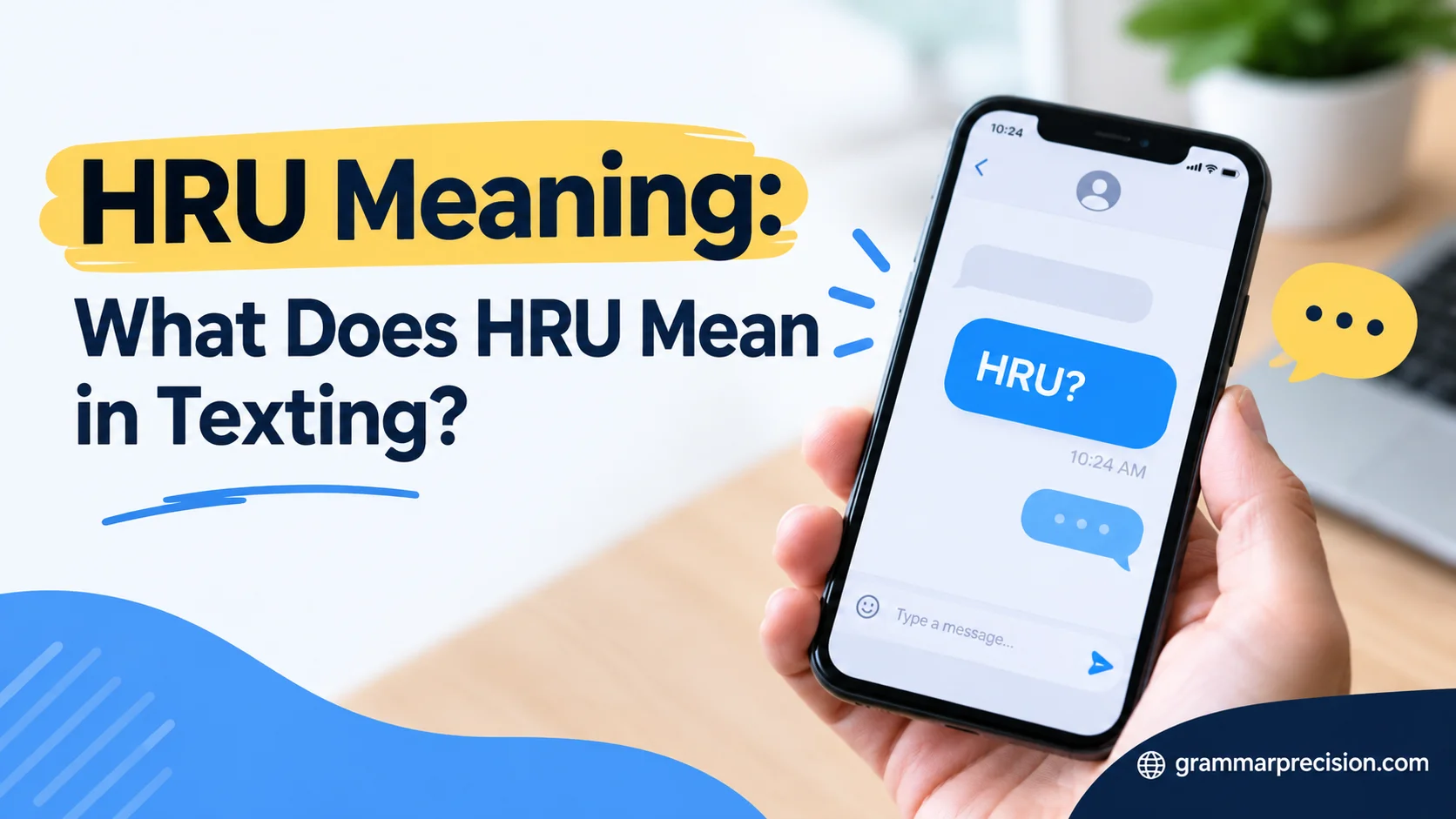
Have you ever received a quick “HRU?” message and wondered what it really means? The HRU Meaning is simple, yet its tone can shift with context, relationship, and English usage.
This guide explains how people use HRU in texting, social media, business communication, meetings, and casual conversations. You’ll also discover how abbreviations differ from standard grammar and formal writing.
From scheduling and time management to online booking, broadcasting, calendar updates, and project management, digital communication demands clear language. However, not every setting welcomes texting shorthand.
This article explores HRU meaning, natural replies, common variations, tone, and appropriate usage while considering US and UK style preferences. You’ll gain practical examples that help you communicate with greater clarity and consistency across personal and professional settings.
What Does HRU Mean in Text?
HRU stands for “How Are You?” It is an informal abbreviation used in digital communication. Instead of typing the complete three-word question, someone can use three letters to communicate the same basic idea.
For example:
Person A: Hey! HRU?
Person B: I’m doing good! How about you?
In this exchange, HRU simply asks about the other person’s well-being. There’s no complicated hidden definition.
Collins English Dictionary also defines hru as an abbreviation for “how are you?” in messaging and social media.
HRU Meaning at a Glance
| Term | Meaning | Tone | Typical Use |
| HRU | How Are You? | Casual | Texts and chats |
| hru? | How are you? | Very casual | DMs and messages |
| HRU today? | How are you today? | Friendly | Personal conversations |
| Hey, HRU? | Hey, how are you? | Warm | Conversation opener |
The capitalization doesn’t normally change the meaning. HRU, hru, and Hru generally communicate the same question.
Why Do People Use HRU Instead of “How Are You?”
At first glance, shortening three words into three letters might seem unnecessary. Yet texting culture has always favored speed, convenience, and conversational rhythm.
Early digital communication encouraged users to shorten words because typing could take more effort than it does today. SMS also had character limits, while older mobile phones often required repeated key presses. Texting shorthand developed within this broader environment.
Today, the reason is often less about saving characters and more about matching the casual tone of digital conversation.
Compare these:
- “How are you?”
- “HRU?”
- “Hey, hru?”
- “yo hru”
All four communicate a similar basic question. However, they create slightly different impressions.
“How are you?” sounds complete and neutral. “HRU?” feels quicker and more informal. Add “Hey” or an emoji, and the message can feel warmer.
That’s why HRU meaning in texting involves more than simply expanding the letters. The surrounding conversation matters too.
How Is HRU Used in Modern Digital Communication?
HRU works primarily as a conversation opener or check-in. Someone might send it after saying hello, following a previous conversation, or simply because they want to start talking.
You can encounter HRU in many informal settings:
- Text messages
- Instagram DMs
- Snapchat conversations
- WhatsApp chats
- Discord conversations
- Gaming chats
- Dating-app messages
- Social media messages
- Casual group chats
The core meaning doesn’t change across these platforms. What changes is the social context.
For example, a close friend sending “hru?” may genuinely want to know how your day is going. A stranger on a social platform might simply be opening a conversation.
HRU as a Simple Greeting
Sometimes HRU functions almost like “Hey, how’s it going?”
A: Morning! HRU today?
B: Pretty good. Just getting ready for work.
Here, the sender isn’t necessarily asking for an emotional deep dive. They’re opening the door to conversation.
HRU as a Genuine Check-In
The abbreviation can also communicate real concern.
A: You seemed stressed yesterday. HRU today?
B: Honestly, much better. Thanks for checking.
The words remain short, but the surrounding context gives them greater emotional weight.
HRU as a Reconnection Message
After a long gap, HRU can help restart communication without sounding overly serious.
A: Hey! It’s been forever. HRU?
B: I know! I’m doing great. How have you been?
In this situation, HRU works as a low-pressure bridge back into conversation.
What Does HRU Mean Depending on the Context?
One of the most important things to understand about HRU meaning is that the abbreviation itself doesn’t determine the sender’s intentions.
Context does.
A message from a best friend differs from the same message sent by someone you barely know. Likewise, punctuation, emojis, previous messages, and timing can influence how you interpret it.
| Situation | Likely Function | Possible Tone |
| Close friend | Checking in | Caring |
| New acquaintance | Starting conversation | Friendly |
| Dating match | Opening a chat | Casual or flirty |
| Coworker | Informal check-in | Friendly |
| Old friend | Reconnecting | Warm |
| Group chat | Starting discussion | Casual |
This distinction matters because people sometimes try to assign a definite romantic meaning to HRU.
There isn’t one.
If someone you like sends “HRU?”, it could show interest in talking. However, the abbreviation alone doesn’t prove romantic intent. Look at the broader conversation instead.
Does HRU Mean Something Different From a Guy or Girl?
The basic HRU meaning doesn’t change based on gender. If a guy sends HRU, it normally means “How are you?” If a girl sends HRU, it normally means the same thing.
What can change is the context and relationship.
For example:
Friend: Hey, HRU?
Crush: Heyy, HRU? 😊
The second message may feel warmer because of the spelling and emoji. Still, those details don’t establish a definite romantic meaning.
A better approach is to consider:
- What did they say before HRU?
- Do they normally text you first?
- Did they continue the conversation afterward?
- Did they ask follow-up questions?
- Is the overall conversation playful or romantic?
- Are there other clear signs of personal interest?
Don’t read too much into three letters alone. Digital communication depends heavily on context.
How to Reply to HRU Naturally
The easiest response to HRU is simply to answer the question and return it.
For example:
“I’m good! HBU?”
Here, HBU means “How About You?”
However, you don’t have to stop there. If you want to keep the conversation moving, add a small detail.
Instead of:
“Good.”
Try:
“Pretty good! I just finished dinner. HBU?”
That second answer gives the other person something to respond to. It turns a greeting into an actual conversation.
Short Replies to HRU
If you’re busy, a short response works perfectly well:
- “Good, hbu?”
- “I’m good! You?”
- “Doing well.”
- “Pretty good.”
- “Not bad!”
- “Great! How about you?”
Friendly Replies to HRU
When you want to sound more engaged:
- “I’m doing pretty well! How about you?”
- “Good so far. How’s your day going?”
- “I’m great! What have you been up to?”
- “Doing well! Haven’t talked to you in ages.”
Funny HRU Replies
Humor can make a simple check-in more memorable:
- “Surviving Monday somehow 😂”
- “Powered by coffee and optimism.”
- “Still functioning, so that’s a win.”
- “Ask me after my second cup of coffee.”
- “Better now that someone finally asked!”
Flirty HRU Replies
If the conversation already has a romantic tone, you can make your answer playful:
- “Better now that I’m hearing from you.”
- “I’m good. What about you, troublemaker?”
- “Doing great. What made you think of me?”
- “Pretty good. How are you, handsome?”
- “I was fine until you distracted me.”
The key is matching the existing tone. A flirty response can feel awkward if the conversation has been completely platonic.
Also Read This: Semi-Monthly Meaning: Definition, Grammar & Examples
What If You Aren’t Doing Well?
You don’t have to pretend everything is perfect.
If someone asks HRU and you’re having a difficult day, you can answer honestly while deciding how much you want to share.
For example:
“Honestly, it’s been a rough day, but I’m getting through it.”
Or:
“Not my best day, but I appreciate you asking.”
You can also keep things brief:
“A little tired today. How about you?”
This gives you control over the conversation. HRU doesn’t require a cheerful answer.
HRU vs. HYD vs. HBU vs. WYD
Several texting abbreviations look similar because they serve related conversational purposes. However, they aren’t interchangeable.
| Abbreviation | Full Meaning | Main Purpose |
| HRU | How Are You? | Ask about someone’s well-being |
| HYD | How You Doing? | Casual check-in |
| HBU | How About You? | Return a question |
| WBU | What About You? | Return or extend a question |
| WYD | What You Doing? | Ask what someone is doing |
| HYB | How You Been? | Ask how someone has been |
Consider this short conversation:
A: HRU?
B: I’m good. HBU?
A: I’m good too. WYD tonight?
Each abbreviation performs a different job.
HRU asks about well-being. HBU turns the question back. WYD shifts the topic toward someone’s current activity.
Understanding these differences makes texting shorthand much easier to follow.
Is HRU Formal or Informal?
HRU is informal. It belongs to casual digital communication rather than formal English.
That doesn’t mean the abbreviation is rude. It simply means you should consider your audience and setting before using it.
HRU Works Well In:
- Personal texts
- Casual DMs
- Friend group chats
- Gaming conversations
- Informal social media messages
- Casual dating conversations
Avoid HRU In:
- Formal business emails
- Job applications
- Academic assignments
- Official letters
- Professional proposals
- Formal customer communication
For example, texting a close friend:
“Hey, HRU?”
sounds completely natural.
Writing to a potential employer:
“Hi, HRU?”
would be unnecessarily casual.
A better professional alternative would be:
“I hope you’re doing well.”
This illustrates an important communication principle: good writing isn’t just about correct grammar. It’s also about choosing language that fits the situation.
Is HRU Rude?
No. HRU is not inherently rude.
Its informal style can sometimes feel abrupt when there is no additional context. Compare:
“HRU”
with:
“Hey! How are you doing? 😊”
The first is much shorter. The second feels warmer and more expressive.
Still, brevity doesn’t automatically equal rudeness. Many people naturally use lowercase abbreviations and short messages when texting.
If you’re unsure how someone intended HRU, examine the whole conversation rather than one abbreviation.
Does Punctuation Change the HRU Meaning?
Punctuation can subtly affect tone even though it doesn’t change the literal definition.
Compare these examples:
- “HRU?” — direct and casual
- “Hey, HRU?” — friendlier
- “HRU 😊” — warm or cheerful
- “hru lol” — relaxed and playful
- “HRU…” — potentially uncertain or serious depending on context
These aren’t strict rules. Digital tone is highly personal.
Emojis, punctuation, capitalization, and surrounding words can provide useful clues, but none should be treated as a guaranteed code.
Common Mistakes When Using HRU
HRU is simple, yet a few mistakes can make the conversation feel unnatural.
Using HRU in Formal Communication
A professional email usually deserves complete words and a more polished greeting.
Assuming HRU Is Always Flirty
A person asking HRU may simply be being friendly. Don’t automatically interpret a basic check-in as romantic interest.
Giving a One-Word Answer When You Want Conversation
“Good” technically answers the question. However, it gives the other person very little to work with.
Try adding one small detail.
“Good! Just got home from work. You?”
Now you’ve created an opening for another message.
Ignoring the Question
If someone sends HRU and you immediately change the subject, they may feel as though you skipped their attempt to connect.
A quick answer is usually enough.
A Simple HRU Conversation Case Study
Imagine two people who haven’t spoken for several months.
Alex: Hey! Long time no talk. HRU?
Sam: I’m doing great! I started a new job recently. HBU?
Alex: That’s awesome! I’m good too. How’s the new job going?
Notice what happened.
The first HRU wasn’t just a question. It opened a door. Sam answered and added information, which gave Alex something specific to discuss.
This is why a good reply doesn’t always need to be long. Sometimes one useful detail can keep an entire conversation moving.
When Should You Use “How Are You?” Instead of HRU?
Use the full phrase whenever clarity, professionalism, or formality matters.
For example:
Casual:
“Hey! HRU?”
Neutral:
“Hey! How are you?”
Professional:
“I hope you’re doing well.”
All three can serve similar purposes, but they belong to different communication environments.
The best choice depends on who you’re talking to, why you’re contacting them, and how formal the conversation needs to be.
Other Natural Ways to Say HRU
If you want alternatives that sound less repetitive, try these:
Casual Alternatives
- “How’s it going?”
- “How are things?”
- “How’ve you been?”
- “What’s up?”
- “How’s your day going?”
Warm Alternatives
- “How have you been lately?”
- “How are things going with you?”
- “How’s everything on your end?”
- “I hope you’ve been doing well.”
Professional Alternatives
- “How are you doing?”
- “I hope you’re doing well.”
- “I hope everything is going well.”
- “How have things been?”
Each option carries a slightly different tone. “What’s up?” feels relaxed, while “I hope you’re doing well” sounds more polished.
FAQs About HRU Meaning
What does HRU stand for?
HRU stands for “How Are You?” It is an informal abbreviation commonly used in texting, messaging, social media, and online chats.
What does HRU mean in texting?
HRU means “How Are You?” in texting. Someone usually sends it to check on you, start a conversation, or reconnect after some time apart.
How do you respond to HRU?
Answer naturally based on how you’re actually doing. You could say “I’m good, HBU?”, “Doing great!” or give a slightly longer response if you want to continue the conversation.
Is HRU a slang word?
HRU is better described as a texting abbreviation or informal shorthand. It isn’t a standard English word. People mainly use it in casual digital communication.
Is HRU formal or informal?
HRU is informal. It’s suitable for friends, casual acquaintances, social media contacts, and relaxed conversations. Use “How are you?” or another polished alternative in formal communication.
What does HRU mean from a girl or guy?
The literal meaning remains “How Are You?” regardless of who sends it. The message might carry additional warmth or romantic interest depending on the broader conversation, but HRU alone doesn’t establish that intention.
Is HRU rude?
No. HRU is generally casual rather than rude. However, its abbreviated style may feel too informal in professional or formal situations.
What is the difference between HRU and HBU?
HRU means “How Are You?” while HBU means “How About You?” HRU usually asks the initial question, while HBU commonly returns the question after someone has answered.
What is the difference between HRU and WYD?
HRU means “How Are You?” and asks about someone’s well-being. WYD means “What You Doing?” and asks what someone is currently doing.
Conclusion:
HRU meaning is simple: “How Are You?” This three-letter abbreviation gives people a quick way to check in, start conversations, and reconnect through casual digital communication.
However, context adds another layer. The same HRU can sound caring, friendly, playful, or slightly flirty depending on the relationship and surrounding messages. That’s why the abbreviation shouldn’t be interpreted in isolation.
When you receive HRU, answer naturally and match the sender’s tone. If you want the conversation to continue, add a small detail and return the question. In formal settings, skip the abbreviation and use the complete phrase instead.