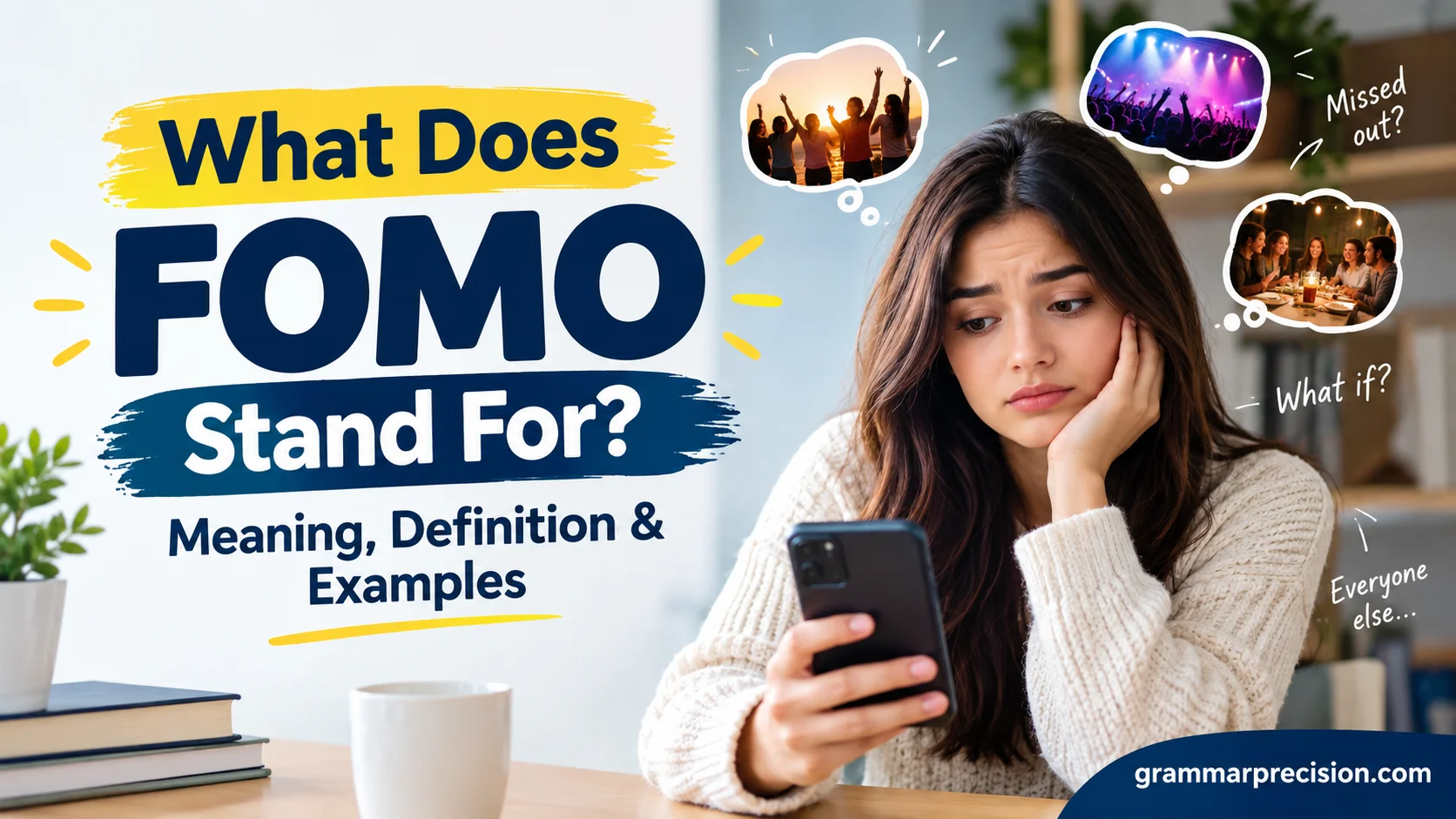
Have you ever wondered why you suddenly want something simply because everyone else has it? What Does FOMO Stand For? This guide explains the popular acronym in plain, everyday English, covering its meaning, usage, examples, and connection to modern online communication and social behavior.
You’ll learn how FOMO works in everyday English usage, business communication, and digital contexts involving scheduling, time management, online booking, broadcasting, meetings, calendars, and project management. We’ll also clarify how the expression fits grammar, formal writing, and consistency. Regional preferences and style guides, including US vs. UK English, may influence wording, so understanding context helps you use the term naturally and accurately.
What Does FOMO Stand For?
FOMO stands for “fear of missing out.”
The phrase describes anxiety or concern about missing an experience, opportunity, event, trend, or social activity that other people are enjoying.
Consider this simple example:
Your friends are going to a concert. You don’t particularly want to go, but seeing their photos makes you regret staying home. That’s FOMO.
The important idea isn’t simply missing something. It’s the fear or discomfort associated with missing it.
You might think:
- “What if something amazing happens without me?”
- “What if everyone has fun and I’m left out?”
- “What if I miss an important opportunity?”
- “What if I make the wrong choice by staying home?”
That mental pressure can push you toward an action you wouldn’t otherwise choose.
What Does Each Letter in FOMO Mean?
| Letter | Word | Meaning |
| F | Fear | Worry or anxiety |
| O | Of | Connects the phrase |
| M | Missing | Not experiencing something |
| O | Out | Being excluded from an experience |
So the easiest way to remember what FOMO stands for is:
F = Fear
O = Of
M = Missing
O = Out
That’s the entire phrase in four letters.
FOMO Meaning in Simple English
In simple English, FOMO means being worried that you’re missing something good while other people are enjoying it.
For example, imagine you’ve had a long week. You decide to stay home on Friday night. Later, you see pictures of your friends at a restaurant laughing together.
Suddenly, staying home doesn’t feel quite as satisfying.
You might think, “Maybe I should have gone.”
That feeling is FOMO.
However, FOMO doesn’t always involve parties or friends. You can experience it when you see people traveling, buying popular products, getting promotions, attending conferences, investing, learning new skills, or trying the latest trend.
FOMO vs. Simply Missing Something
There’s a useful distinction here.
Missing out is a situation.
FOMO is the emotional reaction to that situation.
For example:
- “I missed the party.” = You weren’t there.
- “I had FOMO because I missed the party.” = You felt uneasy about not being there.
You can miss something without experiencing FOMO. If you happily skip a crowded party because you’d rather read at home, there’s no real fear involved.
That’s why FOMO is more about perception and emotion than the event itself.
What Does FOMO Mean in Texting?
In texting, FOMO usually means the same thing as “fear of missing out,” but people use the acronym because it’s faster and more casual.
You might text:
“Everyone’s going tonight. Major FOMO!”
Or:
“I wasn’t going to buy tickets, but my FOMO got the better of me.”
Another common use appears when someone posts about an event:
“Looks amazing! I’m getting serious FOMO.”
In these situations, FOMO communicates a feeling without requiring a long explanation.
Common FOMO Texting Patterns
You may see expressions such as:
- I have FOMO.
- I’m getting FOMO.
- This is giving me FOMO.
- My FOMO is kicking in.
- I don’t want FOMO tomorrow.
- Major FOMO right now.
- I went because of FOMO.
These expressions are informal and conversational. They’re especially common in texts, comments, captions, and social media conversations.
How to Pronounce FOMO
FOMO is normally pronounced as a word rather than saying each letter separately.
The pronunciation has two syllables, with the emphasis generally falling on the first syllable.
Think of it as a compact spoken word formed from the first letters of the phrase.
You may occasionally hear someone spell out the individual letters when explaining the acronym. In ordinary conversation, however, the word-like pronunciation is the more natural choice.
FOMO Grammar: How Do You Use It in a Sentence?
Although FOMO began as an acronym, English speakers commonly use it as a noun in informal communication.
The most natural sentence patterns are surprisingly simple.
“I Have FOMO”
This is one of the most common constructions.
“I can’t go to the festival, and I already have FOMO.”
Here, FOMO functions as a noun describing the emotional state.
“I’m Feeling FOMO”
You can also describe the feeling directly:
“I’m feeling FOMO after seeing everyone’s vacation pictures.”
This construction emphasizes the temporary emotion.
“FOMO Made Me…”
This structure explains how the feeling influenced your decision.
“FOMO made me buy tickets.”
“FOMO made me join the group chat.”
The expression suggests that fear of missing something affected your behavior.
“I Got FOMO”
This is highly conversational.
“I got FOMO when I saw the photos, so I changed my plans.”
It works especially well in casual speech and texting.
“That Gives Me FOMO”
You can also describe something as a trigger.
“Those travel videos give me serious FOMO.”
This construction often appears in social media comments and casual conversations.
FOMO Examples in Everyday English
The easiest way to understand FOMO meaning is to see it in different situations.
FOMO in Friendships
“Everyone went out without me, and I definitely got FOMO.”
Here, the person feels excluded from a social experience.
FOMO at a Party
“I wanted to stay home, but I had FOMO about the party.”
The person isn’t necessarily excited about attending. They simply don’t want to miss what might happen.
FOMO in Travel
“Seeing everyone’s vacation photos gave me serious FOMO.”
The feeling comes from comparing your experience with someone else’s.
FOMO in Shopping
“The sale ends tonight, so I bought it because of FOMO.”
Limited-time offers can create pressure by making people believe they’ll regret waiting.
FOMO at Work
“Everyone signed up for the conference, so I started feeling FOMO.”
The concern here involves professional opportunities rather than entertainment.
FOMO in Education
“My classmates were taking that course, and I had FOMO about missing an important skill.”
FOMO can influence decisions about classes, certifications, workshops, and training.
FOMO in Technology
“Everyone upgraded their phone, and suddenly I had FOMO.”
The desire isn’t necessarily based on need. Social comparison creates the pressure.
A Quick FOMO Case Study
Imagine two friends, Maya and Jordan.
Maya decides not to attend a weekend music festival because she wants to save money. At first, she’s completely comfortable with her decision.
On Saturday evening, however, Jordan starts posting photos from the festival. Maya sees the crowd, the lights, and her friends having fun.
Nothing about her original decision has changed.
Yet her perception has changed.
She begins imagining everything she’s missing. She wonders whether she made the wrong choice. Eventually, she buys an expensive last-minute ticket.
That’s a classic FOMO pattern:
Decision → Exposure to others → Comparison → Fear of missing out → Changed behavior
The interesting part is that Maya’s original choice may have been perfectly reasonable. FOMO didn’t necessarily reveal a better decision. It simply made the alternative look more attractive.
FOMO vs. Fear of Missing Out
There is no major difference in meaning between FOMO and fear of missing out.
The difference is mainly one of style and context.
| Expression | Style | Typical Use |
| FOMO | Informal | Texts, social media, casual conversation |
| Fear of missing out | More explicit | Explanations, articles, formal discussion |
For example:
“I have FOMO about the party.”
sounds casual.
Meanwhile:
“The fear of missing out can influence consumer decisions.”
sounds more explanatory or academic.
Both describe the same basic concept.
FOMO vs. Missing Out vs. Regret
These terms overlap, but they aren’t identical.
Missing out means failing to experience something.
FOMO means worrying about missing an experience.
Regret usually happens when you look back and wish you’d made a different choice.
For example:
“I didn’t attend the concert.” — Missing out.
“I was afraid I’d miss something exciting.” — FOMO.
“I wish I’d gone.” — Regret.
The timeline can help you remember the distinction.
FOMO often happens before or during a decision. Regret often appears afterward.
FOMO vs. JOMO
If FOMO is the fear of missing out, JOMO is the joy of missing out.
JOMO describes feeling comfortable with staying away from something because you genuinely prefer your current choice.
| FOMO | JOMO |
| Fear of missing out | Joy of missing out |
| Worries about other people’s experiences | Enjoys your own experience |
| Often involves comparison | Often involves contentment |
| “Should I be there?” | “I’m happy right here.” |
| Can create pressure | Can reduce pressure |
For example:
FOMO: “Everyone’s going out. Maybe I should go.”
JOMO: “Everyone’s going out, but I’m enjoying a quiet evening.”
Neither mindset automatically makes someone right or wrong. The difference lies in why you’re making the choice.
FOMO vs. FOBO vs. YOLO
Modern English has several short expressions that can appear together, but they describe different ideas.
| Term | Full Form | Main Idea |
| FOMO | Fear of Missing Out | Fear of missing an experience |
| JOMO | Joy of Missing Out | Enjoyment of staying away |
| FOBO | Fear of a Better Option | Fear that another choice might be better |
| YOLO | You Only Live Once | Encouragement to embrace an opportunity |
FOMO asks, “What am I missing?”
FOBO asks, “What if there’s a better option?”
YOLO says, “Life is short, so why not?”
These concepts can overlap. Someone might experience FOMO about a party while simultaneously experiencing FOBO about which event to attend.
Also Read This: What Does GSA Stand For? Meanings, Uses, Examples & Context
Is FOMO Slang?
FOMO is informal language, but it’s more than obscure internet slang.
The expression has become widely recognized in mainstream English. People use it in ordinary conversations, journalism, marketing, business discussions, and popular culture.
Still, context matters.
In a casual message, this works perfectly:
“I have FOMO about missing the concert.”
In a formal report, you might write:
“The fear of missing out can influence consumer behavior.”
The full phrase usually sounds more polished when the audience expects formal language.
Is FOMO an Acronym?
Yes. FOMO is formed from the initial letters of “fear of missing out.”
In everyday usage, people pronounce it as a word rather than reading each letter separately. That makes it function much like many other familiar acronyms that have become ordinary vocabulary.
Where Did FOMO Come From?
The feeling behind FOMO is ancient, but the modern acronym has a more recent history.
Marketing researcher Dan Herman has discussed the concept and used the expression in academic work around the turn of the millennium. Later, Patrick J. McGinnis popularized the acronym through a 2004 article in The Harbus, Harvard Business School’s student newspaper.
McGinnis described FOMO alongside another expression, FOBO, meaning “fear of a better option.” His article examined the difficulty of committing to one social choice when numerous alternatives seemed available.
The term eventually spread far beyond the Harvard campus.
The rise of the internet and social media gave FOMO an enormous cultural boost. Instead of hearing about an event afterward, people could watch other people’s experiences unfold almost immediately.
That changed the scale of the problem.
Before constant digital updates, you might know that you missed a party. Today, you can potentially see photographs, videos, comments, stories, reactions, and live updates from the entire evening.
The acronym suddenly fit the digital age remarkably well.
Why Does Social Media Create FOMO?
Social media doesn’t invent the human desire to belong. It does, however, make comparison much easier.
Consider how quickly information travels now.
You can wake up and immediately see:
- A friend traveling abroad
- A coworker celebrating a promotion
- Someone attending an exclusive event
- A celebrity using a new product
- Friends meeting without you
- People discussing a trend you haven’t tried
- Someone announcing an opportunity you didn’t know existed
The result can feel like standing outside hundreds of rooms while seeing what happens inside each one.
The Highlight-Reel Effect
Social media usually shows selected moments, not complete lives.
People tend to share exciting trips, celebrations, achievements, meals, purchases, and milestones. They rarely post every boring Tuesday afternoon.
That creates a distorted comparison.
You may compare your ordinary day with someone else’s carefully selected best moments.
This is one reason FOMO can feel stronger online than offline.
Why Do People Experience FOMO?
FOMO can come from several overlapping psychological pressures.
The Need to Belong
Humans naturally value social connection. Being excluded can feel uncomfortable because belonging matters.
If everyone in your group attends an event, missing it may feel like more than missing an activity. It can feel like missing part of the group.
Social Comparison
You may judge your own experience by looking at what others appear to have.
For example:
“They’re advancing faster than me.”
“Everyone is traveling except me.”
“Everyone knows about this trend except me.”
The comparison creates urgency.
Too Many Choices
Modern life offers countless alternatives.
You can choose among restaurants, careers, courses, destinations, entertainment options, investments, hobbies, and social events.
More options can sound wonderful. In practice, they can make commitment harder.
Fear of an Irreversible Missed Opportunity
Some opportunities feel temporary.
A concert happens once. A sale ends tonight. A job application closes Friday. A friend may move away.
When something feels scarce, FOMO can intensify.
Is FOMO Always Bad?
Not necessarily.
A small amount of FOMO can sometimes motivate you to participate in something genuinely valuable.
Suppose your friends invite you hiking. You initially hesitate because you’re tired. Later, you realize you would actually enjoy the experience.
FOMO might push you to reconsider.
The problem appears when fear consistently overrides your actual preferences, budget, priorities, or well-being.
For example, buying something you don’t need because everyone else owns it isn’t necessarily a smart decision.
Likewise, accepting every invitation because you’re afraid of missing something can leave you exhausted.
The better question is:
“Do I actually want this, or am I afraid of what I’ll miss?”
That question creates useful distance between your preference and the pressure you’re feeling.
Common Mistakes When Using FOMO
Even though FOMO is easy to understand, several usage mistakes are common.
Mistake: Treating FOMO as a Formal Technical Term
FOMO is widely recognized, but it remains informal.
Use the full phrase when writing for a highly formal audience unless the context specifically calls for the acronym.
Mistake: Confusing FOMO With Jealousy
Jealousy and FOMO can overlap, but they aren’t identical.
Jealousy often involves concern about losing something you already have. FOMO focuses on something you fear you’re missing.
Mistake: Assuming FOMO Always Involves Parties
FOMO can involve social events, but it can also involve money, careers, technology, education, travel, relationships, and personal goals.
Mistake: Assuming Everyone With FOMO Wants to Participate
Sometimes people don’t actually want the experience.
They simply don’t want to feel excluded.
That’s an important difference.
How to Remember What FOMO Means
Use this simple memory trick:
F — Fear
O — Of
M — Missing
O — Out
Then connect it to a familiar situation.
Imagine your friends ordering pizza without you.
You don’t necessarily want pizza.
But suddenly you want to know why everyone else is having it.
That’s FOMO.
Another useful shortcut is:
FOMO = “What if I’m missing something?”
If that question captures the feeling, you’re probably dealing with FOMO.
FOMO in Modern Everyday English
FOMO has become useful because it compresses a complicated emotional experience into four memorable letters.
Instead of saying:
“I feel anxious because everyone else seems to be experiencing something interesting while I’m not there.”
You can simply say:
“I’m getting FOMO.”
That’s the power of modern slang and informal language. A long emotional explanation becomes a compact expression that other people immediately understand.
The term also continues to evolve with digital culture. It can describe everything from missing a party to missing an investment opportunity, a product launch, a trend, or an online conversation.
In other words, FOMO isn’t limited to where you are. It often concerns what you believe you’re missing.
FAQs About FOMO
What does FOMO stand for?
FOMO stands for “fear of missing out.” It describes anxiety or concern about missing an enjoyable, valuable, or important experience while other people participate.
What does FOMO mean in texting?
In texting, FOMO means the same thing as “fear of missing out.” People commonly use it to describe feeling left out or worrying that they’re missing something exciting.
Is FOMO a slang word?
FOMO is informal language that has become widely recognized in modern English. It’s common in texting, social media, casual conversation, and popular culture.
What’s the opposite of FOMO?
A commonly used opposite is JOMO, meaning “joy of missing out.” It describes feeling happy or peaceful about choosing not to participate.
Can FOMO be used in formal writing?
You can use FOMO in formal writing when the audience knows the term or when you’re discussing the concept directly. Otherwise, “fear of missing out” usually provides a clearer and more formal choice.
What’s the difference between FOMO and JOMO?
FOMO involves worrying about what you’re missing, while JOMO involves feeling content with what you’ve chosen instead.
How do you use FOMO in a sentence?
You can say, “I got FOMO when I saw everyone’s pictures from the concert.” You can also say, “That vacation video gave me serious FOMO.”
Conclusion:
So, what does FOMO stand for? It stands for “fear of missing out,” a common expression for the worry that you’re missing an exciting or valuable experience while others are enjoying it.
FOMO can appear in friendships, travel, shopping, careers, entertainment, education, and social media. It can influence decisions because people naturally care about belonging, opportunities, and social connection.
Remember the simplest definition: FOMO is the fear that something good is happening without you. Once you understand that idea, the acronym, grammar, examples, and related expressions become much easier to recognize and use naturally.