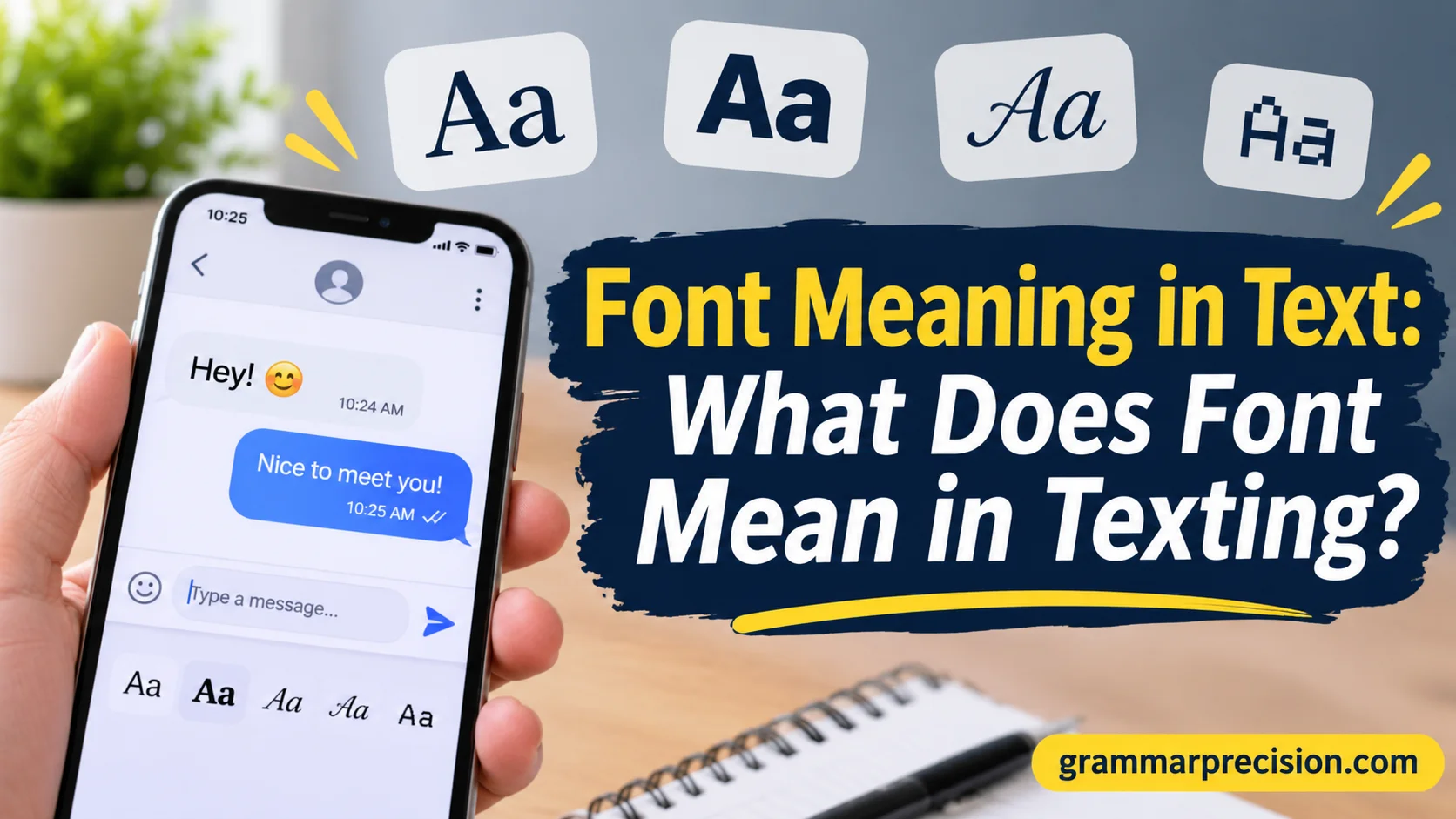
Have you ever wondered what someone means when they mention font meaning in text? Understanding this simple term helps you recognize digital lettering, formatting, and everyday communication.
Fonts influence how messages appear across social media, messaging apps, and professional platforms. This article explores font styles, texting examples, typography, and digital usage, helping you understand their differences. You’ll also discover how visual presentation, readability, and consistency improve online communication.
From decorative lettering to professional typography, choosing the right style makes a difference. Whether you’re exploring English usage, grammar, formal writing, or digital design, understanding fonts helps you communicate clearly. We’ll also explain how fonts support business communication, social media branding, and effective content presentation.
Quick Answer: What Does Font Mean in Text?
Font means the visual style and appearance of letters, numbers, and symbols. In texting, it usually refers to how written characters look, including their shape, size, thickness, and design.
For example, someone might say, “I love that font!” when they notice attractive lettering in a message or social media post. The word can also describe a particular writing style or the visual personality of someone’s text.
However, context matters. Font isn’t a universal texting abbreviation or a slang term with one hidden definition. Its meaning generally relates to the appearance of written characters.
What Does Font Mean in Texting?
When someone mentions a font in a text message, they’re usually discussing the appearance of written words. They might refer to bold letters, decorative characters, cursive writing, or another visual style.
Think about receiving two messages with identical wording. One appears in plain black letters while the other uses colorful decorative characters. Although both communicate the same sentence, their appearance creates different impressions.
That difference explains why fonts matter in digital conversations.
The Basic Meaning of Font in Digital Conversations
A font is a particular design used to display letters, numbers, punctuation marks, and symbols. It determines how individual characters appear on your screen.
For example, consider these different presentations:
- Regular: Hello, how are you?
- Bold: Hello, how are you?
- Italic: Hello, how are you?
- Decorative: 𝓗𝓮𝓵𝓵𝓸, 𝓱𝓸𝔀 𝓪𝓻𝓮 𝔂𝓸𝓾?
Each version communicates the same message. However, the visual presentation changes its personality.
In everyday texting, people often use the word font loosely. They might mean the typeface, lettering style, or formatting applied to their messages.
Why People Say “Font” Instead of “Text Style”
The word font is shorter and more familiar than technical typography terms. Most people understand what someone means when they ask about a particular font.
For example, imagine a friend sharing an Instagram story with elegant lettering. You might ask, “Which font did you use?”
You probably aren’t interested in the technical differences between typefaces and font files. You simply want to know how they created that appearance.
People commonly use font to describe:
- Decorative lettering in social media posts.
- Different text styles in messaging applications.
- Bold or italic formatting.
- Custom lettering used in digital designs.
- The overall appearance of written characters.
How Context Changes the Meaning of Font
Context helps you understand what someone actually means. The same word can refer to different aspects of digital writing.
Consider these situations:
| Conversation | Possible meaning |
| “I like your font.” | The lettering looks attractive. |
| “Change the font.” | Use a different text style. |
| “That’s not my font.” | The appearance doesn’t match their preference. |
| “What font is this?” | They’re asking about the lettering design. |
| “Your font looks different.” | The characters appear unusual or changed. |
Notice that none of these expressions automatically communicates a secret emotion or hidden message. The surrounding conversation provides the necessary clues.
What Does Font Mean on Social Media?
Social media has made fonts an important part of digital self-expression. People use different lettering styles to make their content recognizable, attractive, and easier to scan.
A simple caption can look completely different when someone changes its typography. That small design choice can help a post feel playful, elegant, dramatic, or professional.
However, each platform handles fonts differently.
Font Meaning on TikTok
TikTok creators frequently experiment with text to make videos more engaging. They use different lettering styles for captions, subtitles, jokes, and important announcements.
For example, a creator might place large bold text across a video to introduce an entertaining moment. Another might use smaller lettering to explain something happening in the background.
Common TikTok font uses include:
- Highlighting important words in videos.
- Creating attention-grabbing opening captions.
- Adding subtitles for viewers.
- Matching text styles with video aesthetics.
- Making humorous content more expressive.
When someone asks about a TikTok font, they usually want to identify or recreate the lettering used in a video.
Font Meaning on Instagram
Instagram users often treat fonts as part of their visual identity. Stories, reels, captions, and promotional graphics all benefit from thoughtful typography.
For example, someone sharing a birthday announcement might choose decorative lettering. A business promoting a new product might prefer clean, readable text.
Instagram fonts can help communicate different moods:
- Elegant: Suitable for invitations and aesthetic stories.
- Bold: Useful for announcements and important messages.
- Minimalist: Creates a clean and modern appearance.
- Playful: Adds personality to casual content.
- Handwritten: Creates a personal and friendly feeling.
The right font can make a post more visually appealing without changing its actual message.
Font Meaning on Snapchat
Snapchat users often personalize their snaps with text overlays. They can change text appearance, emphasize words, and position captions around photographs.
For example, someone sharing a picture of their lunch might add a playful caption using large lettering. Another person might use simple text to explain where they took a photograph.
In this setting, font usually means the appearance of text added to a snap.
Font Meaning on Discord
Discord communities use text formatting to organize conversations and express ideas. Members can make words bold, italic, underlined, or formatted as code.
For example:
- **Hello** creates bold text.
- *Hello* creates italic text.
- __Hello__ creates underlined text.
- `Hello` creates inline code formatting.
These formatting options make messages easier to understand. They also help users distinguish important information from ordinary conversation.
Different Ways People Use the Word Font in Text Messages
Although font has a straightforward definition, people mention it in several everyday situations. Understanding these uses helps you avoid confusing a simple design comment with something more personal.
Talking About Someone’s Writing Style
Sometimes, people use font to describe how someone’s written messages look. They might notice unusual capitalization, consistent punctuation, or distinctive lettering.
For example, imagine your friend always sends messages using lowercase letters. You might recognize their messages immediately because their writing has a consistent appearance.
Someone could describe that recognizable presentation as their friend’s font. Technically, they’re discussing a writing habit rather than a specific typeface.
Referring to Decorative Letters and Symbols
Decorative fonts appear frequently in usernames, bios, captions, and personal messages. People use them to make ordinary words look more interesting.
Here are some examples:
| Regular text | Decorative text |
| Beautiful | 𝓑𝓮𝓪𝓾𝓽𝓲𝓯𝓾𝓵 |
| Hello | ℌ𝔢𝔩𝔩𝔬 |
| Love | 𝕃𝕠𝕧𝕖 |
| Best Friend | 𝐁𝐞𝐬𝐭 𝐅𝐫𝐢𝐞𝐧𝐝 |
| Good Morning | 𝙶𝚘𝚘𝚍 𝙼𝚘𝚛𝚗𝚒𝚗𝚐 |
These styles can make messages feel more personal. However, some decorative characters might not display correctly on every device.
Describing a Message’s Appearance
People sometimes use font when discussing whether a message looks attractive, readable, or appropriate.
For instance, someone might say, “That font is too small.” They’re probably talking about readability rather than the message’s meaning.
Likewise, a person might recommend a cleaner font for a presentation or professional announcement.
Using Font as a Joke or Sarcastic Expression
Online conversations often include playful comments about writing habits. Font can become part of these jokes when someone notices unusual lettering or an exaggerated text style.
Imagine your friend sends a dramatic message using enormous capital letters. You might jokingly comment on their font.
However, don’t assume every unusual use represents established internet slang. People sometimes create playful expressions within their own conversations.
Popular Examples of Font in Text Conversations
Examples make the meaning easier to understand. The following conversations show how people might naturally use font while texting.
Everyday Texting Examples
Example 1: Asking about a font
- Alex: “Where did you get this font?”
- Sam: “I downloaded it from a font app.”
Here, Alex wants to know where Sam found the lettering style.
Example 2: Complimenting someone’s font
- Mia: “I love your Instagram bio!”
- Emma: “Thanks! I changed the font yesterday.”
The conversation focuses on the decorative appearance of Emma’s bio.
Example 3: Requesting a different font
- Ryan: “Can you change the font on this invitation?”
- Jake: “Sure. Would you prefer something more elegant?”
Ryan wants a different lettering style for the invitation.
Funny and Casual Examples
Friends sometimes discuss fonts humorously, especially when sharing screenshots or unusual designs.
Example 4:
- Lily: “Why does your message look so dramatic?”
- Noah: “Because the font deserves attention!”
Example 5:
- Ben: “That font looks like something from a fantasy movie.”
- Chris: “That’s exactly the vibe I wanted.”
These conversations show how fonts can become part of casual humor.
Flirty or Playful Examples
A font-related comment can occasionally become playful or flirtatious. However, the surrounding conversation determines whether someone intends to flirt.
Example 6:
- Ava: “Your messages always look so cute.”
- Leo: “Maybe I should make them even prettier for you.”
Example 7:
- Emma: “I like the font you used.”
- Daniel: “Glad you noticed. I wanted to impress you.”
These examples use font as a conversation starter. The word itself doesn’t automatically indicate romantic interest.
Examples From Social Media Comments
People also discuss fonts when reacting to creative posts.
| Social media comment | What it communicates |
| “This font is gorgeous!” | The lettering looks attractive. |
| “Where can I find this font?” | The person wants the same style. |
| “The font matches the aesthetic.” | The lettering suits the design. |
| “This font is hard to read.” | The characters lack readability. |
| “I need this font for my bio.” | The person wants to recreate the appearance. |
What Are the Different Types of Fonts?
Fonts come in many styles, and each creates a different visual impression. Learning their basic categories helps you choose suitable lettering for messages, websites, and social media content.
Serif Fonts
Serif fonts contain small decorative strokes at the ends of certain letters. These details give characters a traditional and recognizable appearance.
Examples include:
- Times New Roman
- Georgia
- Garamond
- Baskerville
Serif fonts frequently appear in books, newspapers, magazines, and formal documents.
Best use: Long-form reading, editorial layouts, and traditional designs.
Sans Serif Fonts
Sans serif fonts don’t have the small finishing strokes found in serif lettering. Their appearance usually feels clean, simple, and modern.
Popular examples include:
- Arial
- Helvetica
- Roboto
- Open Sans
- Verdana
You can find these fonts across websites, mobile applications, advertisements, and digital documents.
Best use: Screens, user interfaces, presentations, and modern branding.
Script Fonts
Script fonts imitate handwriting or calligraphy. Their flowing characters can make ordinary words appear elegant and personal.
Examples include:
- Brush Script
- Pacifico
- Great Vibes
- Dancing Script
People often use script fonts for invitations, greeting cards, wedding designs, and decorative social media graphics.
Best use: Short decorative phrases, invitations, and creative designs.
Decorative Fonts
Decorative fonts feature unusual shapes, patterns, and distinctive character designs. Some look playful while others appear futuristic or dramatic.
You might see them in:
- Gaming usernames.
- Event posters.
- Halloween graphics.
- Music promotions.
- Social media headings.
However, decorative fonts aren’t always suitable for long paragraphs. Their unusual shapes can make reading difficult.
Monospaced Fonts
Monospaced fonts give every character the same horizontal space. Unlike many ordinary fonts, a narrow letter receives the same character width as a wider one.
Common examples include:
- Courier New
- Consolas
- Monaco
- IBM Plex Mono
Developers frequently use monospaced fonts because they help align programming code. They’re also useful for displaying technical information.
Why Do People Use Different Fonts in Messages?
People don’t choose fonts only because they look attractive. Typography influences how readers experience information and understand its presentation.
Expressing Personality
Your font choices can reflect your creative preferences. Someone who enjoys minimalist designs might choose clean lettering. Another person might prefer colorful and decorative styles.
For example, a teenager creating a social media bio might use cursive characters to create an elegant appearance.
A professional photographer might choose a modern sans serif font to match a clean portfolio.
Creating Emotional Impact
Different lettering styles can influence the mood of a message.
Consider these examples:
- Bold letters: Draw attention to important information.
- Italic letters: Add emphasis or distinguish particular words.
- Decorative lettering: Creates a playful or artistic impression.
- Handwritten styles: Often feel personal and informal.
However, fonts don’t communicate emotions perfectly. Your actual words and surrounding context remain more important.
Making Messages Stand Out
A distinctive font can help important information attract attention. Businesses use this technique in promotional graphics, announcements, and advertisements.
For example, a restaurant might display its discount using large bold lettering. Customers can notice the offer without reading every detail.
The same approach works for social media announcements and event invitations.
Improving Visual Appeal
Well-chosen fonts make digital content look organized and attractive. They also help establish a consistent design across different platforms.
For better results:
- Choose readable fonts for longer messages.
- Use decorative styles sparingly.
- Maintain consistent text formatting.
- Create enough contrast between text and background.
- Avoid combining too many unrelated font styles.
A simple design often communicates more effectively than an overcrowded one.
Font vs. Typeface: What’s the Difference?
People often use font and typeface interchangeably. Although they’re closely related, the terms have slightly different technical meanings.
A typeface refers to the overall design of a collection of characters. A font traditionally refers to a particular style, weight, or size within that design.
For example, Arial is a typeface. Arial Bold is a specific font style within that family.
Here’s a simple comparison:
| Feature | Font | Typeface |
| Meaning | A particular text style or variation | The overall character design |
| Example | Arial Bold | Arial |
| Purpose | Displays text in a particular style | Defines the visual character design |
| Common use | Everyday digital communication | Typography and graphic design |
In modern digital conversations, most people don’t worry about this distinction. They simply say font when discussing how letters look.
How to Change Fonts in Text Messages and Social Media
Changing your font can make messages more expressive and visually interesting. Fortunately, several devices and applications offer simple ways to customize text.
Changing Fonts on Android
Many Android phones include built-in font customization options. However, available settings depend on your manufacturer and Android version.
You can generally follow these steps:
- Open your phone’s Settings.
- Find the Display or Wallpaper and Style section.
- Look for Font Size and Style or a similar option.
- Select an available font.
- Preview the appearance before applying it.
Samsung devices, for example, offer font customization through their display settings.
Changing Fonts on iPhone
iPhones provide several ways to customize text appearance. However, iOS doesn’t offer a universal system-wide font replacement for every application.
You can:
- Adjust text size through Display and Brightness settings.
- Install supported fonts through compatible applications.
- Use formatting options in applications that support them.
- Copy decorative Unicode characters from a text generator.
Remember that installing a font doesn’t guarantee every messaging application will use it.
Using Online Font Generators
Online font generators convert ordinary text into decorative Unicode characters. You can copy the results and paste them into supported platforms.
For example, typing “Good Morning” might produce:
- 𝓖𝓸𝓸𝓭 𝓜𝓸𝓻𝓷𝓲𝓷𝓰
- 𝐆𝐨𝐨𝐝 𝐌𝐨𝐫𝐧𝐢𝐧𝐠
- 𝔾𝕠𝕠𝕕 𝕄𝕠𝕣𝕟𝕚𝕟𝕘
These characters aren’t necessarily different installed fonts. Many are separate Unicode symbols that resemble stylized letters.
Unicode Fonts vs. Regular Fonts: What’s the Difference?
This distinction matters when you copy decorative text between applications.
Regular fonts change how a device displays existing characters. Unicode provides standardized characters that computers recognize across different systems.
For example, ordinary English letters use the basic Latin alphabet. Decorative mathematical alphanumeric symbols provide additional stylized characters.
| Feature | Regular fonts | Decorative Unicode text |
| How it works | Changes character appearance | Uses different encoded characters |
| Installation | May require installation | Usually doesn’t |
| Copying | Depends on application support | Often works across platforms |
| Accessibility | Usually better supported | Can create reading difficulties |
| Searchability | Generally remains normal text | May behave differently |
Unicode decoration can look attractive. However, screen readers and search systems may interpret these characters differently.
For important information, ordinary readable text remains the safer choice.
Common Misunderstandings About Font Meaning
The word font seems simple, but several misunderstandings can cause confusion.
Here are some mistakes worth avoiding.
Misunderstanding 1: Font always means slang.
Font isn’t automatically a slang expression. Its standard meaning relates to the visual design of letters and characters.
Misunderstanding 2: Font and handwriting mean the same thing.
Handwriting refers to how someone physically writes. Font refers to the design used to display characters digitally or in print.
Misunderstanding 3: Different fonts always communicate different emotions.
A bold font doesn’t automatically mean anger. Likewise, cursive lettering doesn’t always communicate romance.
Misunderstanding 4: Every decorative font works everywhere.
Some decorative characters appear differently across devices. Others might show as empty squares or unsupported symbols.
Misunderstanding 5: Font and text formatting are identical.
Font describes character design while formatting includes additional presentation choices. These include alignment, spacing, color, and emphasis.
Understanding these differences makes digital communication much easier.
FAQs About Font Meaning in Text
Font usually refers to the visual appearance or style of letters in a message. It can describe bold, italic, cursive, decorative, or other lettering styles. The exact meaning depends on the conversation.
Not necessarily. Some people informally use font to describe someone’s recognizable writing style or visual presentation. However, font doesn’t have an established universal meaning related to attitude.
They probably noticed a change in your lettering style or message appearance. You might have switched fonts, used decorative characters, or changed your formatting.
Font is primarily a typography term. Social media users sometimes use it informally, but it isn’t a universally recognized slang abbreviation. Always consider the surrounding conversation.
You can use a decorative text generator to convert regular letters into stylized Unicode characters. Copy the result and paste it into a compatible messaging application.
A typeface describes the overall design of characters. A font traditionally represents a particular style, weight, or size within that typeface. People often use both terms interchangeably in everyday conversations.
Fonts can influence how readers interpret a message’s tone and presentation. However, they don’t normally change the actual dictionary meaning of its words. The written message and surrounding context remain essential.
People use fancy fonts to personalize bios, highlight important words, and create attractive stories. Decorative lettering can also help maintain a consistent visual identity across posts.
Conclusion:
Understanding font meaning in text helps you recognize how lettering styles shape digital conversations. From decorative characters to bold formatting, fonts influence how messages appear across platforms. Choosing suitable styles makes your content more attractive, readable, and expressive.
Whether you’re texting friends, designing social media posts, or creating professional content, the right font makes communication more engaging. Explore different typography styles, prioritize readability, and maintain visual consistency. Remember, attractive lettering matters, but clear communication always deserves priority.
Latest Posts:
- What Does # Mean in Text? Meaning, Uses, & Examples
- BFE Meaning: What Does BFE Mean in Text?
- NT Meaning in Text: What Does NT Mean in Texting?
- YHU Meaning in Text: Definition, Examples, & How to Use It
- WYH Meaning in Text: Definition, Examples, & How to Respond