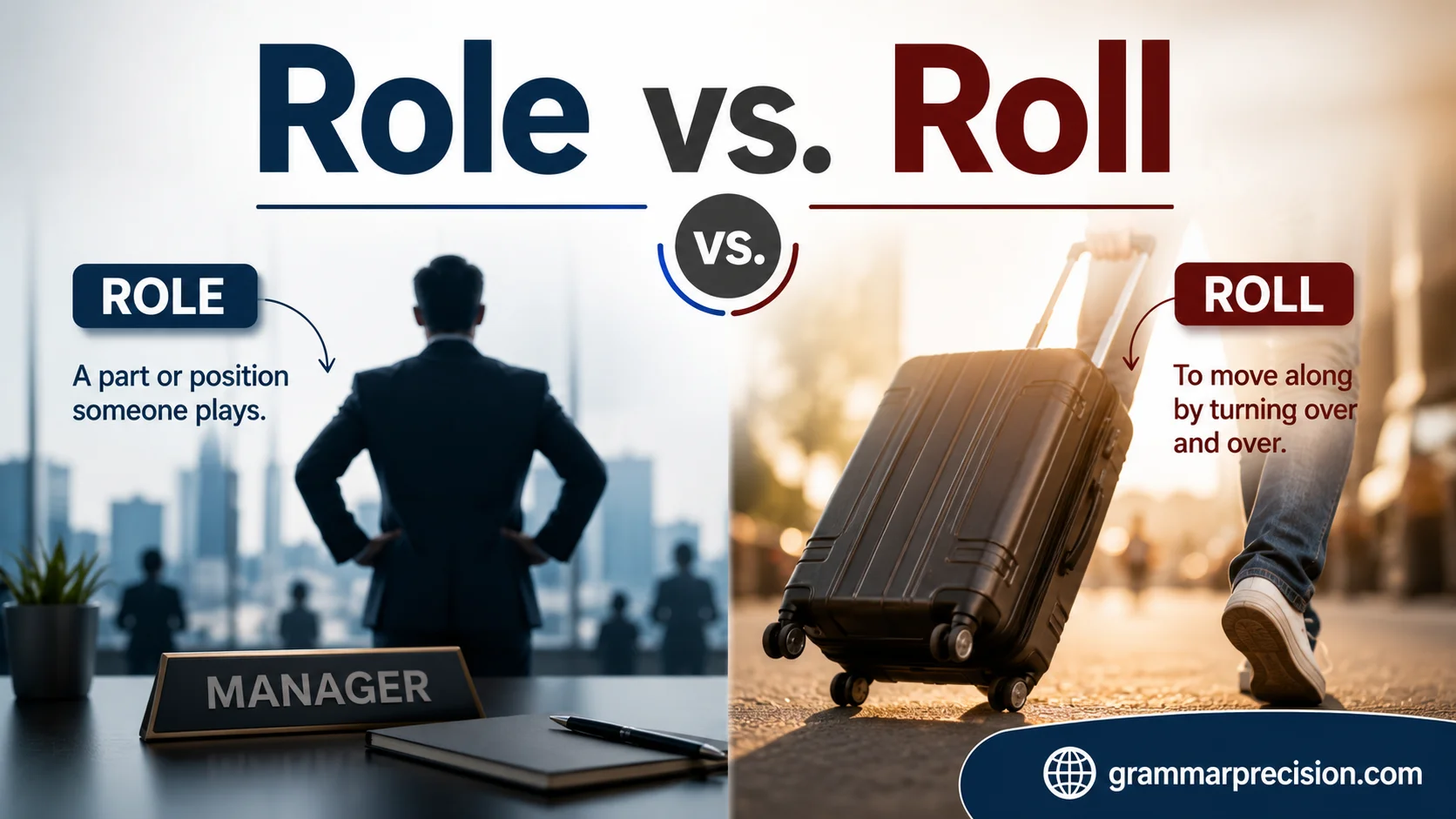
Role vs. Roll can confuse even experienced writers because these words sound the same but have different meanings. This guide explains their differences, uses, examples, and simple tricks to remember the correct word.
Understanding role vs. roll helps you avoid common grammar mistakes in everyday writing and professional communication. While role describes a responsibility, purpose, or character, roll refers to movement, food, lists, or actions. Learning their differences makes your sentences clearer and more accurate.
Many people mix up these homophones because pronunciation does not reveal the spelling. However, once you learn the meaning, context, and usage rules, choosing between role and roll becomes much easier. This complete guide provides practical examples and helpful explanations to improve your English writing skills.
Role vs. Roll: Quick Answer
The simplest way to remember the difference is:
| Word | Meaning | Example |
| Role | A purpose, duty, responsibility, or character someone has | “She plays an important role in the company.” |
| Roll | Movement, a list, a type of food, or an action | “The ball will roll down the hill.” |
Think of it this way:
- Role = Responsibility
- Roll = Rotation or Round things
If you’re talking about what someone does, represents, or contributes, you probably need role.
If you’re talking about something moving, turning, being listed, or a type of food, you probably need roll.
What Is the Difference Between Role and Roll?
Although role and roll sound identical when spoken, they come from different origins and serve different purposes in sentences.
The word role focuses on function or identity. It answers questions like:
- What is someone responsible for?
- What position does someone have?
- What character does someone play?
- What impact does something have?
For example:
“The teacher’s role is to help students learn.”
Here, role explains the teacher’s responsibility.
On the other hand, roll often focuses on physical action or a thing. It can describe movement, a food item, a record, or even a continuous activity.
For example:
“The child watched the toy car roll across the floor.”
Here, roll describes movement.
A helpful comparison:
| Question | Correct Word |
| What responsibility does someone have? | Role |
| What character does an actor play? | Role |
| What happens when something turns over? | Roll |
| What do you eat with dinner? | Roll |
| What list contains names? | Roll |
Role Meaning: Definition, Uses, and Examples
The word role is a noun that describes a person’s position, responsibility, purpose, or function. It tells us how someone or something contributes to a situation.
You’ll often see role used in workplaces, relationships, education, entertainment, and society.
Role as a Responsibility or Duty
One of the most common meanings of role is a responsibility someone has.
Every person takes on different roles throughout life. A person might be:
- A parent at home
- A manager at work
- A student in school
- A volunteer in the community
Each position comes with certain expectations and responsibilities.
Examples:
- “The manager’s role is to guide the team.”
- “Parents play a major role in a child’s development.”
- “Technology has an important role in modern education.”
In these examples, role describes the purpose or contribution of a person or thing.
Role in the Workplace
In professional settings, role usually refers to someone’s job responsibilities.
When companies hire employees, they often define each person’s role so everyone understands their tasks.
For example:
“My role in the marketing department is creating content strategies.”
This means the person’s responsibility is creating strategies.
Common workplace phrases include:
| Phrase | Meaning | Example |
| Job role | A person’s work responsibilities | “The job role requires communication skills.” |
| Leadership role | A position where someone guides others | “She accepted a leadership role.” |
| Key role | An important responsibility | “He played a key role in the project’s success.” |
| Supporting role | A position that helps others | “The assistant has a supporting role.” |
Role in Movies, Theater, and Entertainment
Another popular meaning of role relates to acting.
When an actor appears in a movie, show, or play, they perform a role. The word describes the character they represent.
Examples:
- “She got the lead role in the new movie.”
- “The actor prepared carefully for his role as a detective.”
- “The supporting role received many positive reviews.”
In entertainment, you may hear:
Lead Role
The main character or most important character.
Example:
“The actress earned a lead role in the award-winning film.”
Supporting Role
A character who helps develop the main story.
Example:
“His supporting role made the movie more interesting.”
Role Model
A person admired because of their behavior, achievements, or values.
Example:
“Many young athletes consider her a role model.”
Common Expressions With Role
English speakers use role in many common phrases. Learning these expressions helps you understand natural conversations.
Play a Role
Meaning: To have an influence or importance.
Examples:
- “Exercise plays an important role in maintaining good health.”
- “Communication plays a major role in building relationships.”
Notice that this phrase doesn’t always refer to acting. It often means having an effect.
Take on a Role
Meaning: To accept a responsibility.
Examples:
- “She took on the role of team leader.”
- “He took on a new role after receiving a promotion.”
Fill a Role
Meaning: To perform a specific function.
Example:
“The new employee will fill the role of customer support specialist.”
Role Reversal
Meaning: A situation where people exchange responsibilities or positions.
Example:
“The movie explores a role reversal between parents and children.”
Roll Meaning: Definition, Uses, and Examples
The word roll has several meanings, which makes it one of the more flexible words in English.
Unlike role, which usually focuses on purpose or responsibility, roll often describes:
- Movement
- Food
- Lists
- Sounds
- Actions
- Continuous progress
The meaning depends completely on the context.
Roll as Movement
The most common use of roll is describing something that moves by turning over and over.
Examples:
- “The ball began to roll across the field.”
- “The wheels rolled smoothly on the road.”
- “The baby learned how to roll over.”
When something rotates around itself while moving, we use roll.
A simple image:
⚽ A ball moving forward → roll
A person turning from one side to another → roll
Roll as a Food Item
The word roll can also describe a small piece of bread or a similar food.
Examples:
- “I ordered a dinner roll with my meal.”
- “She baked fresh cinnamon rolls.”
- “The restaurant serves warm bread rolls.”
Common types of rolls include:
| Type of Roll | Description |
| Dinner roll | Small bread served with meals |
| Cinnamon roll | Sweet pastry with cinnamon filling |
| Spring roll | A rolled food item often filled with vegetables or meat |
| Sushi roll | Rice and ingredients wrapped together |
In these examples, roll has nothing to do with movement. It refers to the shape or preparation of food.
Roll as an Official List or Record
Many people forget that roll can also mean a list of names.
This use appears often in formal situations.
Examples:
- “The teacher checked the class roll.”
- “His name appears on the electoral roll.”
- “The attendance roll was updated yesterday.”
A roll in this sense is a recorded list of people.
Common examples:
- Attendance roll
- Voter roll
- Membership roll
- Honor roll
Roll as an Action or Continuous Activity
The word roll can also describe an action that continues over time. In these situations, it often means to start something, continue something, or move something forward.
This use appears frequently in everyday conversations, business discussions, and informal speech.
Roll Out
The phrase roll out means to introduce or launch something new.
Examples:
- “The company will roll out a new app next month.”
- “The school rolled out a new learning program.”
- “The brand plans to roll out updated products worldwide.”
In business, roll out is especially common because companies often introduce new services, features, and policies.
Roll With It
The expression roll with it means to accept a situation and adapt instead of resisting it.
Example:
“The schedule changed at the last minute, but we decided to roll with it.”
Imagine riding a wave. You don’t fight every movement. You adjust and keep moving forward. That’s the idea behind this phrase.
On a Roll
The phrase on a roll means someone is experiencing success, progress, or a series of positive results.
Examples:
- “The team has won five games and is on a roll.”
- “She’s been writing excellent articles and is really on a roll.”
It doesn’t mean someone is physically rolling. It describes momentum.
Roll the Dice
The phrase roll the dice comes from games where players throw dice to decide an outcome.
Today, it also means taking a risk.
Example:
“Starting a new business can feel like rolling the dice, but careful planning improves your chances.”
Role vs. Roll: Side-by-Side Comparison
Because these words sound identical, comparing them visually can make the difference easier to remember.
| Category | Role | Roll |
| Pronunciation | Same as roll | Same as role |
| Word type | Usually a noun | Noun or verb |
| Main idea | Purpose, responsibility, character | Movement, food, list, action |
| Common question | “What does someone do?” | “What happens or what thing is it?” |
| Example | “She has an important role in the company.” | “The ball will roll away.” |
Role vs. Roll Examples in Real-Life Situations
Sometimes the best way to understand confusing words is to see them in everyday situations.
Workplace Example
Incorrect:
“My roll at the company is managing social media.”
Correct:
“My role at the company is managing social media.”
Why?
The sentence talks about a responsibility, not movement or a list.
Cooking Example
Incorrect:
“Please pass me a role.”
Correct:
“Please pass me a roll.”
Why?
The sentence refers to bread, so roll is correct.
Movie Example
Incorrect:
“She played the main roll in the film.”
Correct:
“She played the main role in the film.”
Why?
An actor performs a character’s role.
Classroom Example
Incorrect:
“The teacher checked the class role.”
Correct:
“The teacher checked the class roll.”
Why?
A class roll is a list of students.
How Native Speakers Remember Role vs. Roll
Learning the difference becomes much easier when you connect each word with a mental image.
Memory Trick for Role
Think:
Role = Responsibility
Both words begin with R, but the key idea is what someone is responsible for.
Examples:
- A teacher’s role
- A leader’s role
- An actor’s role
Ask yourself:
“Am I talking about someone’s purpose or duty?”
If yes, choose role.
Memory Trick for Roll
Think:
Roll = Round Movement
A wheel rolls because it is round.
A ball rolls because it rotates.
A bread roll gets its name from its rounded shape.
Ask yourself:
“Is something moving, turning, listed, or shaped like a roll?”
If yes, choose roll.
Also Read This: Is It Worth It or Does It Worth It? The Correct Grammar Explained
Common Mistakes People Make With Role and Roll
Even experienced writers sometimes confuse these words because pronunciation gives no clue about spelling.
Here are some of the most common mistakes.
Mistake: Using Roll for Responsibility
Wrong:
“The manager has an important roll in the company.”
Correct:
“The manager has an important role in the company.”
The manager is not physically rolling. The sentence describes influence and responsibility.
Mistake: Using Role for Food
Wrong:
“I ate a garlic role with dinner.”
Correct:
“I ate a garlic roll with dinner.”
The word refers to bread, not a responsibility.
Mistake: Confusing Role Model With Roll Model
Wrong:
“My father is my roll model.”
Correct:
“My father is my role model.”
A role model is someone you admire and want to learn from.
Mistake: Confusing Attendance Roll
Wrong:
“The teacher marked the attendance role.”
Correct:
“The teacher marked the attendance roll.”
An attendance roll is a list of names.
Role vs. Roll in Professional Writing
Choosing the correct word matters even more in professional communication.
A small spelling mistake can change the meaning of a sentence and make your writing appear less polished.
Consider these examples:
Business Report
Incorrect:
“Marketing plays a significant roll in customer growth.”
Correct:
“Marketing plays a significant role in customer growth.”
The sentence discusses importance and influence.
Project Description
Incorrect:
“John’s roll was to manage the design team.”
Correct:
“John’s role was to manage the design team.”
The sentence describes a responsibility.
Product Launch
Correct:
“The company will roll out the new software next week.”
Here, roll out is correct because it means introducing something.
Why Role and Roll Are Confusing
English has thousands of words borrowed from different languages. Over time, spelling and pronunciation changed in different ways.
Words like role and roll became identical in sound but kept separate meanings and spellings.
These words are called homophones.
Other common homophones include:
| Word Pair | Meaning Difference |
| To / Too / Two | Direction, also, number |
| There / Their / They’re | Place, ownership, contraction |
| Right / Write | Correct, create text |
| Pair / Pear | Two items, fruit |
| Whole / Hole | Complete, opening |
Understanding homophones helps you become a more accurate writer.
Role vs. Roll Practice Quiz
Test yourself by choosing the correct word.
Fill in the blanks:
1. The coach played an important ___ in the team’s success.
Answer: role
Reason: The coach had an important responsibility.
2. The child watched the toy car ___ across the floor.
Answer: roll
Reason: The car moved by turning.
3. She received the lead ___ in the new television series.
Answer: role
Reason: She played a character.
4. The waiter brought warm bread ___.
Answer: roll
Reason: It refers to food.
5. The teacher called names from the class ___.
Answer: roll
Reason: A roll is a list of names.
6. Exercise plays a major ___ in staying healthy.
Answer: role
Reason: Exercise has an influence or purpose.
Quick Reference Guide: Role vs. Roll
| If You Mean… | Use |
| Responsibility | Role |
| Character in a story | Role |
| Importance or influence | Role |
| Movement | Roll |
| Bread or food item | Roll |
| List of names | Roll |
| Launching something new | Roll |
| Taking a chance | Roll |
FAQs:
What is the difference between role and roll?
Role refers to a responsibility, purpose, position, or character that someone has. For example, “She plays an important role in the company.” On the other hand, roll usually refers to movement, food, a list, or an action. For example, “The ball will roll across the floor.”
Are role and roll pronounced the same?
Yes, role and roll are homophones, which means they have the same pronunciation but different meanings and spellings. Because they sound identical, many people confuse them while writing. The best way to choose the correct word is to focus on the context and meaning of the sentence.
How can I remember when to use role or roll?
A simple trick is to remember that role = responsibility. If you are talking about someone’s job, duty, influence, or character, use role. Remember that roll = round movement. If something moves, turns, appears on a list, or describes food, use roll.
Can roll be used as both a noun and a verb?
Yes, roll can function as both a noun and a verb. As a verb, it describes movement, such as “The wheel will roll downhill.” As a noun, it can describe food or a list, such as “I ordered a bread roll” or “The teacher checked the attendance roll.”
Why do people confuse role and roll?
People often confuse role and roll because they sound exactly the same when spoken. English contains many homophones that share pronunciation but have different meanings. The key to avoiding mistakes is understanding the definition, sentence context, and purpose of each word before choosing the spelling.
Conclusion:
The difference between role and roll becomes much easier when you connect each word with its main idea. A role represents a responsibility, function, or character, while a roll describes movement, food, records, or actions. Although these words sound identical, their meanings are completely different. By learning their uses and practicing with examples, you can confidently choose the correct word and improve your overall English writing accuracy.