Have you ever received DWL in a text message and wondered what those three letters actually mean? Understanding modern internet slang helps you follow casual conversations and respond confidently.
This article explores DWL meaning, its texting usage, social media interpretations, and practical examples. You’ll also discover how DWL compares with LOL, LMAO, and ROFL, when to use it, and how context influences its meaning.
Whether you’re improving English usage, understanding digital communication, or exploring modern slang, this guide makes everything easier. Discover how abbreviations shape online conversations, why people use them, and how to communicate naturally while maintaining clarity and consistency.
Quick Answer: What Does DWL Mean?
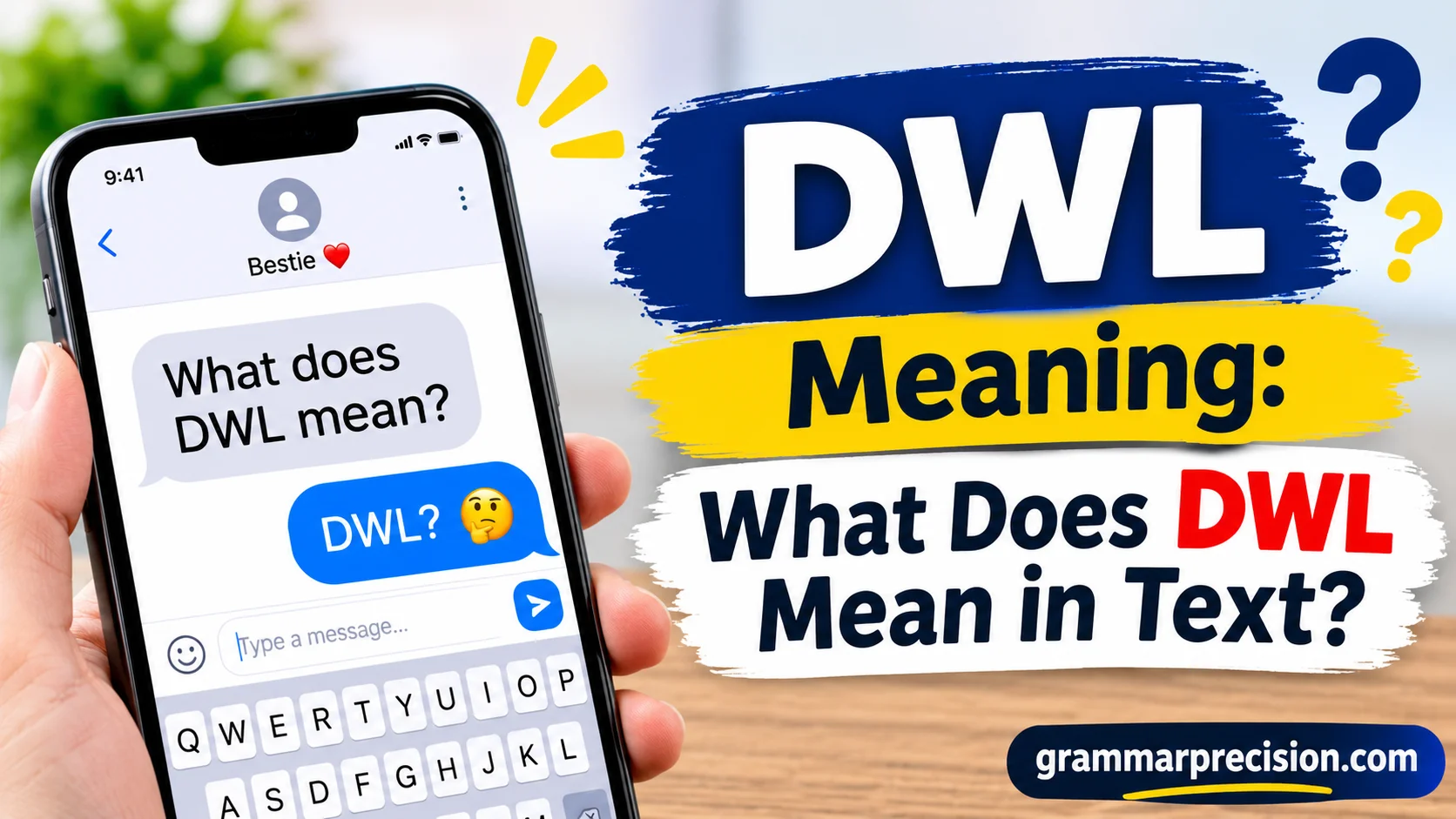
DWL means “Dying With Laughter” in informal texting and internet slang. People use it when something seems extremely funny or makes them laugh uncontrollably.
For example:
- Friend: “I accidentally walked into the wrong classroom and started talking.”
- You: “DWL! That’s embarrassing.”
In this conversation, DWL communicates amusement rather than literal distress.
Here are the essential details:
| DWL Detail | Explanation |
| Full form | Dying With Laughter |
| Meaning | Something is extremely funny |
| Category | Internet slang |
| Tone | Casual and humorous |
| Common use | Texting and social media |
| Similar expressions | LOL, LMAO, ROFL |
| Formality | Informal |
You can use DWL when responding to jokes, hilarious stories, funny pictures, or unexpected situations.
What Does DWL Stand For?
DWL most commonly stands for Dying With Laughter in the texting context discussed here. It’s a playful expression that exaggerates how funny someone finds something.
The phrase doesn’t describe an actual physical condition. Instead, it uses dramatic language to communicate laughter.
Imagine your friend sends you a video of someone slipping on a banana peel in a cartoon. You might respond with DWL to show that the video genuinely made you laugh.
The abbreviation saves time while communicating an emotional reaction.
Understanding the Words Behind DWL
Each word contributes to the expression’s meaning:
- Dying: An exaggerated way of describing an intense reaction.
- With: Connects the reaction to its cause.
- Laughter: Shows that the person finds something funny.
Together, these words create a humorous expression for uncontrollable laughter.
People frequently use similar exaggerations in everyday language. For example, someone might say, “I’m dead,” after hearing an incredibly funny joke.
Neither expression describes a literal situation.
DWL Meaning in Text Messages
Text messages often lack facial expressions, gestures, and vocal tone. That’s why abbreviations like DWL help communicate emotions more clearly.
When someone sends DWL, they’re usually telling you that your message made them laugh. It can also acknowledge a funny situation without requiring a lengthy response.
For example, consider this exchange:
Person A: “My little brother tried making coffee and accidentally added salt instead of sugar.”
Person B: “DWL 😂”
The second person uses DWL to show amusement at the unexpected mistake.
Why People Use DWL in Texting
Several reasons explain why people include DWL in everyday messages.
1. It saves time: Typing three words takes longer than sending three letters.
2. It communicates emotion: DWL quickly tells someone that their message was funny.
3. It keeps conversations relaxed: The abbreviation creates a friendly and informal atmosphere.
4. It matches internet culture: Online conversations frequently use shortened expressions and playful language.
5. It encourages interaction: A humorous response can keep conversations moving naturally.
However, DWL doesn’t always mean someone is laughing uncontrollably. Sometimes people use it simply to acknowledge something amusing.
How People Use DWL in Everyday Conversations
DWL works in several casual situations. Its exact tone depends on the relationship between the people communicating and the surrounding conversation.
Here are some common situations where you might encounter it.
DWL in Friendly Chats
Friends often use DWL when sharing embarrassing stories, jokes, funny observations, or unexpected experiences.
Example:
- Friend: “I waved at someone who wasn’t even waving at me.”
- You: “DWL! I’ve done that before.”
This response combines humor with a relatable experience.
DWL in Funny Conversations
When someone shares a particularly hilarious observation, DWL can express a stronger reaction than a simple acknowledgment.
Example:
- Person A: “My cat knocked everything off the table and then looked offended.”
- Person B: “DWL, cats really have no shame.”
Here, the abbreviation emphasizes how entertaining the situation seems.
DWL on Snapchat and Instagram
Social media platforms encourage quick reactions through comments, direct messages, stories, and shared videos.
You might see DWL underneath a funny Instagram Reel or in response to a Snapchat story.
Example:
Someone posts a video of their friend attempting a dance challenge and completely missing the rhythm.
A viewer comments:
“DWL 😂 This made my day!”
The abbreviation communicates amusement without requiring a detailed explanation.
DWL in WhatsApp Messages
WhatsApp conversations frequently include abbreviations, emojis, stickers, and voice notes.
DWL fits naturally into informal conversations between friends and family members.
For example:
- Friend: “Dad tried using voice typing and sent a message full of random words.”
- You: “DWL 🤣 Ask him to try again!”
The expression makes the conversation feel playful and spontaneous.
DWL Examples in Real Text Conversations
Sometimes, seeing an abbreviation inside an actual conversation makes its meaning easier to understand.
Below are 15 examples showing how people might naturally use DWL in different situations.
| Situation | Example Conversation |
| Funny mistake | “I wore two different shoes today.” — “DWL!” |
| School humor | “Our teacher forgot what homework she assigned.” — “DWL 😂” |
| Workplace joke | “My computer crashed during the presentation.” — “DWL, terrible timing!” |
| Friendship | “You still remember that embarrassing moment?” — “DWL, of course!” |
| Family story | “Grandma called the Wi-Fi a magic television wire.” — “DWL!” |
| Funny video | “Did you watch that dancing dog?” — “DWL 🤣” |
| Cooking disaster | “I burned instant noodles.” — “DWL, how?” |
| Gaming | “I fell off the map again.” — “DWL bro!” |
| Unexpected event | “The delivery guy brought the wrong package.” — “DWL 😂” |
| School memory | “Remember when we got lost on the field trip?” — “DWL!” |
| Group chat | “Someone just sent the funniest meme.” — “DWL!” |
| Social media | “This video is too funny.” — “DWL 😭” |
| Embarrassing moment | “I called my teacher Mom.” — “DWL, that’s hilarious!” |
| Friendly teasing | “You forgot your own birthday?” — “DWL, don’t remind me!” |
| Random joke | “My alarm clock gave up before I did.” — “DWL!” |
These examples demonstrate that DWL usually communicates amusement, surprise, or playful teasing.
Notice how the surrounding words help establish the tone. The same abbreviation can sound friendly, sarcastic, or exaggerated depending on the situation.
How to Reply When Someone Sends DWL
Receiving DWL doesn’t require a complicated response. Usually, a short and friendly message keeps the conversation flowing.
Your reply should match the original message and your relationship with the sender.
Funny Replies to DWL
If someone reacts to your joke with DWL, you can respond with another humorous comment.
Try these:
- “Wait until you hear the next part!”
- “I knew you’d find that funny.”
- “I’m still laughing about it.”
- “Don’t encourage me!”
- “That’s only the beginning.”
- “You haven’t seen anything yet.”
- “I couldn’t make this up!”
- “My life is basically a comedy show.”
These replies work especially well when you’re already joking around.
Casual Replies to DWL
Sometimes, you don’t need another joke. A relaxed response is enough.
Here are some natural options:
- “Haha, right?”
- “I know!”
- “Exactly!”
- “Glad you enjoyed it.”
- “That was hilarious.”
- “I couldn’t stop laughing either.”
- “Seriously!”
- “Same here!”
These responses acknowledge the other person’s reaction without changing the conversation’s direction.
Flirty Replies to DWL
If you’re chatting with someone romantically, DWL can create an opportunity for playful flirting.
For example:
- “At least I know how to make you smile.”
- “Your laugh is worth the effort.”
- “I’ve got more jokes just for you.”
- “Wait until we meet in person.”
- “Making you laugh is becoming my favorite hobby.”
Use these responses when the conversation already has a comfortable, flirtatious tone. Otherwise, an overly romantic reply might feel unexpected.
Friendly Replies to DWL
When a friend sends DWL, you can keep things simple and warm.
Consider these options:
- “You’re too easy to entertain.”
- “That’s why we’re friends.”
- “I knew you’d appreciate that.”
- “We always find something ridiculous to laugh about.”
- “More funny stories coming soon!”
The best response feels natural rather than rehearsed.
Is DWL Positive, Negative, or Neutral?
DWL is generally a positive expression because it communicates laughter and amusement.
However, the tone can change depending on the conversation.
| Context | Possible Meaning | Tone |
| Funny joke | Something is hilarious | Positive |
| Embarrassing story | Finding a mistake amusing | Playful |
| Friendly teasing | Laughing at a friend’s comment | Casual |
| Sarcastic conversation | Mocking an exaggerated situation | Potentially negative |
| Unexpected news | Reacting with amusement or disbelief | Context-dependent |
For instance, if your friend shares a funny childhood memory, DWL probably communicates genuine amusement.
However, if someone shares something painful and receives DWL, the response could seem insensitive or mocking.
The surrounding conversation matters more than the abbreviation itself.
Before interpreting someone’s reaction, consider what they were responding to and how they usually communicate.
DWL vs. LOL vs. LMAO: What’s the Difference?
DWL belongs to the same general family of internet expressions as LOL and LMAO. All three communicate laughter, but they aren’t necessarily interchangeable in every conversation.
Understanding their differences helps you choose the right expression.
| Abbreviation | Full Form | Meaning | Typical Tone |
| DWL | Dying With Laughter | Something is extremely funny | Playful |
| LOL | Laughing Out Loud | Something is funny or amusing | Casual |
| LMAO | Laughing My Ass Off | Finding something very funny | Strong and informal |
| ROFL | Rolling On the Floor Laughing | Extremely amused | Exaggerated |
| LMFAO | Laughing My Freaking/Fucking Ass Off | Strong amusement | Very informal |
DWL vs. LOL
LOL is one of the most recognizable internet abbreviations. People use it for jokes, funny observations, and even mildly amusing comments.
DWL generally communicates a more exaggerated reaction.
Example:
- Friend: “I forgot where I parked my bicycle.”
- You: “LOL, seriously?”
- You: “DWL, that’s actually hilarious!”
Both responses communicate amusement, but DWL emphasizes the stronger reaction.
DWL vs. LMAO
LMAO expresses intense laughter and has a more explicit, informal full form.
DWL communicates a similar idea without using profanity in its standard expansion.
For that reason, someone might prefer DWL in conversations where they want a humorous expression without using stronger language.
DWL vs. ROFL
ROFL stands for “Rolling On the Floor Laughing.”
Like DWL, it exaggerates the physical experience of laughing. Both expressions suggest that something is extremely entertaining.
However, ROFL has a longer history in internet chat culture and remains recognizable to many online users.
Does DWL Have Different Meanings in Different Contexts?
Although DWL commonly means Dying With Laughter in the texting context, abbreviations don’t always have one universal definition.
Different industries, communities, and online groups sometimes assign different meanings to the same combination of letters.
For example, an abbreviation used in a casual conversation might have a completely different interpretation in a technical document.
Therefore, you shouldn’t automatically assume that every appearance of DWL refers to laughter.
DWL in Casual Online Conversations
In informal chats, the laughter interpretation is the relevant one when someone responds to a joke, meme, or funny story.
Example:
“Your reaction to that video was priceless. DWL!”
The context makes the humorous meaning clear.
DWL Outside Social Media
In technical, educational, or professional settings, DWL might appear as an organization-specific abbreviation or specialized term.
Its interpretation depends on the subject being discussed.
For example, a document about engineering might use an abbreviation differently from a conversation about internet slang.
When you encounter unfamiliar initials, check the surrounding sentence instead of guessing.
How to Understand DWL From Context
Use these clues to identify what someone means:
- Look at the previous message: Was it a joke, meme, or funny story?
- Check the conversation’s tone: Does the discussion feel playful?
- Consider the platform: Is the abbreviation appearing in a casual chat or professional document?
- Look for emojis: Laughing emojis can support the humorous interpretation.
- Ask when necessary: If the meaning remains unclear, request clarification.
A little context can prevent a surprisingly large misunderstanding.
DWL Meaning on Snapchat, TikTok, and Instagram
Social media platforms have helped internet slang spread between different communities. DWL can appear in comments, captions, private messages, and reactions.
However, its popularity isn’t necessarily the same across every platform.
DWL on Snapchat
Snapchat conversations are often quick, personal, and informal.
Someone might send DWL after receiving a funny picture or watching an amusing video.
Example:
“Your selfie filter looks ridiculous DWL 😂”
The abbreviation communicates laughter and friendly teasing.
DWL on TikTok
TikTok revolves around short videos, trends, comedy, and entertaining content.
You might encounter DWL in comments responding to funny clips or unexpected moments.
Example:
“DWL, the ending caught me completely off guard!”
Here, the abbreviation emphasizes the viewer’s amusement.
DWL on Instagram
Instagram users communicate through Reels, Stories, comments, and direct messages.
DWL can appear as a quick reaction to a funny post or an amusing conversation.
Example:
“DWL! Why does this remind me of our school days?”
The message combines laughter with a personal reference.
What Does DWL Mean From a Girl?
When a girl sends DWL, she generally means that something made her laugh or that she finds your message amusing.
However, the abbreviation doesn’t automatically indicate romantic interest.
Consider these possibilities:
- Friendly reaction: She genuinely finds your joke funny.
- Playful teasing: She’s laughing at something silly you said.
- Casual acknowledgment: She’s keeping the conversation relaxed.
- Flirty interaction: She’s enjoying playful conversation and showing interest.
For example:
You: “I spent ten minutes looking for my phone while holding it.”
Her: “DWL 😂”
She’s probably amused by your mistake.
Look at the broader conversation before deciding whether her response carries a romantic meaning.
What Does DWL Mean From a Guy?
When a guy sends DWL, he usually uses it to communicate amusement, just like anyone else.
The abbreviation doesn’t have a special gender-specific meaning.
For example:
You: “I accidentally sent my grocery list to my teacher.”
Him: “DWL bro, that’s embarrassing!”
His response suggests that he finds the situation funny.
Depending on your relationship, his message might also include friendly teasing or casual banter.
Remember: The meaning comes from the conversation, not the sender’s gender.
When Should You Avoid Using DWL?
Although DWL works well in casual conversations, it doesn’t belong everywhere.
Some situations require more thoughtful language and a different tone.
Avoid using DWL in these circumstances:
- Professional emails: Use clear, complete sentences instead.
- Serious discussions: Laughter-related slang might make you seem dismissive.
- Sensitive situations: Someone experiencing a difficult moment may misunderstand your reaction.
- Formal academic writing: Internet abbreviations generally don’t fit academic standards.
- Conversations with unfamiliar people: Not everyone recognizes DWL.
For example, responding to someone’s serious personal problem with DWL could appear disrespectful.
Instead, consider the situation before choosing your words.
Common Mistakes People Make When Using DWL
Internet slang looks simple, but misunderstandings can still happen.
Here are several mistakes worth avoiding.
Assuming DWL always has one meaning: Abbreviations can change across different communities and subjects.
Using it in formal writing: DWL is informal slang rather than standard professional language.
Confusing it with LOL: Both express laughter, but they have different full forms.
Taking it literally: Dying With Laughter is an exaggeration, not a description of physical harm.
Ignoring the conversation’s tone: A humorous abbreviation might sound insensitive in a serious discussion.
Assuming romantic interest: Someone sending DWL doesn’t automatically mean they’re flirting.
Once you understand these distinctions, using DWL becomes much easier.
FAQs About DWL Meaning
DWL commonly means Dying With Laughter in texting. People use it to express amusement when something seems extremely funny. It’s similar to LOL and LMAO and usually appears in casual conversations.
Not exactly. Both abbreviations communicate laughter, but DWL stands for Dying With Laughter while LOL means Laughing Out Loud. DWL generally expresses a more exaggerated reaction.
On Snapchat, DWL generally communicates that someone finds a picture, message, video, or situation hilarious. It’s an informal way to react to something amusing.
When a girl sends DWL, she usually means that something made her laugh. It can communicate friendliness, amusement, or playful teasing. However, it doesn’t automatically indicate romantic interest.
A guy generally uses DWL to show that he finds something funny. Its meaning doesn’t change based on gender. The surrounding conversation determines whether the response feels friendly, sarcastic, or playful.
Generally, no. DWL is casual internet slang and doesn’t suit formal emails, business documents, or professional communication. Use complete expressions such as “That’s funny” instead.
Yes! You can combine DWL with laughing emojis to make your reaction more expressive.
Common combinations include:
- DWL 😂
- DWL 🤣
- DWL 😭
- DWL 💀
These combinations help communicate humor and exaggeration in casual conversations.
DWL stands for Dying With Laughter while LMAO means Laughing My Ass Off. Both express strong amusement, but LMAO includes profanity in its standard full form.
Conclusion:
Understanding DWL meaning helps you navigate modern texting and social media conversations confidently. This popular abbreviation stands for Dying With Laughter and expresses strong amusement. Whether chatting with friends or sharing funny content, DWL keeps your digital communication casual, friendly, and entertaining.
Now that you understand its meaning, examples, and usage, you can recognize DWL in different conversations. Remember to consider the context and tone before responding. Although DWL works perfectly in casual chats, choose clear and appropriate language for professional communication. Keep exploring internet slang to improve your digital communication skills.
Latest posts:
- What Does # Mean in Text? Meaning, Uses, & Examples
- BFE Meaning: What Does BFE Mean in Text?
- NT Meaning in Text: What Does NT Mean in Texting?
- YHU Meaning in Text: Definition, Examples, & How to Use It
- WYH Meaning in Text: Definition, Examples, & How to Respond