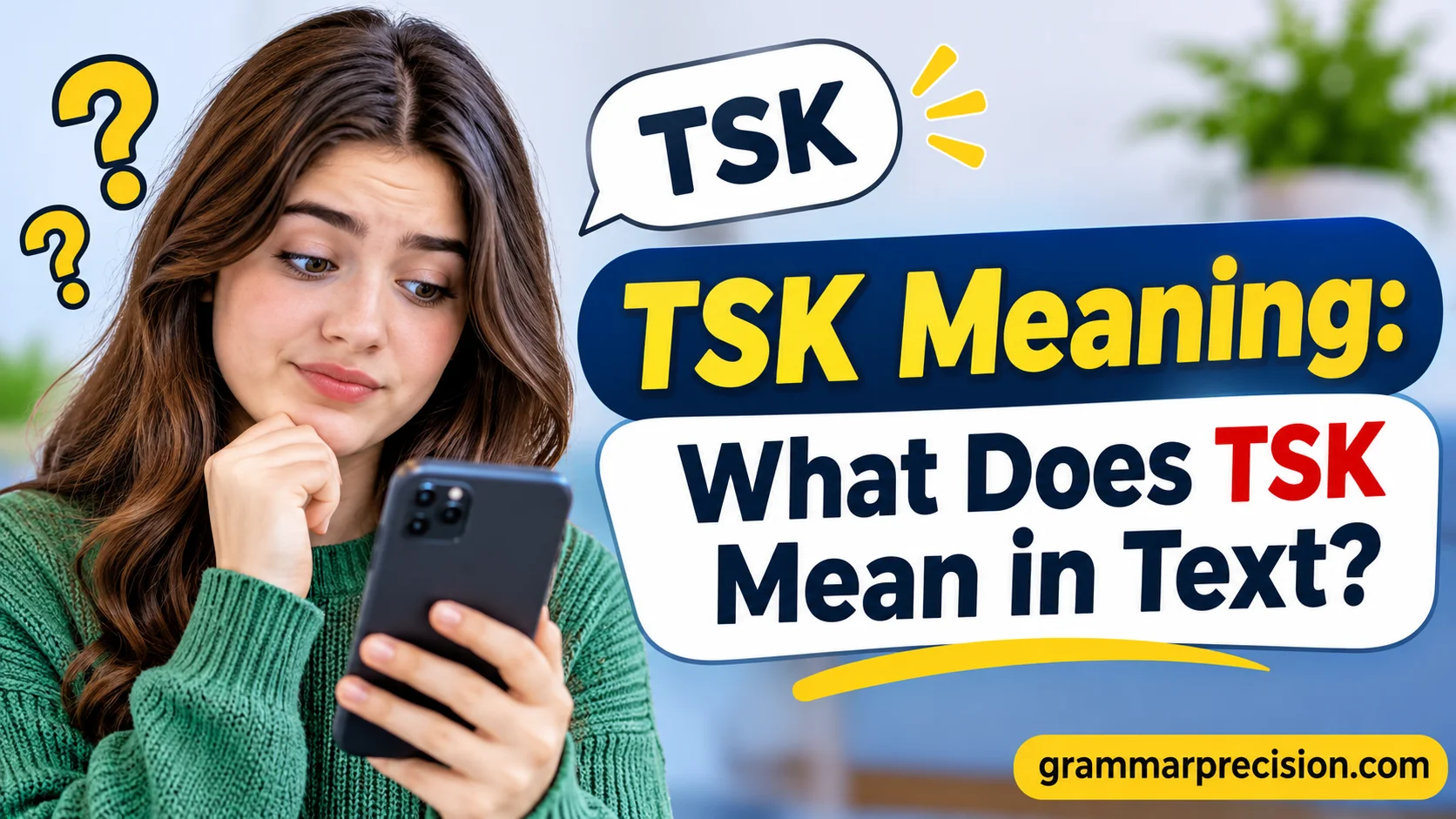
Have you ever received a message containing TSK and wondered what the sender really meant? Understanding TSK meaning helps you recognize disapproval, disappointment, annoyance, and playful reactions in everyday conversations.
This article explores how people use TSK in texting, social media, and casual conversations. You’ll discover its origin, emotional meanings, pronunciation, and practical examples while learning how context influences its interpretation. We also explain common comparisons with similar expressions and appropriate responses.
Whether you’re improving your English usage, understanding digital communication, or exploring informal language, this guide makes everything easier. Discover how TSK works across different situations and why this small expression adds meaning to modern conversations.
Quick Answer: What Does TSK Mean?
TSK represents a clicking sound people make with their tongues to express disapproval, disappointment, annoyance, or mild frustration. It’s an example of an onomatopoeic expression, meaning its written form imitates an actual sound.
For example:
- Friend: “I forgot my wallet at home again.”
- You: “Tsk! You really need to check your pockets before leaving.”
In this conversation, TSK communicates mild frustration while keeping the exchange playful.
Unlike many texting abbreviations, TSK doesn’t usually stand for a longer phrase. Instead, it represents a recognizable human reaction.
What Does TSK Mean in Text?
In texting, TSK usually expresses disapproval or disappointment without requiring a lengthy explanation. Someone might use it when you make a silly mistake, share disappointing news, or do something they consider careless.
Think of it as a digital version of shaking your head or clicking your tongue.
However, the exact meaning depends on your relationship with the sender and the surrounding conversation.
Here are its most common interpretations:
TSK as an Expression of Disapproval
People often type TSK when they disagree with someone’s behavior or decisions. It communicates that something wasn’t appropriate, sensible, or expected.
For example:
- Friend: “I told everyone your secret.”
- You: “Tsk! You shouldn’t have done that.”
Here, the expression shows disappointment and mild criticism.
TSK as a Sound of Annoyance or Frustration
Sometimes, TSK communicates irritation rather than serious disapproval. It can express frustration when something goes wrong or someone repeats an annoying habit.
For example:
- Person A: “My internet stopped working again.”
- Person B: “Tsk! That’s the third time today.”
The sender isn’t necessarily angry. They’re simply reacting to an irritating situation.
TSK as a Way to Show Disappointment
TSK can also communicate disappointment when someone makes a poor decision or misses an opportunity.
For example:
- Friend: “I didn’t study for tomorrow’s exam.”
- You: “Tsk! You had the entire weekend.”
This response suggests that the friend could have made a better choice.
What Does TSK Mean on Social Media?
Social media users frequently communicate through short reactions rather than complete sentences. TSK fits naturally into this style because it expresses an emotion quickly.
You might encounter it in comments, private messages, captions, or conversations.
However, its meaning doesn’t change dramatically between platforms. The surrounding content usually determines the intended emotion.
TSK Meaning on Snapchat
On Snapchat, TSK can communicate playful disappointment, annoyance, or disapproval between friends.
For example:
- Friend: “I accidentally deleted our favorite picture.”
- You: “Tsk! How could you?”
The response sounds disappointed but might also carry a playful tone.
TSK Meaning on TikTok
TikTok users may write TSK in comments when reacting to questionable decisions, funny mistakes, or surprising behavior.
For example:
- Creator: “I spent my entire paycheck on snacks.”
- Comment: “Tsk! Financial planning left the chat.”
Here, TSK introduces a humorous reaction rather than serious criticism.
TSK Meaning on Instagram
On Instagram, people might use TSK in direct messages, comments, or story replies.
For example:
- Friend posts a picture of a completely burned pizza.
- You reply: “Tsk! What happened to dinner?”
The expression adds a teasing reaction to the situation.
TSK Meaning in WhatsApp Messages
WhatsApp conversations often include informal expressions that make everyday communication feel more natural.
For example:
- Friend: “I forgot to bring your book.”
- You: “Tsk! I reminded you twice.”
Depending on your relationship, this could sound genuinely annoyed or completely playful.
Where Does the Expression TSK Come From?
Unlike modern internet abbreviations, TSK didn’t originate from social media or smartphone messaging. It comes from an actual sound people make using their tongues.
The expression represents a clicking noise associated with reactions such as disapproval, impatience, disappointment, or mild frustration.
The Origin of the Tsk Sound
The sound represented by TSK is commonly called a clicking or tutting sound. People produce it by briefly creating and releasing pressure with their tongue against part of their mouth.
In English, writers use spellings such as tsk, tut, and tsk-tsk to represent this sound.
People have used these written forms to communicate reactions in conversation and literature long before modern texting became popular.
How TSK Became Popular in Digital Communication
As online messaging developed, people started using written expressions to replace facial expressions, gestures, and vocal reactions.
For example:
- LOL represents laughter.
- Sigh represents an audible expression of frustration or disappointment.
- Hmph represents displeasure or annoyance.
- TSK represents a clicking sound associated with disapproval.
TSK became a convenient way to communicate a reaction without explaining everything.
Its short spelling also makes it suitable for quick conversations.
How to Use TSK in Everyday Conversations
Using TSK correctly isn’t difficult once you understand its emotional purpose. You can include it at the beginning of a sentence or use it independently as a reaction.
The key is choosing a situation where a clicking sound makes sense.
Here are three common ways to use it.
Using TSK to Express Disapproval
When someone makes a questionable decision, TSK can communicate that you don’t approve.
Examples:
- “Tsk! You shouldn’t have lied about that.”
- “Tsk, that’s not how you treat your friends.”
- “Tsk! You know better than that.”
These examples express criticism without requiring aggressive language.
Using TSK to Show Mild Frustration
You can also use TSK when something repeatedly goes wrong.
Examples:
- “Tsk! My laptop froze again.”
- “Tsk, we missed the bus by seconds.”
- “Tsk! I forgot my headphones.”
This usage usually communicates irritation rather than serious anger.
Using TSK Playfully With Friends
Among close friends, TSK can become a humorous expression. It may even make a teasing comment sound less serious.
Examples:
- “Tsk! Someone forgot their anniversary.”
- “Tsk, look who’s finally awake.”
- “Tsk! You ate the last slice?”
The friendly relationship helps establish the playful meaning.
TSK Meaning in Different Contexts
One interesting thing about TSK is that the same expression can communicate different emotions. A single message doesn’t always reveal the sender’s complete intention.
To understand it properly, consider the relationship and situation.
| Situation | Possible meaning | Example |
| From a friend | Playful disappointment | “Tsk! You forgot again.” |
| From a partner | Mild annoyance | “Tsk, you’re late.” |
| In a group chat | Humorous criticism | “Tsk! Another silly decision.” |
| During an argument | Disapproval | “Tsk, that’s unfair.” |
| After bad news | Disappointment | “Tsk! That’s unfortunate.” |
TSK From a Friend
When a friend sends TSK, they might be teasing you about something you’ve done.
For instance, forgetting someone’s birthday or arriving late could earn a simple “Tsk!”
However, close friendships often allow people to express criticism without creating serious tension.
TSK From Your Partner
When your partner sends TSK, the meaning depends heavily on the conversation.
It could communicate playful frustration, disappointment, or genuine irritation.
For example:
“TSK! You promised we’d watch that movie together.”
This response might indicate that your partner feels disappointed because you forgot a shared plan.
TSK in a Group Chat
In group conversations, TSK can work as a quick reaction to someone’s comment or decision.
For example:
- Alex: “I accidentally sent the message to the wrong group.”
- Sarah: “Tsk! That’s awkward.”
- Mike: “We need a new group administrator.”
Here, the expression adds humor to an embarrassing situation.
TSK During an Argument
During disagreements, TSK can sound more critical than playful.
Someone might use it to express dissatisfaction with another person’s behavior.
For example:
“Tsk! You never listen when I’m explaining something important.”
In this situation, the expression emphasizes frustration. It’s better to consider the entire conversation rather than interpreting those three letters alone.
TSK Meaning Examples in Text Messages
Examples make slang easier to understand because they show how people use expressions naturally.
Here are some practical TSK conversations covering different situations.
Casual Conversation Examples
Example 1:
- Alex: “I forgot my lunch at home.”
- Sam: “Tsk! What are you going to eat now?”
Example 2:
- Mia: “I missed my favorite show’s new episode.”
- Emma: “Tsk! You should’ve watched it yesterday.”
Example 3:
- Jake: “I left my phone in the car.”
- Ryan: “Tsk, you’re always forgetting something.”
Funny TSK Text Examples
Example 4:
- Lily: “I ordered pizza and finished it alone.”
- Noah: “Tsk! Not even one slice for me?”
Example 5:
- Ben: “I woke up at noon again.”
- Chris: “Tsk! The early bird has officially retired.”
Example 6:
- Ava: “I bought another pair of shoes.”
- Mia: “Tsk! Your shopping addiction is winning.”
TSK Examples Showing Annoyance
Example 7:
- Daniel: “I canceled our plans at the last minute.”
- James: “Tsk! You could’ve told me earlier.”
Example 8:
- Sophie: “You forgot to lock the door.”
- Liam: “Tsk! I’ll check it next time.”
Example 9:
- Ella: “I borrowed your charger and lost it.”
- Grace: “Tsk! That was my favorite charger.”
These examples demonstrate how TSK can communicate different levels of disappointment, annoyance, and playful criticism.
Is TSK Rude or Disrespectful?
TSK isn’t automatically rude, but it can sound disrespectful when someone uses it to criticize another person’s actions.
Its emotional impact depends on tone, timing, and the relationship between the people communicating.
For example, sending “Tsk!” after your friend makes a harmless mistake might seem funny. Sending the same expression during a serious disagreement could sound dismissive.
When TSK Sounds Judgmental
TSK may sound judgmental when it accompanies criticism or accusations.
For example:
“Tsk! You should know better than that.”
This sentence suggests that the other person made an unnecessary or careless mistake.
When TSK Is Just Playful
Among friends, TSK can become a lighthearted expression.
For example:
“Tsk! You finished the chocolate without saving me any?”
The message communicates mock disappointment rather than genuine anger.
How Tone Changes Its Meaning
Written messages don’t always communicate emotions clearly. Without facial expressions or voice tone, readers must interpret the sender’s intention.
Consider these differences:
| Message | Likely impression |
| “Tsk!” | Disapproval or disappointment |
| “Tsk 😂” | Playful annoyance |
| “Tsk, seriously?” | Frustration |
| “Tsk-tsk!” | Emphasized disapproval |
| “Aww, tsk!” | Gentle disappointment |
The surrounding conversation matters more than punctuation alone.
How to Reply When Someone Says TSK
Receiving TSK doesn’t mean you need to defend yourself immediately. Sometimes the sender is joking, while other times they’re expressing genuine disappointment.
Choose your response according to the situation.
Funny Responses to TSK
If someone uses TSK playfully, respond with humor.
- “Hey, don’t judge me!”
- “I plead guilty!”
- “My bad, your honor.”
- “It happens to the best of us.”
- “Stop making that disappointed sound!”
Friendly Responses to TSK
When you want to keep things casual, try these replies:
- “Oops, sorry!”
- “I’ll do better next time.”
- “Don’t worry, I’ve got this.”
- “You’re right about that.”
- “Okay, lesson learned!”
Serious Responses to TSK
If someone seems genuinely upset, acknowledge their feelings.
- “I understand why you’re disappointed.”
- “You’re right. I should’ve handled that differently.”
- “Sorry, I didn’t mean to upset you.”
- “Let’s talk about what happened.”
- “I’ll make sure it doesn’t happen again.”
Flirty Responses to TSK
When someone you like sends TSK playfully, you can answer with a little charm.
- “Aww, don’t be disappointed in me.”
- “I’ll make it up to you.”
- “That cute little TSK again?”
- “You’re still adorable when you’re annoyed.”
- “Can I earn a smile instead?”
The best reply matches the sender’s mood instead of making the conversation unnecessarily complicated.
TSK vs. Other Similar Expressions
Several English expressions communicate emotions similar to TSK. However, each has a slightly different sound and conversational purpose.
Understanding these differences helps you choose the right expression.
| Expression | Meaning | Common usage |
| TSK | Disapproval or disappointment | Reacting to mistakes |
| Tsk-tsk | Stronger or repeated disapproval | Criticizing behavior |
| SMH | Shaking my head | Expressing disbelief |
| Sigh | Disappointment or frustration | Reacting to problems |
| Hmph | Annoyance or displeasure | Showing dissatisfaction |
| Tut-tut | Disapproval | Commenting on poor behavior |
TSK vs. Tsk-Tsk
Both expressions communicate disapproval or disappointment.
However, tsk-tsk repeats the clicking sound and often emphasizes criticism more strongly.
Example:
- TSK: “Tsk! You forgot again.”
- Tsk-tsk: “Tsk-tsk! You really need to pay attention.”
TSK vs. SMH
SMH stands for Shaking My Head. People use it online when something seems ridiculous, disappointing, or frustrating.
TSK represents a clicking sound, while SMH describes a physical gesture.
Example:
- TSK: “Tsk! You broke the new phone.”
- SMH: “SMH, how did you manage that?”
TSK vs. Sigh
A sigh is a breath people release when they feel tired, frustrated, disappointed, or relieved.
TSK involves a clicking sound rather than an exhalation.
Example:
- TSK: “Tsk! Another missed deadline.”
- Sigh: “Sigh, another missed deadline.”
Both can express frustration, but their sounds and emotional styles differ.
TSK vs. Tut-Tut
Tut-tut is another written representation of a tongue-clicking sound. It often communicates disapproval or mild criticism.
It’s especially common in expressions that sound traditional or slightly theatrical.
Example:
“Tut-tut! That’s not a very sensible decision.”
Other Possible Meanings of TSK
Although TSK commonly represents a clicking sound in everyday English, its interpretation can vary across specialized subjects and communities.
In technical discussions, abbreviations may use the same letters for unrelated terms.
For example:
- Texting and social media: A clicking sound expressing disapproval or disappointment.
- Everyday conversation: An interjection used to react to mistakes or questionable behavior.
- Specialized terminology: TSK may appear as an organization-specific or technical abbreviation.
Therefore, don’t assume every appearance of TSK has the same meaning.
When you encounter it in a message, examine the surrounding words and conversation before deciding what the sender intended.
FAQs About TSK Meaning
When a girl sends TSK, she may be expressing disappointment, annoyance, or playful disapproval. For example, she might write “Tsk! You forgot again” after you make a small mistake. Her tone and relationship with you help determine whether she’s joking or genuinely upset.
When a guy texts TSK, he usually communicates mild frustration, disappointment, or disapproval. He might also use it jokingly when teasing friends. The surrounding conversation provides the clearest indication of his intention.
TSK is primarily a written representation of a clicking sound made with the tongue. It’s an example of onomatopoeia, not a conventional abbreviation with a universally accepted full form.
Yes. TSK frequently expresses disappointment when someone makes a mistake, behaves carelessly, or makes a questionable decision. However, it can also communicate annoyance, criticism, or playful teasing.
Absolutely! People sometimes use TSK sarcastically to exaggerate disappointment or tease someone. For example, “Tsk! Someone forgot their own birthday.” The humorous situation makes the expression sound less serious.
They’re closely related expressions. Both represent tongue-clicking sounds associated with disapproval or disappointment. However, repeating the expression as TSK-TSK can emphasize the reaction.
TSK generally belongs in informal communication, dialogue, and conversational writing. You can use it in fiction or casual messages, but formal reports and professional documents usually require clearer wording.
Conclusion:
Understanding TSK meaning helps you recognize how people express disapproval, disappointment, annoyance, and playful frustration in everyday conversations. Whether you encounter it in texting or social media, knowing its context makes interpreting this simple expression much easier.
As digital communication continues evolving, short expressions like TSK make conversations more expressive and natural. Remember to consider the sender’s tone, relationship, and situation before responding. With these insights, you can understand its meaning, use it appropriately, and communicate more confidently in everyday English.
Latest Posts:
- What Does # Mean in Text? Meaning, Uses, & Examples
- BFE Meaning: What Does BFE Mean in Text?
- NT Meaning in Text: What Does NT Mean in Texting?
- YHU Meaning in Text: Definition, Examples, & How to Use It
- WYH Meaning in Text: Definition, Examples, & How to Respond