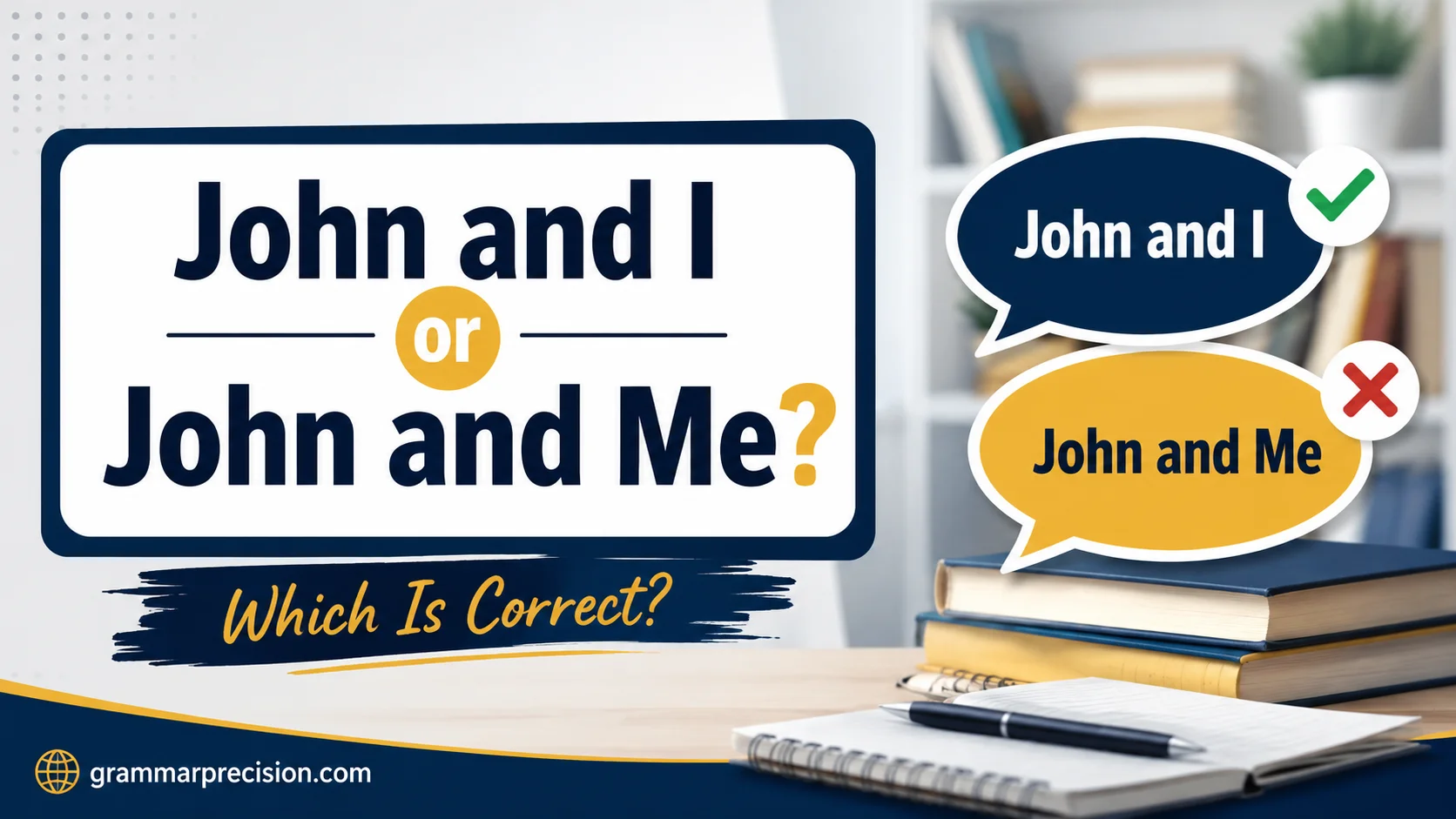
John and I or John and Me? helps you understand the correct use of pronouns in English. This guide explains their grammar rules, sentence roles, and proper usage clearly.
Choosing between John and I, John and Me, and Me and John depends on the role they play in a sentence. Use John and I as a subject pronoun when performing an action, while John and me works as an object pronoun when receiving an action.
To avoid common mistakes, use a quick mental check by removing the other name. This simple rule of thumb improves your writing clarity, communication skills, and confidence. With regular practice, you can master these grammar phrases and choose the correct form easily.
What Is the Difference Between “John and I” and “John and Me”?
The main difference is the grammatical role each pronoun plays.
“I” is a subject pronoun. It acts as the person or thing doing the action.
“Me” is an object pronoun. It receives the action or comes after a preposition.
Think of it like a movie:
- The subject is the person holding the camera and creating the action.
- The object is the person appearing in the scene and receiving what happens.
For example:
- John and I wrote the article.
- The editor reviewed the article written by John and me.
In the first sentence, John and I perform the action of writing. In the second sentence, John and me receive the action of being reviewed or mentioned.
Understanding When to Use “John and I”
You should use John and I when you and John are the people performing the action in a sentence.
The easiest way to recognize this is to look at what happens before the verb. If the phrase answers the question “Who is doing this?”, you need I.
Examples of “John and I” Used Correctly
- John and I went to the conference yesterday.
- John and I completed the project before the deadline.
- John and I are planning a trip next month.
- The manager said John and I were responsible for the presentation.
In each example, John and the speaker actively do something:
- John and I went.
- John and I completed.
- John and I are planning.
- John and I were responsible.
Because the pair performs the action, I is the correct choice.
Understanding When to Use “John and Me”
You should use John and me when someone else performs an action toward you and John.
In these situations, John and you are receiving the action rather than doing it.
Examples of “John and Me” Used Correctly
- The teacher congratulated John and me.
- Sarah invited John and me to dinner.
- The company gave John and me new responsibilities.
- The coach spoke with John and me after practice.
Here, someone else performs the action:
- The teacher congratulated.
- Sarah invited.
- The company gave.
- The coach spoke.
John and the speaker receive those actions, so me is correct.
The Simple Trick to Choose Between “John and I” and “John and Me”
Many grammar mistakes disappear when you use one quick test:
Remove John from the sentence and see whether “I” or “me” sounds correct.
Let’s look at a few examples.
Example 1
Incorrect:
John and me went to the store.
Remove John:
Me went to the store.
That sounds wrong.
The correct version is:
John and I went to the store.
Because:
I went to the store.
works perfectly.
Example 2
Incorrect:
The teacher called John and I.
Remove John:
The teacher called I.
That sounds incorrect.
The correct version is:
The teacher called John and me.
Because:
The teacher called me.
is correct.
This simple trick works because English pronouns change depending on their job in the sentence.
Why Do People Say “John and I” Too Often?
One reason this mistake happens is because many people believe “I” always sounds more educated or formal than “me.”
That idea is common but incorrect.
For example:
❌ The award was given to John and I.
Many people choose this because they think “I” sounds more professional. However, the sentence uses the preposition “to,” which requires an object.
Correct:
✅ The award was given to John and me.
Using “me” does not make a sentence less intelligent. It simply makes it grammatically accurate.
Why Do People Say “John and Me” Incorrectly?
The opposite mistake happens when people use me as a subject.
For example:
❌ John and me finished the assignment.
The phrase is incorrect because John and the speaker perform the action.
Correct:
✅ John and I finished the assignment.
Remember:
Do the action = I
Receive the action = me
This one rule solves most cases.
Common Mistakes With “John and I” vs. “John and Me”
Even experienced English speakers sometimes mix up John and I and John and me. These mistakes usually happen because people focus on what sounds polite rather than how the sentence actually works.
Let’s look at the most common errors and how to fix them.
Mistake: Using “John and I” After a Preposition
Prepositions such as to, for, with, between, from, and about usually require an object pronoun.
Incorrect:
❌ This secret stays between John and I.
Why is it wrong?
The word between is a preposition. It needs an object, so “I” cannot be used here.
Correct:
✅ This secret stays between John and me.
More examples:
- The teacher spoke with John and me.
- The gift was sent to John and me.
- The decision was made for John and me.
A helpful reminder:
After a preposition, choose “me,” not “I.”
Mistake: Thinking “John and I” Is Always More Polite
Many people were taught that saying “John and I” sounds more respectful. While it may sound more formal in some situations, it is not automatically correct.
For example:
❌ The manager thanked John and I for our work.
Some people choose this sentence because they think “I” sounds better. However, the manager is thanking someone, and that person receives the action.
Correct:
✅ The manager thanked John and me for our work.
The correct grammar choice matters more than trying to sound formal.
Mistake: Putting Yourself First in “Me and John”
In casual conversations, you might hear people say:
❌ Me and John went to the restaurant.
This structure is common in everyday speech, but standard English usually places the other person first and uses the subject pronoun.
Correct:
✅ John and I went to the restaurant.
Putting the other person first sounds more natural and polite in formal English.
However, the important part is not the order of names. The important part is choosing the right pronoun.
“John and I” vs. “John and Me” in Different Situations
Understanding real-world examples makes grammar rules easier to remember. Here is how these phrases work in different situations.
| Situation | Correct Phrase | Example |
| Performing an action | John and I | John and I created a new website. |
| Receiving an action | John and me | The client contacted John and me. |
| After a preposition | John and me | The invitation was sent to John and me. |
| Describing a shared experience | John and I | John and I traveled together. |
| Being mentioned by someone else | John and me | The teacher praised John and me. |
The pattern stays the same:
Subject = does the action
Object = receives the action
How “John and I” and “John and Me” Work in Professional Writing
Grammar becomes especially important in professional situations. A small pronoun mistake in an email, report, or presentation can distract readers from your message.
Workplace Examples
Correct:
✅ John and I prepared the monthly sales report.
John and the speaker created the report, so they are the subjects.
Correct:
✅ The director reviewed the report with John and me.
The director performed the action. John and the speaker received it.
Incorrect:
❌ The director reviewed the report with John and I.
Because “with” requires an object, “me” is necessary.
“John and I” vs. “John and Me” in Everyday Conversations
People often worry about sounding incorrect when speaking. The good news is that the rule works the same way in conversations.
Talking About Plans
Correct:
- John and I are going hiking this weekend.
- Would you like to join John and me?
Talking About Events
Correct:
- John and I attended the meeting.
- The organizer thanked John and me afterward.
Talking About Relationships
Correct:
- John and I have been friends for years.
- The teacher gave John and me advice.
The more you notice these patterns, the easier the choice becomes.
The Grammar Behind “John and I” vs. “John and Me”
The technical explanation involves something called pronoun case.
English pronouns change their form depending on their function in a sentence.
There are three main types of pronoun cases:
| Pronoun Type | Purpose | Examples |
| Subject Pronouns | Perform the action | I, he, she, we, they |
| Object Pronouns | Receive the action | me, him, her, us, them |
| Possessive Pronouns | Show ownership | mine, his, hers, ours, theirs |
“I” belongs to the subject group.
“Me” belongs to the object group.
Here are some examples:
Subject pronoun:
John and I enjoy reading.
Who enjoys reading?
John and I.
They perform the action.
Object pronoun:
The librarian helped John and me.
Who received help?
John and me.
They receive the action.
Tricky Cases: Sentences That Confuse Many People
Some sentences are harder because the grammar structure is less obvious.
“It Was John and I” or “It Was John and Me”?
Many people struggle with sentences using “was.”
Example:
❌ It was John and I who completed the task.
The traditional grammar rule says:
✅ It was John and me who completed the task.
However, this area has some variation in modern English usage. Many speakers naturally say “John and I” because they are thinking of the phrase as a subject.
For formal writing, many editors prefer rewriting the sentence:
✅ John and I completed the task.
This version removes the confusion completely.
“Between John and I” or “Between John and Me”?
This is one of the most common grammar mistakes.
Incorrect:
❌ Between John and I, the plan will probably fail.
Correct:
✅ Between John and me, the plan will probably fail.
Why?
Because between is a preposition, and prepositions require object pronouns.
Other examples:
- Between you and me
- Between her and me
- Between them and us
Never use:
- Between you and I ❌
- Between John and I ❌
“John and I” or “John and Me” After “Like”?
This depends on the sentence structure.
Example:
Nobody understands this better than John and I.
Many people debate sentences like this. In everyday English, you may hear both versions.
For clearer writing, restructure the sentence:
✅ Nobody understands this better than John and I do.
Now “John and I” clearly acts as the subject of “do.”
Or:
✅ Nobody understands this better than me.
This works when “me” is the object of comparison.
Also Read This: Also Have or Have Also: The Complete Guide
A Quick Memory Formula
If you only remember one thing, remember this:
Remove the other person’s name.
Ask yourself:
- Would I say “I did it”?
- Or would I say “Someone did it to me”?
Examples:
John and I finished the project.
Remove John:
“I finished the project.”
Correct.
The teacher called John and me.
Remove John:
“The teacher called me.”
Correct.
This small test acts like a grammar compass. When you feel unsure, it points you in the right direction.
Quick Reference Guide: “John and I” vs. “John and Me”
When you need a fast answer, this simple guide can help you choose the correct phrase without overthinking.
| Question to Ask | Correct Choice | Example |
| Is John and the speaker doing the action? | John and I | John and I wrote the article. |
| Is someone else doing something to John and the speaker? | John and me | The editor contacted John and me. |
| Does the phrase come after a preposition? | John and me | She sat beside John and me. |
| Does removing John leave “I” as the correct word? | John and I | I went home. → John and I went home. |
| Does removing John leave “me” as the correct word? | John and me | She called me. → She called John and me. |
This table covers most situations you’ll encounter in everyday English.
However, grammar becomes easier when you understand the reason behind the rule rather than memorizing examples.
Practice Quiz: Can You Choose the Correct Pronoun?
Test yourself with these sentences. Choose John and I or John and me.
Sentence 1
_____ went to the library after school.
Answer:
✅ John and I went to the library after school.
Why?
John and the speaker perform the action of going, so the subject pronoun I is correct.
Sentence 2
The teacher gave extra homework to _____.
Answer:
✅ The teacher gave extra homework to John and me.
Why?
The teacher performs the action. John and the speaker receive the homework, so me is correct.
Sentence 3
The manager asked _____ to prepare the presentation.
Answer:
✅ The manager asked John and me to prepare the presentation.
Why?
The manager asked someone. John and the speaker receive the action of being asked.
Sentence 4
_____ are responsible for organizing the event.
Answer:
✅ John and I are responsible for organizing the event.
Why?
John and the speaker perform the role of organizing.
Sentence 5
The award was presented to _____.
Answer:
✅ The award was presented to John and me.
Why?
The word “to” is a preposition, so it needs the object pronoun me.
How to Improve Your Pronoun Accuracy
Using John and I and John and me correctly becomes easier with practice. You don’t need to memorize hundreds of grammar rules. Instead, focus on a few habits.
Pay Attention to the Verb
The verb often reveals whether you need I or me.
Ask:
Who is performing the action?
Example:
John and I designed the logo.
Who designed it?
John and I.
Therefore, use I.
Now compare:
The customer thanked John and me.
Who received the thanks?
John and me.
Therefore, use me.
Slow Down When Writing Formal Content
In casual speech, people often choose pronouns based on what sounds natural. That’s normal.
However, when you write:
- Emails
- Reports
- Essays
- Applications
- Business documents
take a moment to check the sentence structure.
A five-second grammar check can make your writing look much more polished.
Read the Sentence Without the Other Person’s Name
This method deserves repeating because it solves the majority of mistakes.
Example:
John and I completed the assignment.
Remove John:
I completed the assignment.
Correct.
Example:
The teacher praised John and me.
Remove John:
The teacher praised me.
Correct.
FAQs:
What is the difference between John and I and John and Me?
John and I is used when the phrase acts as the subject of a sentence and performs an action. John and me is used when the phrase acts as the object and receives an action. Understanding this difference helps you use pronouns correctly in both writing and speaking.
When should I use John and I?
Use John and I when you and John are the ones doing the action in a sentence. For example, “John and I went to the store.” Removing “John” leaves “I went to the store,” which sounds correct because I is the subject.
When should I use John and Me?
Use John and me when someone else performs an action toward you and John. For example, “The teacher called John and me.” Removing “John” leaves “The teacher called me,” which shows that me is receiving the action.
Is Me and John grammatically correct?
Yes, Me and John can be grammatically correct in certain situations, but it is usually considered more polite to mention the other person first. However, you should still choose between I and me based on whether the phrase is the subject or object.
What is the easiest way to remember John and I vs John and Me?
The easiest method is a mental check. Remove the other person’s name and see if the sentence sounds right. If “I” fits, use John and I. If “me” fits, use John and me. This simple rule of thumb works in most situations.
Conclusion:
Understanding John and I and John and Me becomes easier when you learn their sentence roles. Remember that John and I performs the action, while John and me receives it. Using this simple grammar rule improves your writing clarity, confidence, and overall English communication skills. With practice, choosing the correct phrase becomes natural.