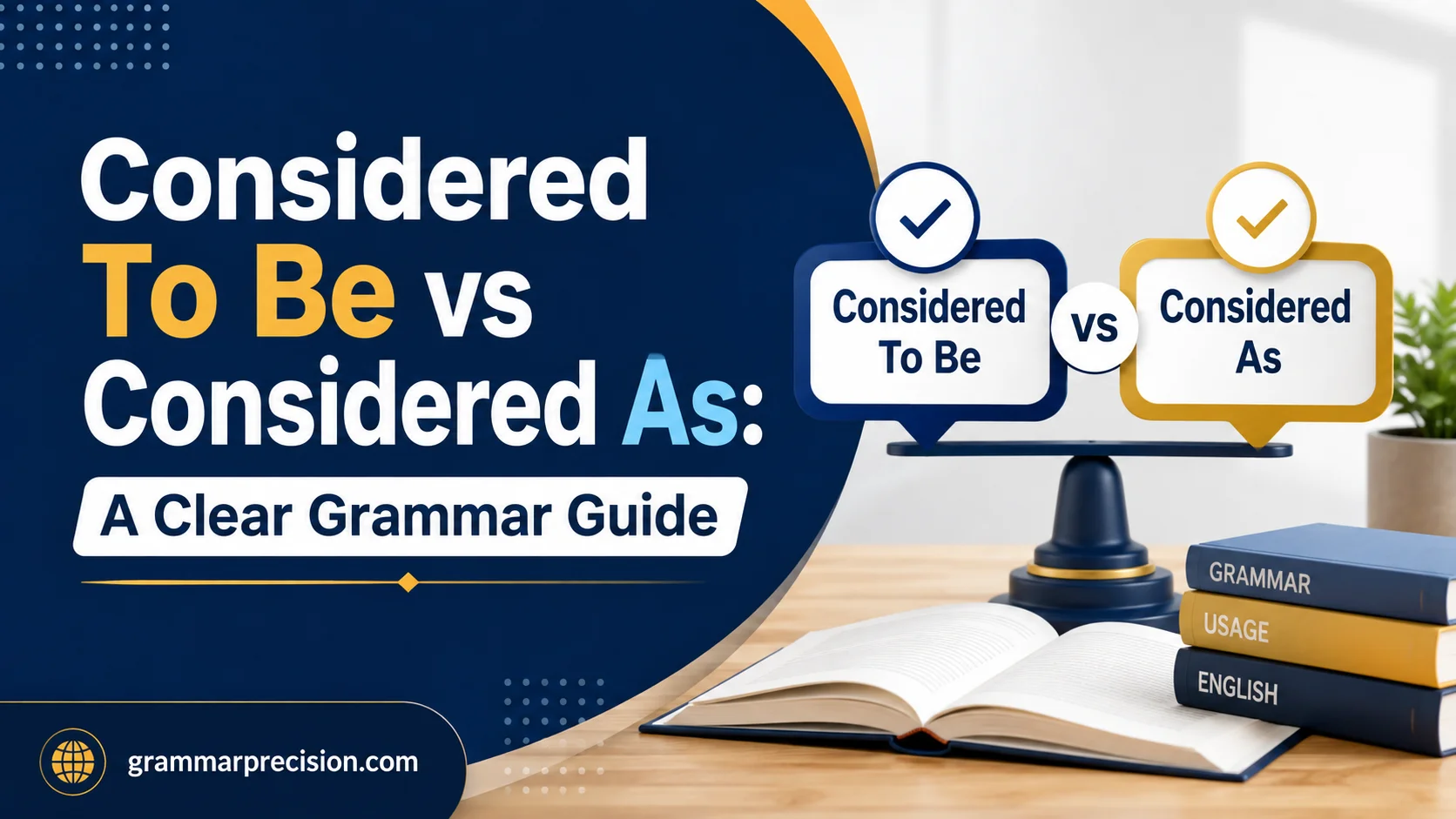
If you’re confused about Considered To Be vs Considered As, you’re not alone. These phrases look similar, but their grammar and usage can differ significantly in English.
Understanding Considered To Be vs Considered As becomes easier once you know how each structure works. Considered to be is widely used to express a belief or judgment, while considered as can sound unnatural in many standard English sentences. Learning these patterns helps you write with greater accuracy, clarity, and confidence.
In this guide, you’ll discover the meaning, grammar rules, sentence patterns, and practical examples behind both expressions. You’ll also learn how considered, considered to be, and regarded as differ, so you can choose the right phrase naturally in academic, professional, and everyday English.
Considered To Be vs Considered As: The Answer in 30 Seconds
Here’s the practical answer:
- Considered to be is a standard and very common construction.
- Considered can often replace considered to be without changing the basic meaning.
- Considered as is not the preferred choice when as simply introduces a description or identity.
- Regarded as is the natural alternative when you specifically want the pattern verb + as.
- Considered as does appear in English, including in dictionary examples, but its acceptability depends on the structure and meaning.
Compare these sentences:
She is considered to be an excellent teacher.
She is considered an excellent teacher.
Both are natural. Now compare:
She is regarded as an excellent teacher.
That sentence is natural too. The trouble starts when regarded as gets mixed with considered:
She is considered as an excellent teacher.
For careful standard English, especially formal writing, the safer choices are considered to be, considered, or regarded as.
Why “Considered As” Sounds Right Even When It Isn’t
The confusion comes from a very understandable pattern. English has several verbs that describe how someone views or classifies a person or thing. Many of them naturally take as.
For example:
- regard someone as a leader
- view something as a problem
- describe someone as an expert
- see something as an opportunity
- classify something as a risk
Because regard as is so common, writers sometimes transfer as to consider.
That creates a familiar-looking sentence:
He is considered as a leading expert.
The sentence may appear in real English, especially in international or learner writing. However, standard grammar guides generally prefer:
He is considered to be a leading expert.
Or, even more simply:
He is considered a leading expert.
Cambridge’s grammar guidance states that consider + object + to be is a standard pattern and explicitly says that as is not normally used with consider in that construction. Oxford provides a more nuanced picture because its American English dictionary records consider + as in some contexts.
So the best lesson isn’t “English has one rigid rule everywhere.” It’s this: if you mean that people believe someone or something has a certain quality or identity, use considered to be, considered, or regarded as.
What “Considered To Be” Actually Means
Considered to be means that someone or a group of people believes, judges, or views someone or something as having a particular quality, status, identity, or condition.
The basic structure is:
Subject + be + considered + to be + complement
For example:
The restaurant is considered to be one of the best in town.
The phrase tells you about a shared judgment or belief. It doesn’t necessarily prove that the restaurant really is the best. It tells you that people generally hold that view.
That distinction matters.
Consider:
The painting is considered to be a masterpiece.
This means people regard the painting as a masterpiece. It does not automatically mean every critic agrees.
Considered To Be With Nouns
Use considered to be + noun phrase when you identify someone or something as a particular type of person, thing, role, or category.
Examples:
- Maya is considered to be a talented architect.
- The bridge is considered to be an engineering landmark.
- This book is considered to be a modern classic.
- The policy is considered to be a major reform.
Considered To Be With Adjectives
You can also use the construction before an adjective.
Examples:
- The area is considered to be safe.
- The exam is considered to be difficult.
- His explanation was considered to be reasonable.
- The treatment is considered to be effective.
In many of these sentences, you can remove to be:
The area is considered safe.
The exam is considered difficult.
Both forms are grammatical. The shorter version often sounds more direct.
Considered To Have
The pattern can also describe an earlier action, possession, or achievement:
She is considered to have written the most influential study on the subject.
Here, to have written places the writing before the current judgment. Oxford lists consider + object + to have as another established pattern.
What “Considered As” Means
This is where things get interesting.
Considered as can appear in English, but it isn’t the normal replacement for considered to be in standard constructions such as:
He is considered to be a leader.
Changing that to:
He is considered as a leader.
doesn’t produce the preferred standard pattern.
Consider can directly take an object and a complement:
They consider her intelligent.
They consider her a leader.
They consider her to be a leader.
English doesn’t need as to connect the object with its description.
By contrast, regard normally requires as in this meaning:
They regard her as a leader.
Oxford explains that regard somebody/something as something is its main structure, while as cannot simply be dropped from that construction.
Considered vs Considered To Be vs Considered As
These three forms deserve a closer look.
| Structure | Typical use | Example | Recommendation |
| considered to be | Believed or judged to have a quality/status | She is considered to be an expert. | Excellent |
| considered + complement | Same basic meaning in a shorter form | She is considered an expert. | Excellent |
| considered as | Context-dependent and less standard in the “believed to be” sense | She is considered as an expert. | Usually avoid |
| regarded as | Viewed or thought of as | She is regarded as an expert. | Excellent |
| viewed as | Seen or interpreted as | She is viewed as an expert. | Excellent |
For example:
The city is considered to be expensive.
The city is considered expensive.
Both communicate the idea that people judge the city to be expensive.
Oxford similarly notes that to be can often be omitted after consider.
The “Consider” Construction Most Learners Miss
The word consider does more than introduce an opinion. Its grammar changes depending on what you want to say.
Consider + Object
When consider means “think carefully about,” you simply use an object:
We considered the proposal.
She considered the consequences.
They carefully considered his suggestion.
Here, consider means to think about something. You don’t need to be or as.
Consider + Object + Adjective
You can use an adjective as a complement:
We consider the plan reasonable.
They consider the rule unfair.
Most people consider the neighborhood safe.
The adjective describes the object.
Consider + Object + Noun
A noun phrase can also function as the complement:
They consider Maya a reliable leader.
We consider this decision a mistake.
Many historians consider the building an important landmark.
Notice something important: there is no as.
Consider + Object + To Be
You can make the relationship more explicit:
They consider Maya to be a reliable leader.
We consider this decision to be a mistake.
Many historians consider the building to be an important landmark.
Also Read This: Imply vs Infer: Stop Confusing These Two Words
Considered To Be vs Regarded As
This is the comparison that makes the whole topic click.
Consider and regard can express similar ideas, but they use different grammatical patterns. Cambridge explains that consider + object + to be is standard, while regard + object + as is the established pattern.
Compare:
| With consider | With regard |
| They consider him to be honest. | They regard him as honest. |
| She is considered a specialist. | She is regarded as a specialist. |
| The plan is considered effective. | The plan is regarded as effective. |
| He is considered to be responsible. | He is regarded as responsible. |
Both verbs can communicate a judgment. The grammar simply takes a different route.
A useful memory trick is:
Consider → to be
Regard → as
That isn’t a universal rule for every possible meaning of these verbs. It’s a highly practical rule for the specific “think of someone or something in a particular way” construction.
Case Study: Fixing a Common Grammar Mistake
Imagine a student writes:
The new policy is considered as an important step toward reform.
At first glance, nothing looks terribly wrong. The sentence is understandable. Yet the structure mixes the familiar pattern regarded as with considered.
There are three cleaner choices:
The new policy is considered to be an important step toward reform.
The new policy is considered an important step toward reform.
The new policy is regarded as an important step toward reform.
Which one should you choose?
If you want the most explicit consider construction, use the first. If you want concise prose, use the second. If you naturally want as, switch the verb to regarded.
That’s the real trick. Don’t force “as” into a sentence just because the meaning feels like “regarded as.” Change the verb instead.
Considered To Be in Academic and Professional Writing
In academic, technical, and professional writing, precision matters. A small grammatical choice can affect how polished a sentence feels.
Considered to be works especially well when you’re reporting a commonly held judgment:
- The compound is considered to be stable under normal conditions.
- The theory is considered to be highly influential.
- The method is considered to be reliable.
- The region is considered to be economically important.
Still, don’t use the phrase mechanically. If a shorter construction works, use it.
Instead of:
The findings are considered to be significant.
you can write:
The findings are considered significant.
Or:
The findings are regarded as significant.
Good writing isn’t about choosing the longest grammatical structure. It’s about choosing the structure that communicates the idea cleanly.
Common Mistakes With Considered To Be and Considered As
Mistake: Copying “Regarded As”
Wrong for the standard pattern:
She is considered as a specialist.
Better:
She is considered to be a specialist.
Or:
She is regarded as a specialist.
Mistake: Assuming “as” Always Follows “Consider”
English verbs don’t work like interchangeable Lego pieces.
Because you can say regarded as, viewed as, and seen as, it doesn’t follow that you should say considered as in every similar sentence.
Learn the pattern with the verb.
Mistake: Confusing “Consider” With “Think About”
Remember that consider has more than one meaning.
I considered the offer.
Here, considered means thought carefully about.
I considered the offer to be reasonable.
Here, it means judged or believed the offer was reasonable.
Those are related ideas, but their structures differ.
Considered To Be vs Considered As: A Quick Reference
| If you want to say… | Best choice |
| People believe he is honest. | He is considered to be honest. |
| People judge him honest. | He is considered honest. |
| People view him as honest. | He is regarded as honest. |
| People see him in that way. | He is viewed as honest. |
| People think about the issue carefully. | They considered the issue. |
This table captures the core distinction without turning grammar into a maze.
FAQs:
Is “considered to be” grammatically correct?
Yes, considered to be is grammatically correct and widely used in English. It means that someone or something is believed, judged, or viewed as having a particular quality or status. For example, “She is considered to be an expert” is a natural sentence.
Is “considered as” correct English?
Considered as can appear in English, but it isn’t usually the preferred structure when you mean “believed or judged to be.” In most standard sentences, use considered to be or simply considered. For example, “He is considered to be a leader” sounds more natural than “He is considered as a leader.”
What is the difference between “considered to be” and “regarded as”?
Both expressions can describe a belief, opinion, or judgment, but they follow different grammatical patterns. We normally say considered to be and regarded as. For example, “She is considered to be talented” and “She is regarded as talented” are both natural.
Can “considered to be” and “considered” be used interchangeably?
Often, yes. In many sentences, you can remove to be without changing the basic meaning. For example, “The book is considered to be valuable” and “The book is considered valuable” are both correct. The shorter version can sound more direct and concise.
Which should I use in formal writing: “considered to be” or “considered as”?
For formal and academic writing, considered to be is generally the safer choice when expressing a judgment or belief. You can also use considered for a concise style. If you specifically want to use as, choose regarded as, viewed as, or seen as.
Conclusion:
Understanding considered to be vs considered as becomes simple when you focus on the sentence structure. Considered to be is the standard choice for expressing a belief or judgment.
Considered can often provide a shorter alternative without changing the meaning. When you need as, use regarded as or viewed as for natural, polished English.