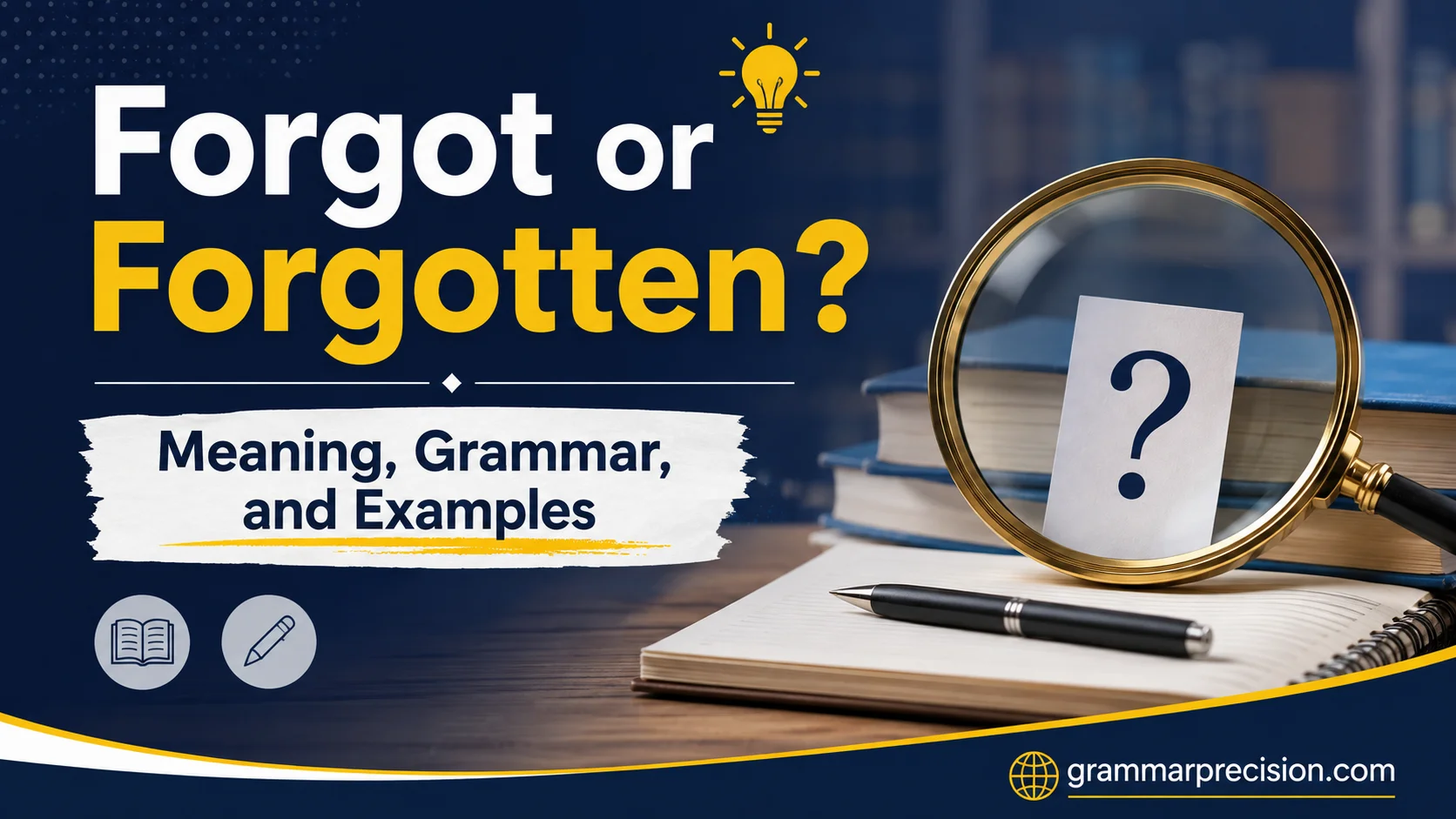
Forgot or Forgotten can be confusing because both forms come from the same irregular verb, yet each follows a different grammar rule. Learning when to use each form makes your English clearer.
The difference becomes much easier once you understand their grammatical roles. Forgot works as the simple past form, while forgotten serves as the past participle. This distinction matters when you build sentences with did, have, has, or had.
Whether you’re writing an email, answering a grammar question, or speaking in everyday English, choosing the right form can make your sentence sound more natural. In this guide, you’ll discover clear rules, useful examples, common mistakes, and simple tricks to remember the difference.
Forgot or Forgotten: Which Is Correct?
Both “forgot” and “forgotten” are correct. The important question is how you use them.
Use forgot when you need the simple past:
I forgot my wallet yesterday.
Use forgotten when a helping verb creates a perfect construction:
I have forgotten my wallet.
Here’s the difference at a glance:
| Word | Grammatical form | Typical use | Example |
| forget | Base form | Present or infinitive | I often forget names. |
| forgot | Simple past | Completed past action | I forgot her name. |
| forgotten | Past participle | Perfect tenses | I have forgotten her name. |
| forgetting | Present participle | Continuous forms | I keep forgetting her name. |
The verb forget is irregular, so it doesn’t follow the usual -ed pattern. You don’t say forgetted. Its main forms are forget, forgot, forgotten, forgetting.
That irregular pattern is worth memorizing because you’ll encounter it constantly in everyday English.
What Does “Forgot” Mean?
Forgot is the simple past form of forget. It describes something that happened or was true at a particular point in the past.
For example:
- I forgot your name.
- She forgot her keys.
- We forgot about the meeting.
- They forgot to lock the door.
- He forgot what time the movie started.
The action belongs to the past. The speaker presents it as a completed event.
Consider this sentence:
I forgot my umbrella this morning.
The word forgot tells you that the forgetting occurred in the past. The sentence doesn’t need have, has, or had.
When Should You Use “Forgot”?
Use forgot when you’re describing a completed past event, especially when you mention a finished time.
Common time expressions include:
- yesterday
- last night
- last week
- this morning
- two days ago
- when I was younger
- during the meeting
- after school
For example:
I forgot my password yesterday.
She forgot to call me last night.
We forgot about the appointment two days ago.
There’s a useful clue here: if the sentence naturally answers “What happened?”, simple past often fits.
What happened yesterday?
I forgot my passport.
That doesn’t mean every sentence containing a past-time idea must use forgot. English tense choice depends on the speaker’s intended time relationship. Still, a clearly finished past event strongly favors the simple past.
What Does “Forgotten” Mean?
Forgotten is the past participle of forget. It normally appears with an auxiliary or helping verb when it forms a perfect tense.
For example:
I have forgotten your name.
She has forgotten the address.
They had forgotten about the deadline.
The structure looks like this:
have/has/had + forgotten
That’s the key.
You shouldn’t normally replace forgotten with forgot in standard present-perfect or past-perfect constructions.
Forgotten in the Present Perfect
The present perfect connects a past event with the present in some way.
I have forgotten his name.
The forgetting happened earlier, but the result matters now: you don’t remember his name.
Compare that with:
I forgot his name yesterday.
The second sentence simply reports a past event.
This distinction becomes much clearer when you imagine a timeline:
Past event → present relevance
I have forgotten my password.
↓
I can’t remember it now.
The past action has a present consequence.
Forgotten in the Past Perfect
The past perfect uses had + past participle.
She had forgotten her keys before she left.
Here, two past events exist. Forgetting the keys happened first. Leaving happened later.
Think of the sequence like this:
Forgot keys → left home → realized the problem
Because forgetting occurred before another past event, had forgotten makes the sequence explicit.
Forgot vs. Forgotten at a Glance
The simplest comparison looks like this:
| Situation | Correct form | Example |
| Simple past | forgot | I forgot my notebook. |
| Present perfect | have/has forgotten | I have forgotten my notebook. |
| Past perfect | had forgotten | I had forgotten my notebook. |
| Future perfect | will have forgotten | I will have forgotten it by then. |
| Modal perfect | might have forgotten | She might have forgotten. |
| Infinitive | forget | Don’t forget to call. |
The pattern is remarkably consistent. When an auxiliary such as have, has, had, might have, must have, or will have requires a past participle, forgotten is the standard form.
Is “I Have Forgot” or “I Have Forgotten” Correct?
In standard American English, the correct form is:
I have forgotten.
Not:
I have forgot.
Why? Because have + past participle creates the present perfect, and forgotten is the standard past participle of forget. Major American dictionary sources identify forgotten as the past participle while also noting that American English may encounter forgot in some usage contexts.
The same rule applies to other perfect constructions:
- I have forgotten.
- She has forgotten.
- We have forgotten.
- He had forgotten.
- They had forgotten.
- You might have forgotten.
- She must have forgotten.
A useful test is to look at the word immediately before the verb.
If you see have, has, had, or a modal + have, think past participle.
They have forgotten the rules.
He must have forgotten the appointment.
We had forgotten where we parked.
Is It “I Forgot” or “I Have Forgotten”?
Both can be correct, but they frame the situation differently.
I Forgot
Use I forgot for a simple past event.
I forgot your birthday last year.
The sentence focuses on what happened.
I Have Forgotten
Use I have forgotten when the past action has a connection to the present.
I have forgotten your birthday date.
The focus now is the speaker’s current lack of memory.
Here’s another useful pair:
I forgot my keys this morning.
I have forgotten my keys.
The first sentence places the event in a finished past time. The second emphasizes the current situation. Perhaps you’re standing outside your house right now, staring at the locked door. Suddenly, grammar becomes painfully practical.
Forgot vs. Forgotten in Different Tenses
Understanding the tense system makes this comparison much easier.
Simple Past: Forgot
Subject + forgot + object
She forgot the appointment.
We forgot the tickets.
Present Perfect: Have/Has Forgotten
Subject + have/has + forgotten + object
She has forgotten the appointment.
We have forgotten the tickets.
Past Perfect: Had Forgotten
Subject + had + forgotten + object
She had forgotten the appointment before the reminder arrived.
Future Perfect: Will Have Forgotten
Subject + will have + forgotten + object
By next year, I will have forgotten most of these details.
Modal Perfect: Modal + Have + Forgotten
He may have forgotten.
She might have forgotten the address.
They must have forgotten the deadline.
Notice the recurring architecture. The helper does the tense work, while forgotten remains the past participle.
Forgot or Forgotten in Questions
Questions follow the same grammatical logic.
For simple past questions, use did + forget, not did + forgot:
Did you forget your keys?
Did she forget the appointment?
Did they forget the address?
This is another common trap. Once did carries the past tense, the main verb returns to its base form.
Incorrect:
Did you forgot your wallet?
Correct:
Did you forget your wallet?
For present-perfect questions, use have/has + forgotten:
Have you forgotten your password?
Has she forgotten my name?
For past perfect:
Had they forgotten the deadline?
The pattern is easy to remember:
Did + forget
Have/Has + forgotten
Had + forgotten
Forgot or Forgotten in Negative Sentences
Negative sentences reveal the same distinction.
For simple past, use didn’t + forget:
I didn’t forget your birthday.
She didn’t forget the tickets.
Not:
I didn’t forgot your birthday.
For present perfect, use haven’t/hasn’t + forgotten:
I haven’t forgotten you.
She hasn’t forgotten the meeting.
For past perfect:
They hadn’t forgotten the instructions.
Again, the auxiliary determines the structure.
Also Read This: Shoo-In or Shoe-In? Correct Spelling, and Examples
Forgot to Do vs. Forgot Doing
Here’s a deeper distinction that many quick grammar guides miss.
Forget to do something means you failed to remember an action that you were supposed to perform.
I forgot to send the email.
The email wasn’t sent because you didn’t remember to send it.
Forget doing something means you don’t remember the experience or action itself.
I forgot sending the email.
This suggests that the email was sent, but you don’t remember doing it.
The difference can be subtle but important.
| Structure | Meaning | Example |
| forget to + verb | Fail to remember an intended action | I forgot to lock the door. |
| forget + -ing | Fail to remember a past experience/action | I forgot meeting him. |
Cambridge Dictionary recognizes both patterns and gives examples involving forget to + infinitive and forget + -ing.
So don’t treat these structures as interchangeable. They can describe completely different situations.
Forgot About vs. Forgot
Forgot can stand alone with an object:
I forgot the meeting.
But forgot about often emphasizes that something slipped from your attention.
I forgot about the meeting.
The second sentence can suggest that the meeting had been on your mind previously but disappeared from your immediate awareness.
You can also use forget about when you mean to stop thinking about something:
Let’s forget about the argument.
She tried to forget about the mistake.
Dictionary definitions of forget include meanings related to failing to remember, failing to do something, and stopping thinking about someone or something.
Common Mistakes With Forgot and Forgotten
These errors appear frequently because English irregular verbs don’t always behave intuitively.
“I Have Forgot”
Incorrect in standard usage:
I have forgot the answer.
Correct:
I have forgotten the answer.
“I Had Forgot”
Incorrect in standard usage:
She had forgot her passport.
Correct:
She had forgotten her passport.
“Did You Forgot?”
Incorrect:
Did you forgot the meeting?
Correct:
Did you forget the meeting?
After did, use the base form.
“I Didn’t Forgot”
Incorrect:
I didn’t forgot.
Correct:
I didn’t forget.
This rule applies broadly to regular and irregular verbs alike. Once did carries the past tense, the main verb doesn’t need another past-tense form.
American English: Is “Forgot” Ever Used as a Past Participle?
You may occasionally hear or see forgot where standard edited American English would normally use forgotten, especially in informal speech or particular dialects.
However, for clear, polished writing, forgotten is the safer and standard choice after have, has, and had. Major dictionary references distinguish forgot as the past form and forgotten as the past participle.
That distinction matters most in formal writing, academic work, professional communication, and grammar tests.
In other words, don’t let a casual spoken form convince you that the standard written rule has disappeared.
Real-Life Examples of Forgot and Forgotten
Context often makes the correct choice obvious.
At School
I forgot my homework yesterday.
I have forgotten where I saved my assignment.
She had forgotten about the test until her friend mentioned it.
At Work
I forgot to attach the file.
We have forgotten the exact deadline.
He had forgotten to include the final paragraph.
In Daily Conversation
Sorry, I forgot your name.
I’ve forgotten where I parked.
Did you forget your keys?
Have you forgotten what I told you?
In Formal Writing
The committee had forgotten to include the final recommendation.
Several important details have been forgotten over time.
The last example also shows another role for forgotten: it can appear in passive constructions.
Forgotten as an Adjective
Forgotten doesn’t always function as a verb form. It can also act as an adjective meaning something that is no longer remembered, noticed, or valued.
For example:
The town became a forgotten corner of the region.
He discovered a forgotten manuscript.
The building stood as a forgotten relic of another era.
Here, forgotten describes a noun. It doesn’t simply express a person’s act of forgetting.
This adjectival use gives the word a broader meaning. Something can be forgotten because people no longer remember it, recognize its importance, or pay attention to it.
A Simple Timeline Test
When you’re unsure whether to use forgot or forgotten, picture the action on a timeline.
Finished past event:
Yesterday → I forgot my keys.
Past action with a present connection:
Earlier → I have forgotten my keys → Now I’m locked out.
Earlier past action before another past event:
Forgot keys → left home → I had forgotten my keys.
This mental picture can be more useful than memorizing a dozen isolated rules.
A Quick Cheat Sheet
Keep this miniature guide handy:
- I forgot → simple past
- I didn’t forget → negative simple past
- Did you forget? → past question
- I have forgotten → present perfect
- She has forgotten → present perfect
- I had forgotten → past perfect
- They might have forgotten → modal perfect
- Don’t forget → base form
- I keep forgetting → present participle
If did appears, use forget.
If have, has, had, or a modal + have appears, use forgotten in standard American English.
Practice: Choose “Forgot” or “Forgotten”
Try these before checking the answers.
- I ___ my wallet yesterday.
- She has ___ the appointment.
- Did you ___ to call him?
- They had ___ the address.
- I haven’t ___ your kindness.
- He ___ his password last night.
- We might have ___ the instructions.
- Don’t ___ your umbrella.
- Has she ___ about the meeting?
- I didn’t ___ the deadline.
Answers
- forgot
- forgotten
- forget
- forgotten
- forgotten
- forgot
- forgotten
- forget
- forgotten
- forget
The pattern becomes obvious once you stop treating these words as competing choices. They’re different forms of the same irregular verb.
FAQs:
Is “forgotten” the past tense of “forget”?
No. Forgot is the simple past form of forget, while forgotten is the past participle. You use forgot for completed past actions, such as “I forgot my keys.” You typically use forgotten with helping verbs such as have, has, or had.
Is “I have forgot” grammatically correct?
In standard American English, “I have forgotten” is the correct form. The verb have requires the past participle in this construction. For example, “I have forgotten his name” correctly uses forgotten rather than forgot.
Should I say “I forgot” or “I have forgotten”?
Both forms can be correct, depending on the context. Use “I forgot” for a completed past event, especially with a finished time. Use “I have forgotten” when the past action has a connection to the present, such as when you still can’t remember something.
Is “Did you forgot?” or “Did you forget?” correct?
“Did you forget?” is correct. When you use did to form a past-tense question, the main verb returns to its base form. Therefore, you say “Did you forget your wallet?” rather than “Did you forgot your wallet?”
Is “I had forgot” or “I had forgotten” correct?
“I had forgotten” is the standard form. The auxiliary had requires the past participle, so forgotten fits the structure. For example, “I had forgotten the appointment before my friend reminded me” correctly shows that one past action happened before another.
Conclusion:
Understanding forgot vs. forgotten becomes much easier when you focus on their grammatical roles. Forgot is the simple past form, while forgotten is the past participle. Remember to use forget after did and forgotten after have, has, or had. With these simple patterns and regular practice, you can use both forms confidently in everyday English.