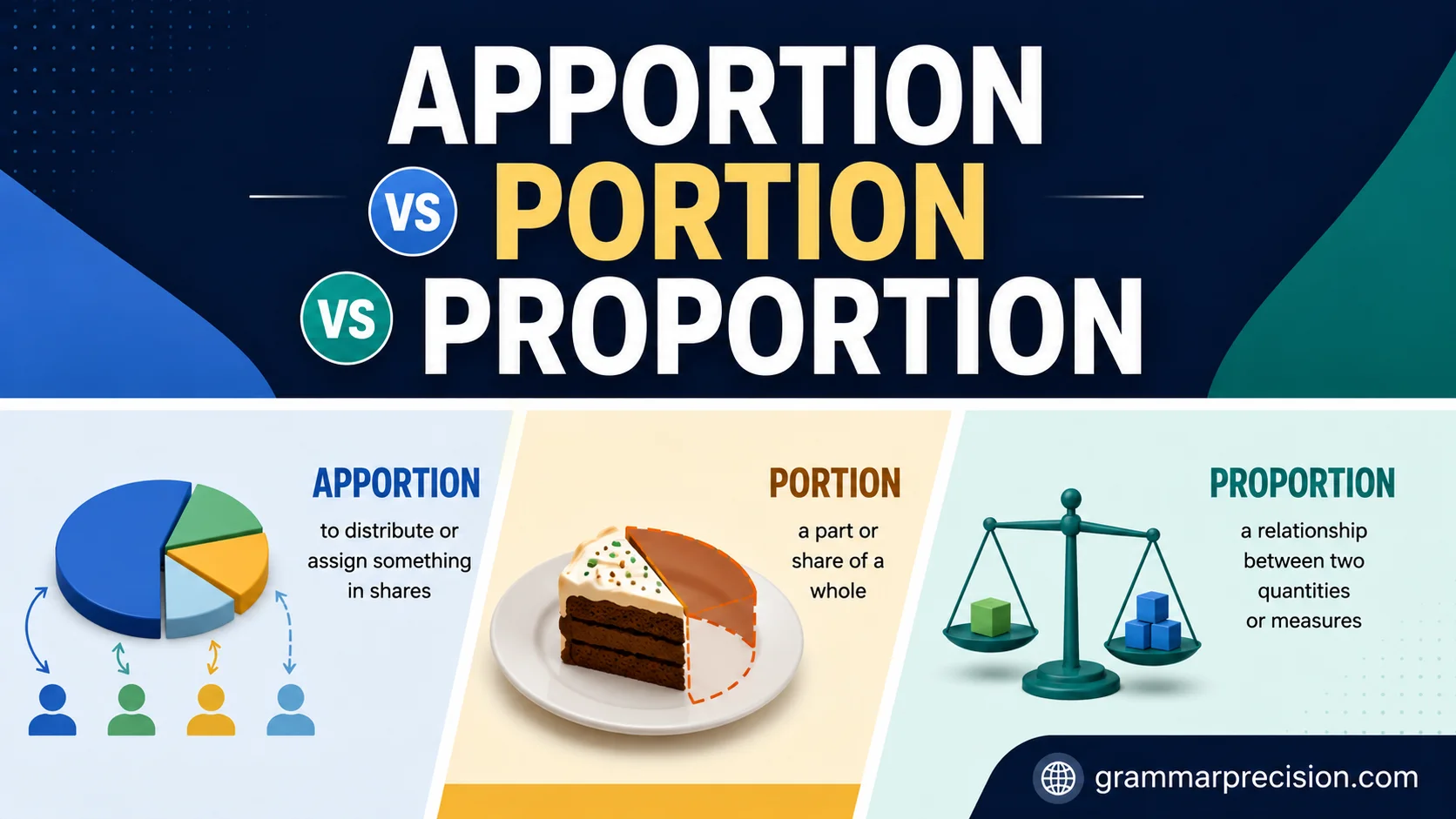
Understanding Apportion vs Portion vs Proportion helps you avoid common English mistakes and choose the right word easily. These similar terms have different meanings related to dividing parts and relationships.
Many writers confuse these three words because they look alike but work differently in sentences. Apportion focuses on distribution while portion describes a part of something larger. Proportion explains the connection between parts and the whole. Learning these differences makes your writing more clear and accurate with better word choices in daily and professional communication.
This guide explores Apportion vs Portion vs Proportion with simple examples, comparisons, and practical tips. You will discover how each word works and when to use it correctly. With helpful explanations, tables, and real-life examples, you can quickly understand these confusing terms and improve your English skills. The right word can make your message more powerful and meaningful today.
Apportion vs Portion vs Proportion: Quick Difference Explained
The easiest way to understand these words is to look at their main purpose.
| Word | Meaning | Main Idea | Example |
| Apportion | To divide or distribute something among people or groups | Allocation | The manager apportioned tasks among team members. |
| Portion | A part or share of something larger | A piece | I ate a small portion of the meal. |
| Proportion | The relationship between different parts of something | Ratio or balance | A large proportion of students passed the exam. |
A simple memory trick:
- Apportion = Assign a share
- Portion = A piece
- Proportion = A relationship between parts
Think of a pizza:
- Cutting the pizza and giving slices to friends = apportion
- One slice of pizza = portion
- Comparing how much pizza each person receives = proportion
What Does Apportion Mean? Definition, Usage, and Examples
The word apportion means to divide something and give specific amounts to different people, groups, or purposes.
It usually involves planning, fairness, or distribution.
When you apportion something, you don’t just randomly split it. You decide how much each person or group should receive.
Apportion Meaning in Simple Words
Apportion means to allocate or distribute a resource, responsibility, amount, or share.
For example:
- A company apportions its budget among different departments.
- A government apportions funds to various projects.
- A teacher apportions classroom duties among students.
The word often appears in formal writing, business documents, legal discussions, and official reports.
When Should You Use Apportion?
You should use apportion when something is being divided among multiple parties.
Common situations include:
Dividing Money
Example:
The organization apportioned $500,000 among several community programs.
The money wasn’t just split randomly. Someone decided how much each program should receive.
Sharing Responsibilities
Example:
The project leader apportioned tasks based on each employee’s skills.
The leader assigned different responsibilities to different people.
Distributing Resources
Example:
The company apportioned resources to improve customer service.
Resources could include money, time, workers, or equipment.
Apportion Examples in Everyday Sentences
Here are some natural examples:
- The coach apportioned playing time among all team members.
- The family apportioned the inheritance between three children.
- The manager apportioned the workload fairly.
- The government apportioned funding for education programs.
A helpful clue:
If you can replace the word with “distribute” or “allocate,” then apportion is probably the right choice.
What Does Portion Mean? Definition and Examples
The word portion refers to a part, piece, or share of something bigger.
Unlike apportion, portion does not focus on the act of dividing. It focuses on the part that someone receives or uses.
For example:
She ate a portion of the cake.
The sentence talks about the piece of cake, not the process of dividing it.
Portion as a Noun
Most commonly, portion works as a noun.
It describes a specific amount or section of something.
Examples:
- A portion of the population supports the idea.
- He saved a portion of his salary.
- This restaurant serves large portions.
In these examples, portion means a part of a larger thing.
Portion as a Verb
Although less common, portion can also work as a verb.
It means to divide something into parts.
Examples:
- The chef portioned the ingredients before cooking.
- The company portioned the supplies for each department.
However, apportion sounds more formal when you talk about planned distribution.
Compare:
The chef portioned the food into containers.
This means the chef divided food into serving sizes.
The manager apportioned the budget among departments.
This means the manager decided how much money each department should get.
Portion vs Part: Are They the Same?
Many people use portion and part as if they mean exactly the same thing. Sometimes they do, but there is a small difference.
Part is a general word.
Example:
A part of the machine is broken.
Portion often suggests a measured or specific amount.
Example:
A portion of the machine’s profits goes to charity.
The second sentence suggests a defined share.
What Does Proportion Mean? Understanding the Difference
The word proportion describes the relationship between different parts of something compared with each other or the whole.
It often connects with ideas like:
- Ratio
- Percentage
- Balance
- Size comparison
Example:
A large proportion of customers prefer online shopping.
This means a large percentage or share of customers have that preference.
Proportion in Mathematics
In mathematics, proportion explains that two ratios are equal.
Example:
2/4 = 3/6
Both fractions represent the same relationship.
This is why proportion is strongly connected with comparison.
Also Read This: What Happen or What Happened? The Complete Grammar Guide With Examples
Proportion in Everyday Language
You don’t need to use proportion only in math.
People use it in normal conversations too.
Examples:
- A small proportion of employees work remotely.
- The building has unusual proportions.
- The proportion of young voters increased.
In these examples, proportion explains the relationship between groups or sizes.
Apportion vs Portion vs Proportion: Detailed Comparison
| Feature | Apportion | Portion | Proportion |
| Word Type | Verb | Noun/Verb | Noun |
| Main Meaning | Divide and assign | A part or share | Relationship between parts |
| Focus | Action | Piece | Comparison |
| Common Use | Business, law, planning | Food, objects, amounts | Statistics, measurements |
| Example | They apportioned the money. | I received my portion. | A high proportion agreed. |
Common Mistakes Between Apportion, Portion, and Proportion
Many writers confuse these words because they sound related.
Here are common mistakes:
Mistake: Using Portion When You Mean Distribution
Incorrect:
The company portioned the budget among departments.
Better:
The company apportioned the budget among departments.
Why?
Because the sentence focuses on distributing money.
Mistake: Using Proportion for a Physical Piece
Incorrect:
I ate a proportion of the cake.
Better:
I ate a portion of the cake.
Why?
A cake slice is a piece, so portion works better.
Mistake: Using Apportion for Comparison
Incorrect:
A large apportion of students passed.
Better:
A large proportion of students passed.
Why?
You are talking about a percentage or group relationship.
Real-Life Examples: Choosing the Right Word
Imagine a company has a yearly budget.
The company decides:
“We will give 40% to marketing, 30% to research, and 30% to operations.”
The company apportions the budget.
Each department receives a portion of the budget.
The relationship between these amounts is the proportion of the budget.
This simple example shows how all three words connect.
Apportion vs Portion vs Proportion in Academic Writing
Students and professionals often use these words in reports and essays.
Here are examples:
Research Writing
Researchers analyzed the proportion of participants who supported the new method.
Business Writing
The company apportioned additional funds to improve technology.
General Writing
Each employee received a portion of the annual bonus.
Using the correct word makes your writing sound more accurate and professional.
Easy Memory Tricks to Remember the Difference
Use these shortcuts:
Apportion = Allocation
Both words begin with an “A” idea:
Apportion → Allocate
Portion = Piece
Think:
Portion = Part
Both start with “P.”
Proportion = Percentage
Think:
Proportion = Percentage relationship
These simple connections make remembering much easier.
FAQs:
What is the main difference between apportion, portion, and proportion?
Apportion means to divide or distribute something among different people, groups, or purposes. Portion means a part or share of something bigger, while proportion explains the relationship between parts or a comparison between amounts. Each word has a different purpose depending on the context.
How can I easily remember the difference between apportion and portion?
You can remember it with a simple trick: apportion = allocate, which means to assign or distribute something. Portion = part, which means a piece or share of something. If you are talking about the action of dividing, use apportion. If you are talking about the result, use portion.
Can portion and proportion be used interchangeably?
No, portion and proportion are not interchangeable because they describe different ideas. A portion refers to a specific piece or amount of something, while a proportion refers to the balance, ratio, or relationship between different parts. For example, a slice of cake is a portion, but the amount of cake compared to the whole cake is a proportion.
Is apportion commonly used in everyday English?
Apportion is used in English, but it appears more often in formal situations like business, government, law, and planning. People usually use words like divide or share in casual conversations. For example, a company may apportion funds between departments.
What is the best way to use proportion in a sentence?
Use proportion when you want to describe a comparison, percentage, or relationship between things. For example, “A large proportion of customers prefer online shopping” means a large percentage or share of customers have that preference.
Conclusion:
Understanding Apportion vs Portion vs Proportion becomes simple when you focus on their main meanings. Apportion is about dividing and assigning, portion is about a piece or share, and proportion is about relationships and comparisons. By learning these small differences, you can improve your English accuracy, write clearer sentences, and communicate your ideas more effectively.