Have you ever come across PPM Meaning on a water report, product label, or laboratory result? At first glance, “parts per million” may sound highly technical. In reality, it describes a simple ratio used to express tiny concentrations with clarity.
This guide explains what PPM means, how the measurement works, and why it appears across science, manufacturing, environmental testing, and everyday products. You’ll also see practical examples and easy conversions that make this concept easier to understand and remember.
Clear terminology matters in every field, from business communication and project management to laboratory reporting. While terms such as scheduling, time management, online booking, broadcasting, meetings, and calendar belong to different contexts, precise English usage still shapes how information reaches readers. Likewise, grammar, formal writing, and consistency improve technical explanations.
This article focuses on PPM definitions, calculations, comparisons, and real-world applications while briefly recognizing US and UK style preferences where relevant. Whether you’re reading a technical report or simply searching for PPM meaning, the goal is straightforward: make a complex-looking term feel simple.
What Does PPM Mean?
PPM means parts per million. It expresses the proportion or concentration of something within a larger amount. In its simplest form, 1 PPM means 1 part of a substance per 1,000,000 parts of the mixture.
For example, imagine a huge collection containing one million individual pieces. If exactly one piece represents a contaminant, the concentration is 1 PPM. The same mathematical ratio can describe chemicals in water, gases in air, trace metals in soil, or impurities in manufactured materials.
PPM doesn’t identify the substance by itself. It only describes its proportion. Therefore, a reading of 10 PPM has no complete meaning until you know what was measured, where it was measured, and how the concentration was defined.
What Does One Part Per Million Mean?
The easiest way to picture 1 PPM is as one item hidden among one million items. That’s a tiny fraction.
Mathematically:
1 PPM = 1/1,000,000 = 0.000001
As a percentage:
1 PPM = 0.0001%
That relationship makes PPM especially handy for trace concentrations. Writing 0.0001% is possible, but saying 1 PPM is much easier to read and compare.
Consider these examples:
- 1 PPM = 1 part in 1,000,000
- 10 PPM = 10 parts in 1,000,000
- 100 PPM = 100 parts in 1,000,000
- 1,000 PPM = 1,000 parts in 1,000,000
- 10,000 PPM = 1% of the total
A useful shortcut is to remember that 10,000 PPM equals 1%.
Why Do Scientists and Professionals Use PPM?
Scientists often work with quantities that are too small to describe comfortably as percentages. PPM provides a compact scale for these measurements.
Suppose a material contains 0.005% of a trace substance. The number looks small and includes several zeros. Expressing the same concentration as 50 PPM makes the value easier to communicate.
PPM also supports quick comparisons. A laboratory technician can immediately see that 200 PPM represents twice the concentration of 100 PPM when the same measurement basis applies.
However, PPM isn’t automatically a measure of danger, quality, or safety. A concentration’s significance depends on the substance, exposure route, measurement conditions, and applicable standard.
How PPM Works as a Concentration
PPM is fundamentally a ratio. The general concentration formula is:
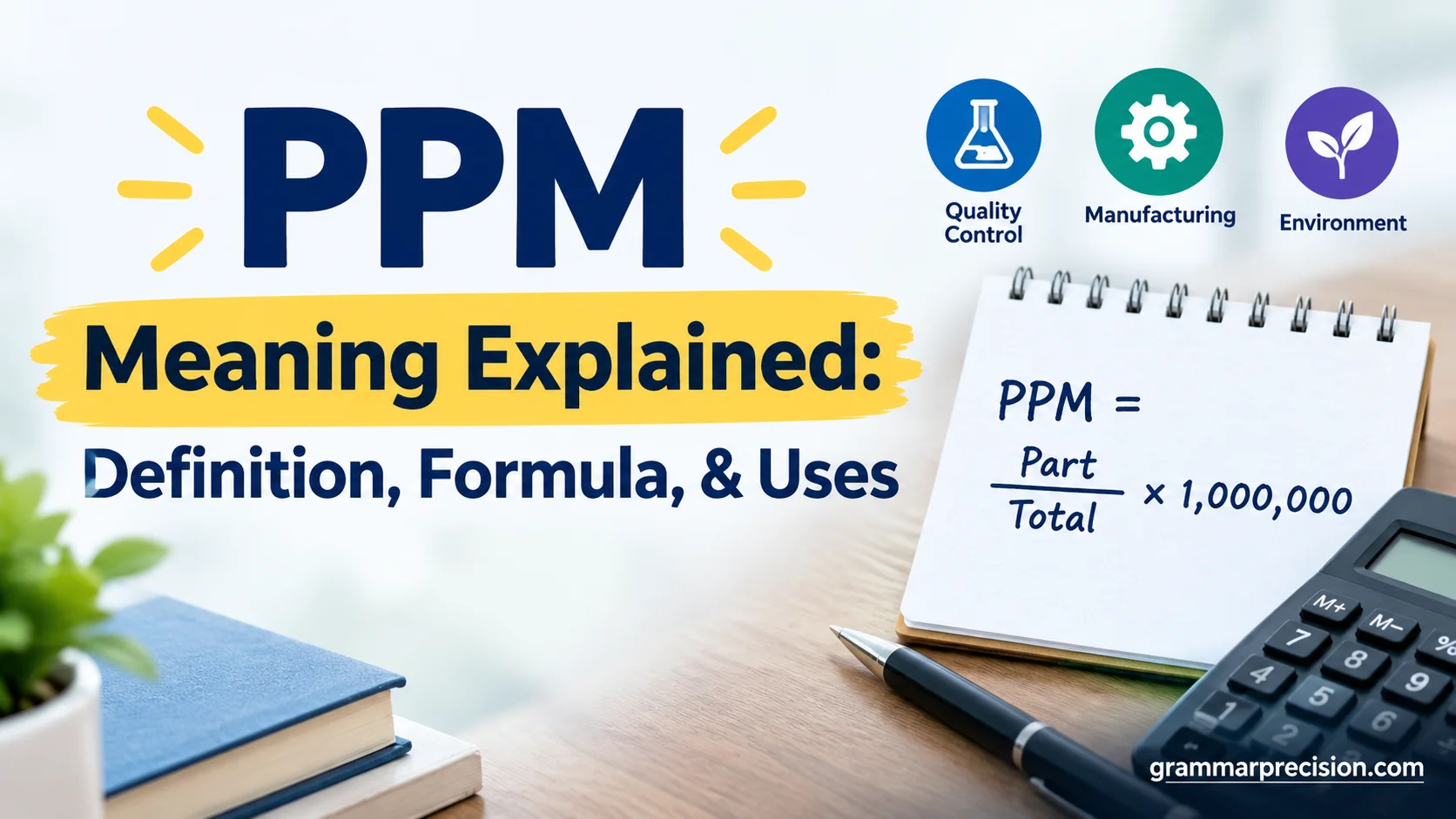
PPM = (amount of substance ÷ total amount of mixture) × 1,000,000
The numerator represents the substance being measured. The denominator represents the relevant total mixture.
For example, suppose a sample contains 3 grams of a substance within 1,000,000 grams of total material:
PPM = (3 ÷ 1,000,000) × 1,000,000 = 3 PPM
The units must be compatible. If you’re comparing mass to mass, both quantities need the same mass unit. The same principle applies when a particular application defines a volume-based ratio.
Is PPM a Unit?
PPM behaves differently from ordinary physical units such as grams or liters. It is fundamentally a dimensionless ratio. It describes how much of one thing exists relative to another.
In practice, though, people attach PPM to specific measurement contexts. For example, water testing may report a concentration in PPM based on mass per volume. Gas measurements may use a volume-based interpretation.
That’s why saying “10 PPM” without context can be incomplete.
How to Calculate PPM
The standard PPM calculation is straightforward:
PPM = (part ÷ whole) × 1,000,000
Imagine a 500-kilogram batch contains 0.25 kilograms of a trace ingredient.
PPM = (0.25 ÷ 500) × 1,000,000
PPM = 500 PPM
The calculation works because both quantities use the same mass unit.
For another example, suppose a laboratory finds 0.0008 grams of a substance in 800 grams of a sample.
PPM = (0.0008 ÷ 800) × 1,000,000
PPM = 1 PPM
How to Convert PPM to Percentage
To convert PPM into a percentage, divide the PPM value by 10,000.
Percentage = PPM ÷ 10,000
Examples:
- 1 PPM = 0.0001%
- 25 PPM = 0.0025%
- 100 PPM = 0.01%
- 500 PPM = 0.05%
- 1,000 PPM = 0.1%
- 10,000 PPM = 1%
To convert a percentage into PPM, reverse the operation:
PPM = percentage × 10,000
So, 0.25% equals 2,500 PPM.
PPM Conversion Chart
| Concentration | Percentage | PPM |
| 0.0001% | 0.0001% | 1 PPM |
| 0.001% | 0.001% | 10 PPM |
| 0.01% | 0.01% | 100 PPM |
| 0.1% | 0.1% | 1,000 PPM |
| 1% | 1% | 10,000 PPM |
| 2% | 2% | 20,000 PPM |
This table reveals the scale clearly. Even 1% represents 10,000 PPM, which shows why PPM is useful for smaller concentrations.
What Does PPM Mean in Water?
Water testing is one of the most familiar places you’ll encounter PPM. Reports may use PPM to describe dissolved substances, including certain minerals, disinfectants, or contaminants.
For dilute water solutions, 1 PPM is often approximately equivalent to 1 milligram per liter (mg/L). This practical relationship works because a liter of water has a mass close to 1 kilogram under ordinary conditions.
The word “approximately” matters. PPM is a ratio, while mg/L is a mass-per-volume concentration. Their numerical values align closely for dilute aqueous solutions under common conditions, but they aren’t universally interchangeable.
PPM in Drinking Water
A water report might list several substances in PPM. Each number needs to be interpreted according to the substance and the relevant water-quality standard.
For example, a report could show:
| Parameter | Example reading |
| Substance A | 2 PPM |
| Substance B | 0.5 PPM |
| Substance C | 20 PPM |
These numbers cannot be judged simply by size. A higher PPM doesn’t automatically mean greater health risk. Different substances have different properties and different recommended or regulated limits.
PPM in Pool Water
Pool maintenance also uses PPM frequently. Chlorine, for example, may be discussed in PPM when operators monitor sanitizer levels.
The useful lesson is simple: PPM tells you concentration, not the entire story. The correct target depends on the pool type, water chemistry, testing method, and applicable guidance.
What Does PPM Mean in Air?
Air-quality and environmental measurements can use PPM to describe the concentration of gases. Instead of thinking about a solid or liquid mixture, picture a mixture of gases occupying the same space.
For example, a gas concentration reported as 400 PPM means approximately 400 parts of that gas per one million parts of the measured gas mixture, depending on the measurement convention.
PPM can be useful for monitoring industrial emissions, indoor air contaminants, and atmospheric gases. Some gases occur naturally at relatively high concentrations, while others appear only in trace amounts.
Why Air PPM Needs Context
A PPM value for a gas doesn’t automatically tell you whether conditions are safe. Interpretation can depend on exposure duration, temperature, pressure, ventilation, the particular gas, and the applicable occupational or environmental limit.
A short-term reading and a long-term exposure measurement may answer very different questions.
PPM in Chemistry and Laboratories
Chemists use PPM when a substance occurs in a relatively small concentration. It can describe trace impurities, dissolved chemicals, metals, or other components in a sample.
Laboratory instruments may detect extremely small concentrations. In such settings, PPM can provide a convenient reporting scale when the measured amount is larger than typical PPB ranges but still tiny compared with the whole sample.
Accuracy matters enormously. A reported value such as 2.1 PPM may look precise, but its meaningful precision depends on the instrument, calibration, sampling procedure, detection limits, and uncertainty.
Also Read This: Glib Meaning: What It Means
PPM in Food, Agriculture, and Soil
PPM also appears in agriculture and food-related testing. Soil laboratories may report nutrient concentrations or trace elements using PPM. Food testing can use similar terminology for certain residues or components.
Farmers and agronomists may use PPM alongside other measures when assessing soil chemistry. The number becomes useful when compared with the appropriate crop, soil type, testing method, and agronomic recommendation.
Food measurements require similar care. A PPM value for one compound cannot be interpreted using the limits established for another compound.
PPM in Manufacturing and Quality Control
Manufacturers use PPM for contamination, material composition, defects, and process control. Here, the term can describe either concentration or a rate depending on the context.
For instance, a production team might discuss defective units in terms of parts per million. In that situation, PPM refers to a defect rate, not a chemical concentration.
If a process produces 50 defective units per million opportunities, the defect rate is 50 PPM. This usage demonstrates an important point: the phrase “parts per million” can describe a ratio even when no chemical mixture exists.
Case Study: A Production Line
Imagine a factory produces 2,000,000 components and discovers 100 defective pieces.
Defect PPM = (100 ÷ 2,000,000) × 1,000,000
The result is 50 PPM.
Now compare that with a chemical sample containing 50 PPM of an impurity. Both values use the same mathematical scale, but they describe completely different things.
PPM vs. Percentage: What’s the Difference?
PPM and percentage both express proportions. Their scales differ.
One percent equals 10,000 PPM. Therefore, 1 PPM equals 0.0001%.
This makes PPM especially convenient for trace quantities.
| Feature | PPM | Percentage |
| Full meaning | Parts per million | Parts per hundred |
| Base | 1,000,000 | 100 |
| 1 PPM | 0.0001% | — |
| 1% | 10,000 PPM | 1% |
| Typical use | Trace quantities | Broader proportions |
Neither format is inherently better. The appropriate choice depends on the size and context of the ratio.
PPM vs. PPB: What’s the Difference?
PPB means parts per billion. It represents an even smaller concentration scale.
One PPM equals 1,000 PPB.
That means:
- 1 PPM = 1,000 PPB
- 0.1 PPM = 100 PPB
- 0.01 PPM = 10 PPB
- 0.001 PPM = 1 PPB
When concentrations become extremely small, PPB can prevent a report from becoming crowded with decimal places.
For example, 0.003 PPM can be expressed as 3 PPB. The second form may be easier to read in a trace-analysis report.
Does 1 PPM Always Mean the Same Thing?
Mathematically, 1 PPM always represents one part per million parts. Practically, however, the measurement basis can change.
You should ask:
- What substance was measured?
- What material contains it?
- Is the ratio based on mass, volume, or another basis?
- What testing method produced the result?
- What standard or reference value applies?
For water, people commonly compare PPM numerically with mg/L for dilute solutions. That shortcut shouldn’t automatically transfer to every liquid, gas, solid, or industrial mixture.
Common PPM Mistakes and Misunderstandings
PPM seems simple, yet several mistakes appear frequently.
Mistake 1: Treating PPM and Percent as Identical
They aren’t. 1% equals 10,000 PPM, not 100 PPM.
Mistake 2: Assuming PPM Always Means mg/L
PPM is a ratio. mg/L is a concentration expressed as mass per volume. They can have approximately equal numerical values in dilute water solutions, but the concepts aren’t identical.
Mistake 3: Judging a Value Without Identifying the Substance
A reading of 10 PPM could describe very different substances. The number alone doesn’t establish whether a measurement is acceptable, harmful, useful, or insignificant.
Mistake 4: Ignoring Measurement Uncertainty
Laboratory measurements aren’t magically exact. Sampling errors, calibration, instrument limits, and analytical methods can affect the reported value.
Mistake 5: Confusing Concentration With Defect Rate
A manufacturing report may use PPM to describe defective products. That doesn’t mean the factory has a chemical concentration of 50 PPM.
PPM Quick Reference Guide
Keep these relationships handy:
- PPM = parts per million
- 1 PPM = 1 part in 1,000,000
- 1 PPM = 0.0001%
- 1% = 10,000 PPM
- 1 PPM = 1,000 PPB
- PPM = (part ÷ whole) × 1,000,000
- Percentage = PPM ÷ 10,000
- PPM = percentage × 10,000
When reading a PPM result, identify the substance, medium, measurement basis, method, and applicable standard before drawing conclusions.
How to Read a PPM Measurement Correctly
Seeing a PPM value on a report is only the beginning. The surrounding information determines what the number actually tells you.
Start with the measurement target. A result for chlorine isn’t interpreted like a result for lead, sulfur, carbon monoxide, or a manufacturing defect rate. Next, check the sample type. Water, air, soil, food, and metal alloys can use different measurement conventions.
Then look at the unit or basis shown beside the result. A laboratory report may provide PPM alongside mg/L, mg/kg, or another unit. Don’t assume that every PPM value can be converted using the same shortcut.
Finally, check the reference value. A test result might be compared with a product specification, process target, environmental limit, or quality-control threshold. Those references serve different purposes.
A useful rule is: “The number tells you how much; the context tells you what it means.” That distinction prevents many errors.
Why PPM Matters in Everyday Decisions
You don’t need to work in a laboratory to encounter PPM. You might see it while checking drinking water, maintaining a swimming pool, reading a soil analysis, evaluating air quality, or reviewing a product specification.
PPM also helps professionals communicate without drowning readers in zeros. Compare 0.004% with 40 PPM. Both describe the same proportion, yet the second format is easier to scan and compare.
The real value of PPM isn’t the acronym itself. It’s the shared numerical language it creates across science, engineering, environmental monitoring, and quality control.
A Simple PPM Example to Remember
Picture a container holding exactly one million grains of rice. If one grain represents the substance being measured, its concentration is 1 PPM. If 100 grains represent that substance, the concentration becomes 100 PPM.
This analogy also shows why PPM is a ratio rather than a fixed amount. One PPM in a small sample contains far less material than one PPM across a massive industrial batch. The proportion stays the same while the actual quantity changes.
For quick mental math, remember three anchors: 1 PPM = 0.0001%, 100 PPM = 0.01%, and 10,000 PPM = 1%. Once those values become familiar, many PPM conversions become almost automatic.
PPM in Electronics and Materials
Precision industries may track tiny quantities of impurities because small changes can affect product performance. Material specifications can therefore express trace elements or contamination levels in PPM.
The same principle applies to process control. A small PPM change may signal a shift that deserves investigation, especially when engineers compare results over time rather than examining one reading in isolation.
FAQs About PPM Meaning
What does PPM stand for?
PPM stands for parts per million. It describes a ratio in which one part exists among one million parts of the whole.
What is 1 PPM equal to?
1 PPM equals 0.0001%. It represents one part per 1,000,000 parts.
Is 1 PPM the same as 1 mg/L?
Not universally. In dilute water solutions, 1 PPM is often approximately 1 mg/L because of water’s density. The equivalence depends on the measurement context.
How many PPM are in 1%?
1% equals 10,000 PPM. You can convert percentage to PPM by multiplying the percentage value by 10,000.
Is higher PPM always worse?
No. PPM only describes a proportion or concentration. Whether a particular value matters depends on what was measured, the context, exposure, and the applicable standard.
Conclusion:
Understanding PPM meaning becomes much easier once you remember one idea: parts per million describes a tiny ratio. One PPM represents one part in a million, while 10,000 PPM equals 1%. That simple relationship explains why professionals use PPM to communicate trace concentrations and rates clearly.
From water testing and air monitoring to laboratory analysis, agriculture, and manufacturing, PPM appears in many fields. Still, the number needs context. Before interpreting any reading, identify the substance, measurement basis, testing method, and relevant standard. That approach turns a confusing number into useful information.