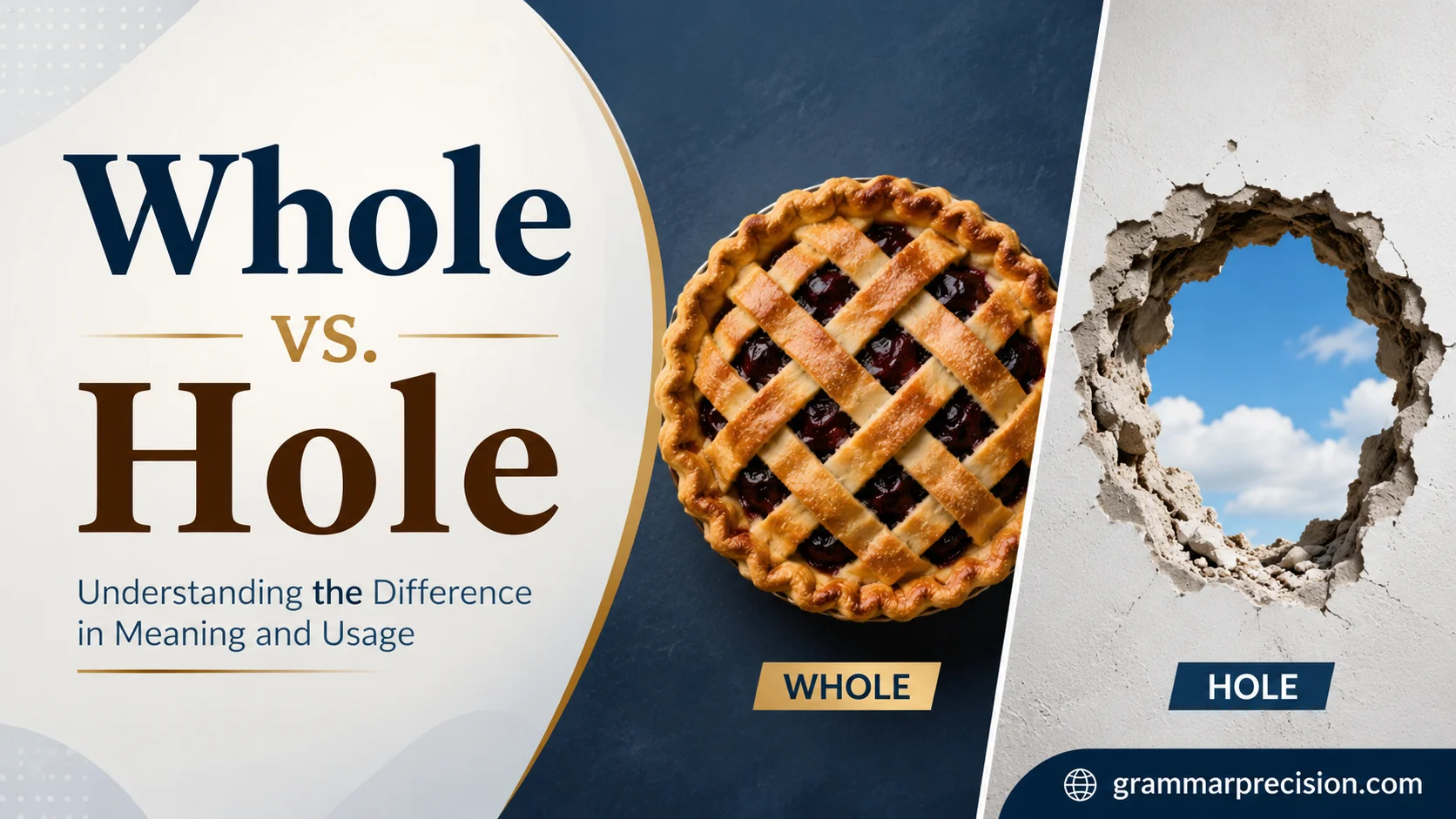
Whole vs. Hole can confuse even experienced English learners because these words sound the same but have different meanings. This guide explains their differences with simple examples, helping you use both words correctly in writing and conversation.
English contains many confusing word pairs, and whole vs. hole is a perfect example. While whole means something complete or entire, hole refers to an opening, gap, or empty space. Understanding these words helps you avoid mistakes and improve your English accuracy in everyday communication.
Many people mix up whole and hole because their pronunciation is identical. However, their meanings are completely different. By learning the definitions, examples, and usage rules, you can easily remember when to use each word. This article provides a clear explanation that makes the difference simple and memorable.
Whole vs. Hole: What Is the Difference?
The main difference between whole and hole comes down to meaning.
| Word | Meaning | Type of Word | Example |
| Whole | Complete, entire, or all parts together | Adjective/Noun | I ate the whole pizza. |
| Hole | An opening, gap, or empty space | Noun | There is a hole in my shirt. |
The easiest way to remember:
- Whole = Complete
- Hole = Empty space
Think about a puzzle. When every piece is connected, the puzzle is whole. If one piece is missing and there is a gap, that gap is like a hole.
Although both words sound the same, they belong to different categories of meaning. They are examples of homophones, which are words that have the same pronunciation but different meanings and spellings.
What Does Whole Mean?
The word whole means something that is complete, full, or not divided into parts.
When you use whole, you are talking about the entire amount of something.
For example:
- I watched the whole movie.
- She spent the whole day studying.
- The whole family attended the event.
In each sentence, whole means “all of it” or “the complete amount.”
Whole Meaning Explained in Simple Words
Imagine you have a chocolate bar.
If you eat only one piece, you have eaten part of it.
If you eat every piece, you have eaten the whole chocolate bar.
The word whole focuses on completeness.
It tells the reader that nothing is missing.
Examples of Whole in Everyday Sentences
Here are common examples:
- He read the whole book in one night.
- We waited the whole afternoon for the results.
- She cleaned the whole house before guests arrived.
- The whole team worked together.
- I spent my whole weekend relaxing.
Notice how whole often appears before a noun:
- whole day
- whole year
- whole story
- whole world
- whole group
Different Uses of Whole in English Grammar
The word whole can work in different ways depending on the sentence.
Whole as an Adjective
Most commonly, whole acts as an adjective because it describes a noun.
Examples:
- I drank the whole bottle of water.
- They watched the whole match.
- She told the whole truth.
Here, whole describes the complete amount.
Whole as a Noun
Sometimes whole refers to something complete by itself.
Examples:
- The parts create a beautiful whole.
- We need to understand the whole before studying the details.
In these examples, whole means the complete thing.
Common Phrases Using Whole
English speakers use several common expressions with whole.
Wholeheartedly
Meaning: With complete effort or full emotion.
Example:
- She supported the project wholeheartedly.
On the Whole
Meaning: Generally or overall.
Example:
- On the whole, the event was successful.
Whole New World
Meaning: A completely different experience.
Example:
- Traveling alone opened a whole new world for him.
What Does Hole Mean?
The word hole means an opening, empty space, or gap.
Unlike whole, which represents completeness, hole represents something missing or an empty area.
Examples:
- There is a hole in the wall.
- The ball went into the hole.
- My shoes have a hole in them.
A hole can be physical, like a hole in the ground, or symbolic, like an emotional hole.
Hole Meaning Explained With Real-Life Examples
You can find holes everywhere.
A hole can appear in:
- Clothing
- Walls
- Roads
- Ground
- Objects
- Containers
For example:
A tire with a hole cannot hold air properly.
A bucket with a hole cannot hold water.
A wall with a hole has an opening.
The key idea is that something has a gap or missing part.
Also Read This: Acumen vs. Acuity vs. Acuteness: Why These Words Mean Very Different
Examples of Hole in Everyday Sentences
- The mouse escaped through a small hole.
- Someone made a hole in the fence.
- The gardener dug a hole for the plant.
- There is a hole in my jacket.
- The golfer hit the ball into the hole.
Different Types of Holes You Should Know
Physical Hole
A real opening that you can see.
Examples:
- A hole in a door
- A hole in the ground
- A hole in clothing
Figurative Hole
Sometimes people use hole to describe a difficult situation or missing element.
Examples:
- The company has a financial hole.
- Losing him left a hole in their lives.
Here, hole does not mean a physical opening. It means a problem or absence.
Whole vs. Hole: Side-by-Side Comparison
| Feature | Whole | Hole |
| Meaning | Complete or entire | Opening or gap |
| Focus | Everything together | Something missing |
| Pronunciation | Same | Same |
| Spelling | Starts with “wh” | Starts with “h” |
| Example | I ate the whole cake. | There is a hole in the cake box. |
Why Do Whole and Hole Sound the Same?
The reason whole and hole confuse people is because they sound identical.
These words are called homophones.
Other examples of homophones include:
- Two / Too
- Their / There
- Your / You’re
- Sea / See
English has many words like this because the language developed from different sources, including Latin, French, Germanic languages, and Old English.
The spelling stayed different even when pronunciation became similar.
Whole vs. Hole Sentence Examples
Seeing examples in context makes the difference much easier.
Correct Use of Whole
✅ I finished the whole assignment.
Meaning: I completed all of it.
❌ I finished the hole assignment.
Meaning: I finished an opening or gap, which does not make sense.
Correct Use of Hole
✅ There is a hole in the fence.
Meaning: There is an opening.
❌ There is a whole in the fence.
Meaning: The fence is complete, which changes the meaning.
Common Mistakes With Whole and Hole
Many learners mix these words because they sound identical.
Here are common mistakes:
Mistake: Using Hole Instead of Whole
Incorrect:
- I watched the hole movie.
Correct:
- I watched the whole movie.
Why?
The person watched the complete movie, not an opening in the movie.
Mistake: Using Whole Instead of Hole
Incorrect:
- There is a whole in my sock.
Correct:
- There is a hole in my sock.
Why?
The sock has a tear or opening.
Easy Tricks to Remember Whole vs. Hole
Remembering these words becomes easier with simple tricks.
Trick One: Think About the “W”
The W in whole can remind you of “whole = everything.”
Example:
Whole = Whole thing
Trick Two: Think About Space
A hole creates space.
Examples:
- Hole in a wall
- Hole in the ground
- Hole in clothing
If something has an opening, use hole.
Whole vs. Hole in Professional Writing
Correct word choice matters in emails, articles, reports, and academic writing.
A small spelling mistake can affect your credibility.
Example:
Incorrect:
The hole team worked hard on the project.
Correct:
The whole team worked hard on the project.
The first sentence suggests the team has a gap. The second means everyone participated.
Practice Quiz: Whole or Hole?
Choose the correct word.
The dog dug a ___ in the backyard.
Answer: hole
I spent the ___ morning preparing.
Answer: whole
There is a ___ in the roof.
Answer: hole
She ate the ___ sandwich.
Answer: whole
Related Words That Cause Similar Confusion
English has many confusing word pairs.
Whole vs. Entire
Both mean complete.
Examples:
- I read the whole book.
- I read the entire book.
They are often interchangeable.
Hole vs. Opening
Both can describe a gap.
Examples:
- There is a hole in the wall.
- There is an opening in the wall.
However, hole often suggests a physical gap.
FAQs:
What is the main difference between whole and hole?
Whole means something that is complete, entire, or all together, while hole means an opening, gap, or empty space. For example, “I ate the whole cake” means you ate all of it, but “There is a hole in the cake box” means there is an opening or damage.
Are whole and hole pronounced the same?
Yes, whole and hole have the same pronunciation, which makes them common homophones in English. Although they sound identical when spoken, their spellings and meanings are different. Context helps you understand which word fits the sentence.
How can I easily remember the difference between whole and hole?
A simple trick is to remember that whole means complete and hole means a gap. If something has all its parts together, use whole. If something has an empty space or opening, use hole.
Can whole and hole be used in professional writing?
Yes, both words can be used in professional writing, but choosing the correct one is important. Using “hole” instead of “whole” can completely change the meaning of a sentence and may make your writing look inaccurate.
What are some common mistakes with whole and hole?
A common mistake is writing “the hole team” instead of “the whole team.” The first suggests an opening or gap in the team, while the second means every member of the team. Always check the meaning before choosing the word.
Conclusion:
Understanding the difference between whole vs. hole helps you improve your English writing and communication skills. Although these words sound the same, they represent completely different ideas. Whole focuses on something complete, while hole describes a gap or opening.
By remembering their meanings and practicing with examples, you can avoid common mistakes and use these words with confidence.