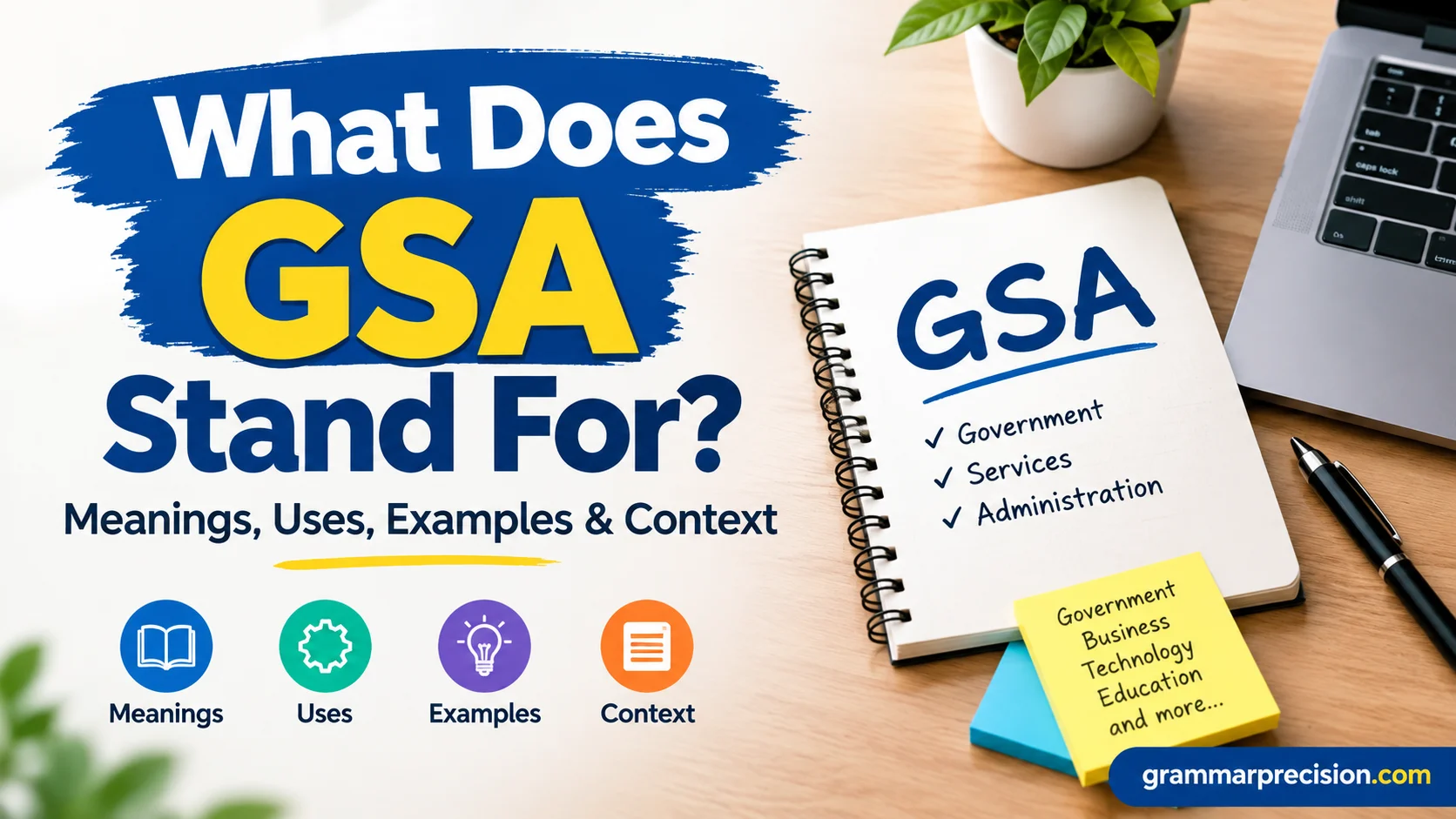
Have you ever seen GSA in a message, calendar, or business document and wondered what it means? What Does GSA Stand For? depends heavily on context, because this abbreviation can represent different terms. It may relate to scheduling, meetings, broadcasting, online booking, or business communication.
In this guide, we’ll explore the most common meanings of GSA, explain how context determines its interpretation, and clarify its use in formal writing. You’ll also see examples connected to time management, project management, calendar systems, and English usage. We’ll briefly consider US and UK regional preferences, style guides, grammar, and consistency so you can choose the right meaning confidently.
Quick Answer: What Does GSA Stand For?
GSA most commonly stands for General Services Administration, an independent U.S. government agency established in 1949. It helps federal agencies obtain products and services, manage workplaces and property, and use technology and shared services more effectively.
Today, GSA describes its role around several major areas: real estate, acquisition, technology, and shared services. The agency reports $126 billion in products and services moving through federal contracts and about 360 million rentable square feet under its real-estate responsibilities.
The acronym can also have different meanings outside federal government. That’s why context matters. A school organization, professional association, medical document, or technical paper may use GSA for something completely different.
| Context | Likely meaning of GSA | What it refers to |
| U.S. federal government | General Services Administration | Federal agency |
| Government purchasing | GSA / Multiple Award Schedule | Contracting and procurement system |
| Schools | Often a school-specific organization | Depends on the institution |
| Business | Industry-specific abbreviation | Depends on the field |
| Science or technology | Specialized technical term | Depends on the subject |
GSA Definition: General Services Administration
The General Services Administration is an independent federal agency that supports the basic operations of government. President Harry Truman established GSA on July 1, 1949, to streamline federal administrative work.
Its original responsibilities included managing government supplies, workplaces, records, and surplus property. Over time, its mission changed dramatically. Modern GSA focuses on helping agencies acquire what they need, manage federal real estate, improve technology, and share services.
Think of GSA as a large support system behind the scenes. Most Americans won’t interact with it every day, yet federal agencies depend on many of its services.
GSA’s work can affect everything from office space and federal procurement to digital tools and government-wide purchasing programs. Its current mission reflects that broad reach.
Why Was GSA Created?
GSA emerged after World War II when the federal government wanted a more coordinated way to handle administrative functions. Rather than having multiple organizations perform overlapping support duties, the government consolidated several functions into one agency.
That consolidation created a central place for supplies, property, workplaces, and related administrative services. The arrangement also gave the government greater purchasing leverage.
Over the decades, GSA expanded and reshaped its role as federal needs changed. Technology, professional services, real estate optimization, and digital modernization have become important parts of its responsibilities.
What Does the GSA Do?
The easiest way to understand GSA is to look at what it actually provides. Instead of thinking of it as one narrow department, picture a government-wide service platform.
Acquisition and Procurement
GSA helps agencies buy commercial products and services. Its acquisition programs can simplify purchasing by establishing contracts and purchasing channels that agencies can use.
The Multiple Award Schedule, commonly called the GSA Schedule or MAS, is especially important. It gives eligible government buyers access to millions of commercial products and services through contracts with approved vendors.
GSA says its Schedule program supports federal, state, local, territorial, and tribal governments along with other eligible buyers. The program covers areas ranging from professional services and information technology to transportation, facilities, security, furniture, and office management.
Federal Real Estate
GSA also manages a large part of the federal government’s real-estate needs. Its Public Buildings Service provides and manages workplaces for federal agencies.
The agency says it supports more than 1 million federal civilian workers through its real-estate mission. It also oversees the preservation of more than 480 historic buildings.
This responsibility involves much more than owning buildings. It can include leasing, construction, maintenance, workspace planning, sustainability, and property management.
Technology Services
Modern government relies heavily on technology, so GSA’s role extends into IT acquisition and shared technology services.
For example, the GSA Multiple Award Schedule IT category gives eligible buyers access to 7.5 million commercial IT products, services, and solutions from thousands of vendors. Offerings include cloud-related services, electronic commerce, and other technology solutions.
This matters because agencies don’t always need to create a new procurement process from scratch. Government-wide purchasing vehicles can reduce duplication and help agencies reach qualified vendors more efficiently.
Shared Government Services
GSA also provides services and expertise that can support multiple agencies. Shared services can reduce duplicated effort and allow agencies to concentrate more heavily on their core missions.
That broader role explains why the phrase “GSA services” can mean many things. It isn’t a single product. It represents a collection of government-wide capabilities.
What Is a GSA Schedule?
Here’s where the acronym becomes especially important for businesses.
A GSA Schedule, now known as the Multiple Award Schedule (MAS), is a long-term government-wide contracting program. It allows commercial companies to sell products and services to eligible government buyers under established contract terms.
The Federal Acquisition Regulation recognizes the Federal Supply Schedule program as the GSA Schedules Program or Multiple Award Schedule Program. The program gives federal agencies a streamlined way to obtain commercial supplies and services.
In simple terms, imagine a large marketplace where qualified vendors have already completed a significant portion of the contracting process. Government buyers can then use the Schedule program to find and purchase eligible offerings under established procedures.
How GSA Schedules Work
A business first seeks a Schedule contract by responding to the relevant GSA solicitation and meeting applicable requirements. Once awarded a contract, the company can compete for orders that agencies place through the Schedule.
However, getting on Schedule does not guarantee sales. GSA specifically notes that individual contractors receive no guaranteed sales.
The benefit is access. GSA says the Schedule program opens the door to federal contracting opportunities exceeding $39 billion annually and describes it as the most common procurement method used by federal agencies.
Who Can Buy Through a GSA Schedule?
Eligible buyers can include:
- U.S. federal agencies
- Certain state and local governments
- Tribal governments
- U.S. territorial governments
- Other authorized organizations
Eligibility depends on the particular program and purchasing authority. Buyers must still follow applicable ordering rules rather than treating a Schedule as an unrestricted shopping account.
What Can Be Sold Through a GSA Schedule?
The range is surprisingly broad. Current MAS offerings span categories such as:
- Information technology
- Professional services
- Facilities
- Furniture and furnishings
- Office management
- Transportation and logistics
- Security and protection
- Travel
- Industrial products and services
- Scientific solutions
- Human capital
GSA organizes offerings through Special Item Numbers, or SINs. A SIN groups generally similar supplies or services so buyers and sellers can identify the appropriate purchasing category.
GSA Contract vs. GSA Schedule: Are They the Same?
Not exactly.
A GSA Schedule contract is one specific type of government-wide contract vehicle. The broader phrase GSA contract can refer to different contract vehicles administered or supported by GSA.
For example, GSA works with the Multiple Award Schedule, government-wide acquisition contracts, and multi-agency contracts. These vehicles have different purposes, scopes, and ordering structures.
A useful distinction looks like this:
| Term | Basic meaning |
| GSA | General Services Administration |
| GSA Schedule | Common name for the Multiple Award Schedule |
| MAS | Multiple Award Schedule |
| FSS | Federal Supply Schedule |
| SIN | Special Item Number |
| GWAC | Governmentwide Acquisition Contract |
| MAC | Multi-Agency Contract |
Knowing these differences prevents a common mistake: treating every federal purchasing vehicle as a GSA Schedule.
Other Meanings of GSA
Although General Services Administration is the dominant meaning in U.S. federal procurement, GSA isn’t universally defined that way.
GSA in Schools
In education, GSA can refer to a student organization. One common expansion is Gender and Sexuality Alliance, although schools and organizations may choose different wording.
The exact meaning depends on the institution. A school club page mentioning meetings, students, inclusion, or campus activities probably isn’t talking about the federal agency.
That distinction is important because context can completely change the definition.
GSA in Business
Business documents may use GSA to describe government contracting, a specific organization, or an industry-specific term.
If a company discusses GSA Schedule pricing, MAS, SINs, federal buyers, or government contracts, the intended meaning is almost certainly connected to the General Services Administration.
On the other hand, an acronym appearing in a private company’s internal report may have an entirely different definition.
GSA in Technology and Science
Technical fields often create abbreviations that make sense only within a specialized discipline. A research paper may use GSA for a scientific method, organization, measurement, or technical concept.
Therefore, don’t assume that every appearance of GSA refers to Washington or federal procurement. Read the surrounding terminology first.
GSA in Healthcare and Other Fields
Healthcare, professional associations, transportation, finance, and other industries can also use GSA as an abbreviation.
There is no universal rule saying that three letters must have one fixed meaning. Acronyms behave like labels. Their meaning comes from the environment surrounding them.
Also Read This: What Does SSI Stand For? Definitions, Uses & Examples
GSA Meaning Cheat Sheet
When you encounter GSA, use this quick guide:
Federal contract + GSA Schedule + vendor → General Services Administration.
Government building + federal workplace → General Services Administration.
School club + students + meetings → likely a school-specific GSA.
Scientific paper + specialized terminology → check the paper’s abbreviation list.
Company report + industry-specific language → check the organization’s terminology.
This simple approach can save you from confidently choosing the wrong definition.
How to Tell Which GSA Meaning Someone Means
Context is your best detective.
Start by looking at the words immediately around GSA. Terms such as Schedule, MAS, SIN, federal agency, procurement, contract, and vendor strongly point toward the General Services Administration.
Next, identify the setting. A federal website and a high-school student handbook have very different acronym ecosystems.
Finally, check whether the document defines the abbreviation. Professional writing often introduces an abbreviation the first time it appears. For example:
“The General Services Administration (GSA) manages…”
After that introduction, the writer can simply use GSA.
If the document never defines it, nearby terminology usually provides the clue.
GSA Acronym vs. Initialism
Is GSA technically an acronym?
In everyday writing, people often call shortened forms like GSA acronyms. Strictly speaking, an acronym is usually pronounced as a word, while an initialism is pronounced letter by letter.
GSA is normally spoken as “G-S-A.” Under the stricter distinction, that makes it an initialism rather than a traditional pronounceable acronym.
Still, “GSA acronym” remains a common search phrase. That is why both terms appear in everyday explanations.
How Do You Pronounce GSA?
GSA is pronounced by saying each letter separately:
G-S-A
You don’t normally pronounce it as one blended word.
In formal speech, pronounce the letters clearly, especially when introducing the term to someone unfamiliar with federal contracting. After the meaning is established, the initialism becomes easy to recognize.
GSA Examples in Different Contexts
A few examples make the distinction clearer.
Government Example
“The agency purchased its software through a GSA Schedule contract.”
Here, GSA refers to the General Services Administration and its Schedule program.
Business Example
“The company is pursuing a GSA contract to expand its federal customer base.”
Again, the context points to government procurement.
School Example
“Students attended the GSA meeting after school.”
Here, the meaning could be a Gender and Sexuality Alliance or another school organization. The surrounding school context matters.
Technical Example
“The researchers defined GSA in the methodology section.”
In this case, the document itself should provide the intended definition.
A Practical Case Study: Why Context Changes Everything
Imagine that three people receive the same message:
“Please contact GSA before Friday.”
A federal contractor may immediately think about the General Services Administration. A high-school student may think about a school club. A researcher may search the abbreviation within a technical paper.
The letters haven’t changed. The context has.
Now add one phrase:
“Please contact GSA about your Schedule offer before Friday.”
The meaning becomes much clearer because Schedule and offer point toward federal procurement.
This illustrates a useful rule: never interpret an acronym in isolation when multiple meanings exist.
Common Misunderstandings About GSA
Several misconceptions can create confusion.
GSA Doesn’t Mean Only One Thing
The General Services Administration is the primary meaning in U.S. government contexts, but other fields use GSA differently.
A GSA Schedule Doesn’t Guarantee Business
Being awarded a Schedule contract provides access to opportunities. It doesn’t promise a vendor any particular amount of revenue.
GSA Isn’t the Same as Every Federal Contract
GSA administers and supports multiple contracting programs, but federal agencies can also buy through other contracting channels.
GSA Isn’t Just About Office Supplies
The agency’s modern responsibilities include real estate, acquisition, technology, and shared services. Its purchasing programs cover an extensive range of commercial products and professional services.
GSA and MAS Aren’t Unrelated Terms
When you see GSA Schedule, MAS, or Federal Supply Schedule, you’re often looking at different names connected to the same major Schedule program.
GSA Facts Worth Remembering
Here are the key facts in one place:
- Established: July 1, 1949
- Full name: General Services Administration
- Type: Independent U.S. federal agency
- Core areas: Real estate, acquisition, technology, and shared services
- Major procurement program: Multiple Award Schedule
- Common Schedule abbreviations: MAS and FSS
- Schedule offerings: More than 12 million commercial items
- Federal contracting opportunities through Schedule: More than $39 billion annually, according to GSA
- Federal civilian workforce supported through GSA real estate: More than 1 million workers
- Historic buildings overseen: More than 480
GSA’s current public materials report $126 billion in products and services through federal contracts and approximately 360 million rentable square feet. These numbers help put the agency’s scale into perspective.
FAQs About What GSA Stands For
What does GSA stand for in government?
GSA stands for General Services Administration. It is an independent federal agency that supports government operations through acquisition, real estate, technology, and shared services.
What does GSA mean in business?
In a business discussing federal procurement, GSA usually refers to the General Services Administration. It may specifically refer to a GSA Schedule, government contract, vendor relationship, or federal purchasing opportunity.
What does GSA stand for in school?
In schools, GSA can refer to a Gender and Sexuality Alliance or another student organization. The exact expansion depends on the school or organization.
What is a GSA Schedule?
A GSA Schedule, now called the Multiple Award Schedule, is a government-wide contracting program that gives eligible buyers access to commercial products and services from approved contractors.
Does a GSA Schedule guarantee sales?
No. A Schedule contract provides access to contracting opportunities, but GSA does not guarantee sales to individual contractors.
Is GSA the same as MAS?
GSA is the General Services Administration, the agency. MAS stands for Multiple Award Schedule, one of its major procurement programs.
What does GSA mean on a federal contract?
On a federal contract, GSA usually identifies the General Services Administration or a contract vehicle associated with the agency. The specific contract documents determine the exact program.
Conclusion:
So, what does GSA stand for? In U.S. government and federal contracting, it stands for General Services Administration. The agency supports acquisition, real estate, technology, and shared services while helping government organizations operate more efficiently.
The term becomes especially important in federal procurement because the GSA Schedule, or Multiple Award Schedule, connects eligible government buyers with commercial vendors. However, GSA can mean something entirely different in schools, science, healthcare, or specialized business settings.
The smartest way to interpret GSA is simple: look at the context first. When words such as Schedule, MAS, SIN, vendor, and federal contract appear nearby, the General Services Administration is almost certainly the intended meaning.