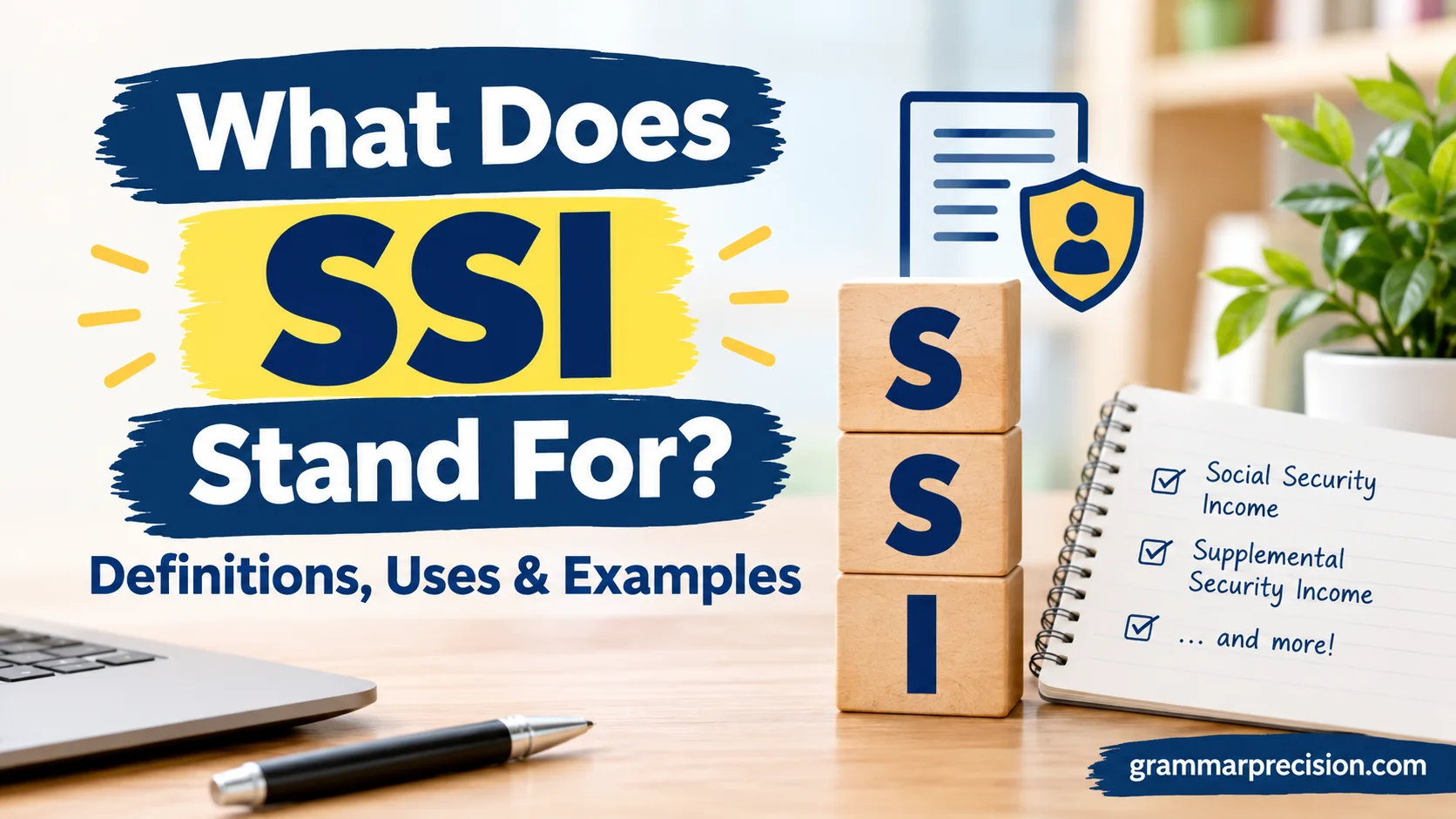
Have you ever seen SSI in a calendar, message, or business document and wondered, “What does SSI stand for?” This abbreviation can have different meanings depending on the context, including scheduling, meetings, broadcasting, online booking, and business communication.
Understanding the intended meaning helps you communicate clearly and avoid confusion, especially when abbreviations appear in professional or digital settings. In this guide, you’ll discover the meaning of SSI, its common interpretations, and how context determines its use. We’ll also explore time management, project management, calendar systems, and formal writing where abbreviations can affect clarity and consistency.
You’ll learn how English usage and grammar influence abbreviation choices, with brief guidance on US vs. UK regional preferences and common style-guide conventions. Whether you encountered SSI in a workplace, booking system, broadcast, or written message, this article explains it in plain English.
What Does SSI Stand For?
SSI most commonly stands for Supplemental Security Income in U.S. government and benefits discussions. It is a federal program administered by the Social Security Administration (SSA) for people with limited income and resources who are aged 65 or older, blind, or disabled. Children who are blind or have qualifying disabilities can also receive SSI.
However, SSI also stands for Server Side Includes in web development. In that setting, the term describes a server-side technology that can insert reusable content into web pages.
So, the right answer depends on where you encountered the abbreviation.
| SSI meaning | Common context | Basic meaning |
| Supplemental Security Income | Government and benefits | Federal assistance for eligible people with limited income and resources |
| Server Side Includes | Web development | A server-side method for inserting content into web pages |
| Surgical Site Infection | Healthcare | An infection associated with a surgical procedure |
| Small-Scale Integration | Electronics | An early integrated-circuit classification |
| Other specialized meanings | Business, education, science, organizations | Context-specific terminology |
The first two meanings deserve the most attention because they appear frequently and have very different definitions.
SSI Meaning in Social Security: Supplemental Security Income
When someone asks about SSI in connection with benefits, disability, low income, or the Social Security Administration, Supplemental Security Income is almost certainly the intended meaning.
SSI provides monthly payments to eligible people who meet financial and categorical requirements. Unlike traditional Social Security benefits, SSI isn’t based on a person’s past work record. The program is funded from general U.S. Treasury revenues rather than Social Security payroll taxes.
What Is Supplemental Security Income?
Supplemental Security Income is a needs-based federal program. The SSA administers it and evaluates factors such as income, resources, living arrangements, and qualifying age, blindness, or disability.
For 2026, the federal maximum SSI payment is $994 per month for an eligible individual and $1,491 for an eligible couple. An essential person amount can be $498. Actual payments can be lower because countable income and other circumstances affect the benefit. Some states also provide supplemental payments.
The 2026 federal amounts reflect a 2.8% cost-of-living adjustment (COLA). The SSA reported 7,392,201 recipients of federally administered SSI payments in December 2025.
Who Can Receive SSI?
SSI generally serves three main groups:
- People age 65 or older who meet the financial rules
- People who are blind and meet the financial rules
- People with a qualifying disability who meet the financial rules
Children can also qualify because of blindness or disability.
Financial eligibility matters because SSI is designed for people with limited income and resources. A person can have a disability and still fail the SSI financial requirements. Conversely, meeting the financial requirements doesn’t automatically establish disability eligibility.
Is SSI the Same as Social Security?
No. SSI and Social Security are separate programs, even though the SSA administers both.
Social Security benefits generally depend on a worker’s earnings record and payroll-tax contributions. SSI does not depend on your prior work history or a family member’s work history. The programs can sometimes overlap, which creates much of the confusion.
| Feature | SSI | Social Security |
| Full name | Supplemental Security Income | Social Security benefits |
| Main basis | Financial need plus qualifying status | Insured work or family record |
| Work history required | Generally no | Generally yes for worker benefits |
| Funding | General Treasury funds | Social Security trust funds |
| Administered by | SSA | SSA |
| Can programs overlap? | Yes | Yes |
A useful memory trick is simple: SSI focuses on need, while Social Security generally focuses on an insured work record.
SSI vs. SSDI: What’s the Difference?
Another common mix-up involves SSDI, which stands for Social Security Disability Insurance.
Both SSI and SSDI can provide disability-related benefits, but they use different eligibility systems. SSI considers financial need and qualifying disability or blindness. SSDI generally requires a qualifying disability plus enough work credits from employment covered by Social Security.
For example, imagine two people with similar medical limitations. One has a long work history and enough credits but limited current ability to work. That person may qualify for SSDI. Another person may have a qualifying disability but little or no qualifying work history and limited resources. That person may potentially qualify for SSI instead.
In some cases, a person can qualify for both programs. The key isn’t simply the diagnosis. Financial circumstances and work history also matter.
SSI Meaning in Technology: Server Side Includes
Now move from government benefits to web development, and SSI takes on a completely different identity: Server Side Includes.
Server Side Includes is a server-side technology that lets a web server insert content into a webpage before delivering that page to the browser. Developers can use it for repeated elements such as headers, footers, navigation menus, or other shared content.
The concept is straightforward. Instead of copying the same block of HTML into dozens of pages, a server can insert that shared file when the page is requested.
How Server Side Includes Work
Imagine a website with 100 pages. Every page has the same footer.
Without a reusable inclusion method, you might duplicate that footer across all 100 files. If the copyright year changes, you could face a tedious editing job.
With SSI, the page can contain an instruction that tells the server to include a separate file. The server processes that instruction and sends the resulting HTML to the visitor.
A simplified example looks like this:
<!–#include virtual=”/includes/footer.html” –>
The browser doesn’t need to understand the SSI directive. The server handles the inclusion first.
Why Developers Use SSI
SSI can make certain websites easier to maintain because shared content lives in one place.
Common uses include:
- Site-wide headers
- Navigation menus
- Footers
- Repeated announcements
- Simple dynamic information
- Shared HTML fragments
SSI isn’t a modern replacement for every server-side framework. Today’s web applications often use templating engines, component systems, or full-stack frameworks. Still, SSI can remain useful for relatively simple server-rendered websites.
SSI and File Extensions
SSI-enabled pages often use extensions such as .shtml, although server configuration can vary. The important point is that the web server must be configured to recognize and process SSI instructions.
That distinction matters. Simply typing an SSI directive into an ordinary HTML file doesn’t guarantee that anything will happen. The server has to support and enable the feature.
Other Meanings of SSI
SSI isn’t limited to Social Security and web development. Specialized industries use the same three letters for different concepts.
SSI in Healthcare
In healthcare, SSI can stand for Surgical Site Infection. This refers to an infection associated with a surgical procedure.
The context makes the meaning easy to spot. If a medical report discusses an operation, wound care, antibiotics, or postoperative complications, SSI may refer to surgical site infection rather than Supplemental Security Income.
Healthcare professionals may discuss factors such as infection prevention, wound assessment, antimicrobial treatment, and postoperative monitoring when using this abbreviation.
SSI in Electronics
In electronics, SSI can refer to Small-Scale Integration. The term belongs to the history of integrated circuits and describes chips containing a relatively small number of logic gates or equivalent components.
You’re more likely to encounter this meaning in electronics history, computer engineering, semiconductor discussions, or educational material about the evolution of integrated circuits.
SSI in Business and Organizations
Businesses and organizations sometimes create their own abbreviations. In these settings, SSI may refer to an internal program, system, department, initiative, or metric.
This is where guessing becomes risky. If an acronym appears in an internal document, its definition may be specific to that organization.
A good rule is to check the document’s acronym list, glossary, first occurrence, or surrounding terminology before assigning a meaning.
Also Read This: Stand for Animals: Grammar, Examples & Natural Usage
SSI Meaning by Context
Context works like a filter. It eliminates meanings that don’t belong.
| If you see SSI near… | It most likely refers to… |
| Disability, income, benefits, SSA | Supplemental Security Income |
| Retirement, Social Security taxes, work credits | Social Security-related terminology |
| HTML, server, website, include | Server Side Includes |
| Surgery, wound, infection, antibiotics | Surgical Site Infection |
| Chips, logic gates, semiconductor history | Small-Scale Integration |
| Internal company terminology | Organization-specific meaning |
This approach is faster than memorizing every possible definition.
How to Know Which SSI Meaning Applies
When an abbreviation has several meanings, don’t rely on the letters alone. Read the neighborhood around the abbreviation.
Look at the Topic
Ask what the document is about. A benefits application points toward Supplemental Security Income. A coding tutorial points toward Server Side Includes.
Check the Words Nearby
Related words often reveal the answer immediately.
For example, terms such as income, disability, eligibility, benefits, and resources strongly suggest Supplemental Security Income. Words such as HTML, server, include, page, and directive point toward Server Side Includes.
Consider the Audience
A government benefits form, programming manual, hospital report, and electronics textbook won’t use SSI in the same way.
Check the First Full Definition
Professional documents often spell out an abbreviation the first time it appears. If the document says “Supplemental Security Income (SSI),” you’ve got your answer.
Don’t Assume the Most Familiar Meaning
Familiarity can create mistakes. Someone who knows SSI as Supplemental Security Income may incorrectly interpret it in a programming discussion.
The same problem works in reverse.
SSI Examples You Can Actually Use
Examples make the distinction much easier to remember.
Government Example
“She applied for SSI after her income and resources became limited.”
Here, SSI means Supplemental Security Income because the sentence discusses financial need and benefits.
Technology Example
“The developer used SSI to insert the site’s shared footer.”
Here, SSI means Server Side Includes because the sentence discusses web development.
Healthcare Example
“The patient was monitored for an SSI after surgery.”
Here, SSI most likely means Surgical Site Infection because surgery and infection provide the context.
Electronics Example
“The textbook describes SSI as an early stage in integrated-circuit development.”
Here, SSI means Small-Scale Integration.
The same three letters can therefore describe completely unrelated concepts. Context does the heavy lifting.
A Practical SSI Case Study
Consider a simple situation. A reader sees the sentence, “SSI increased this year.”
At first glance, that sentence tells you almost nothing.
Now add context:
Version A: “SSI payments increased because of the 2026 COLA.”
The meaning is clearly Supplemental Security Income.
Version B: “SSI lets the server insert the navigation menu.”
Now the meaning is clearly Server Side Includes.
Version C: “SSI rates declined after the hospital introduced a new infection-control protocol.”
Here, the intended meaning could be Surgical Site Infection, depending on the specific report.
The lesson is powerful: an acronym rarely carries its complete meaning by itself. The surrounding language completes it.
Common SSI Mistakes to Avoid
Assuming SSI Always Means Supplemental Security Income
This is probably the most common mistake in general discussions. SSI is strongly associated with U.S. benefits, but technology and healthcare use the abbreviation too.
Confusing SSI With Social Security
SSI is administered by the Social Security Administration, but it isn’t simply another name for all Social Security benefits.
Confusing SSI With SSDI
The programs can both involve disability, yet their eligibility foundations differ. SSI emphasizes financial need and qualifying status, while SSDI generally depends on disability and sufficient work credits.
Thinking Server Side Includes Are a Social Security Term
Technical documents may use SSI without any connection to government benefits.
Ignoring the First Definition
If a professional document defines SSI early, use that definition throughout the document unless the author clearly changes contexts.
SSI vs. SSA vs. SSDI: Don’t Mix Them Up
These abbreviations often appear together in benefits discussions, which makes them easy to confuse.
| Acronym | Stands for | Main idea |
| SSI | Supplemental Security Income | Needs-based federal assistance |
| SSA | Social Security Administration | Federal agency that administers Social Security and SSI |
| SSDI | Social Security Disability Insurance | Disability benefits tied generally to insured work history |
A simple memory shortcut helps:
SSI = income assistance.
SSDI = disability insurance.
SSA = the administration.
That isn’t a complete explanation of eligibility, but it’s a useful starting point.
SSI Acronym Cheat Sheet
Keep this quick reference handy:
- SSI: Supplemental Security Income
- SSI: Server Side Includes
- SSI: Surgical Site Infection
- SSI: Small-Scale Integration
- SSA: Social Security Administration
- SSDI: Social Security Disability Insurance
The correct expansion depends on the subject.
FAQs About SSI
What does SSI stand for?
SSI most commonly stands for Supplemental Security Income in U.S. benefits discussions. In technology, it commonly means Server Side Includes. Healthcare and electronics also use SSI for different terms.
What does SSI stand for in Social Security?
In the Social Security context, SSI stands for Supplemental Security Income. It is a needs-based federal program for eligible people with limited income and resources who are aged, blind, or disabled.
What does SSI stand for in technology?
In web development, SSI stands for Server Side Includes. It allows a web server to insert reusable content into webpages before sending the resulting page to a browser.
Is SSI the same as Social Security?
No. SSI is a separate program from Social Security benefits. SSI is needs-based and doesn’t depend on prior work history. Social Security worker benefits generally depend on an insured work record.
What does SSI stand for in healthcare?
In healthcare, SSI can mean Surgical Site Infection. The surrounding terms usually reveal this meaning, especially when a document discusses surgery, wounds, infection prevention, or postoperative care.
What does SSI mean in a text message?
There isn’t one universal texting meaning for SSI. The intended meaning depends on the conversation. If the discussion involves benefits, SSI may mean Supplemental Security Income. If it involves another subject, the abbreviation may mean something else.
Conclusion:
So, what does SSI stand for? The most common answer in U.S. benefits discussions is Supplemental Security Income, a needs-based federal program administered by the Social Security Administration. In web development, however, SSI means Server Side Includes. Healthcare and electronics have their own uses too.
The easiest way to identify SSI is to examine the words around it. Benefits and disability point toward Supplemental Security Income. HTML and servers point toward Server Side Includes. Surgery and infection point toward Surgical Site Infection. Once you use context as your guide, this confusing abbreviation becomes much easier to understand.