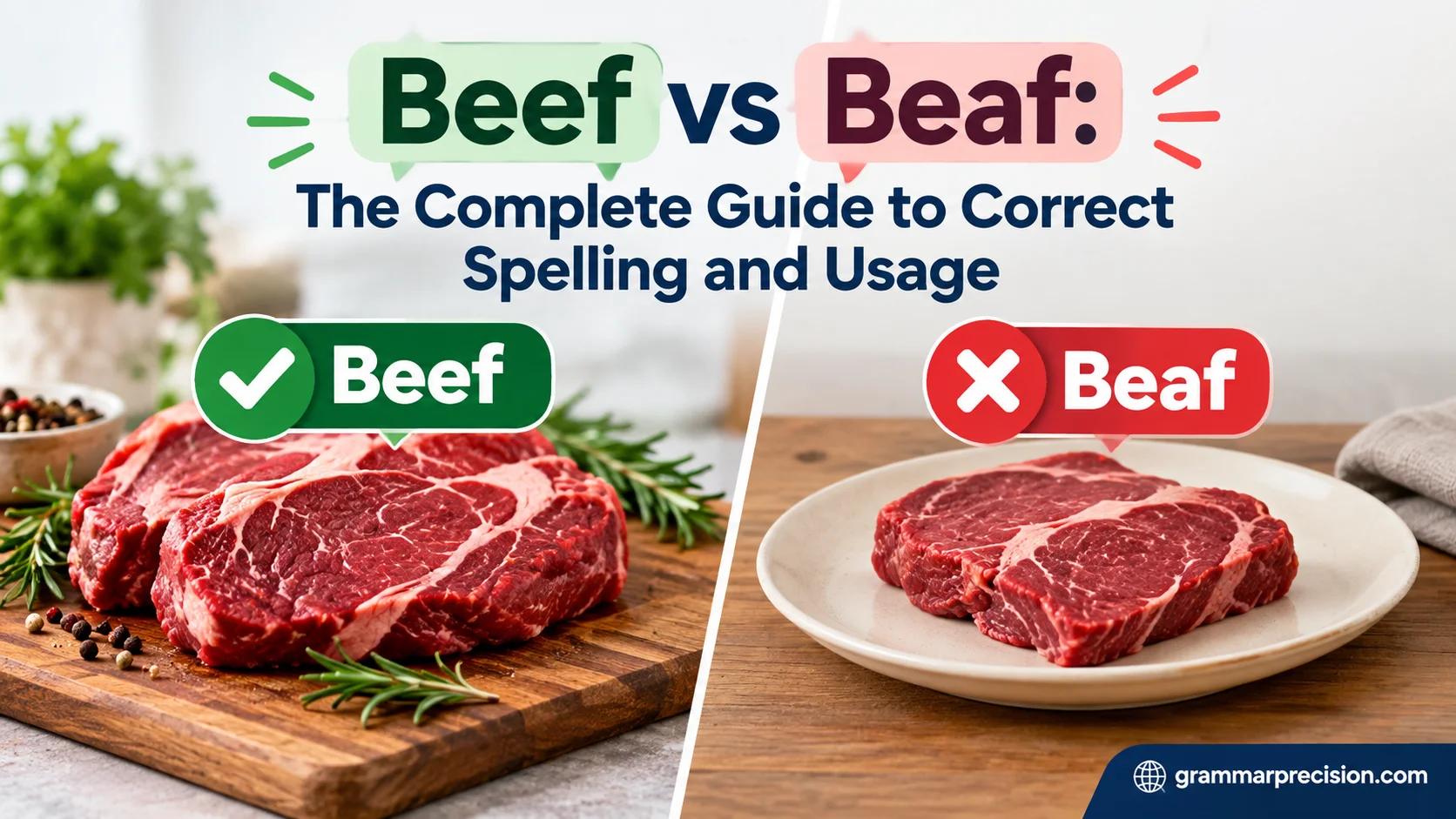
Beef vs Beaf is a common spelling confusion for English learners and writers. Beef is the correct English word for meat from cattle, while Beaf is a misspelling. Understanding this difference can help you write clearly and avoid common spelling mistakes.
The word beef refers to the meat that comes from cattle and is widely used in cooking, food writing, menus, and everyday conversation. It can also have other meanings, such as a complaint or disagreement in informal English. Its meaning depends on the context in which you use it.
On the other hand, beaf isn’t a standard English word in modern English dictionaries. Most of the time, people write it accidentally when they mean beef. If you’re writing an email, article, menu, school assignment, or professional document, always choose beef for the correct spelling and natural English usage.
In this guide, you’ll learn the meaning, spelling, pronunciation, and usage of beef, along with clear examples that show how to use it correctly. We’ll also explain why beaf is incorrect and give you simple tips to remember the correct spelling and avoid making this common English mistake.
Beef vs Beaf: The Short Answer
The correct spelling is beef.
Beaf isn’t the standard spelling of the English word. When someone writes “beaf,” they generally mean beef but have spelled it incorrectly.
| Word | Correct Spelling? | Meaning | Example |
| Beef | ✅ Yes | Meat from cattle; also a complaint or disagreement | We cooked beef for dinner. |
| Beaf | ❌ No | Standard English doesn’t use it as the spelling of beef | “Beaf” is a common misspelling. |
The easiest way to remember the difference is to focus on the middle of the word:
B + EE + F = BEEF
The word contains two e’s, not “ea.”
So, if you’re writing a menu, email, school assignment, article, recipe, or professional document, always use beef.
Is “Beaf” a Word?
In standard modern English, beaf isn’t the correct spelling for the meat that comes from cattle. It’s normally treated as a misspelling of beef.
You may occasionally encounter unusual spellings in historical texts, names, usernames, informal writing, or specialized contexts. However, that doesn’t make “beaf” the standard spelling of the everyday English word.
For normal communication, the rule is straightforward:
Use “beef,” not “beaf.”
This distinction matters because spelling affects clarity. A reader may understand what you mean when you write “beaf,” but the unusual spelling can make your writing look careless or distract from your message.
For example:
- ❌ We ordered beaf steaks.
- ✅ We ordered beef steaks.
- ❌ The recipe requires one pound of beaf.
- ✅ The recipe requires one pound of beef.
- ❌ I don’t usually eat beaf.
- ✅ I don’t usually eat beef.
In casual texting, people often make spelling mistakes without causing serious confusion. In formal writing, however, using the standard form is the better choice.
What Is the Correct Spelling of Beef?
The correct spelling is beef: B-E-E-F.
The double e represents the long “e” sound you hear in the word. The spelling is fixed, so changing the ee to ea creates a spelling error.
Here are a few simple examples:
- Beef is a popular type of meat.
- We bought fresh beef from the market.
- She ordered a beef burger.
- The restaurant serves grilled beef.
- They need to beef up their security system.
A useful memory trick is to connect beef with other familiar words containing “ee,” such as:
- see
- feel
- green
- sleep
- week
- keep
- deep
Of course, English spelling doesn’t follow one perfect rule. Still, remembering the visual pattern b + ee + f can help prevent the “beaf” mistake.
What Does “Beef” Mean?
The word beef has several meanings. Its most familiar meaning relates to food, but it can also describe a complaint or disagreement and can function as part of a verb phrase.
Beef as a Type of Meat
As a noun, beef refers to the meat obtained from cattle.
For example:
We had beef with rice for dinner.
In cooking and food-related contexts, beef can refer to many different cuts and preparations. Examples include:
- beef steak
- ground beef
- roast beef
- beef ribs
- beef brisket
- beef stew
- beef burger
- beef kebabs
Notice that beef is generally treated as an uncountable noun when you’re talking about the meat as a substance.
You’d normally say:
I bought some beef.
rather than:
I bought a beef.
However, specific food items can be countable:
We ordered two beef burgers.
This small grammar distinction becomes useful when writing recipes, menus, and everyday conversations.
Beef as a Complaint
In informal English, beef can also mean a complaint, grievance, or disagreement.
For example:
I have a beef with the way this decision was handled.
Here, “beef” has nothing to do with food. The speaker means they have a problem or complaint about something.
Another example is:
What’s your beef with the new policy?
This means:
What problem or complaint do you have with the new policy?
This use is informal, so it works better in casual conversations than in highly formal writing.
Beef as a Verb
You may also see beef in the expression “beef up.”
To beef up something means to make it stronger, larger, more effective, or more substantial.
For example:
The company plans to beef up its cybersecurity measures.
The sentence means the company plans to strengthen or improve its cybersecurity.
More examples include:
- The school needs to beef up its security.
- We should beef up the report with stronger evidence.
- The coach wants to beef up the team’s defense.
- The manufacturer beefed up the vehicle’s safety features.
The phrase is informal but extremely common in everyday English.
Beef in Slang
In informal speech, particularly in conversations about conflict or disagreements, beef can refer to an ongoing dispute between people or groups.
For example:
The two musicians have had a beef for years.
This means they’ve had a continuing disagreement or conflict.
Because this meaning is slang or highly informal, you shouldn’t automatically use it in academic or formal business writing.
Beef Pronunciation Guide
Beef is pronounced with a long “e” sound. It rhymes with words such as:
- leaf
- chief
- grief
- brief
- thief
A simple pronunciation approximation is “beef” exactly as it looks when spoken naturally.
The key point is that the pronunciation doesn’t change simply because someone writes the word incorrectly as “beaf.”
For example:
- beef → correct spelling
- beaf → incorrect spelling
Both may be intended to represent the same pronunciation, but only beef is the standard spelling.
This is a good example of why spelling by sound can sometimes lead English learners astray. English contains many words whose pronunciation doesn’t provide enough information to determine the spelling.
Why People Write “Beaf” Instead of “Beef”
The Beef vs Beaf confusion usually comes from phonetic spelling.
When you hear “beef,” you hear a long ee sound. Some learners then associate that sound with the spelling ea, especially because English contains many familiar words using “ea.”
Consider:
- sea
- clean
- dream
- speak
- mean
These words contain ea but produce an “ee” sound.
As a result, someone might logically assume that “beef” should follow the same pattern and write beaf.
That’s understandable, but English spelling isn’t a mathematical formula. A particular sound can have multiple spellings.
Compare these examples:
| Word | Spelling Pattern | Pronunciation Pattern |
| beef | ee | Long e |
| team | ea | Long e |
| these | e-e | Long e |
| machine | i | Long e |
| key | ey | Long e |
The sound is similar, but the spelling differs.
That’s why memorizing the correct spelling of frequently used words remains important.
Beef vs Beaf: Correct and Incorrect Examples
Seeing the two forms side by side makes the distinction much easier.
| ❌ Incorrect | ✅ Correct |
| I cooked beaf yesterday. | I cooked beef yesterday. |
| We need fresh beaf. | We need fresh beef. |
| She doesn’t eat beaf. | She doesn’t eat beef. |
| The recipe uses ground beaf. | The recipe uses ground beef. |
| They served roast beaf. | They served roast beef. |
| We ordered a beaf burger. | We ordered a beef burger. |
| The company must beaf up security. | The company must beef up security. |
| What’s your beaf with him? | What’s your beef with him? |
The pattern is consistent: whenever you mean the standard English word, choose beef.
Also Read This: Despite vs. In Spite Of: What’s the Difference?
How to Use Beef in a Sentence
The word beef can appear in many different sentence structures. Understanding the context helps you use it naturally.
Simple Sentences With Beef
- Beef is rich in protein.
- We cooked beef for dinner.
- He ordered a beef sandwich.
- The market sells fresh beef.
- She prefers chicken to beef.
Questions With Beef
- Do you eat beef?
- How should I cook this beef?
- What kind of beef do you want?
- What’s your beef with the manager?
Negative Sentences
- I don’t eat beef.
- She doesn’t like beef stew.
- They aren’t serving beef tonight.
- He doesn’t have a beef with the team.
Formal Contexts
When discussing food, nutrition, agriculture, or economics, beef works perfectly well in formal writing.
For example:
Beef production plays an important role in many agricultural economies.
Another example:
The restaurant introduced several new beef dishes to its menu.
However, the slang meaning of “beef” should usually be replaced with a more formal word such as complaint, disagreement, dispute, concern, or grievance when you’re writing professionally.
“Beef” vs “Beef Up”: Don’t Confuse Them
Although beef and beef up contain the same word, they don’t have the same grammatical function.
Beef can refer to meat:
We bought beef for the barbecue.
It can also refer to a complaint:
He has a beef with the new rule.
But beef up is a phrasal verb:
The company needs to beef up its security.
The phrase means strengthen, increase, reinforce, or improve something.
| Expression | Meaning | Example |
| beef | Meat from cattle | We cooked beef. |
| have a beef with | Have a complaint or disagreement | She has a beef with the decision. |
| beef up | Strengthen or improve | They beefed up security. |
Understanding these differences prevents confusion when you encounter “beef” outside a food-related context.
“Have a Beef With” vs “Have a Problem With”
These expressions can communicate a similar idea, but their tone differs.
Have a beef with is informal:
I have a beef with the way they handled the situation.
Have a problem with is more neutral:
I have a problem with the way they handled the situation.
For professional communication, you might choose an even more precise expression:
I have a concern about the way the situation was handled.
Or:
I disagree with the way the situation was handled.
The choice depends on your audience. If you’re chatting with a friend, “What’s your beef?” may sound perfectly natural. In a formal report, it would sound too casual.
Beef in American English
In American English, beef is widely used for both its literal and informal meanings.
The literal food-related meaning is completely standard:
We bought ground beef for tacos.
The informal meaning appears in everyday speech, entertainment, journalism, and social media:
The two celebrities have an ongoing beef.
You may also encounter the word in expressions such as:
What’s your beef?
and
I have a beef with that idea.
The meaning becomes clear from context. If someone says they’re buying beef at a grocery store, they’re talking about food. If someone asks, “What’s your beef with me?” they’re asking about a complaint or disagreement.
Common Spelling Mistakes Related to Beef
“Beaf” isn’t the only spelling mistake people can make when trying to write unfamiliar words. Phonetic spelling often produces forms that look reasonable but aren’t standard.
Some possible misspellings include:
- beaf
- bief
- befe
- beefh
- beef incorrectly replaced with another vowel pattern
The important lesson isn’t to memorize every possible mistake. Instead, train yourself to recognize the correct visual form:
BEEF
When you’re unsure, pause and check the word before using it in an important document.
This matters particularly in:
- resumes
- school assignments
- professional emails
- restaurant menus
- websites
- recipes
- business documents
- published articles
A single spelling mistake may not change the meaning, but repeated errors can affect how polished your writing appears.
A Simple Rule for Remembering Beef
Here’s an easy memory trick:
Beef has “EE” in the middle, just like the long “e” sound you hear when you say it.
Think of the word visually:
B + EE + F = BEEF
You can also connect it with rhyming words:
beef → chief → brief → grief → leaf
They don’t all have exactly the same spelling pattern, but seeing beef beside these familiar words can reinforce its correct form.
Another useful technique is to remember a common phrase rather than an isolated word:
beef burger
ground beef
beef up security
have a beef with someone
When you learn the word inside familiar phrases, you’re less likely to reconstruct its spelling incorrectly later.
Quick Practice Exercise
Choose beef or beaf in each sentence.
- We bought fresh ___ for dinner.
- The company needs to ___ up its security system.
- She doesn’t eat ___.
- What’s your ___ with the new policy?
- He ordered a ___ burger.
- They served roast ___ at the event.
- The manager wants to ___ up the team before the competition.
- I don’t have any ___ with your decision.
Answers and Explanation
All eight answers are beef.
- We bought fresh beef for dinner.
- The company needs to beef up its security system.
- She doesn’t eat beef.
- What’s your beef with the new policy?
- He ordered a beef burger.
- They served roast beef at the event.
- The manager wants to beef up the team before the competition.
- I don’t have any beef with your decision.
Notice how the meaning changes according to context, but the spelling never changes to beaf.
Beef vs Beaf: A Real-World Case Study
Imagine a restaurant is creating a new printed menu. One item is supposed to read:
Grilled Beef Steak
An employee accidentally writes:
Grilled Beaf Steak
Customers will probably understand the intended meaning. Still, the mistake looks unprofessional on a menu that represents the restaurant’s brand.
Now imagine the same error appears repeatedly across the restaurant’s website, social media posts, and promotional material. The issue becomes more noticeable.
This simple example shows why correct spelling matters even when the meaning remains obvious.
Correct spelling isn’t only about passing a grammar test. It’s also about presenting information clearly and professionally.
Beef vs Beaf: Key Facts at a Glance
| Question | Answer |
| Which spelling is correct? | Beef |
| Is “beaf” standard English? | No |
| How many e’s are in beef? | Two |
| What does beef commonly mean? | Meat from cattle |
| Can beef have another meaning? | Yes, it can mean a complaint or disagreement |
| What does “beef up” mean? | Strengthen or improve |
| Is “have a beef with” formal? | No, it’s informal |
| Does pronunciation change the spelling? | No |
| Should you use “beaf” in formal writing? | No |
FAQs:
Is “Beaf” a correct English word?
No, “beaf” is not the standard spelling in English. If you mean meat from cattle, the correct word is “beef.” Using “beaf” in formal or everyday writing would generally be considered a spelling mistake.
What does “beef” mean?
Beef commonly means the meat obtained from cattle. For example, “We had beef for dinner.” In informal English, beef can also mean a complaint, problem, or disagreement with someone.
How do you pronounce “beef”?
Beef is pronounced /biːf/, which sounds like “beef” with a long “ee” sound. The spelling contains “ee,” making it easier to remember the correct pronunciation and distinguish it from incorrect spellings such as “beaf.”
Why do people spell “beef” as “beaf”?
People may write “beaf” because English spelling can sometimes be confusing, especially for English learners. The pronunciation doesn’t always make the spelling obvious. However, beef is the accepted spelling, so it’s best to remember it as B-E-E-F.
Is “beef” used only for food?
No. Although beef most commonly refers to cattle meat, it also has an informal meaning. When someone says, “I have a beef with him,” they mean they have a complaint, disagreement, or problem with that person.
Conclusion:
Beef vs Beaf is easy to understand once you remember that beef is the correct spelling. It refers to cattle meat, while beaf is generally a spelling error in standard English.
In everyday writing, choose beef whenever you mean meat from cattle. Remember the double “e” in beef, and you’ll avoid this common spelling mistake in your writing, assignments, menus, and professional communication.
Learning small spelling differences can make your English writing clearer and more accurate. Whether you’re an English learner or an experienced writer, using the correct word improves clarity, credibility, and communication. Always use beef, not “beaf,” in standard English.