Too High or To High can be confusing when you’re writing in English. Learn the correct spelling, meaning, and usage so you can avoid common grammar mistakes in everyday writing.
The phrase too high means something is higher than needed, expected, or acceptable. It uses too to show excess or an unwanted degree. You may use it when discussing prices, levels, heights, temperatures, limits, or standards. Understanding this simple rule can improve your English grammar and writing accuracy.
The spelling to high is generally incorrect in standard English when you mean excessive height or degree. In this guide, you’ll learn the difference between too high and to high, see clear examples, understand the grammar rule, and discover how to choose the correct expression confidently in everyday English.
Too High or To High: Quick Answer
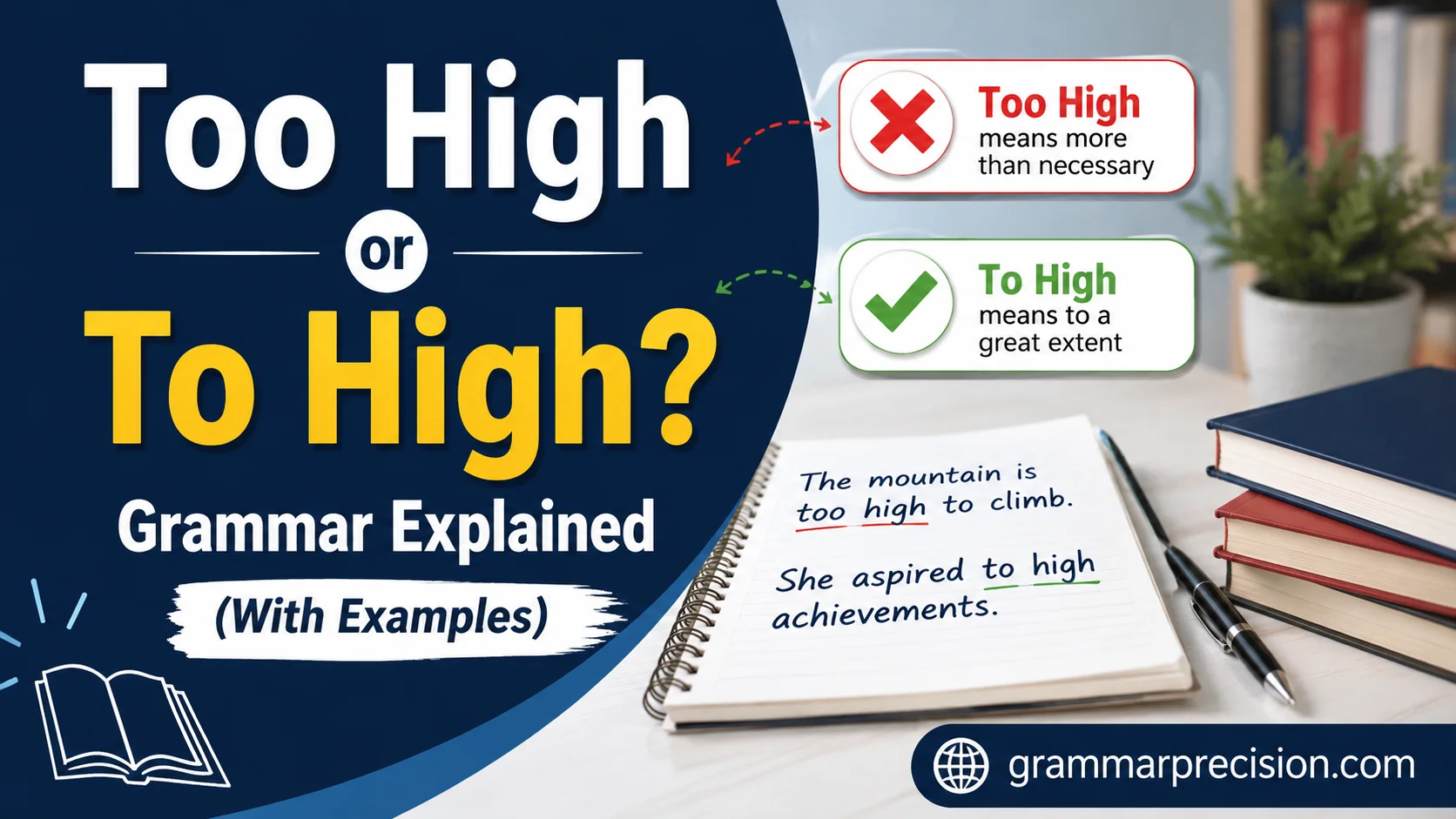
Too high is the correct phrase when you mean excessively high, higher than necessary, or higher than acceptable.
Correct
- The shelf is too high.
- The price is too high.
- The temperature is too high.
- The wall is too high to climb.
- Your expectations are too high.
Incorrect in the intended meaning
- The shelf is to high.
- The price is to high.
- The temperature is to high.
- The wall is to high to climb.
The basic rule is straightforward:
Use “too high” when “too” means “more than enough” or “excessively.”
English dictionaries classify too as an adverb and describe this use as indicating something beyond what is wanted, suitable, necessary, or enough.
| Phrase | Correct? | Meaning |
| Too high | ✅ | Higher than desirable or acceptable |
| To high | ❌ in this intended construction | Usually a spelling or grammar error |
| Two high | ❌ | “Two” refers to the number 2 |
That distinction solves most cases immediately.
Why “Too High” Is Correct
The secret lies in the grammatical role of too.
In too high, the word too modifies the adjective high. It tells you that the degree of “high” has gone beyond an appropriate limit.
Consider these sentences:
- The ceiling is high.
- The ceiling is very high.
- The ceiling is too high.
Each sentence communicates something slightly different.
High simply describes the ceiling.
Very high emphasizes its height.
Too high adds a judgment about that height. It suggests that the ceiling has reached a level that creates a problem or exceeds what is suitable for the situation.
That distinction is important. Too doesn’t merely make an adjective stronger. It often introduces the idea of excess.
For example:
The coffee is hot.
This is a neutral observation.
The coffee is very hot.
Now the speaker emphasizes the temperature.
The coffee is too hot.
Now the temperature has crossed a practical limit. Perhaps you can’t drink it yet.
The same pattern works with high.
The price is high.
The price is very high.
The price is too high.
The last sentence tells the reader that the price isn’t merely substantial. It’s higher than the speaker considers reasonable or affordable.
Cambridge and Oxford both describe this use of too as coming before adjectives or adverbs to indicate a degree greater than what is good, necessary, possible, or suitable.
What Does “Too High” Mean?
Too high generally means higher than an acceptable, desired, practical, or reasonable level.
The exact standard depends on context.
A price can be too high for your budget. A shelf can be too high for a child to reach. A temperature can be too high for a particular process. A sound level can be too high for comfortable listening.
In other words, “too high” needs an implied or stated limit.
Too High Can Describe Physical Height
The top shelf is too high for me to reach.
The shelf isn’t necessarily high in an absolute sense. It might be perfectly reachable for someone taller.
Too High Can Describe Cost
The restaurant’s prices are too high for students.
Here, “high” refers to cost rather than physical elevation.
Too High Can Describe Temperature
The oven temperature is too high for this recipe.
The phrase describes a measurement that exceeds the appropriate range.
Too High Can Describe Sound
The volume is too high.
Nothing is physically elevated. Instead, the intensity of the sound exceeds a comfortable level.
Too High Can Describe Abstract Ideas
The company’s expectations are too high.
Now high describes a standard or expectation. The phrase still expresses excess.
This flexibility explains why too high appears in many different kinds of English.
Why “To High” Doesn’t Work
The word to has several important jobs in English, but expressing excessive degree isn’t one of them.
Most commonly, to works as a preposition or as part of an infinitive construction.
For example:
- We drove to the airport.
- She walked to school.
- Give the letter to him.
- I want to leave.
- They plan to study.
- He tried to climb.
Notice something important: when to introduces an infinitive, it normally comes before a base-form verb.
to climb
to reach
to run
to improve
High, however, is usually an adjective in phrases such as “too high.”
So if you write:
The shelf is to high.
you haven’t used the infinitive structure correctly. You also haven’t used to as a directional preposition.
That’s why the sentence doesn’t work.
Dictionary.com similarly distinguishes to from too by explaining that to commonly expresses relationships such as direction or introduces an infinitive, while too can mean “also” or “to an excessive degree.”
What Is the Difference Between “To” and “Too”?
The simplest way to understand these words is to give each one a separate job.
To Shows Direction or Relationship
You can use to when something moves toward a place or person.
We went to the store.
She sent the email to her manager.
He walked to the top of the hill.
To Introduces an Infinitive
You also use to before the base form of a verb.
I want to learn.
She needs to leave.
They decided to wait.
We tried to climb the wall.
Too Shows Excess
When too means “more than enough” or “more than acceptable,” it normally comes before an adjective or adverb.
The bag is too heavy.
The water is too cold.
The shelf is too high.
He drives too quickly.
Cambridge’s grammar guidance specifically notes that too is used immediately before adjectives and adverbs in this meaning.
Too Can Also Mean “Also”
There is another common meaning of too.
I want to come too.
She likes coffee too.
They were invited too.
Here, too means also or as well. This meaning isn’t related to height, but knowing it helps you recognize the word more easily.
A Simple Visual Rule for “Too High”
When you’re unsure whether to write to high or too high, ask yourself one question:
Is something higher than it should, needs, or can reasonably be?
↓
YES
↓
TOO HIGH
If the answer is yes, too high is the phrase you want.
For example:
The rent is higher than I can afford.
That becomes:
The rent is too high.
Or:
The branch is higher than I can reach.
That becomes:
The branch is too high.
It’s a small mental trick, but it works surprisingly well.
Too High in Real-World Examples
One reason this phrase causes confusion is that high can describe far more than physical elevation.
| Context | Example | What “high” describes |
| Price | The price is too high. | Cost |
| Temperature | The temperature is too high. | Heat |
| Shelf | The shelf is too high. | Physical position |
| Volume | The volume is too high. | Sound level |
| Speed | The speed is too high. | Rate |
| Risk | The risk is too high. | Degree of danger |
| Expectations | Expectations are too high. | Standards |
| Pressure | The pressure is too high. | Measured force |
| Interest rate | The rate is too high. | Financial level |
| Mountain | The mountain is too high to climb easily. | Elevation |
This versatility makes too high a useful phrase in everyday conversation, business writing, technical communication, and academic contexts.
Too High vs. Very High: What’s the Difference?
These expressions look similar, but they don’t communicate the same idea.
High
High simply describes a level above a reference point.
The building is high.
There isn’t necessarily a complaint.
Very High
Very high increases the intensity.
The building is very high.
The speaker emphasizes the building’s considerable height.
Too High
Too high introduces excess.
The building is too high for this neighborhood.
Now the speaker suggests that the height has crossed some relevant boundary.
Here’s the difference at a glance:
| Expression | Main idea | Example |
| High | Elevated level | The shelf is high. |
| Very high | Extremely elevated | The shelf is very high. |
| Too high | Beyond a suitable limit | The shelf is too high to reach. |
The distinction matters because replacing too with very can change the meaning.
The price is very high.
This could simply describe an expensive product.
The price is too high.
This suggests that the price exceeds what someone is willing or able to pay.
Too often carries a practical consequence.
Also Read This: Protagonist vs Antagonist: Easy Ways to Tell Them Apart
Too High to…: The Construction You Should Know
One of the most useful patterns in English is:
too + adjective + to + verb
This structure explains why you can sometimes see both too and to in the same sentence.
For example:
The shelf is too high to reach.
Here, the two words have completely different jobs.
- too = excessively
- high = adjective
- to reach = infinitive
The sentence doesn’t contain a mistake. In fact, it’s a textbook example of both words working correctly.
More Examples
The wall is too high to climb.
The price is too high to justify.
The ceiling is too high to paint without a ladder.
The temperature is too high to work safely.
The mountain is too high to reach in one day.
Oxford’s American English dictionary gives the same general grammatical pattern, describing too + adjective/adverb + to-infinitive as a way to express a degree beyond what is possible or suitable.
Why This Pattern Is Easy to Misread
Look at this sentence:
The box is too heavy to carry.
Someone learning English might see too and to close together and assume one of them should disappear.
Neither should.
Too modifies heavy.
To introduces carry.
The structure is:
too + heavy + to + carry
Once you see the grammatical roles, the confusion disappears.
Too High vs. Too Tall
Another useful distinction involves high and tall.
Both words relate to vertical measurement, but they’re not interchangeable in every situation.
Tall commonly describes people, buildings, trees, and other objects considered vertically elongated.
She is tall.
That is a tall building.
High often focuses on position, elevation, level, or distance above a reference point.
The shelf is high.
The plane is flying high.
The mountain is high.
Therefore:
The shelf is too high for me to reach.
sounds natural.
Meanwhile:
The building is too tall for the neighborhood.
can sound more natural when discussing its overall vertical size.
Context determines the best choice.
Too High vs. Too Much
Another common mistake is treating too high and too much as interchangeable.
They’re not.
Use too high when you’re describing a level, degree, measurement, or intensity.
The temperature is too high.
The price is too high.
The pressure is too high.
Use too much with an excessive quantity or amount.
There is too much water.
We spent too much money.
He added too much salt.
The distinction becomes especially clear with nouns:
The price is too high.
The price is too high for my budget.
But:
We paid too much for it.
Both sentences can describe the same situation from different grammatical angles.
Cambridge’s grammar guidance distinguishes too + adjective/adverb from too much and too many, which modify quantities of uncountable and countable nouns respectively.
Common Mistakes With “Too High”
Even experienced writers can make small homophone errors when typing quickly.
Mistake: Using “To High”
❌ The price is to high.
✅ The price is too high.
Mistake: Using “Two High”
❌ The shelf is two high.
✅ The shelf is too high.
Two refers to the number 2. It has no role in this construction.
Mistake: Confusing “Too High” With “Very High”
❌ The price is too high.
when you simply mean the price is notably expensive.
Better:
The price is very high.
Use too high when the amount crosses a meaningful limit.
Mistake: Forgetting the Second “O”
This is the most common spelling problem:
to high ❌
too high ✅
A useful memory device is simple:
Too has two o’s because it means more.
It’s not a formal grammar rule. It’s just a handy spelling trick.
A Mini Case Study: How One Letter Changes the Message
Imagine a customer writing a complaint about a hotel.
The intended sentence is:
The room rate is too high for what the hotel offers.
That sentence clearly tells the reader that the price exceeds the customer’s acceptable limit.
Now imagine the same sentence written as:
The room rate is to high for what the hotel offers.
The reader can probably infer the intended meaning. However, the spelling error immediately weakens the sentence.
In professional writing, small mistakes can distract readers from the message. The problem isn’t the complexity of the grammar. It’s that to and too perform different grammatical functions.
The same issue can appear in resumes, emails, school assignments, product reviews, business reports, and social media posts.
A two-letter distinction can make a sentence look polished or careless.
How to Remember “Too High” Every Time
Try this three-part memory system.
Remember “Too” for Excess
If you can replace too with excessively, you almost certainly need too.
The price is too high.
becomes:
The price is excessively high.
The meaning remains intact.
Remember “To” for Movement or Action
If to introduces a destination or a verb, use to.
Go to the store.
Want to climb.
Need to leave.
Remember “Two” for the Number
If you’re counting, use two.
I have two books.
She bought two tickets.
That gives you a useful three-way test:
| Word | Main use | Example |
| To | Direction or infinitive | Go to school. |
| Too | Excess or addition | It’s too high. |
| Two | Number 2 | I have two books. |
Dictionary.com makes the same core distinction among these three homophones: to has several grammatical functions, too can indicate excess or addition, and two represents the number 2.
Quick Quiz: “To” or “Too”?
See whether you can choose the correct word without looking at the answers.
Try These Sentences
- The price is ___ high for my budget.
- I want ___ climb the mountain.
- The shelf is ___ high to reach.
- She went ___ the top floor.
- The temperature is ___ high.
- They need ___ leave early.
- I bought ___ tickets.
- The volume is ___ high.
- He walked ___ the nearest station.
- The wall is ___ high for the ladder.
Answers
- too
- to
- too
- to
- too
- to
- two
- too
- to
- too
The trick is to focus on meaning rather than pronunciation.
If the word expresses excess, choose too.
If it introduces an action or indicates direction, choose to.
If you’re talking about the number 2, choose two.
Is “To High” Ever Correct?
In ordinary English, to high isn’t the correct replacement for too high.
However, it’s worth being precise. The two words to and high can appear next to each other in unusual grammatical environments if high is functioning in another way or belongs to a larger construction.
That doesn’t make to high a standard phrase meaning “excessively high.”
For practical writing, the rule is much simpler:
If you mean higher than acceptable, write too high.
Don’t overcomplicate it.
FAQs:
Is “Too High” or “To High” Correct?
Too high is correct when you mean something is higher than necessary, expected, or acceptable. “To high” is generally incorrect in standard English because too expresses excess or an excessive degree.
What Does “Too High” Mean?
Too high means that something has reached a level, height, price, temperature, or amount that is more than appropriate or wanted. For example: “The price is too high for me.”
Why Is “To High” Incorrect?
To is usually used to show direction, movement, purpose, or connection, while too can mean “more than needed.” Therefore, when describing an excessive level or height, too high is the correct expression.
Can I Use “Too High” for Prices?
Yes, you can use too high when a price is more than you consider reasonable or affordable. For example: “The rent is too high for this area.” This usage is common in everyday English.
How Can I Remember “Too High”?
A simple way to remember it is that too often means more than necessary. If you want to say something is excessively high, use too high. Remember: “The temperature is too high,” not “to high.”
Conclusion:
Too high is the correct expression when you want to describe something that is higher than necessary or acceptable. The word too shows an excessive degree, while to has different grammatical functions.
Understanding this simple difference can help you avoid a common English grammar mistake. Use too high confidently in everyday speech, formal writing, and clear communication.