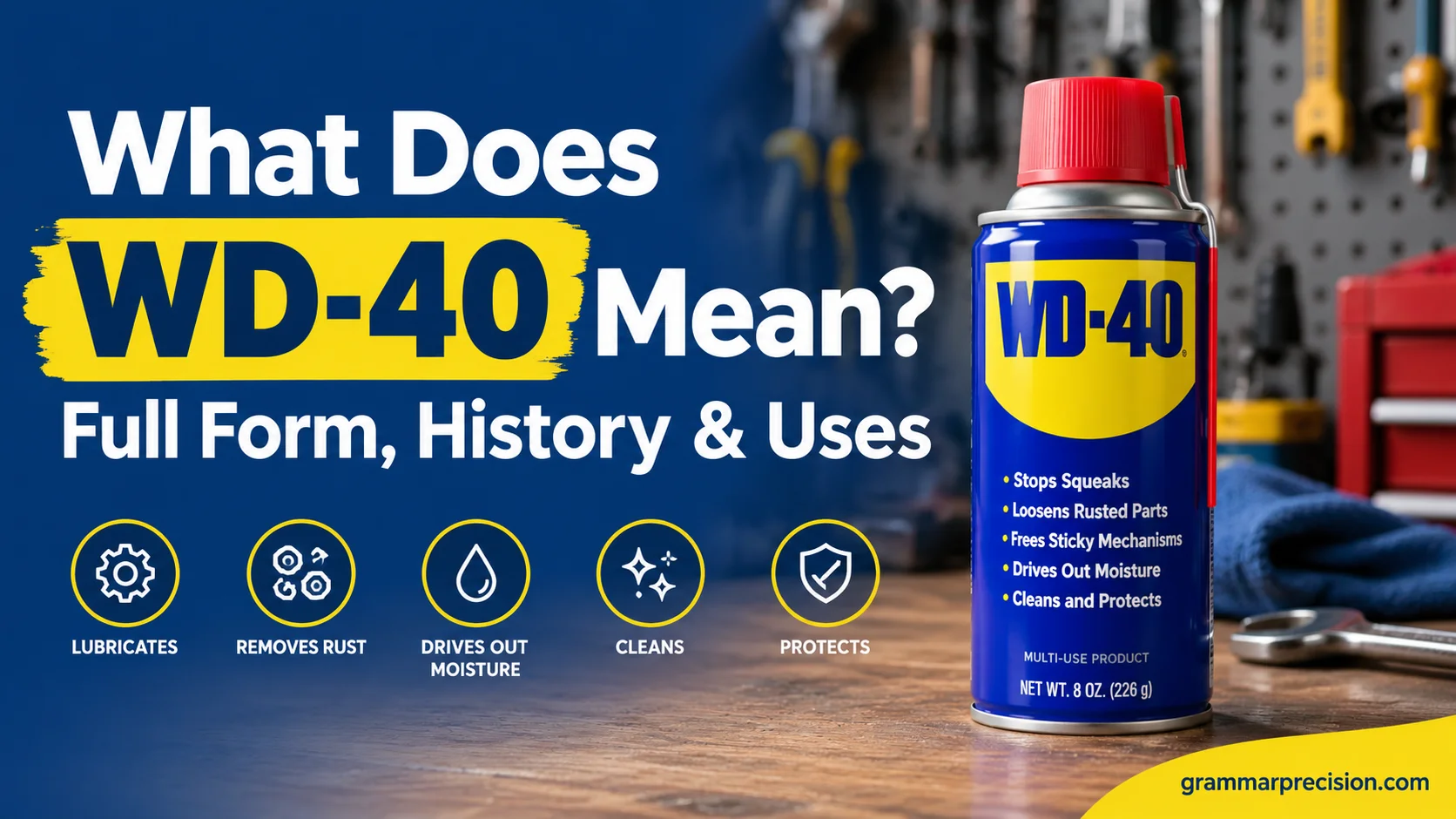
Have you ever looked at that familiar blue-and-yellow can and wondered, what does WD-40 mean? The name has a fascinating story rooted in water displacement, corrosion protection, and product development. This guide explains the WD-40 meaning, its full form, origin, history, and practical uses. You’ll also discover how its role extends from household maintenance to workshops, automotive care, and industrial applications.
Understanding product terminology matters just as much in business communication and formal writing as it does in everyday English usage. Clear wording supports consistency, whether you’re creating a project management schedule, organizing meetings on a calendar, handling online booking, managing scheduling and time management tasks, or preparing broadcasting content. This article also considers US and UK style preferences, since usage can vary across regional style guides and grammar conventions. By the end, you’ll know exactly what WD-40 stands for and why the number 40 matters.
What Does WD-40 Stand For?
WD-40 stands for “Water Displacement, 40th formula.” According to the company, that name came directly from the laboratory work surrounding the product’s development.
The original goal wasn’t to create a magical household spray. Researchers wanted a formula that could help protect metal from moisture, rust, and corrosion. After repeated attempts, the successful formulation emerged on the 40th try.
That achievement explains both parts of the name:
| Part of the Name | Meaning |
| WD | Water Displacement |
| 40 | The 40th formulation attempt |
| WD-40 | Water Displacement, 40th formula |
The name therefore isn’t a random product code. It tells a small piece of the product’s origin story.
Why Does Water Displacement Matter?
Water and bare metal aren’t a friendly combination. Moisture can contribute to corrosion, especially when metal remains exposed for extended periods.
A water-displacing product helps push moisture away from a surface. That basic concept played a central role in WD-40’s original purpose.
So, when someone asks “What does WD-40 mean?”, the shortest accurate answer is Water Displacement, 40th formula.
What Is WD-40?
WD-40 Multi-Use Product is a versatile maintenance product designed for several jobs involving metal, moisture, stuck components, grime, and corrosion.
It can displace moisture, penetrate stuck parts, protect against corrosion, dissolve certain adhesives, and provide lubrication. The manufacturer describes the original formula as having thousands of potential uses across household and industrial settings.
However, “multi-use” doesn’t mean “best for absolutely everything.”
Different jobs often require different formulations. A dedicated grease, silicone lubricant, contact cleaner, or penetrating oil may perform better in specific situations.
Think of WD-40 as a versatile problem-solving tool, not a universal substitute for every maintenance product.
The Fascinating History Behind WD-40
The story starts in 1953 in San Diego, California. Rocket Chemical Company was founded by Norman B. Larsen, Gordon Dawson, and John B. Gregory.
The small company had only three employees when it began working on rust-prevention solvents and degreasers for the aerospace industry.
The challenge was straightforward in theory but difficult in practice: develop a formula that could displace water and help protect metal from corrosion.
It took 40 attempts to get the desired result.
That 40th successful formulation eventually became WD-40 Multi-Use Product.
WD-40’s Aerospace Beginning
The product’s first commercial application involved Convair, an aerospace contractor. Convair used WD-40 to protect the outer skin of the Atlas Missile from rust and corrosion.
Here’s where the story gets interesting.
Some Convair employees liked the product enough to take cans home for personal use. Those unofficial household experiments helped reveal something important: a product created for aerospace maintenance could solve plenty of ordinary household problems too.
That discovery helped shape WD-40’s future.
When Did WD-40 Reach Stores?
WD-40 first appeared on store shelves in San Diego in 1958.
Norm Larsen, founder and president of Rocket Chemical Company, experimented with packaging the formula in aerosol cans. The idea was simple: if industrial workers found useful applications at home, consumers might do the same.
The gamble worked.
By 1960, the company had grown to seven employees and was selling an average of 45 cases per day to hardware and sporting-goods stores throughout the San Diego area.
How Did the Company Get the WD-40 Name?
The company eventually became so closely associated with its only product that it adopted the WD-40 name.
In 1969, Rocket Chemical Company was renamed WD-40 Company. The business later went public in 1973.
Today, WD-40 products are marketed across more than 176 countries and territories, showing just how far that original 1953 formula traveled.
How Does WD-40 Work?
Understanding how WD-40 works makes its many uses easier to understand.
The original product performs several related maintenance functions rather than relying on one single effect. It can help displace moisture, penetrate stuck components, protect metal, loosen certain bonds, and lubricate moving parts.
Imagine a rusty bolt that refuses to move.
Moisture and corrosion may have created a stubborn bond between the metal surfaces. A penetrating product can work its way into those tight spaces and help loosen the connection.
Now consider a metal surface exposed to moisture.
Water sitting against vulnerable metal can encourage corrosion. A water-displacing product can help move that moisture away and leave a protective film behind.
That versatility explains why the same can might appear in a mechanic’s toolbox and a household utility drawer.
Does WD-40 Actually Lubricate?
Yes, but there’s an important distinction.
WD-40 Multi-Use Product can provide lubrication. However, it isn’t automatically the best long-term lubricant for every application.
A specialized lubricant may offer better performance when a component requires:
- Long-lasting lubrication
- High-temperature resistance
- Heavy-load protection
- Specific viscosity
- Food-grade certification
- Specialized plastic or rubber compatibility
The key is to match the product with the job.
What Is WD-40 Made Of?
One of the most interesting facts about WD-40 is that its exact formula remains a trade secret.
The company says it never patented the formula because doing so would require publicly disclosing important formulation information. The company also states that only a single person knows every exact ingredient in the famous formula.
That means websites claiming to reveal a complete official ingredient list should be treated cautiously.
The company does disclose some things the original WD-40 formula does not contain, including:
- Silicone
- Kerosene
- Water
- Graphite
- Chlorofluorocarbons (CFCs)
- Fish oil
This distinction matters because many online discussions confuse WD-40’s reported properties with its exact chemical composition.
What Is WD-40 Used For?
The original product has earned its reputation because it can handle a surprisingly broad range of maintenance jobs.
Here are some of its most practical applications.
Loosening Stuck Parts
Rusty nuts, bolts, hinges, and mechanical components can become difficult to move.
WD-40 can penetrate tight spaces and help loosen stuck connections. For heavily seized components, however, a specialized penetrating product may be a better choice.
Protecting Metal From Corrosion
Moisture is one of the major enemies of exposed metal.
WD-40 can help displace moisture and provide a protective film. This makes it useful for tools, hardware, machinery, and other metal surfaces that need protection from corrosion.
Removing Adhesive Residue
Sticky residue from labels and adhesives can be frustrating.
WD-40 can help loosen certain adhesive residues, making them easier to remove. Always test an inconspicuous area first because surface compatibility varies.
Silencing Squeaky Mechanisms
A squeaky hinge can turn a quiet room into a miniature horror movie.
WD-40 can reduce friction and help quiet certain moving mechanisms. For long-term lubrication, though, a dedicated hinge or mechanical lubricant may provide better results.
Cleaning Certain Surfaces
WD-40 can help loosen grease, grime, tar, and residue from suitable surfaces.
Its manufacturer specifically lists applications involving adhesive removal and cleaning-related tasks.
25 Clever WD-40 Uses You Might Not Know
WD-40 has accumulated thousands of reported uses over the decades. Some are practical, while others are surprisingly unusual.
Here are useful examples:
- Loosening rusty bolts
- Protecting metal tools from moisture
- Cleaning certain adhesive residue
- Helping free stuck hinges
- Removing road tar from suitable automotive surfaces
- Protecting outdoor metal hardware
- Loosening corroded mechanical parts
- Helping clean grime from tools
- Protecting certain metal components during storage
- Reducing squeaks in suitable mechanisms
- Helping remove stubborn labels
- Displacing moisture from appropriate metal components
- Cleaning certain bicycle components
- Helping loosen seized fasteners
- Protecting workshop tools from surface corrosion
- Removing certain sticky residues
- Helping free moving mechanical parts
- Cleaning suitable metal surfaces
- Maintaining certain hinges
- Helping remove grime from equipment
- Protecting selected outdoor hardware
- Helping loosen old mechanical connections
- Cleaning certain automotive residues
- Maintaining appropriate moving parts
- Helping restore movement to stuck mechanisms
Not every use is appropriate for every material. Always check the surface and application before spraying.
WD-40 Uses Around the House
You don’t need a workshop full of machinery to find WD-40 useful.
Around the home, people commonly use it for stiff hinges, sticky residue, metal hardware, tools, and moisture-related maintenance.
For example, imagine a metal hinge that squeaks every time you open a door. A small amount of product can help reduce friction and quiet the movement.
Likewise, an old metal tool stored in a damp garage may develop surface rust. A corrosion-protective product can help protect appropriate metal surfaces.
The important word is appropriate. Don’t spray blindly. Different finishes, materials, and mechanisms respond differently to chemical products.
WD-40 Uses in Automotive and Mechanical Work
WD-40’s industrial background makes mechanical applications especially relevant.
It can help with:
- Rusted fasteners
- Corroded metal parts
- Moisture displacement
- Mechanical cleaning
- Stuck components
- Tool maintenance
- Certain moving parts
- Corrosion protection
Its industrial documentation lists applications involving hinges, wheels, pulleys, rollers, chains, gears, joints, conveyors, hoists, and tools.
Still, professional maintenance often requires specialized products. Heavy-duty equipment may need a grease designed for pressure, heat, or continuous mechanical loads.
What Should You NOT Use WD-40 For?
A product’s versatility can create a dangerous misconception: if it works in many situations, perhaps it works in all situations.
It doesn’t.
Avoid treating WD-40 as a universal solution for applications that require a specialized product or manufacturer-approved treatment.
Be particularly cautious with:
- Surfaces sensitive to solvents
- Applications requiring food-safe lubricants
- High-temperature environments
- Heavy-load machinery
- Precision mechanisms requiring specialized lubrication
- Surfaces where the manufacturer prohibits petroleum-based products
- Electrical applications where the specific product isn’t approved
For valuable equipment, follow the manufacturer’s maintenance instructions first.
Is WD-40 a Permanent Lubricant?
Usually, that’s the wrong way to think about it.
WD-40 Multi-Use Product can lubricate. However, its broader purpose includes moisture displacement, penetration, cleaning, and corrosion protection.
If a bearing, gear, chain, or machine requires a durable lubricant under specific operating conditions, choose a product formulated for that environment.
A simple rule helps:
Use a multi-purpose product for versatility. Use a specialized lubricant when the application demands specialized performance.
That distinction can prevent unnecessary wear and maintenance problems.
WD-40 vs. Other Maintenance Products
Choosing the right product becomes easier when you understand the difference between common categories.
| Product Type | Main Purpose | Best For |
| WD-40 Multi-Use | Multi-purpose maintenance | Moisture, stuck parts, protection, light lubrication |
| Penetrating oil | Penetrating corrosion bonds | Severely seized fasteners |
| Grease | Long-lasting lubrication | Bearings, heavy-load mechanisms |
| Silicone lubricant | Lubrication and material compatibility | Certain rubber, plastic, and sliding applications |
| Contact cleaner | Electrical contact cleaning | Appropriate electrical components |
| Rust remover | Removing corrosion | Treating established rust |
The right choice depends on the problem.
If a bolt won’t move, penetration matters. If a bearing operates under heavy load, long-lasting lubrication matters more.
Original WD-40 vs. WD-40 Specialist Products
Another common source of confusion involves the word WD-40 itself.
WD-40 is both a brand and the name associated with the original Multi-Use Product. The company also sells specialty maintenance products designed for more specific jobs.
That distinction is important.
The original Multi-Use Product focuses on broad maintenance tasks. Specialist products can target particular needs such as heavy-duty lubrication, penetrating action, corrosion protection, or other maintenance requirements.
So, don’t assume every blue-and-yellow can performs identically.
Read the label and choose the formulation designed for the job.
Common WD-40 Myths Debunked
WD-40 has been around for decades, so myths have naturally accumulated around it.
Myth: WD-40 Means 40 Ingredients
False.
The “40” refers to the successful 40th formulation attempt, not the number of ingredients.
Myth: WD-40 Was Originally a Household Product
False.
Its original development focused on aerospace applications involving rust prevention and water displacement.
Myth: WD-40 Was Invented in the 1940s
False.
The product dates to 1953. Rocket Chemical Company began its work that year in San Diego.
Myth: WD-40 Has a Fully Public Formula
False.
The exact formula remains a closely protected trade secret.
Myth: WD-40 Is the Best Lubricant for Everything
False.
It can lubricate, but specialized products can perform better for specific operating conditions.
A Quick WD-40 Case Study: From Missile Protection to Household Staple
WD-40’s evolution offers a useful lesson in product development.
The original problem: protect aerospace metal from rust and corrosion.
The technical solution: create a water-displacing formulation.
The unexpected discovery: workers found practical household applications.
The consumer opportunity: package the product in an aerosol can.
The result: a specialized industrial solution became a mainstream household product.
The transition is remarkable because the product didn’t begin with a broad consumer market. Its versatility emerged through real-world use.
That makes WD-40 an excellent example of how one solution can develop an entirely new market when users discover additional applications.
Interesting WD-40 Facts
Here are several facts worth remembering:
- WD-40 originated in 1953.
- Rocket Chemical Company began with three employees.
- The successful formula came after 40 attempts.
- Convair first used it commercially to protect the Atlas Missile’s exterior.
- WD-40 reached San Diego store shelves in 1958.
- The company became WD-40 Company in 1969.
- WD-40 Company went public in 1973.
- The original formula remains a trade secret.
- WD-40 products are marketed in more than 176 countries and territories.
- The brand has accumulated thousands of reported uses over the decades.
FAQs About What WD-40 Means
What does WD-40 mean?
WD-40 means “Water Displacement, 40th formula.” The name refers to the successful formulation developed on the 40th attempt in 1953.
What does WD stand for in WD-40?
WD stands for Water Displacement. The original product was developed to help protect metal from moisture and corrosion.
Why is WD-40 called WD-40?
The product received the name because its water-displacing formulation succeeded on the 40th attempt. The name came from the laboratory work surrounding its development.
What was WD-40 originally made for?
WD-40 was originally developed for aerospace applications, particularly to help protect metal from rust and corrosion. Convair used it on the outer skin of the Atlas Missile.
Is WD-40 a lubricant?
Yes. WD-40 Multi-Use Product can lubricate, but it also performs other functions such as moisture displacement, penetration, cleaning, and corrosion protection. Specialized lubricants may be better for demanding applications.
Is WD-40 made with fish oil?
No. The company specifically states that WD-40 Multi-Use Product does not contain fish oil.
Is WD-40 safe for every surface?
No. Surface compatibility matters. Always check the product label and test an inconspicuous area when you’re unsure.
Conclusion:
Ultimately, understanding what does WD-40 mean reveals its practical history, from water displacement to corrosion protection, helping explain why this versatile product remains popular worldwide.
WD-40 combines history, versatility, and practical value in one familiar product. Understanding its full form, original purpose, common uses, limitations, and safety considerations helps you choose it wisely for household, automotive, mechanical, and maintenance tasks.