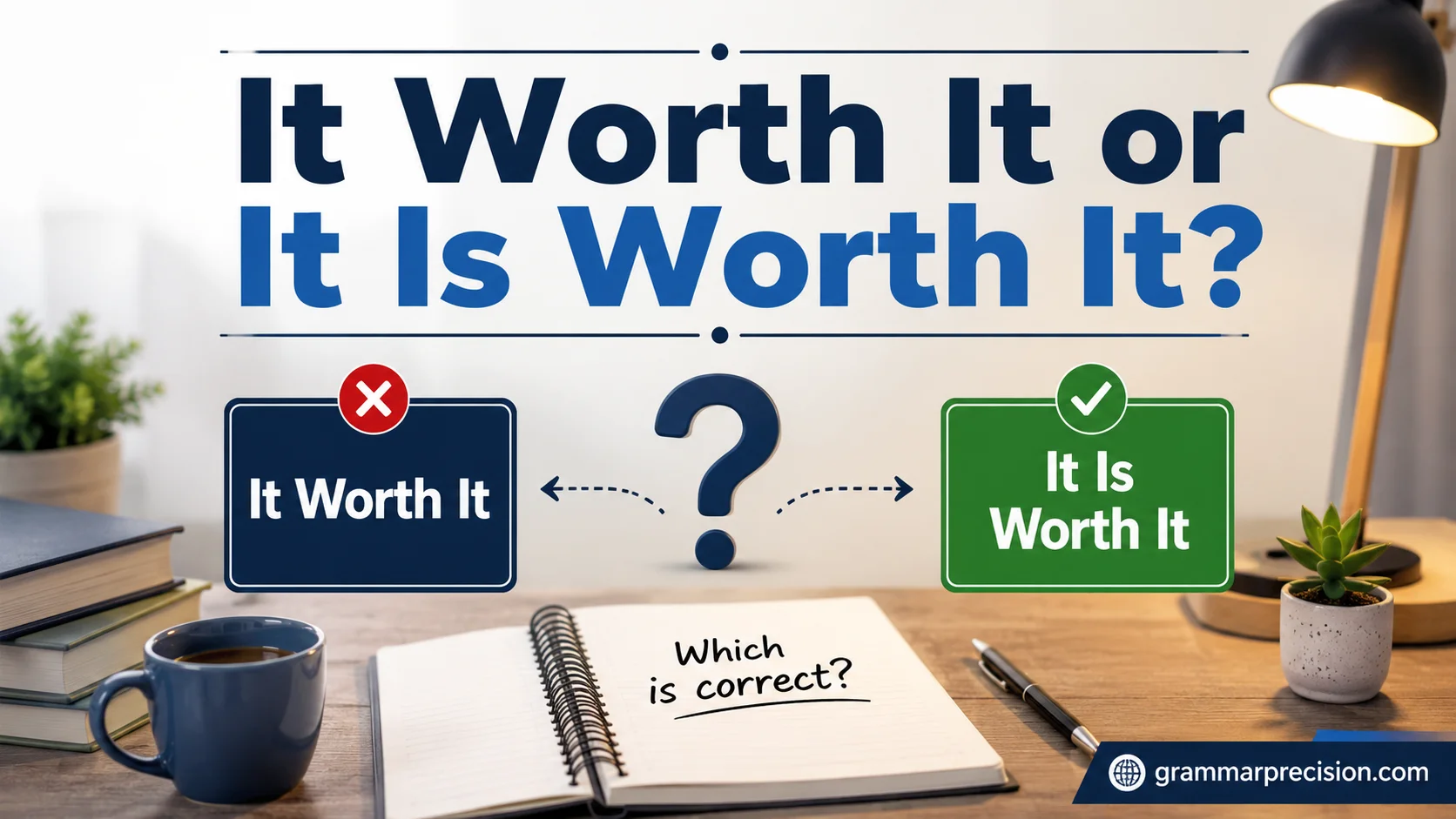
Wondering whether It Worth It or It Is Worth It is correct? You’re not alone. This guide explains the right grammar, common mistakes, and everyday usage in simple English.
Many English learners accidentally write “It Worth It” because they translate directly from their native language or overlook the linking verb. Understanding this small grammar rule can make your writing and speaking sound much more natural, accurate, and confident in both formal and everyday conversations.
In this complete guide, you’ll discover the correct expression, learn the grammar behind “It Is Worth It,” explore practical examples, avoid common mistakes, and master useful sentence patterns. By the end, you’ll use this phrase with confidence, accuracy, and a much better understanding of everyday English.
The Short Answer
If you’re looking for a quick answer, here it is.
| Phrase | Correct? | Reason |
| It is worth it. | ✅ Yes | Complete sentence with the linking verb is. |
| It worth it. | ❌ No | Missing the verb is. |
Correct Example
It is worth it to study every day.
Incorrect Example
It worth it to study every day.
The difference is only one small word, but that word makes all the difference.
Why “It Worth It” Is Incorrect
Many learners ask why they can’t simply say “it worth it.” The answer comes down to basic English sentence structure.
Every complete English sentence usually needs a subject and a verb.
In this sentence:
- It = subject
- Is = linking verb
- Worth it = complement
Without the verb is, the sentence is incomplete.
Think of it like building a bridge. Remove one support beam and the bridge collapses. In the same way, removing is breaks the sentence.
Sentence Structure
Subject + Linking Verb + Complement
It + is + worth it
Now compare it with the incorrect version.
Subject + Complement
It + worth it ❌
The verb is missing, so the sentence doesn’t follow English grammar rules.
Why “It Is Worth It” Is Correct
The phrase “it is worth it” follows the standard English pattern.
The word worth functions as an adjective after the linking verb is.
Here’s the formula.
| Formula | Example |
| Subject + be + worth + noun | It is worth the money. |
| Subject + be + worth + pronoun | It is worth it. |
| Subject + be + worth + verb-ing | It is worth reading. |
Notice something important.
The verb to be changes depending on the subject and tense.
Present Tense
- It is worth it.
- This is worth buying.
- The trip is worth taking.
Past Tense
- It was worth it.
- The wait was worth it.
Future
- It will be worth it.
Once you understand this pattern, you’ll avoid one of the most common grammar mistakes in English.
What Does “Worth It” Actually Mean?
The expression worth it means something provides enough value, benefit, or satisfaction to justify the cost, effort, time, or risk.
In simple words, it answers one question:
Was the result good enough?
For example:
- The movie was expensive, but it was worth it.
- The vacation cost a lot of money, but it was worth every dollar.
- Learning English takes time, but it is worth it.
The phrase can refer to many different things.
- Money
- Time
- Effort
- Energy
- Patience
- Risk
- Sacrifice
Whenever the benefits outweigh the costs, you can say something is worth it.
Understanding the Grammar Behind “Worth”
One reason learners struggle with this phrase is that worth doesn’t behave like a regular adjective.
Instead, it often introduces a noun or a verb ending in -ing.
Correct Patterns
- It is worth the effort.
- It is worth the wait.
- It is worth reading.
- It is worth trying.
- It is worth visiting.
Incorrect Patterns
- It is worth to read. ❌
- It is worth to try. ❌
- It worth reading. ❌
Remember this simple rule.
After worth, use a noun or a verb ending in -ing.
Everyday Examples of “It Is Worth It”
Grammar becomes much easier when you see it in real situations.
At Work
Imagine you’re working overtime to finish a project.
Your coworker asks,
“Was staying late really necessary?”
You answer,
“Yes, it was worth it because we impressed the client.”
Another example:
- The training course took three weeks.
- It was worth it because everyone learned new skills.
At School
Students often use this phrase after exams.
Examples:
- Studying every evening was worth it.
- Buying that textbook is worth it.
- Practicing every day is worth the effort.
Even difficult subjects become rewarding over time.
Shopping
Consumers constantly decide whether products are worth buying.
Examples:
- The laptop was expensive, but it is worth it.
- Those shoes cost more than expected, but they’re worth it.
- The premium version is worth the extra money.
Notice how worth it often appears in reviews.
Travel
Travel requires both money and planning.
Examples include:
- The hike was exhausting, but it was worth it.
- The long flight was worth every minute.
- Visiting the museum is worth your time.
Travel blogs frequently use this expression because readers want to know whether an experience justifies the expense.
Relationships
People also use the phrase emotionally.
Examples:
- Building trust is worth the effort.
- Waiting for the right opportunity was worth it.
- Every challenge was worth it in the end.
The expression isn’t limited to money. It often describes emotional rewards.
Common Mistakes English Learners Make
Even advanced learners occasionally misuse this phrase.
Here are the most frequent mistakes.
| Mistake | Correct Form |
| It worth it. | It is worth it. |
| It worth buying. | It is worth buying. |
| It worth the money. | It is worth the money. |
| It worth to read. | It is worth reading. |
| Worth to watch. | Worth watching. |
Mistake One: Omitting the Verb
This is the biggest mistake.
Incorrect:
It worth it.
Correct:
It is worth it.
Mistake Two: Using “To” After Worth
Many learners say:
It is worth to visit.
Correct version:
It is worth visiting.
Mistake Three: Translating Directly
In many languages, the equivalent expression doesn’t require a linking verb.
Learners naturally transfer that grammar into English.
That’s why “it worth it” appears so often.
Learning English becomes easier when you stop translating word for word.
Instead, learn complete expressions.
Why Native Speakers Sometimes Say “Worth It”
Here’s something that confuses learners.
Native speakers occasionally say only:
Worth it!
Isn’t that breaking the grammar rule?
Not really.
This is called ellipsis, where words are intentionally omitted because everyone understands the meaning.
For example:
Friend:
“How was the concert?”
Reply:
“Worth it!”
The full sentence is actually:
“It was worth it.”
The shortened version is acceptable in conversation because the missing words are understood.
However, this doesn’t mean “it worth it” suddenly becomes correct.
There’s a big difference.
| Expression | Acceptable? |
| Worth it! | ✅ Yes (informal reply) |
| It was worth it. | ✅ Yes |
| It is worth it. | ✅ Yes |
| It worth it. | ❌ No |
Similar Expressions You Should Learn
Once you’ve mastered it is worth it, you’ll notice several related expressions.
It’s Worth Trying
Example:
It’s worth trying a different approach.
It’s Worth Remembering
Example:
It’s worth remembering that practice improves fluency.
It’s Worth Visiting
Example:
That national park is worth visiting.
It’s Worth Seeing
Example:
The sunset is worth seeing.
It’s Worth Buying
Example:
This dictionary is worth buying if you study English regularly.
These expressions follow exactly the same grammar pattern.
Also Read This: Entwined or Intertwined: The Complete Guide to Understanding the Difference
Quick Grammar Formula You Can Memorize
Instead of memorizing hundreds of sentences, remember one simple formula.
Subject
+
Verb “to be”
+
Worth
+
Noun / Pronoun / Verb-ing
Examples:
- It is worth the effort.
- It is worth your time.
- It is worth reading.
- It was worth waiting.
- The experience was worth every second.
Whenever you build a sentence using this pattern, you’ll almost always be correct.
A Simple Memory Trick
Imagine worth as a passenger.
The passenger cannot drive the car.
The verb is is the driver.
Without the driver, the car doesn’t move.
Likewise, without is, your sentence doesn’t work.
Remember this phrase:
No “is,” no sentence.
That tiny rule can save you from making this mistake for the rest of your life.
Formal vs. Informal Usage of “It Is Worth It”
One reason this expression appears in so many situations is its flexibility. You can use it in formal writing, business conversations, academic discussions, and everyday speech.
The wording changes slightly depending on the situation, but the grammar rule stays the same.
| Situation | Recommended Expression | Example |
| Everyday conversation | It is worth it. | It is worth it if you enjoy the experience. |
| Business | It is worth the investment. | The software is worth the investment. |
| Academic writing | It is worth considering. | The proposal is worth considering before making a decision. |
| Reviews | It is worth buying. | The camera is worth buying for beginners. |
| Travel | It is worth visiting. | The historic district is worth visiting in the spring. |
Notice that “worth” adapts naturally to different contexts without changing the grammar.
“Worth It” in Movies, Reviews, and Social Media
If you’ve ever read online reviews or watched YouTube videos, you’ve probably seen headlines like these:
- Is the new phone worth it?
- Is the premium plan worth it?
- Was the upgrade worth it?
- Is college worth it?
- Is the subscription worth it?
Reviewers use this phrase because readers want one simple answer:
Does the value justify the cost?
Here are some realistic examples.
Product Review
The headphones cost more than competing models. However, the sound quality and battery life make them worth it.
Restaurant Review
Dinner wasn’t cheap. Still, the fresh ingredients and outstanding service made the experience worth it.
Travel Blog
Reaching the waterfall required a two-hour hike. Every step was worth it once the view came into sight.
These examples show that worth it often summarizes an overall evaluation rather than describing a single feature.
Expressions That Follow the Same Grammar Pattern
Once you understand “it is worth it,” you’ll recognize many similar sentence structures.
| Correct Expression | Meaning |
| It is possible. | Something can happen. |
| It is important. | Something has significance. |
| It is necessary. | Something is required. |
| It is useful. | Something has practical value. |
| It is difficult. | Something is challenging. |
| It is amazing. | Something is impressive. |
| It is worth it. | Something provides enough value. |
Each sentence follows the same basic pattern:
Subject + Linking Verb + Complement
That makes them easy to remember together.
Common ESL Errors and How to Fix Them
Even experienced English learners repeat a few common mistakes. Understanding why they happen makes them easier to avoid.
Leaving Out the Verb
Incorrect:
It worth the money.
Correct:
It is worth the money.
Always check that every sentence has a verb.
Using an Infinitive Instead of an -ing Verb
Incorrect:
It is worth to learn English.
Correct:
It is worth learning English.
After worth, use a noun or a gerund (-ing form).
Confusing “Worth” and “Worthy”
These words look similar but have different meanings.
| Word | Example |
| Worth | The trip is worth the cost. |
| Worthy | She is worthy of recognition. |
Worth describes value.
Worthy describes deserving something.
Overusing “Worth It”
Although the phrase is useful, repeating it too often can make your writing sound repetitive.
Instead, vary your vocabulary.
For example:
- It justifies the cost.
- It offers excellent value.
- The benefits outweigh the expense.
- The experience pays off.
- The investment makes sense.
- The results justify the effort.
These alternatives create smoother, more engaging writing.
Tips to Avoid This Mistake Forever
Grammar becomes easier when you develop habits instead of memorizing isolated rules.
Here are several practical strategies.
Learn Complete Phrases
Instead of memorizing individual words, remember complete expressions such as:
- It is worth it.
- It is worth trying.
- It is worth reading.
- It is worth visiting.
- It is worth your time.
Learning chunks improves both fluency and accuracy.
Listen to Native English
Watch interviews, podcasts, documentaries, or television shows.
Pay attention to how speakers naturally use worth in conversation.
You’ll quickly notice that “it worth it” never appears in standard English.
Read More
Books, newspapers, and quality websites reinforce correct sentence patterns.
The more often you see “it is worth…”, the more natural it becomes.
Practice Speaking
Try creating your own examples every day.
For instance:
- It is worth exercising regularly.
- It is worth saving money.
- It is worth asking questions.
- It is worth helping others.
Small daily exercises build long-term confidence.
Real-Life Case Studies
Seeing grammar in action makes it easier to remember.
Case Study: Buying a Laptop
Emma needed a new laptop for university.
She compared several models before choosing a slightly more expensive option.
After using it for an entire semester, she said,
“It was worth it because it’s faster, lighter, and much more reliable.”
Here, worth it compares the higher price with the long-term benefits.
Case Study: Learning English
David spent a year improving his English.
Some days felt frustrating, and progress seemed slow.
Eventually, he earned a better job with an international company.
Looking back, he said,
“Studying every day was worth it.”
The phrase highlights that the final reward exceeded the effort.
Case Study: Traveling Abroad
A family saved money for two years to visit Japan.
Although planning took months, the memories lasted a lifetime.
Their conclusion was simple:
“The trip was absolutely worth it.”
Again, the phrase summarizes overall value rather than focusing on one specific detail.
Quick Practice Exercise
Choose the correct answer.
Question 1
Which sentence is correct?
- A. It worth buying.
- B. It is worth buying.
✅ Answer: B
Question 2
Which sentence is correct?
- A. It is worth reading.
- B. It is worth to read.
✅ Answer: A
Question 3
Complete the sentence.
The museum ______ worth visiting.
- A. is
- B. are
✅ Answer: A
Question 4
Choose the correct sentence.
- A. The experience was worth it.
- B. The experience worth it.
✅ Answer: A
Question 5
Fill in the blank.
Learning a new language is worth ______.
- A. practice
- B. practicing
✅ Answer: B
If you answered all five correctly, you’ve mastered the basic grammar rule.
Quick Reference Table
Save this table whenever you need a fast reminder.
| Correct | Incorrect |
| It is worth it. | It worth it. |
| It was worth it. | It was worth. |
| It is worth reading. | It is worth to read. |
| It is worth trying. | It worth trying. |
| It is worth your time. | It worth your time. |
Key Takeaways
Before you finish, remember these essential points.
- “It is worth it” is the correct expression.
- “It worth it” is grammatically incorrect because it lacks the linking verb is.
- After worth, use a noun, pronoun, or verb ending in -ing.
- Native speakers may simply say “Worth it!” in casual conversation, but that doesn’t make “it worth it” correct.
- Practice complete sentence patterns instead of translating directly from your native language.
- Reading, listening, and speaking regularly will help the correct structure become automatic.
FAQs:
Is “It Worth It” Ever Grammatically Correct?
No, “It Worth It” is not grammatically correct because it is missing the linking verb “is.” The correct expression is “It Is Worth It,” which forms a complete sentence and follows standard English grammar rules.
Why Do People Say “Worth It!” Instead of “It Is Worth It”?
In casual conversations, native speakers often shorten sentences by leaving out words that are already understood. Saying “Worth it!” is an example of ellipsis, but it does not make “It Worth It” a correct sentence.
What Can Come After the Word “Worth”?
The word “worth” is usually followed by a noun, pronoun, or a verb ending in -ing. For example, you can say, “It is worth the effort,” “It is worth it,” or “It is worth reading.”
Can I Use “It Was Worth It” to Talk About the Past?
Yes. “It Was Worth It” is the correct way to describe something in the past. You can use it when talking about experiences, purchases, or efforts that provided enough value to justify the time, money, or energy spent.
How Can I Remember the Correct Phrase Easily?
A simple way to remember is that every complete English sentence needs a subject and a verb. Whenever you use “worth,” make sure you include the correct form of the verb “to be,” such as is, was, or will be.
Conclusion:
Understanding the difference between “It Worth It” and “It Is Worth It” is an important step toward improving your English grammar. While “It Worth It” is incorrect because it lacks the necessary linking verb, “It Is Worth It” follows the correct sentence structure and is appropriate for both spoken and written English. By remembering the simple grammar pattern and practicing it in everyday situations, you’ll write and speak with greater confidence, accuracy, and fluency.