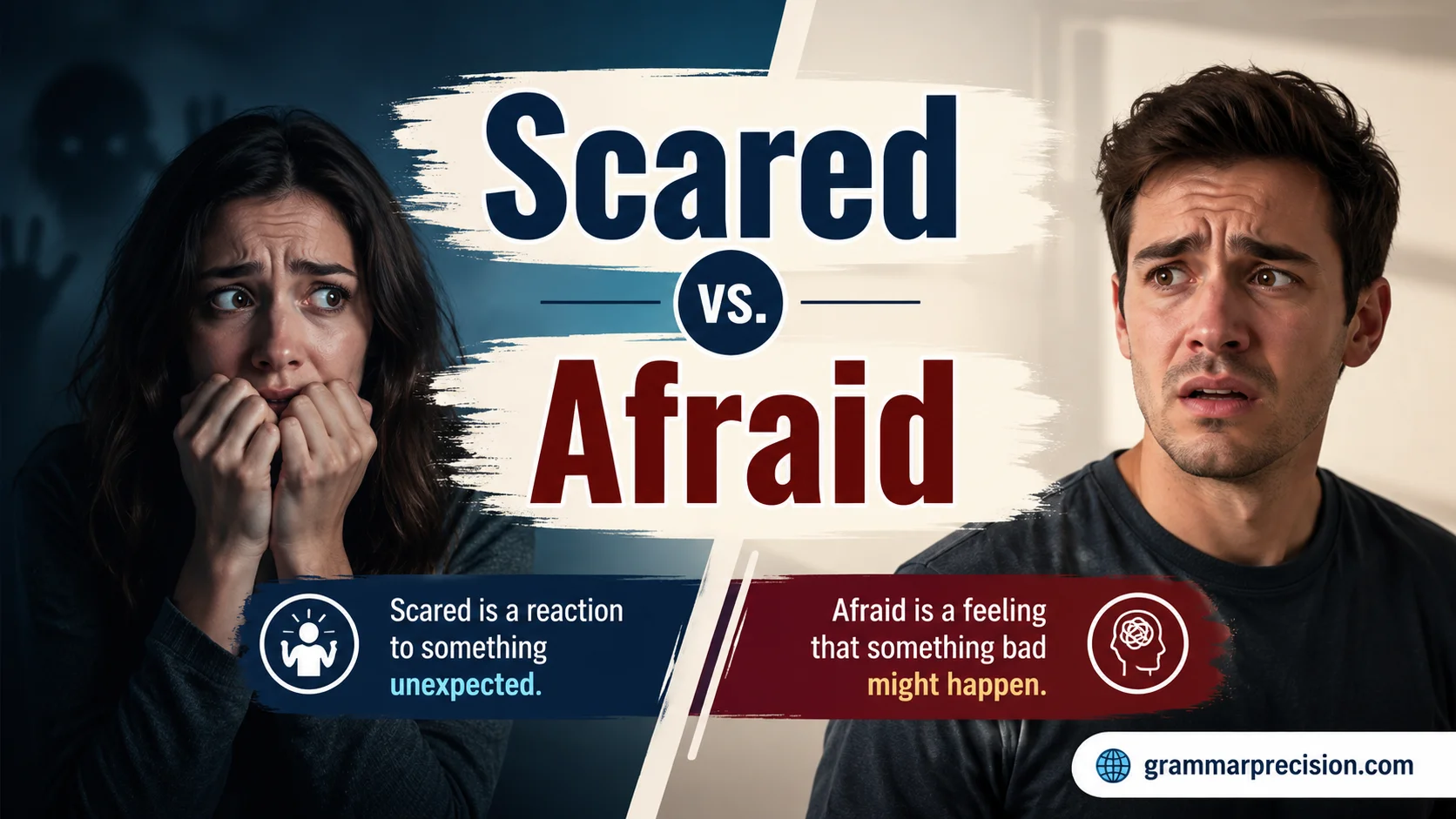
Scared vs. Afraid can confuse many English learners because both words describe fear. This guide explains their differences, meanings, and usage so you can choose the right word confidently.
Fear has many forms, and choosing the correct expression helps you communicate naturally. While scared often describes an immediate emotional reaction, afraid can show worry, concern, or hesitation. Understanding these subtle differences improves your everyday English and makes your conversations sound more fluent.
Many people use scared and afraid interchangeably, but each word carries a slightly different feeling. Through clear examples, practical explanations, and simple comparisons, you’ll learn when to use each term. This complete guide will help you avoid common mistakes and express your emotions more accurately.
Scared vs. Afraid: Quick Answer
The simplest way to understand scared vs. afraid is this:
| Word | Main Meaning | Common Use |
| Scared | Feeling frightened or shocked by something | Immediate fear or strong emotional reaction |
| Afraid | Feeling fear, worry, or concern | Fear about something happening or something you might do |
For example:
- I’m scared of snakes. → Snakes create a strong fear reaction.
- I’m afraid I might fail the test. → You are worried about a possible result.
In many everyday situations, native speakers use both words naturally:
- I’m scared of the dark.
- I’m afraid of the dark.
Both sentences are correct. The difference appears when the meaning goes beyond simple fear.
What Does Scared Mean?
The word scared describes a feeling of fear caused by something frightening, surprising, or dangerous. It usually represents an emotional response that happens when something makes you feel unsafe or uncomfortable.
Think of scared as your body’s instant reaction to fear. Your heart beats faster, your mind becomes alert, and you want to protect yourself.
For example:
- You hear a strange noise at night.
- A dog suddenly runs toward you.
- You watch a frightening movie scene.
In these situations, you might say:
“I was scared when I heard that noise.”
The fear happens because of a specific event.
Examples of Scared in Everyday English
Here are some common examples:
- She was scared when the lights suddenly went out.
- The child is scared of thunderstorms.
- I got scared when someone called my name from behind.
- He was scared after seeing the accident.
Notice how scared often connects with something happening around you.
It feels more emotional and immediate.
What Does Afraid Mean?
The word afraid also means feeling fear, but it has a wider meaning. It can describe fear, worry, uncertainty, or hesitation.
Unlike scared, afraid doesn’t always involve something frightening happening right now.
For example:
“I’m afraid I won’t get the job.”
This sentence does not mean something scary happened. Instead, it shows concern about a possible future outcome.
Common Uses of Afraid
The word afraid appears in several situations:
Fear of Something
- She is afraid of heights.
- They are afraid of losing money.
Fear of Doing Something
- I’m afraid to speak in public.
- He is afraid to ask questions.
Polite Expressions
English speakers also use afraid to politely introduce bad news or disagreement.
Examples:
- I’m afraid we are closed today.
- I’m afraid I can’t attend the meeting.
- I’m afraid that answer isn’t correct.
Here, afraid does not mean actual fear. It makes the statement sound softer and more polite.
The Key Difference Between Scared and Afraid
Although scared and afraid share similar meanings, the feeling behind them can be different.
Scared = Immediate Emotional Fear
When something suddenly frightens you, scared often sounds more natural.
Examples:
- I was scared when the car almost hit me.
- The loud explosion scared everyone.
The fear comes from a direct experience.
Afraid = Fear, Worry, or Concern
When you worry about something that may happen, afraid often fits better.
Examples:
- I’m afraid I won’t finish my project on time.
- She is afraid of making mistakes.
The fear is connected to thoughts, possibilities, or uncertainty.
Scared vs. Afraid: Side-by-Side Comparison
| Feature | Scared | Afraid |
| Meaning | Feeling frightened | Feeling fear, worry, or concern |
| Tone | More casual | Slightly more formal |
| Common in speech | Very common | Very common |
| Focus | Immediate reaction | Fear or possibility |
| Emotional intensity | Often stronger | Can be mild or strong |
| Used for politeness | Rarely | Very common |
Are Scared and Afraid Interchangeable?
In many cases, yes. Native speakers often use them in the same way.
For example:
- I’m scared of spiders.
- I’m afraid of spiders.
Both sentences mean you fear spiders.
However, replacing one word with the other can sometimes change the feeling.
Compare:
Sentence 1:
“I’m scared that I might lose my job.”
This sounds like you feel strong emotional fear.
Sentence 2:
“I’m afraid that I might lose my job.”
This sounds more like worry or concern.
Both are correct, but the emotional tone changes.
Scared vs. Afraid Grammar Rules
Knowing the grammar patterns makes it easier to use these words correctly.
Scared + Of + Noun
Use this structure when you fear something.
Pattern:
Subject + be + scared of + thing
Examples:
- I’m scared of insects.
- She’s scared of flying.
- They’re scared of the dark.
Scared + To + Verb
Use this when you fear doing an action.
Examples:
- He’s scared to drive at night.
- I’m scared to try something new.
- She was scared to open the door.
Afraid + Of + Noun
This structure expresses fear or worry.
Examples:
- He’s afraid of failure.
- I’m afraid of making mistakes.
- She’s afraid of dogs.
Afraid + To + Verb
This shows hesitation or fear about taking an action.
Examples:
- I’m afraid to ask for help.
- She’s afraid to tell the truth.
- He’s afraid to start a new career.
Scared vs. Afraid in Real-Life Situations
Understanding real examples helps you remember the difference.
Situation: Watching a Horror Movie
Natural:
- I was scared during the horror movie.
Why?
Because the movie created an immediate emotional reaction.
You can also say:
- I was afraid during the horror movie.
However, it sounds slightly less common in casual conversation.
Situation: Starting a New Job
Natural:
- I’m afraid I won’t perform well.
Why?
You are worried about a future possibility.
You could say:
- I’m scared I won’t perform well.
This sounds stronger and shows more emotional stress.
Situation: Meeting Someone New
Examples:
- I was afraid to introduce myself.
- I was scared to introduce myself.
Both work.
The difference:
- Afraid suggests hesitation or nervousness.
- Scared suggests stronger fear.
Common Mistakes With Scared and Afraid
Many English learners make small mistakes when using these words.
Mistake: Thinking Afraid Is Only Used for Dangerous Things
Some people believe afraid only describes physical danger.
That isn’t true.
You can be afraid of:
- Failure
- Change
- Making mistakes
- Losing opportunities
- Disappointing someone
Example:
Correct:
“I’m afraid of disappointing my parents.”
Mistake: Using Scared in Every Situation
Although scared works in many conversations, it may sound too emotional in formal situations.
For example:
Informal:
- I’m scared I’ll miss the deadline.
Formal:
- I’m afraid I may miss the deadline.
Both are correct, but the second sounds more professional.
Mistake: Confusing “I’m Afraid” With Fear
The phrase “I’m afraid” has two meanings.
Meaning 1: Feeling Fear
Example:
- I’m afraid of heights.
Meaning 2: Polite Disagreement or Bad News
Example:
- I’m afraid we cannot approve your request.
The second meaning does not express fear.
It simply softens the message.
Scared vs. Afraid vs. Frightened vs. Terrified: Understanding Fear Levels
English has many words that describe fear, but each one carries a slightly different feeling. Learning these differences helps you choose words that match the situation.
While scared and afraid are the most common choices, words like frightened, terrified, and nervous can express different levels of emotion.
Think of fear like a volume control. Some words represent a quiet worry, while others describe overwhelming panic.
| Word | Fear Level | Meaning | Example |
| Concerned | Low | Feeling worried about something | I’m concerned about the results. |
| Afraid | Medium | Feeling fear or worry | She’s afraid of making mistakes. |
| Scared | Medium to High | Strong emotional fear | I’m scared of that strange sound. |
| Frightened | High | Suddenly filled with fear | The child was frightened by the thunder. |
| Terrified | Extreme | Extremely afraid | He was terrified during the storm. |
Scared vs. Frightened
The words scared and frightened have almost the same meaning. Both describe fear caused by something unpleasant or dangerous.
However, frightened sounds slightly more formal and is often used in writing.
Examples:
- The little boy was scared of the dog.
- The little boy was frightened by the loud barking.
In everyday conversation, most people prefer scared because it feels more natural.
Scared vs. Terrified
The difference between these words is mainly about intensity.
Scared describes normal fear.
Example:
- I’m scared of spiders.
Terrified describes extreme fear.
Example:
- I was terrified when I thought I was lost.
If scared is a small wave, terrified is a powerful storm.
You wouldn’t usually say:
- “I was terrified because I forgot my homework.”
That situation may be stressful, but it probably does not create extreme fear.
Also Read This: Wether, Weather, or Whether? The Complete Guide
How Native Speakers Choose Between Scared and Afraid
Native speakers usually choose these words based on the feeling they want to express.
They don’t always think about grammar rules. Instead, they naturally understand the difference through experience.
Here are some common patterns:
Use Scared for Sudden Fear
Examples:
- I got scared when the phone rang at midnight.
- The movie scared me.
- Don’t scare me like that!
The word creates a picture of a quick emotional reaction.
Use Afraid for Worry or Uncertainty
Examples:
- I’m afraid I won’t be able to finish the work.
- She’s afraid of what people will think.
- He’s afraid to take risks.
The fear exists mostly in your thoughts.
Use Afraid for Polite Communication
This is one area where scared cannot replace afraid.
You can say:
- I’m afraid we don’t have that product available.
You cannot say:
- ❌ I’m scared we don’t have that product available.
The second sentence sounds like the speaker feels frightened rather than politely explaining a problem.
Common Expressions With Scared
English speakers use scared in many everyday phrases.
Scared of
This means you feel fear toward something.
Examples:
- She’s scared of dogs.
- I’m scared of deep water.
Scared to Death
This is an expression meaning extremely frightened.
Example:
- That horror movie scared me to death.
It doesn’t mean someone actually died. It simply emphasizes strong fear.
Scared Stiff
This means completely frozen with fear.
Example:
- The unexpected noise scared him stiff.
Scared Out of My Mind
This informal phrase describes intense fear.
Example:
- I was scared out of my mind when I couldn’t find my phone.
Common Expressions With Afraid
The word afraid appears in several useful phrases.
Afraid of
Used when you fear something.
Examples:
- She’s afraid of failure.
- He’s afraid of being alone.
Afraid to
Used when fear prevents someone from doing something.
Examples:
- I’m afraid to ask questions.
- She’s afraid to try something different.
I’m Afraid That…
This phrase often introduces disappointing information.
Examples:
- I’m afraid that the meeting has been canceled.
- I’m afraid that we made a mistake.
This expression sounds polite and professional.
Scared vs. Afraid in American English
In American English, both words are extremely common. However, they appear in slightly different situations.
Casual Conversations
Americans often use scared when talking about daily experiences.
Examples:
- “That movie was scary.”
- “You scared me!”
- “I’m scared of bugs.”
The word feels direct and emotional.
Professional Situations
In workplaces, afraid often sounds more appropriate when expressing concerns.
Examples:
- I’m afraid we need more time to complete this project.
- I’m afraid there may be an issue with the report.
This style sounds respectful and less dramatic.
Scared vs. Afraid Practice Quiz
Choose the correct word.
I was ______ when the lights suddenly turned off.
Answer: scared
Why?
The darkness created an immediate reaction.
She is ______ of making mistakes at work.
Answer: afraid
Why?
The sentence describes worry about a possibility.
I’m ______ we cannot accept your application.
Answer: afraid
Why?
This is a polite expression, not actual fear.
The child was ______ by the loud thunder.
Answer: scared
Why?
The thunder caused a sudden emotional reaction.
He is ______ to speak in front of a large audience.
Answer: afraid or scared
Both work.
However:
- Afraid to speak = hesitation or nervousness.
- Scared to speak = stronger emotional fear.
FAQs:
What is the main difference between scared and afraid?
Scared and afraid both describe fear, but they focus on different feelings. Scared usually describes a strong and immediate reaction to something frightening, while afraid often expresses worry, concern, or hesitation about something that may happen. For example, you can be scared of a loud noise but afraid of making a mistake.
Can scared and afraid be used interchangeably?
Yes, in many situations, scared and afraid can be used interchangeably because both words mean feeling fear. For example, “I’m scared of dogs” and “I’m afraid of dogs” are both correct. However, afraid has additional uses, especially in polite expressions like “I’m afraid I can’t help you.”
Which word is stronger: scared or afraid?
In everyday conversation, scared often sounds stronger because it describes a direct emotional reaction. For example, “I was scared when I heard the explosion” shows an immediate feeling of fear. However, afraid can also describe strong fear depending on the context, such as “She is afraid of losing everything.”
When should I use afraid instead of scared?
You should use afraid when talking about worries, uncertainty, or possible future problems. It is also common in polite communication when giving disappointing information. For example, “I’m afraid the store is closed” sounds more polite than simply saying “The store is closed.”
Is scared more common than afraid in daily English?
Yes, scared is very common in casual conversations, especially when describing personal experiences or sudden fear. Native speakers often say things like “You scared me!” or “I’m scared of heights.” However, afraid remains important because it works well in both everyday speech and more formal situations.
Conclusion:
Understanding Scared vs. Afraid helps you choose the right words when expressing fear, worry, or concern. While scared often describes an immediate emotional reaction, afraid usually shows hesitation, uncertainty, or polite concern. Learning these small differences improves your English vocabulary, makes your conversations more natural, and builds stronger communication skills.