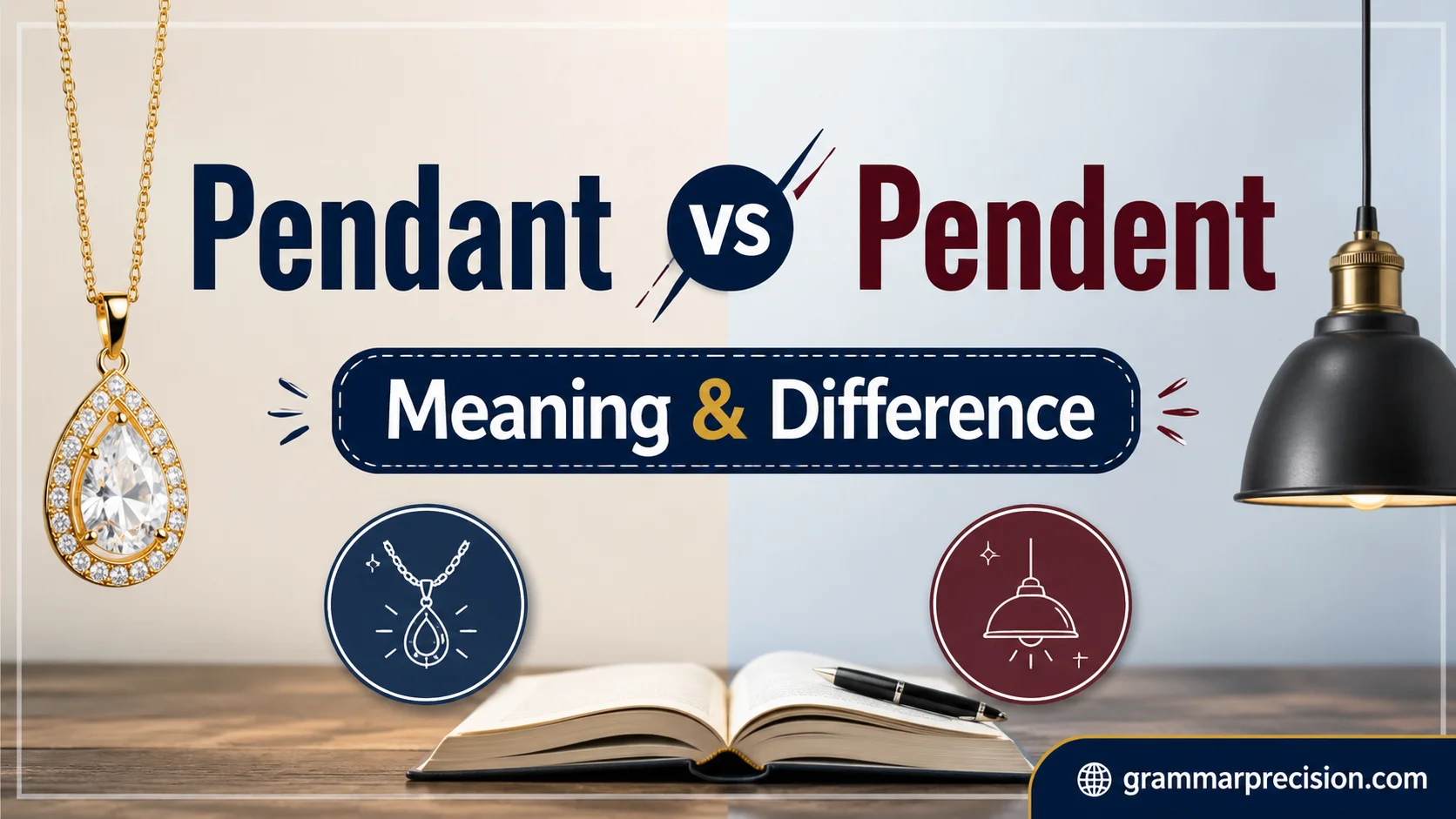
Pendant vs Pendent can be confusing because these words look almost identical but have different meanings and uses. Pendant usually refers to jewelry or something hanging, while pendent describes something that is hanging, unfinished, or awaiting a decision.
The word pendant is commonly used as a noun for a piece of jewelry that hangs from a necklace. It can also describe something that hangs down from another object, such as a decorative light. Understanding its meaning and correct usage will help you choose pendant confidently in everyday English.
In contrast, pendent is less common in modern English, but it still has a clear meaning. It can describe something hanging down, especially in formal or technical writing. It can also mean pending, unresolved, or not yet completed, depending on the context. Knowing this distinction prevents common spelling and grammar mistakes.
Although pendant and pendent share the same root and similar spelling, they aren’t interchangeable in most sentences. Pendant is far more common in everyday English, especially when discussing jewelry. Pendent usually appears in formal contexts where something is hanging or awaiting completion. Learning their meanings, examples, and differences makes the choice much easier.
Pendant vs Pendent at a Glance
The quickest way to understand pendant vs pendent is to compare their core meanings.
| Feature | Pendant | Pendent |
| Main use | A hanging ornament or piece of jewelry | Something hanging or suspended |
| Part of speech | Noun and adjective | Mainly adjective |
| Everyday frequency | Very common | Uncommon |
| Jewelry use | Yes | No |
| Meaning “hanging” | Sometimes | Yes |
| Formal/technical use | Yes | More common |
| Plural | Pendants | Usually no plural as an adjective |
| Example | She wore a gold pendant. | Pendent branches hung above the path. |
There’s an easy rule to remember:
Pendant is usually a thing that hangs. Pendent describes something that hangs.
That small distinction solves most everyday cases.
What Does “Pendant” Mean?
Pendant most commonly refers to an object that hangs from something else. The best-known example is a piece of jewelry attached to a chain or necklace.
For example:
- She bought a silver pendant.
- The necklace has a heart-shaped pendant.
- He gave her a diamond pendant for her birthday.
In these sentences, pendant functions as a noun. It names the object itself.
The word can also describe other hanging objects. A pendant light, for example, is a light fixture suspended from the ceiling. You may see pendant lights in kitchens, dining rooms, offices, restaurants, and modern homes.
Pendant as a Piece of Jewelry
Jewelry is the context where you’ll encounter pendant most often.
A pendant can contain:
- A gemstone
- A religious symbol
- A letter or initial
- A photograph
- A decorative design
- A cultural or historical symbol
The chain and pendant aren’t necessarily the same thing. The chain is what goes around your neck, while the pendant is the decorative piece that hangs from it.
Consider this sentence:
Maria wore a gold chain with a small emerald pendant.
Here, chain identifies the supporting jewelry, while pendant identifies the ornament hanging from it.
The plural form is straightforward: pendants.
Pendant as a Hanging Object
The word doesn’t belong exclusively to jewelry.
In architecture and design, a pendant can refer to a decorative element that hangs downward. In lighting, a pendant is a fixture suspended from a ceiling.
For example:
Three pendant lights hung above the kitchen island.
This usage is common in interior design. A pendant light isn’t necessarily ornamental in the traditional sense. It can provide practical illumination while also contributing to a room’s appearance.
So, don’t make the mistake of thinking pendant always means necklace jewelry. Its broader idea is an object that hangs.
What Does “Pendent” Mean?
Pendent is a real English word, but you’ll see it far less often than pendant.
As an adjective, pendent generally means hanging, suspended, or extending downward.
For example:
Pendent branches brushed against the window.
Here, pendent describes the branches. It doesn’t name the branches themselves.
Another example is:
The pendent vines covered part of the old wall.
The vines hang downward, so pendent describes their position.
This is the major grammatical distinction:
Pendant can name a hanging object. Pendent generally describes something that is hanging.
Pendent Meaning “Hanging”
The most direct meaning of pendent is something that hangs from another point.
You’ll encounter this word more often in literary, descriptive, scientific, architectural, or specialized writing than in casual conversation.
For instance:
Pendent roots descended from the branches.
The adjective emphasizes the physical state of the roots. They’re hanging downward.
In ordinary conversation, however, most people would probably choose hanging, suspended, or another simpler expression.
Instead of:
Pendent cables stretched beneath the structure.
A writer might simply say:
Hanging cables stretched beneath the structure.
That doesn’t make pendent incorrect. It simply makes it less common.
Pendent Meaning “Unresolved”
There’s another important use worth knowing.
In some formal contexts, pendent can describe something that remains undecided, unresolved, or awaiting completion. This meaning overlaps with the idea behind pending.
For example:
The matter remained pendent before the court.
This is formal and relatively uncommon modern usage. In contemporary American English, pending would usually sound more natural:
The matter remained pending before the court.
That’s an important practical point. Knowing that pendent can carry this sense doesn’t mean you should automatically use it instead of pending.
Pendant vs Pendent: The Key Difference
The difference becomes much easier when you focus on what the word is doing in a sentence.
Pendant usually identifies a thing.
Pendent usually describes a condition or position.
Compare these examples:
She wore a beautiful pendant.
The pendant is the object.
She admired the pendent flowers.
Pendent describes the flowers because they’re hanging downward.
Think of it like the difference between a swing and swinging. One can name a thing while the other describes an action or state.
A Simple Memory Trick
Try this:
Pendant = a hanging thing.
Pendent = hanging or suspended.
If you’re talking about something you can buy and wear around your neck, pendant is almost certainly correct.
If you’re using the word as an adjective to describe something hanging down, pendent may fit.
Pendant vs Pendent Pronunciation
The pronunciation can add another layer of confusion because the two words look so similar.
Pendant is commonly pronounced approximately like:
PEN-duhnt
Pendent is commonly pronounced approximately like:
PEN-duhnt
In many varieties of American English, they can sound very similar, and in some contexts they may effectively sound alike to listeners.
That means pronunciation isn’t always a reliable way to distinguish them.
Instead, pay attention to spelling and grammatical function.
If you hear someone say “pendant,” context usually tells you whether they’re discussing jewelry, lighting, architecture, or another hanging object. Written English gives you the additional clue of the final spelling.
Pendant vs Pendent: Grammar Differences
Grammar provides one of the clearest ways to separate these words.
| Word | Typical grammatical role | Example |
| Pendant | Noun | The pendant was made of silver. |
| Pendant | Adjective | They installed pendant lights. |
| Pendent | Adjective | Pendent branches covered the trail. |
Pendant works naturally as a noun:
I lost my pendant.
It can also work attributively as an adjective:
The restaurant installed pendant lighting.
Pendent, by contrast, primarily functions as an adjective:
The pendent leaves moved in the breeze.
You wouldn’t normally say:
I bought a pendent.
That sounds incorrect because pendent doesn’t ordinarily function as the noun for a piece of jewelry.
You’d say:
I bought a pendant.
This grammatical difference is one of the fastest ways to avoid confusion.
Also Read This: Toward vs Towards: What’s the Difference?
Pendant vs Pendent Examples
Seeing the words in realistic sentences makes the distinction stick.
Correct Uses of Pendant
- She received a gold pendant as a graduation gift.
- The necklace has a small heart-shaped pendant.
- We installed two pendant lights over the table.
- The antique pendant featured a blue stone.
- He designed a custom pendant for the collection.
- A glass pendant hung from the ceiling.
- The jeweler polished the silver pendant carefully.
Correct Uses of Pendent
- Pendent branches blocked part of the narrow path.
- The old building had pendent decorative elements.
- Pendent vines covered the stone wall.
- The structure contained several pendent cables.
- Long, pendent leaves surrounded the flowers.
Notice the pattern. Pendant often names an object, while pendent describes something that hangs.
Pendant vs Pendent vs Pending
Here’s where the confusion gets more interesting.
Pendant, pendent, and pending are different words. Their meanings overlap historically, but modern usage separates them.
| Word | Basic meaning | Example |
| Pendant | Hanging object or ornament | She wore a silver pendant. |
| Pendent | Hanging or suspended | Pendent vines covered the wall. |
| Pending | Awaiting a decision or completion | The application is pending. |
The third word, pending, is especially important.
You might say:
The lawsuit is pending.
You wouldn’t normally say:
The lawsuit is pendent.
Although pendent has a formal sense related to something unresolved, pending is the standard modern choice for matters awaiting action or a decision.
Pendant vs Pending
The spelling difference is easy to overlook.
Pendant contains an a:
pendant
Pending contains an i:
pending
The meanings are much farther apart than the spellings suggest.
- Pendant → a hanging object
- Pending → waiting for a decision or action
For example:
The pendant hangs from the necklace.
The application is pending approval.
One describes an object. The other describes a status.
The Hidden Connection Between Pendant and Pendent
Why do these words look so similar?
The answer lies in their shared linguistic history.
Both are connected to the Latin verb pendere, meaning “to hang” or “to weigh.” The same root appears in several English words associated with hanging, weighing, dependence, or waiting.
This family includes words such as:
- Pendant
- Pendent
- Pending
- Pendulum
- Append
- Depend
- Suspend
Their modern meanings aren’t identical, but the underlying idea of hanging or being suspended helps explain the family resemblance.
A pendulum, for example, swings from a fixed point. Something suspended depends on support from above. An item that is pending can be viewed metaphorically as “hanging” while it awaits a result.
Language often works this way. Words that seem unrelated on the surface can share an old conceptual thread underneath.
Pendant vs Pendent in American English
For everyday American English, pendant is overwhelmingly the more familiar word.
You’ll regularly encounter it in:
- Jewelry stores
- Fashion articles
- Product descriptions
- Interior design
- Architecture
- Home improvement
- Everyday conversation
Pendent is much less common. Its specialized or formal character makes it more likely to appear in descriptive or technical writing.
That difference matters when you’re choosing words for your audience.
If your goal is clear, natural communication, don’t reach for pendent simply because it sounds sophisticated. Use the simplest accurate word.
For example, these are both understandable:
Pendent branches reached toward the ground.
Hanging branches reached toward the ground.
The second version sounds more natural to most readers.
However, pendent can be useful when precision, literary tone, or technical terminology calls for it.
Common Mistakes With Pendant and Pendent
These words create several predictable mistakes.
Mistake: Calling Jewelry “Pendent”
Incorrect:
She wore a diamond pendent.
Correct:
She wore a diamond pendant.
A necklace ornament is a pendant, not a pendent.
Mistake: Assuming Pendent Is Simply a Misspelling
It’s tempting to treat pendent as a typo. That’s not accurate.
Pendent is a legitimate English word. It’s simply much less common than pendant in everyday usage.
So, context matters.
Mistake: Using Pendant for Every Meaning of “Hanging”
Although pendant can describe certain hanging things, it doesn’t replace pendent in every grammatical context.
For example:
Pendent branches reached toward the ground.
Here, pendent works naturally as an adjective.
You shouldn’t automatically substitute pendant simply because the words are related.
Mistake: Confusing Pendent With Pending
Remember the practical distinction:
- Pendent = hanging or suspended
- Pending = awaiting a decision, action, or completion
That single contrast prevents many errors.
Pendant vs Pendent: A Quick Decision Guide
Still unsure which word belongs in your sentence? Use this simple decision process.
Are you naming a piece of jewelry?
→ Use pendant.
Are you naming a hanging decorative object?
→ Use pendant.
Are you talking about a hanging light fixture?
→ Use pendant.
Are you describing something that hangs downward?
→ Pendent may be appropriate.
Are you describing something awaiting a decision?
→ Use pending in normal modern English.
Here’s the shortcut worth remembering:
Pendant names the hanging object. Pendent describes the hanging state. Pending describes something waiting for an outcome.
A Real-World Case Study: Choosing the Right Word
Imagine a home-design article describing a kitchen.
The writer wants to explain that three decorative lights hang above a counter. The natural sentence is:
Three pendant lights hang above the kitchen island.
Why pendant?
Because pendant light is an established term for a light fixture suspended from the ceiling.
Now imagine a botanical description:
Long, pendent branches curved toward the stream.
Here, pendent works because the writer is describing the branches’ downward position.
Finally, imagine a legal document:
The application remains pending.
The subject isn’t physically hanging. It’s awaiting a decision.
Three words. Three jobs.
That’s the distinction in action.
How to Remember Pendant vs Pendent
If spelling trips you up, create a mental picture.
Imagine a pendant necklace hanging from a chain. The A in pendant can remind you of an accessory.
Then picture pendent branches drooping from a tree. The word describes their position.
You can also remember this three-part formula:
Pendant = object
Pendent = hanging
Pending = waiting
It isn’t a perfect explanation of every historical use, but it’s an excellent practical rule for everyday writing.
Pendant vs Pendent Mini Quiz
Test yourself before moving on.
Choose pendant, pendent, or pending.
- She bought a ruby ______ for her necklace.
- The ______ branches nearly touched the ground.
- The insurance claim is still ______.
- The room featured three modern ______ lights.
- The jeweler displayed several gold ______.
- Long, ______ leaves surrounded the stem.
- The court case remains ______.
- He gave her a silver heart-shaped ______.
Answers
- pendant
- pendent
- pending
- pendant
- pendants
- pendent
- pending
- pendant
The pattern should now look familiar. When you’re naming the ornament or fixture, choose pendant. When you’re describing something as hanging, pendent can work. When something is awaiting a decision, choose pending.
FAQs:
What is the difference between pendant and pendent?
Pendant is usually a noun that means a piece of jewelry hanging from a necklace or something that hangs from another object. Pendent is less common and generally means hanging, unfinished, or awaiting a decision.
Is pendant a noun or an adjective?
Pendant is most commonly used as a noun. It can refer to a decorative item or piece of jewelry that hangs from a chain. In some contexts, it can also describe something hanging down from another object.
What does pendent mean?
Pendent is an adjective meaning hanging down, unfinished, or not yet decided. It often appears in formal, legal, or technical writing. For example, a matter may remain pendent while people wait for a final decision or resolution.
Is pendent the same as pending?
Pendent and pending are related but aren’t always interchangeable. Pendent can mean something is hanging or awaiting resolution, while pending commonly means something is waiting for a decision, action, or completion. In everyday English, pending is much more common.
Which word should I use in everyday English?
Use pendant when talking about jewelry or something that hangs from another object. Use pendent when you mean hanging, unfinished, or awaiting resolution in a formal context. If you’re discussing a decision that hasn’t been made, pending will usually sound more natural.
Conclusion:
Pendant vs Pendent becomes easier when you remember their main meanings. Pendant usually refers to jewelry or something hanging, while pendent describes something hanging, unfinished, or awaiting resolution in specific contexts.
In everyday English, pendant is the word you’re most likely to encounter, especially when discussing necklaces, jewelry, decorations, or hanging objects. Pendent is less common and tends to appear in formal or specialized writing, so context matters when choosing between them.
The easiest way to avoid confusion is to focus on the meaning of each word before using it. Choose pendant for a hanging ornament or piece of jewelry, and choose pendent when something is hanging or unresolved. This simple distinction will help you use both words accurately.