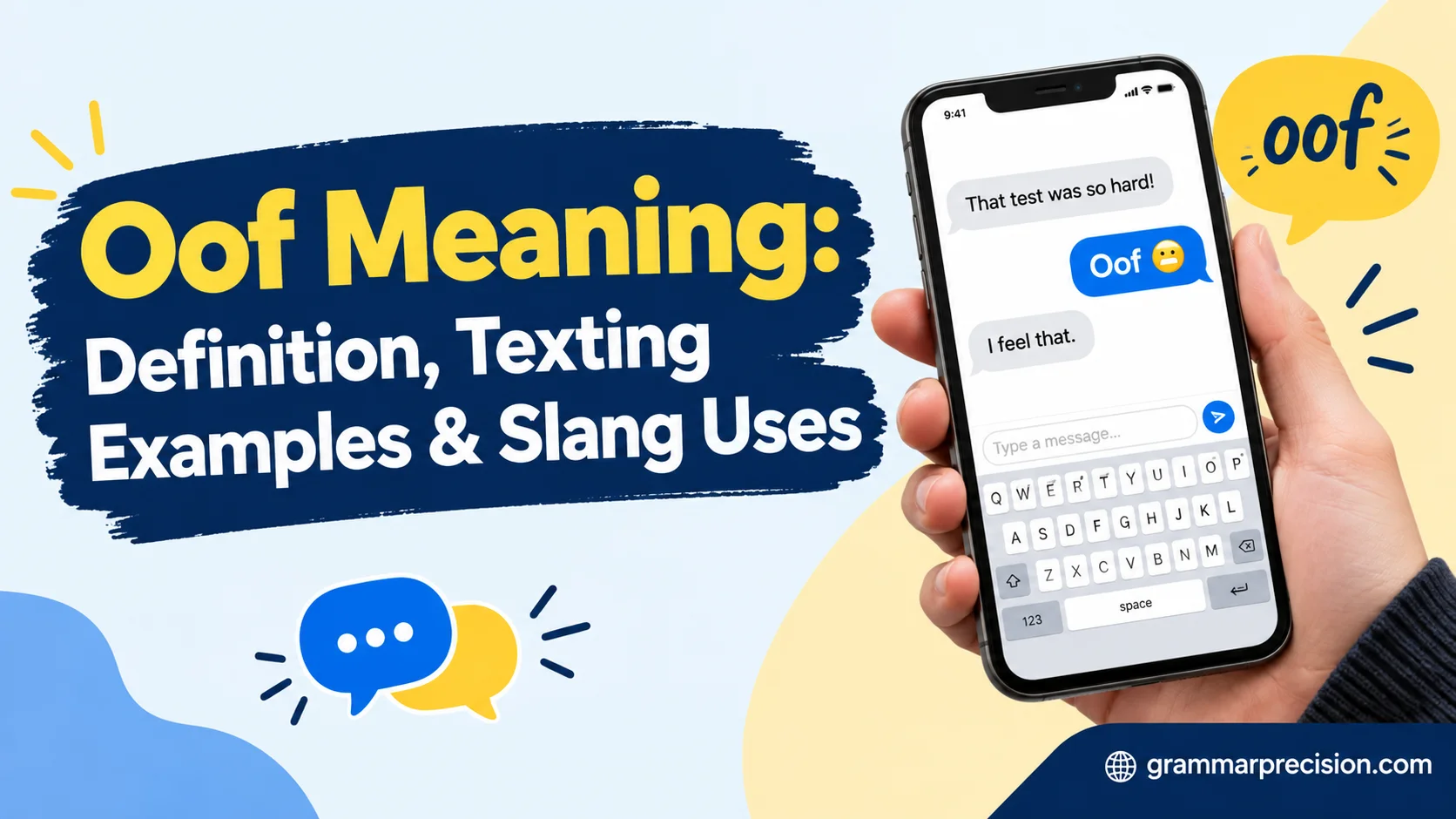
Have you ever seen someone type “oof” in a text message and wondered what they really meant? Oof meaning can express pain, disappointment, embarrassment, sympathy, or an awkward reaction, depending on the conversation. This popular internet expression appears in social media posts, online chats, gaming conversations, and everyday English usage. Understanding its tone helps you communicate naturally and recognize when a simple word carries a deeper emotional message.
In this guide, you’ll discover the meaning of oof, its origin, common examples, and the best ways to use it in different situations. We’ll also explore how context influences its meaning in casual conversations and professional settings. Although oof rarely belongs in formal writing, understanding informal expressions supports better business communication, scheduling discussions, online booking, broadcasting, meetings, calendar management, and project management conversations. We’ll briefly consider US and UK English preferences, along with grammar, style guides, and consistency, so you can use this expression confidently and appropriately.
What Does Oof Mean?
Oof is an informal expression people use to react to something painful, awkward, disappointing, surprising, or emotionally uncomfortable. It often communicates an immediate reaction rather than a carefully explained opinion.
Imagine telling your friend that you studied all night for an exam but accidentally missed it. Your friend might reply, “Oof, that’s rough.” The word acknowledges your unfortunate situation without requiring a lengthy response.
People also use oof when something physically hurts. For example, someone who bumps their knee against a table might say, “Oof!” to express sudden discomfort.
The exact meaning depends on the situation, the speaker’s tone, and the surrounding conversation.
Here are the most common meanings of oof:
- Pain: Reacting to a physical injury or uncomfortable experience.
- Sympathy: Acknowledging someone else’s disappointment or misfortune.
- Embarrassment: Responding to an awkward or humiliating moment.
- Surprise: Reacting to unexpected information.
- Disappointment: Expressing frustration when something goes wrong.
- Humor: Making an unfortunate situation sound funny or less serious.
- Sarcasm: Highlighting an obvious mistake or uncomfortable truth.
Oof usually functions as an interjection, which means it expresses a reaction or emotion. It can stand alone or introduce a longer sentence.
For example, “Oof!” works as a complete reaction, while “Oof, that must have been embarrassing” adds context and empathy.
What Does Oof Mean in Texting?
In texting, oof usually signals a reaction to something uncomfortable, unfortunate, or surprising. Because text messages lack facial expressions and vocal tone, people often use short expressions like oof to communicate feelings quickly.
Imagine that a friend sends you this message:
“Just spilled coffee all over my new shirt before work.”
You might reply, “Oof, that’s unlucky!”
Your response recognizes the problem without making the conversation unnecessarily complicated.
However, oof doesn’t always communicate sympathy. Friends sometimes use it to tease each other, react to embarrassing situations, or point out an obvious mistake.
Consider these texting examples:
| Text message situation | Example response | Likely meaning |
| A friend fails an exam | “Oof, I’m sorry.” | Sympathy |
| Someone trips in public | “Oof 😭” | Embarrassment or humor |
| A friend spends too much money | “Oof, your wallet!” | Playful teasing |
| Someone receives bad news | “Oof, that’s tough.” | Concern |
| A person makes an obvious mistake | “Oof 💀” | Sarcasm or amusement |
| Someone gets an unexpected bill | “Oof, that’s expensive.” | Disappointment |
Oof as a Sign of Sympathy
When someone shares disappointing news, oof can acknowledge their feelings. It’s similar to saying, “That’s rough,” or “I’m sorry that happened.”
For example:
Friend: “My flight got canceled, and now I have to wait eight hours.”
You: “Oof, that’s awful. I hope you find another flight soon.”
Here, oof introduces a sympathetic response. The additional sentence makes your concern clear.
Oof as a Reaction to Embarrassment
People often use oof when someone experiences an awkward moment or makes a public mistake.
For example:
Friend: “I waved at someone who wasn’t waving at me.”
You: “Oof, I’ve done that too!”
This response combines light humor with reassurance. It recognizes the awkwardness without making the person feel worse.
Oof as a Playful or Sarcastic Reaction
Among friends, oof can highlight a mistake in a funny way.
For example:
Friend: “I forgot my own anniversary.”
You: “Oof. You’re in trouble!”
The message sounds teasing rather than cruel when both people understand the joke. However, sarcasm can easily backfire when someone feels genuinely upset.
The key is context: A short “oof” might show empathy, amusement, or criticism depending on your relationship and the situation.
What Does Oof Mean on Social Media?
On social media, oof works as a quick reaction to videos, posts, comments, and personal stories. Users often choose it when a situation feels awkward, unfortunate, shocking, or painfully relatable.
Unlike a detailed comment, oof lets people react immediately. It also fits the fast-moving style of online conversations, where a single word or emoji can communicate an entire emotional response.
Oof Meaning on TikTok
On TikTok, people may comment “oof” under videos featuring embarrassing moments, relationship problems, unexpected failures, or unfortunate situations.
For example, someone might post a video about accidentally sending a private message to the wrong person. A viewer could comment, “Oof, I’d disappear forever.”
The comment expresses secondhand embarrassment while adding humor. Depending on the video, it might also communicate sympathy or surprise.
Oof Meaning on Instagram
On Instagram, oof can appear in comments, direct messages, and replies to Stories. People often use it to acknowledge awkward experiences, disappointing announcements, or relatable mistakes.
For example, if your friend posts a picture of their broken phone, you might reply, “Oof, time for an upgrade.”
The expression can sound friendly and casual. Still, consider the person’s feelings before joking about an expensive repair or stressful situation.
Oof Meaning on Snapchat
On Snapchat, oof often appears in quick exchanges between friends. Someone might send it after receiving an embarrassing photo, hearing unexpected news, or watching a friend make a mistake.
For example:
Friend: “I just realized I’ve been talking while muted for ten minutes.”
You: “Oof 😂”
The response recognizes the awkwardness and keeps the conversation light.
Oof Meaning in Online Comments
Across comment sections, oof can express several reactions at once. A viewer might feel sympathy for someone while also finding the situation unexpectedly funny.
For instance, imagine a creator sharing a story about buying an expensive item that broke the following day. A comment saying “Oof, that’s painful” recognizes the financial disappointment.
Remember that oof doesn’t have one fixed social media meaning. The post, accompanying emojis, and surrounding comments help reveal the intended tone.
What Does Oof Mean in Gaming?
In gaming, oof can describe a reaction to failure, damage, defeat, or an unfortunate in-game event. Players use it in chats, streams, and voice conversations when something goes wrong.
The expression became especially recognizable through Roblox, where a famous character-death sound effect helped make oof part of gaming culture.
For many players, the sound became associated with losing a character or making a mistake. People later used the word outside the game to react to everyday mishaps.
Consider these gaming examples:
- “Oof, I missed the final shot.”
- “That was a big oof.”
- “Oof, we lost the match.”
- “I fell off the map again. Oof!”
- “Oof, that boss fight was brutal.”
In each example, the expression highlights an unfortunate outcome.
Gaming communities also use oof humorously. A player might say it after a teammate makes an avoidable mistake or loses an important round.
However, the word doesn’t always indicate failure. Players can use it after taking damage, witnessing an impressive move, or encountering an unexpected twist.
Gaming context matters: A player saying “oof” after losing a match expresses disappointment, while the same word after a funny glitch may signal amusement.
15 Real-Life Examples of Oof in a Sentence
The easiest way to understand oof is to see how people use it in everyday situations. These examples demonstrate its different meanings and conversational tones.
| Situation | Example sentence | Meaning |
| Exam failure | “Oof, that exam sounds difficult.” | Sympathy |
| Missed flight | “Oof, that’s an expensive mistake.” | Disappointment |
| Awkward encounter | “Oof, did you really say that?” | Surprise or embarrassment |
| Breakup | “Oof, I’m sorry you’re going through that.” | Emotional support |
| Overspending | “Oof, there goes your paycheck.” | Playful teasing |
| Sports defeat | “Oof, they lost in the final seconds.” | Disappointment |
| Gaming mistake | “Oof, I pressed the wrong button.” | Frustration |
| Bad haircut | “Oof, hopefully it grows back quickly.” | Sympathy or humor |
| Work mistake | “Oof, that meeting sounds stressful.” | Understanding |
| Rejected invitation | “Oof, that’s awkward.” | Embarrassment |
| Broken phone | “Oof, that’s going to cost you.” | Concern |
| Unexpected bill | “Oof, that’s a lot of money.” | Surprise |
| Missed deadline | “Oof, you must be stressed.” | Sympathy |
| Failed recipe | “Oof, dinner didn’t go as planned.” | Lighthearted disappointment |
| Public mistake | “Oof, I’d remember that forever.” | Humor or embarrassment |
These examples show that oof works in both serious and lighthearted conversations. The words that follow it often clarify whether the speaker feels concerned, amused, or surprised.
A Realistic Texting Scenario
Imagine that Maya messages her friend about a difficult day.
Maya: “I missed my bus, spilled my drink, and arrived late to work.”
Friend: “Oof, that’s a rough morning. Hope your day gets better!”
The friend uses oof to acknowledge Maya’s frustration. The supportive follow-up makes the message feel caring rather than dismissive.
Now imagine a different exchange:
Alex: “I accidentally liked my ex’s picture from three years ago.”
Friend: “Oof 💀”
Here, the same expression communicates secondhand embarrassment and amusement. The emoji reinforces the playful tone.
These scenarios demonstrate an important point: the meaning of oof comes from the situation as much as the word itself.
How to Reply When Someone Says Oof
Your best response depends on why the other person used oof. Sometimes a funny comeback works perfectly. In other situations, a supportive reply makes more sense.
Funny Replies to Oof
Use a playful response when the conversation feels relaxed and everyone understands the joke.
- “Don’t remind me!”
- “It’s been a long day.”
- “I know, right?”
- “My life is a comedy.”
- “Please respect my struggle.”
- “Character development, I guess.”
- “At least I have a story to tell.”
For example, if a friend says “Oof” after hearing about your failed cooking experiment, you could reply, “The smoke alarm enjoyed the meal more than I did.”
Casual Replies to Oof
Sometimes you just want to keep the conversation moving without making the moment too serious.
Try these responses:
- “Yeah, it wasn’t great.”
- “Tell me about it.”
- “That’s what I’m saying.”
- “It happens.”
- “Honestly, same.”
- “I learned my lesson.”
- “Yeah, not my finest moment.”
These replies work well in everyday texts and group chats.
Supportive Replies to Oof
When someone reacts to genuinely disappointing news, respond with kindness instead of immediately making a joke.
For example:
- “Yeah, it’s been difficult.”
- “Thanks for understanding.”
- “I’m hoping things improve.”
- “I appreciate you listening.”
- “It’s okay. I’ll figure it out.”
- “Yeah, I’m taking it one step at a time.”
If someone says “oof” after you describe a serious problem, you can also explain how you feel. A short reaction doesn’t necessarily mean the person lacks concern.
Flirty Replies to Oof
When the conversation already has a playful, flirtatious tone, you can respond with a little humor.
- “Oof? Is that all I’ve got?”
- “You sound worried about me.”
- “Come on, cheer me up!”
- “You could always make it better.”
- “I was hoping for a little sympathy.”
These replies don’t automatically create romantic interest. Use them only when your existing conversation makes flirting feel natural.
Different Types of Oof and What They Communicate
Although oof has a basic meaning, small changes in spelling, punctuation, and emojis can shift its tone. People often stretch the word or add symbols to make their reactions more expressive.
| Expression | Common interpretation | Example |
| Oof | A general reaction | “Oof, that’s unfortunate.” |
| Big oof | A serious mistake or major setback | “Big oof. You missed the deadline.” |
| Oof! | A strong or immediate reaction | “Oof! That must hurt.” |
| Oof… | Discomfort, awkwardness, or disappointment | “Oof… that’s not good.” |
| Oooooof | An exaggerated reaction | “Oooooof, that’s embarrassing.” |
| Oof 😂 | Humor or playful embarrassment | “Oof 😂 that was awkward.” |
| Oof 💀 | Shock, amusement, or secondhand embarrassment | “Oof 💀 you actually sent it?” |
| Oof 😬 | Awkwardness or discomfort | “Oof 😬 that’s a difficult situation.” |
These interpretations aren’t universal rules. Friends may develop their own texting habits, and the same punctuation can mean different things in different conversations.
What Does Big Oof Mean?
Big oof describes a particularly painful, embarrassing, or unfortunate situation. It adds emphasis to the original expression.
For example, missing a bus might earn a simple “oof.” Missing the bus and arriving late for an important interview could earn a “big oof.”
People also use the phrase humorously to describe obvious mistakes, disappointing results, and awkward social moments.
What Does Oof With Emojis Mean?
Emojis provide extra emotional clues when someone uses oof in a message.
- Oof 😂: Usually suggests laughter or playful embarrassment.
- Oof 💀: Often signals intense amusement, shock, or secondhand embarrassment.
- Oof 😭: Can express exaggerated sadness, sympathy, or laughter, depending on context.
- Oof 😬: Often communicates discomfort or awkwardness.
- Oof 🥲: May suggest disappointment mixed with an attempt to stay positive.
Don’t interpret emojis in isolation. A crying emoji might indicate genuine sadness or laughter so intense that someone can barely respond.
Is Oof Positive, Negative, or Neutral?
Oof is generally neutral as an expression, but people often use it to react to negative or uncomfortable situations. Its emotional meaning depends on the speaker’s intention.
For example, “Oof, you worked hard for that promotion” might express sympathy after someone gets rejected. However, “Oof, that was an amazing performance” could communicate impressed surprise.
The surrounding words usually make the intended meaning clearer.
When Oof Sounds Sympathetic
Oof can acknowledge someone’s disappointment without judging them.
For example:
“ Oof, I’m sorry your plans fell through.”
This response recognizes the problem and opens the door for further conversation. Adding supportive words makes the expression warmer.
When Oof Sounds Sarcastic
Oof may sound sarcastic when someone uses it to highlight a mistake or an embarrassing situation.
For example:
“ Oof, you forgot your presentation on presentation day?”
Depending on the relationship, this might be friendly teasing or an insensitive comment. Tone and timing make a difference.
When Oof Sounds Dismissive
A bare “oof” can feel dismissive when someone shares serious personal news and expects support.
For example, replying only “oof” to a friend’s difficult family situation might leave them wondering whether you care.
A better response acknowledges their feelings: “Oof, I’m really sorry. Do you want to talk about it?”
When someone shares something serious, empathy matters more than a clever reaction.
Oof vs. Ouch vs. Yikes vs. Bruh
Oof, ouch, yikes, and bruh are informal expressions, but they don’t communicate exactly the same thing. Understanding their differences helps you choose the right reaction.
| Expression | Main meaning | Example |
| Oof | A reaction to something painful, awkward, or unfortunate | “Oof, you lost your wallet?” |
| Ouch | Physical pain or emotional hurt | “Ouch, that comment was harsh.” |
| Yikes | Alarm, concern, or discomfort | “Yikes, that road looks dangerous.” |
| Bruh | Disbelief, frustration, surprise, or disappointment | “Bruh, you did it again?” |
Oof vs. Ouch
Oof often covers emotional discomfort, embarrassment, and unfortunate events. Ouch more directly suggests pain, although people also use it for hurtful remarks.
For example, “Oof, that breakup sounds rough” acknowledges a difficult situation. “Ouch, that comment hurt” directly highlights emotional pain.
Oof vs. Yikes
Yikes often expresses alarm or concern about something troubling. Oof tends to sound more like an immediate reaction to a setback.
You might say “Oof” after hearing that someone failed an exam. You might say “Yikes” after learning that someone drove through a dangerous storm.
Oof vs. Bruh
Bruh often communicates disbelief, exasperation, or disappointment, especially among friends. Oof tends to acknowledge the unfortunate or uncomfortable nature of a situation.
For example, “Bruh, you forgot your keys again?” expresses frustration. “Oof, you locked yourself out?” sounds more sympathetic or amused.
These expressions overlap, so the difference often comes down to tone and context rather than strict definitions.
Is Oof Appropriate in Professional Conversations?
Oof works best in casual settings, such as texting friends, chatting with gaming teammates, or commenting on social media. In professional conversations, consider your relationship with the other person and the seriousness of the situation.
For example, replying “Oof” to a coworker who missed a deadline might sound dismissive. A more thoughtful response would be, “That sounds stressful. Is there anything I can do to help?”
Use these alternatives in formal or sensitive situations:
- “That’s unfortunate.”
- “I’m sorry to hear that.”
- “That sounds challenging.”
- “I understand your concern.”
- “I hope things work out.”
You don’t need to avoid oof completely at work. Among close colleagues who communicate casually, it may fit perfectly. However, clear and considerate language is usually safer in formal messages.
FAQs About Oof Meaning
What does oof mean from a girl or guy?
When a girl or guy says oof, they usually express surprise, sympathy, embarrassment, or disappointment. The word alone doesn’t indicate romantic interest. Consider the conversation and your relationship to understand the intended meaning.
Does oof mean someone feels bad for you?
Sometimes. People use oof to acknowledge another person’s difficult experience. However, it can also express amusement, sarcasm, or surprise. Additional words and the situation help clarify the speaker’s feelings.
Is oof rude to say?
Oof isn’t inherently rude. It can sound friendly, funny, or sympathetic. However, using it alone in response to serious news may seem dismissive. Consider adding a supportive sentence when someone needs comfort.
What does big oof mean?
Big oof describes a major mistake, embarrassing moment, or unfortunate situation. It emphasizes the seriousness or awkwardness of an event, often with a humorous tone.
Is oof still popular online?
Oof remains recognizable as an informal internet expression, especially in casual texting, memes, and gaming conversations. Its popularity varies by platform and community, but people continue to use it as a quick reaction.
Conclusion:
Understanding Oof Meaning helps you recognize emotions like pain, disappointment, embarrassment, and sympathy in everyday conversations. This simple expression adds personality to messages and makes informal communication feel more natural and relatable.
Whether you’re chatting with friends or browsing social media, knowing when to use oof improves your understanding of modern slang. Remember to consider context, tone, and audience to communicate clearly and maintain appropriate English usage in every situation.