Have you ever received a message filled with unfamiliar slang? The ONG meaning in chat reveals how people express honesty, agreement, and strong emotions online.
From Snapchat messages to TikTok comments, ONG appears in everyday digital conversations. Understanding its meaning helps you interpret tone, avoid misunderstandings, and communicate naturally across different social platforms.
This guide explores ONG’s definition, origins, texting examples, and common uses. You’ll also learn how it compares with similar abbreviations, including OMG, ISTG, and FR, while discovering when informal slang fits everyday conversations and when clear English usage works better for professional communication.
Quick Answer: What Does ONG Mean in Chat?
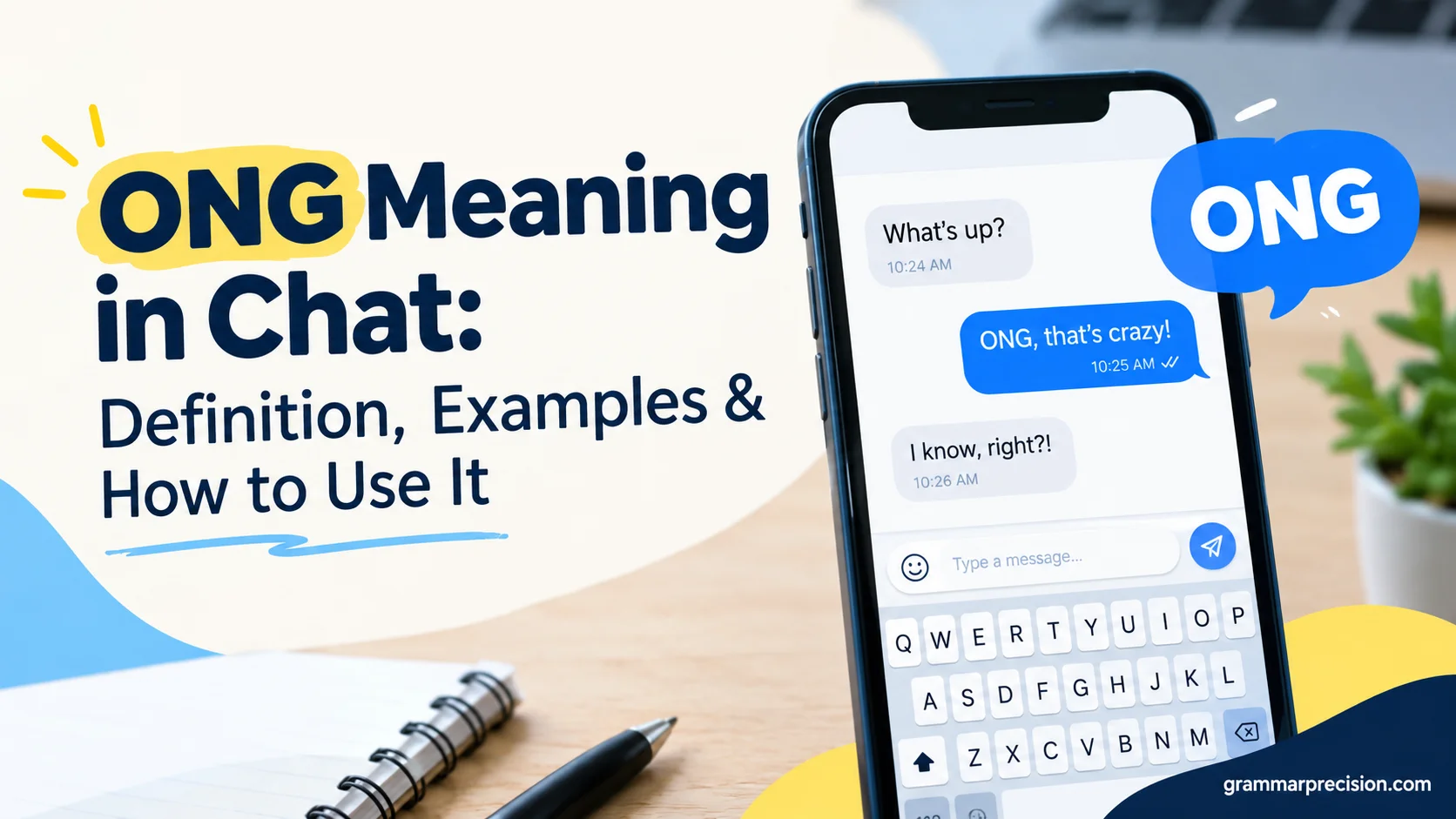
ONG stands for “On God.” It’s an informal expression people use to emphasize that they’re telling the truth or strongly believe something.
For example:
Person A: “That was the best movie I’ve ever watched.”
Person B: “ONG, the ending was incredible!”
Here, Person B uses ONG to agree enthusiastically with Person A.
People also use ONG to make statements sound more convincing. If someone texts, “ONG, I didn’t take your charger,” they’re emphasizing that they’re telling the truth.
In everyday digital communication, ONG commonly expresses:
- Honesty: Emphasizing that a statement is true.
- Agreement: Showing strong support for another person’s opinion.
- Emphasis: Making a feeling or statement sound stronger.
- Excitement: Reacting enthusiastically to something.
- Frustration: Expressing annoyance or disbelief.
The exact meaning depends on the surrounding words and the relationship between the people chatting.
What Does ONG Stand For?
ONG is an abbreviation of “On God,” an expression used in informal speech to emphasize sincerity or conviction. In texting, people often use the shortened form because it’s quick, recognizable, and easy to type.
The Meaning Behind “On God”
The phrase “On God” has a broader linguistic and cultural background than its three-letter abbreviation might suggest.
In everyday speech, people sometimes invoke God to emphasize that they’re being truthful or making a serious statement. Similar expressions include “I swear” and “I promise.” In casual conversations, “On God” can serve a comparable purpose.
For example:
- “On God, I finished the assignment last night.”
- “That restaurant has the best burgers, ONG.”
- “ONG, you won’t believe what happened today.”
In each example, the expression adds emphasis. It doesn’t automatically prove that the speaker is telling the truth, though. People can use emphatic expressions sincerely, jokingly, or sarcastically.
How ONG Became Popular in Online Conversations
As texting and social media became central to everyday communication, abbreviations offered a convenient way to express familiar phrases quickly.
ONG fits naturally into this style. Instead of typing “On God,” someone can write three letters and communicate a similar idea to readers who recognize the slang.
Online conversations also encourage expressive language. People use abbreviations to react to videos, agree with friends, emphasize opinions, and make messages feel more casual.
However, it’s difficult to assign ONG’s popularity to one platform or a single year. Internet slang often spreads through overlapping communities, music, videos, memes, and personal conversations.
How People Use ONG in Chat
ONG can communicate several different emotions without changing its basic meaning. The words surrounding it help you understand what the sender intends.
ONG to Show Honesty
One common use of ONG is to emphasize that a statement is true.
Example:
Alex: “Did you really meet that actor?”
Jordan: “ONG, I saw him at the airport yesterday!”
Jordan uses ONG to make the claim sound sincere. The abbreviation adds emphasis without changing the basic message.
People may use it when explaining something, defending themselves, or trying to convince a friend that they’re not joking.
ONG to Express Agreement
ONG can also show that someone strongly agrees with another person’s opinion.
Example:
Mia: “This week has been exhausting.”
Taylor: “ONG, I need a vacation.”
Taylor isn’t necessarily making a promise or swearing an oath. Instead, the abbreviation reinforces the agreement and adds emotional weight.
In this situation, ONG works like an enthusiastic version of “Exactly!” or “Seriously!”
ONG to Emphasize an Opinion
Sometimes people use ONG to make an opinion sound stronger.
Consider this message:
“ONG, that song deserves more attention.”
The sender wants to emphasize how strongly they feel about the song. The expression adds conviction and makes the message sound more personal.
You might see similar messages about movies, sports, food, fashion, or other everyday interests.
ONG to Express Surprise or Frustration
ONG also appears in emotional reactions, especially when someone wants to emphasize disbelief or annoyance.
For example:
- “ONG, I can’t believe we missed the bus!”
- “ONG, that plot twist was unbelievable.”
- “ONG, why is this assignment so difficult?”
These examples show how context influences tone. The same abbreviation can accompany excitement, surprise, or frustration.
ONG Meaning on Snapchat, TikTok, and Instagram
The ONG meaning in chat generally stays the same across social platforms. However, the setting can influence how people use it.
ONG on Snapchat
Snapchat conversations often involve quick exchanges between friends. ONG fits naturally into messages about school, plans, jokes, and daily experiences.
Example:
“ONG, that picture came out so good!”
The sender emphasizes their reaction to a photo. The expression helps the message feel enthusiastic and informal.
ONG on TikTok
On TikTok, people may use ONG in video comments, captions, and conversations about trending content.
For example:
“ONG, this is exactly what happens every Monday.”
A commenter might write this under a relatable comedy video. The abbreviation strengthens the reaction and signals agreement with the video’s message.
ONG on Instagram
Instagram users may include ONG in direct messages, story replies, and comment sections.
Example:
“ONG, your vacation pictures look amazing!”
Here, ONG adds enthusiasm to a compliment.
People also use it when discussing celebrity news, sharing memes, or reacting to a friend’s post.
ONG in Group Chats and Gaming Communities
Group chats and gaming conversations often move quickly. Short expressions help participants react without interrupting the flow.
For example:
Player A: “We won that match with one second left!”
Player B: “ONG, that ending was insane.”
Player B uses ONG to express excitement and emphasize the unexpected result.
Remember that slang varies between communities. Not everyone uses the same abbreviations, even when they participate on the same platform.
ONG Examples in Text Messages
The easiest way to understand ONG is to see it in different conversational situations.
Here are 15 examples with explanations of what each message communicates.
| Text Message | Meaning | Tone |
| “ONG, I’m telling the truth.” | The speaker emphasizes honesty. | Serious |
| “ONG, that movie was amazing.” | The speaker strongly likes the movie. | Enthusiastic |
| “ONG, I forgot my homework.” | The speaker emphasizes a mistake. | Frustrated |
| “This food is incredible, ONG.” | The speaker strongly praises the food. | Excited |
| “ONG, you’re absolutely right.” | The speaker strongly agrees. | Supportive |
| “ONG, that joke was hilarious.” | The speaker emphasizes amusement. | Playful |
| “ONG, I saw him downtown.” | The speaker emphasizes a claim. | Sincere |
| “ONG, this weather is terrible.” | The speaker emphasizes dissatisfaction. | Annoyed |
| “ONG, we need to try that place.” | The speaker strongly supports an idea. | Enthusiastic |
| “ONG, I can’t stop laughing.” | The speaker emphasizes amusement. | Excited |
| “ONG, that game was difficult.” | The speaker stresses the challenge. | Conversational |
| “ONG, I thought today was Friday.” | The speaker expresses surprise or confusion. | Informal |
| “ONG, you made my day.” | The speaker emphasizes appreciation. | Warm |
| “ONG, this song is stuck in my head.” | The speaker stresses how memorable the song is. | Casual |
| “ONG, that was completely unexpected.” | The speaker emphasizes surprise. | Astonished |
The key takeaway: ONG adds emphasis, but the words around it determine whether the message sounds serious, playful, excited, or frustrated.
ONG vs. OMG vs. ISTG vs. FR
Internet slang often overlaps, so it’s easy to confuse abbreviations that appear in similar situations. Although ONG, OMG, ISTG, and FR can all add emphasis, they don’t communicate exactly the same thing.
| Abbreviation | Full Form | Common Purpose | Example |
| ONG | On God | Emphasizing sincerity or conviction | “ONG, I’m telling the truth.” |
| OMG | Oh My God | Expressing surprise, excitement, or shock | “OMG, that’s incredible!” |
| ISTG | I Swear to God | Strongly emphasizing a statement, promise, or frustration | “ISTG, I left my keys here.” |
| FR | For Real | Expressing agreement, sincerity, or confirmation | “FR, that movie was amazing.” |
| NGL | Not Gonna Lie | Introducing an honest opinion or admission | “NGL, I didn’t enjoy the ending.” |
ONG vs. OMG
The biggest difference is their typical purpose.
ONG often emphasizes sincerity or strong agreement. OMG usually expresses surprise, excitement, or shock.
For example:
- “ONG, this is the best pizza I’ve ever had!” emphasizes a strong opinion.
- “OMG, I didn’t know you were coming!” expresses surprise.
People sometimes use these abbreviations loosely, so their meanings can overlap.
ONG vs. ISTG
Both expressions can emphasize sincerity, but ISTG often sounds stronger or more intense.
“ONG, I didn’t touch your phone” emphasizes the speaker’s denial.
“ISTG, I didn’t touch your phone” can sound more forceful, especially during an argument.
Neither abbreviation guarantees that someone is being truthful. You still need to consider the situation and the person’s credibility.
ONG vs. FR
FR means “For Real.” People use it to express agreement, sincerity, or confirmation.
Compare these examples:
- “ONG, that test was difficult.”
- “FR, that test was difficult.”
Both messages communicate agreement or emphasis. However, ONG carries the “On God” expression, while FR more directly means “For Real.”
ONG vs. NGL
NGL means “Not Gonna Lie.” People commonly use it before sharing an honest opinion, confession, or potentially uncomfortable observation.
For example:
- “ONG, that was a great performance.”
- “NGL, I expected a better performance.”
The first emphasizes a positive judgment. The second introduces an honest opinion that may differ from expectations.
Is ONG Rude, Friendly, or Disrespectful?
ONG isn’t inherently rude or disrespectful. Its tone depends on the message, the relationship between the speakers, and the situation.
When ONG Sounds Friendly
Friends often use ONG to agree, joke around, or express excitement.
For example:
“ONG, we have to go there this weekend!”
The message sounds enthusiastic and friendly. The abbreviation helps communicate excitement without making the conversation feel formal.
When ONG Sounds Serious or Defensive
During disagreements, ONG can make a statement sound more forceful.
Consider this exchange:
Person A: “You told everyone my secret.”
Person B: “ONG, I didn’t tell anyone.”
Person B uses ONG to emphasize a denial. Depending on the surrounding conversation, the response might sound sincere, defensive, or frustrated.
Don’t judge the sender’s intentions from the abbreviation alone. Read the complete message and consider what happened before it.
When You Should Avoid Using ONG
Although ONG works well in casual conversations, it isn’t suitable for every setting.
Avoid using it in situations such as:
- Formal business emails.
- Academic assignments requiring formal language.
- Professional reports and official documents.
- Serious conversations where slang could create confusion.
- Messages to people who may not understand internet abbreviations.
In these situations, choose clearer alternatives such as “I assure you,” “I agree,” or “I’m being honest.”
How to Reply When Someone Says ONG
You don’t need a special response every time someone uses ONG. The best reply depends on what the person is trying to communicate.
Casual Replies to ONG
When someone uses ONG to emphasize an ordinary statement, respond naturally.
Examples include:
- “I believe you!”
- “Seriously?”
- “That’s crazy!”
- “I know, right?”
- “Exactly!”
Choose a reply that fits the conversation instead of forcing slang into every message.
Funny Replies to ONG
If your friend uses ONG in a playful conversation, a humorous response can keep things lively.
For example:
Friend: “ONG, I could eat ten burgers right now.”
You: “Let’s start with one and see what happens.”
Other playful replies include:
- “That’s a bold claim!”
- “Someone’s definitely hungry.”
- “I’ll believe it when I see it.”
- “Your stomach is doing the talking.”
Humor works best when you understand the other person’s tone and know they’ll appreciate the joke.
Replies When Someone Emphasizes the Truth
If someone uses ONG to reassure you, acknowledge their statement without making the exchange unnecessarily complicated.
You could reply:
- “Okay, I understand.”
- “Thanks for explaining.”
- “Got it. I appreciate you telling me.”
- “All right, I hear you.”
If the situation involves a serious disagreement, focus on the actual issue rather than relying on slang to settle it.
Common Mistakes People Make When Using ONG
Although ONG is simple, a few misunderstandings can cause confusion.
Assuming ONG Always Means the Same Thing
ONG generally stands for “On God,” but its emotional meaning changes with context.
A message such as “ONG, that was amazing” expresses enthusiasm. Meanwhile, “ONG, I didn’t do it” emphasizes a denial.
The abbreviation stays the same, but the conversational purpose changes.
Confusing ONG With OMG
ONG and OMG look similar, yet they usually serve different purposes.
Remember this simple distinction:
- ONG: Think sincerity, conviction, or strong agreement.
- OMG: Think surprise, excitement, or shock.
This shortcut won’t explain every possible use, but it works well in everyday texting.
Taking Every Message Literally
People sometimes use slang jokingly or sarcastically. Someone might write “ONG, you’re the worst” after a friend wins a game, even though they’re clearly joking.
Consider the relationship, surrounding messages, and conversation history before deciding what the person means.
Using ONG in Formal Communication
Slang can make personal messages feel natural, but it may look out of place in professional writing.
Instead of writing “ONG, the figures are correct,” consider saying, “I’ve checked the figures, and they are correct.”
The second version communicates the point clearly without relying on informal language.
FAQs About ONG
What Does ONG Mean From a Guy?
When a guy texts ONG, he usually means “On God.” He might be emphasizing honesty, agreeing with you, or expressing a strong reaction. The abbreviation alone doesn’t indicate romantic interest. Consider the full conversation before interpreting his intentions.
What Does ONG Mean From a Girl?
When a girl uses ONG, it generally has the same meaning as when anyone else uses it. She might use it to emphasize a statement, agree with your opinion, or react enthusiastically. Her tone and the surrounding message provide more useful clues than her gender.
Is ONG the Same as OMG?
No. ONG means “On God,” while OMG means “Oh My God.” ONG commonly emphasizes sincerity or conviction, whereas OMG typically expresses surprise, excitement, or shock. However, their usage can overlap in informal conversations.
Is ONG a Bad Word?
ONG isn’t generally considered a swear word. However, it comes from an expression that invokes God, so some people may consider it inappropriate depending on their personal or religious beliefs. Consider your audience when deciding whether to use it.
Does ONG Always Mean Someone Is Telling the Truth?
No. ONG is often used to emphasize honesty, but it doesn’t prove that a statement is true. People can use it sincerely, jokingly, or sarcastically. Evaluate the actual situation rather than treating the abbreviation as evidence.
Can ONG Have Other Meanings?
In ordinary texting slang, ONG most commonly means “On God.” However, abbreviations can have different meanings in specialized communities, workplaces, or organizations. If the surrounding conversation doesn’t make the meaning clear, ask the sender what they intended.
Conclusion:
Understanding the ONG meaning in chat helps you recognize honesty, agreement, and strong emotions in everyday digital conversations. You can now interpret this popular abbreviation more confidently across social media platforms.
Whether you see ONG on Snapchat, TikTok, or in text messages, remember that context shapes its meaning. Use it naturally in casual chats, but choose clear, professional language for formal writing, workplace communication, and important conversations.