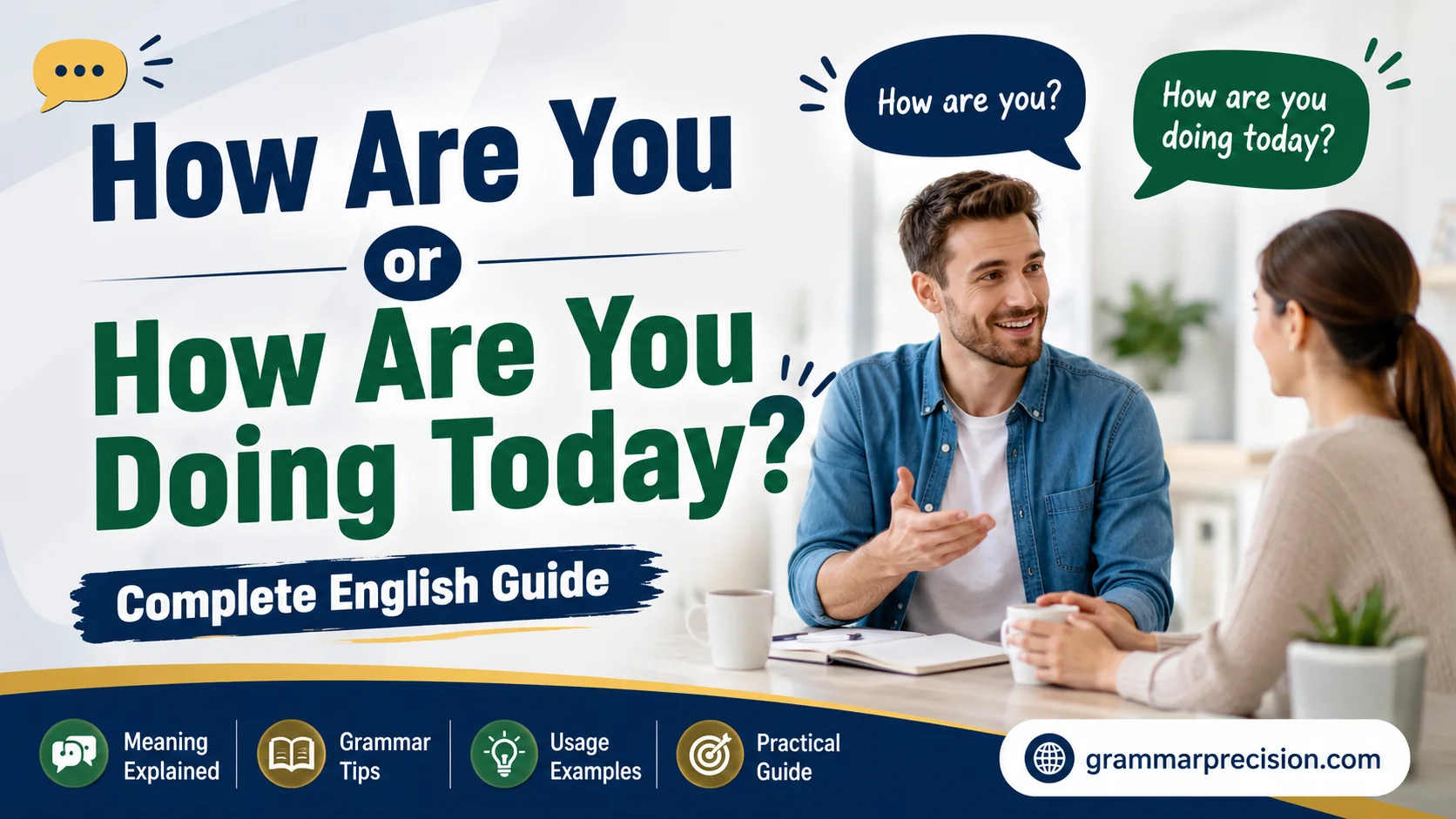
How Are You or How Are You Doing Today may seem like a simple choice, but each phrase creates a slightly different tone and purpose in everyday English conversations, especially when you want to sound friendly, natural, and polite today correctly.
Knowing the difference between these greetings can help you sound more natural, friendly, and confident. Both expressions ask about someone’s well-being, but How are you? often works as a general greeting, while How are you doing today? focuses more clearly on a person’s current mood, condition, or experience. Context determines which phrase feels most appropriate in friendly and professional conversations, depending on your relationship and situation.
This guide explains their meaning, grammar, tone, usage, and practical examples in simple English. You’ll learn how speakers use these questions in casual conversations, professional settings, customer service, emails, and daily communication. We’ll also explore natural responses, common mistakes, and situations where one greeting sounds more suitable than the other in different contexts, helping you make confident choices every day without hesitation and confusion clearly.
By understanding these subtle differences, you can improve your English communication skills and choose words that match your purpose. This guide uses practical language-learning, grammar, vocabulary, and communication principles, supported by clear examples based on everyday usage. Whether you’re a student, professional, teacher, or English learner, you’ll learn to communicate with greater clarity, accuracy, and confidence in real situations with ease and purpose naturally.
How Are You or How Are You Doing Today: The Quick Answer
“How are you?” is the shorter, more general question. You can use it as a greeting, a polite check-in, or a genuine question about someone’s well-being.
“How are you doing today?” is also correct English. It sounds more specific because “today” focuses attention on the person’s present experience. It can suggest that the speaker wants to know how things are going right now rather than simply exchanging a routine greeting.
Compare these examples:
- How are you? — a general check-in or greeting.
- How are you today? — asks about the person’s condition today.
- How are you doing today? — asks how the person is managing or feeling today.
- How’s your day going? — focuses more directly on the day itself.
None of these is automatically “more correct.” The best choice depends on context, relationship, tone, and purpose.
The Real Difference Between These Two Questions
The easiest way to remember the distinction is to think about scope.
“How are you?” casts a wide net. It can refer to your general well-being, mood, health, or life situation. Because people use it so often as a greeting, the listener may answer briefly.
“How are you doing today?” narrows the question. The word “today” gives it a time frame. The speaker is asking about your present state within the context of this particular day.
Imagine two camera shots. “How are you?” is like a wide-angle photograph. “How are you doing today?” is like a snapshot taken right now. Both show the same person, but the second gives you a more specific moment.
How “doing” changes the nuance
The verb “do” can refer to how someone is managing, progressing, or coping with circumstances. That’s why “How are you doing?” often feels slightly more dynamic than “How are you?”
For example, after someone starts a demanding job, you might ask:
“How are you doing?”
You may be asking whether they’re handling the new responsibilities well.
If you add “today,” the question becomes even more immediate:
“How are you doing today?”
That could be appropriate after a stressful morning, an important appointment, or a difficult event.
Why “today” matters
Without “today,” the question can remain broad:
How are you doing?
With “today,” the speaker establishes a clear time reference:
How are you doing today?
This distinction becomes especially useful when someone’s circumstances change from day to day. A person may generally feel fine but have a difficult day. Asking about today acknowledges that possibility.
“How Are You?”: When It Fits Best
Because “How are you?” has become a standard greeting in American English, it works in an enormous range of situations. You can say it to a friend, coworker, neighbor, teacher, customer, or acquaintance.
The important point is that the phrase doesn’t always demand a detailed report.
As a greeting
You might walk into a coffee shop and run into a colleague:
“Hey, Sarah. How are you?”
Sarah might answer:
“I’m good, thanks! How about you?”
The exchange may last only a few seconds. Neither person necessarily expects a long discussion.
That doesn’t make the question meaningless. It simply means that English speakers often use phatic communication—language that helps maintain social connection rather than convey detailed information.
As a genuine question
Context can turn the same words into a serious check-in.
Suppose your friend has been dealing with a stressful situation. When you ask:
“How are you?”
your tone, facial expression, and timing may communicate genuine concern.
The words stay the same, but the conversational meaning changes. Context carries a surprising amount of meaning.
In casual English
“How are you?” sounds natural with friends and family:
- “Hey! How are you?”
- “How are you doing?”
- “Hi, Mom. How are you?”
- “How are you these days?”
The choice often depends more on personal speaking habits than strict grammar rules.
In professional settings
The phrase also works at work:
“Good morning, Mr. Lee. How are you?”
However, in a professional setting, the response usually stays brief unless the relationship is close.
A natural exchange might look like this:
“Good morning. How are you?”
“I’m doing well, thank you. How are you?”
That sounds polite without becoming overly formal.
“How Are You Doing Today?”: When It Fits Best
While “How are you?” can function as a routine greeting, “How are you doing today?” often feels more intentional.
You might use it when you actually want information about the person’s current state.
When checking on someone’s day
Imagine your coworker arrives looking tired. You might say:
“You look a little tired. How are you doing today?”
The question fits because the context makes the person’s current condition relevant.
When you want a more specific answer
Adding “today” can invite the listener to talk about the present rather than their entire life.
For example:
“How are you doing today?”
could receive:
“Much better than yesterday.”
That answer makes sense because the question establishes a time-based comparison.
When showing extra concern
The phrase can sound warm and attentive after a difficult event.
For instance, if a friend had a rough week, you might ask:
“How are you doing today?”
The question acknowledges that their condition may have changed. It also leaves room for a more honest answer.
When context makes “today” important
Sometimes “today” isn’t just extra decoration. It provides useful information.
Consider these situations:
- Someone has an important exam today.
- A coworker is recovering from an illness.
- A friend has a major interview.
- Someone experienced a difficult event yesterday.
- A family member has an unusually demanding day.
In each case, today makes the question more relevant.
Why “Today” Can Change the Conversation
The word “today” does more than add a date to the sentence. It signals that the speaker is interested in a temporary condition, especially when circumstances may shift quickly. Someone can feel excellent generally and still have a miserable Tuesday.
That small word can also make a question feel more connected to the moment. If a friend has an interview, appointment, exam, or difficult meeting, asking about today shows that the immediate situation matters.
For everyday conversation, this gives you a useful shortcut: use the shorter question when you want a broad greeting, and add “today” when the current day provides important context.
Also Read This: Peer vs Pier: What’s the Difference?
The Tone Test: What Does Each Question Communicate?
Words carry meaning, but tone, timing, and context shape how listeners interpret them.
| Phrase | Specificity | Typical Tone | Common Purpose |
| How are you? | General | Friendly, neutral | Greeting or check-in |
| How are you today? | Medium | Warm, attentive | Asking about current condition |
| How are you doing today? | High | Caring, conversational | Checking current well-being |
| How’s it going? | General | Casual | Friendly greeting |
| How’s your day going? | High | Casual, interested | Asking about the current day |
There’s an important nuance here. “How are you doing today?” isn’t automatically more caring than “How are you?” A warm tone can make the shorter question deeply sincere. Conversely, someone can say the longer question mechanically.
The words create a starting point. The speaker’s delivery completes the message.
What Should You Answer?
One reason learners hesitate over these expressions is that they aren’t sure how much information to provide.
The good news? You control the depth of the answer.
If you’re having a great day
Try:
- “I’m doing great, thanks!”
- “I’m really good today.”
- “I’m feeling fantastic.”
- “I’m having a great day. How about you?”
If you’re doing okay
Natural middle-ground answers include:
- “I’m doing okay, thanks.”
- “Pretty good.”
- “Not bad.”
- “I’m doing all right.”
- “I’m hanging in there.”
“Not bad” is especially common in casual American English. It usually means reasonably good, not genuinely bad.
If you’re struggling
You don’t have to pretend everything is perfect.
You could say:
- “I’ve had better days.”
- “I’m having a rough day.”
- “I’m a little stressed today.”
- “Honestly, I’m not doing great.”
- “It’s been a difficult morning.”
These responses allow honesty without requiring you to explain everything.
If you don’t want to share details
A short answer is completely acceptable:
“I’m okay, thanks.”
Then return the question:
“How about you?”
That keeps the conversation moving without opening a topic you’d rather avoid.
A Simple Conversation Formula
If you’re unsure which expression to choose, use this mental formula:
General greeting → “How are you?”
Current situation → “How are you doing today?”
Current day → “How’s your day going?”
Recent life → “How have you been?”
This isn’t an absolute grammar rule. It’s a practical guide for choosing the expression that best matches your intention.
Similar Questions You Should Know
English offers many alternatives that overlap in meaning. However, each one has its own flavor.
How are you today?
This sits between the two main expressions.
“How are you today?”
It asks about the person’s current condition without using “doing.” It can sound warm, polite, or slightly more attentive than a basic greeting.
How are you doing?
This is extremely common in conversational American English.
“Hey, how are you doing?”
It can function almost exactly like “How are you?” when used as a greeting.
How have you been?
This question looks backward over a period of time.
“It’s been months! How have you been?”
The speaker isn’t asking only about this exact moment. They want an update since the last meeting.
How’s everything going?
This phrase can refer to life, work, school, relationships, or another broad area.
“How’s everything going at your new job?”
It often invites a little more information than “How are you?”
How are you feeling?
This phrase focuses more directly on physical or emotional condition.
“You didn’t sleep well last night. How are you feeling?”
That’s different from the broader “How are you?”
How’s your day going?
This one focuses on the person’s day rather than their overall well-being.
“Hey, how’s your day going?”
A natural answer might be:
“Pretty well. I’ve been busy, but I’m almost finished.”
Common Mistakes to Avoid
Even though these expressions are simple, learners sometimes make small usage mistakes.
Mistake: Assuming one phrase is always correct
English rarely works like a multiple-choice test here. Both “How are you?” and “How are you doing today?” are grammatically correct.
The real question is whether the expression suits the situation.
Mistake: Giving an overly long answer to a routine greeting
If someone casually says:
“How are you?”
you don’t need to provide a five-minute life update.
A simple:
“I’m good, thanks. How about you?”
usually works perfectly.
How Native English Speakers Actually Choose
Native speakers don’t usually stop to analyze the grammar before asking these questions. They respond to the situation.
If they pass a neighbor on the sidewalk, they might say:
“Hey, how are you?”
If they know their friend has been dealing with something difficult, they might ask:
“How are you doing today?”
If they want to know about the person’s schedule or mood:
“How’s your day going?”
This flexibility is one reason conversational English can feel difficult at first. The grammar may be simple, but pragmatics—the way language works in context—adds another layer.
Quick Comparison: Which Phrase Should You Use?
| If you want to… | Best choice |
| Give a normal greeting | How are you? |
| Ask about today’s condition | How are you today? |
| Check how someone is coping right now | How are you doing today? |
| Ask about their current day | How’s your day going? |
| Ask about their recent life | How have you been? |
| Sound very casual | How’s it going? |
When in doubt, “How are you?” remains the safest everyday choice. It’s natural, flexible, and widely understood.
FAQs:
Is “How Are You?” grammatically correct?
Yes, “How are you?” is grammatically correct and one of the most common English greetings. You can use it in casual conversations, professional settings, emails, and everyday interactions. It usually asks about someone’s general well-being.
Is “How Are You Doing Today?” correct?
Yes, “How are you doing today?” is also grammatically correct. It usually sounds more focused on the person’s current feelings, condition, or experience. It can feel warmer and more personal, especially when you genuinely want to know how someone is doing.
What is the difference between “How Are You?” and “How Are You Doing Today?”
“How are you?” is a general greeting that can be used almost anywhere. “How are you doing today?” places more emphasis on the person’s current situation. Both are natural, but the second question can sound more caring and conversational.
How should you respond to “How Are You?”
You can respond with a simple, polite answer such as “I’m good, thank you. How are you?” Other natural responses include “I’m doing well,” “I’m great, thanks,” or “Pretty good. How about you?” Your response can change depending on the situation and your relationship with the speaker.
Is “How Are You Doing Today?” better for professional communication?
It can be appropriate in professional communication, especially when speaking with customers, colleagues, students, or clients. However, “How are you?” is often more concise and neutral. Choose the expression that matches the context, relationship, tone, and purpose of your conversation.
Conclusion:
How Are You or How Are You Doing Today are both natural English expressions, but they can communicate slightly different tones and intentions depending on the context and relationship between speakers.
“How are you?” works as a common, general greeting, while “How are you doing today?” focuses more on someone’s present well-being or situation. Both expressions are correct, polite, and useful in everyday and professional communication.
The best choice depends on your purpose, audience, and conversational context. Understanding this small difference can improve your English fluency, grammar, confidence, and communication skills, helping you choose natural expressions in real-life conversations.