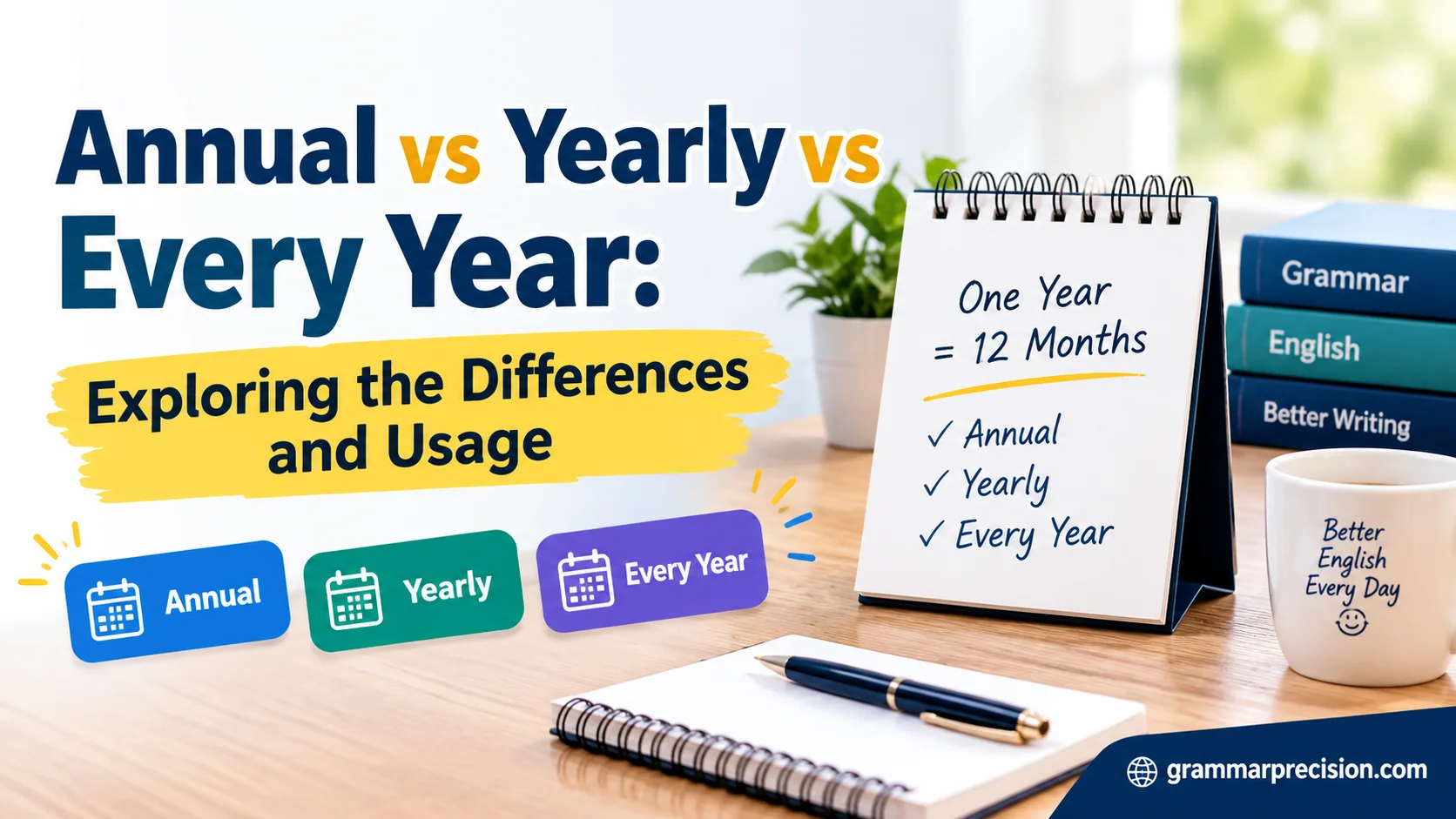
When discussing time, annual vs yearly vs every year can seem confusing. All three relate to a 12-month period, but their usage and meaning can differ. Learning these simple differences will help you write clear, natural, and correct English.
The word annual usually describes something that happens once a year or relates to a particular year. It’s common in formal writing, business, reports, meetings, and official documents. For example, an annual report is a report prepared once every year, while an annual event takes place each year.
Yearly is more flexible and often sounds more natural in everyday English. It can work as an adjective or adverb, depending on the sentence. You might say, “We have a yearly meeting,” or “The price increases yearly.” Its meaning is usually easy to understand because it directly connects an action or event with each year.
Every year is a simple phrase that clearly means once in each year or during each year. It’s especially common in conversational English because it sounds direct and familiar. Although annual, yearly, and every year can sometimes be interchangeable, their grammar, tone, and sentence structure can make one choice better than another.
Why Annual, Yearly, and Every Year Cause Confusion
The confusion starts because the three expressions often describe the same basic idea: something happens once each year or relates to a year.
Consider these sentences:
- We have an annual meeting.
- We have a yearly meeting.
- We have a meeting every year.
The basic message remains similar. However, the grammar changes.
In the first two sentences, annual and yearly describe the noun meeting. In the third, every year tells us how often the meeting happens. That’s the key distinction.
Another reason for the confusion is that dictionaries often define annual and yearly with very similar words. Both can mean happening once a year. Yet English isn’t simply a collection of interchangeable dictionary definitions. A word can have the right meaning while still sounding less natural in a particular sentence.
Quick rule: Use annual or yearly to describe a noun. Use every year when you want to emphasize a repeated action or event.
The Three Expressions in One Sentence
Here’s a sentence that puts all three expressions together:
The company holds an annual conference every year and publishes a yearly industry report.
At first glance, this might look repetitive. In fact, each expression has a distinct grammatical role.
- Annual conference — annual modifies the noun conference.
- Every year — this phrase explains the frequency of holds.
- Yearly industry report — yearly modifies report.
This gives us a useful mental model:
| Expression | Main job | Example |
| Annual | Describes a noun | annual conference |
| Yearly | Describes a noun or action | yearly conference / meet yearly |
| Every year | Shows frequency | meet every year |
Once you see the grammatical job, the choice becomes much less mysterious.
Think of Them as Three Different Tools
Imagine you’re packing for a trip. You wouldn’t use a hammer when you need a screwdriver simply because both are tools. The same principle applies here.
Annual = The Label
Annual usually acts as an adjective. It tells you that something is connected with a particular yearly cycle.
For example:
- annual report
- annual budget
- annual meeting
- annual review
- annual subscription
- annual celebration
Notice what comes after annual. In each case, it modifies a noun.
You can think of annual as a label attached to an event, payment, report, process, or other noun.
The company published its annual report in March.
Here, annual doesn’t tell us exactly what someone did every year. Instead, it identifies the type of report.
Yearly = The Flexible Option
Yearly has a little more flexibility. It can function as an adjective or an adverb.
As an adjective:
We conduct a yearly review of our safety procedures.
As an adverb:
We review our safety procedures yearly.
That flexibility makes yearly useful in both descriptive and action-focused sentences.
However, its adverbial use can sometimes sound less natural than every year. For example, We visit our grandparents yearly is grammatically acceptable, but We visit our grandparents every year often sounds more conversational.
Every Year = The Frequency Marker
Every year works as an adverbial phrase. It tells you when or how often something happens.
For example:
The festival attracts thousands of visitors every year.
The phrase doesn’t describe festival or visitors. Instead, it modifies the action attracts by showing its frequency.
That’s why every year often feels especially natural in everyday English.
The Biggest Grammar Difference: Adjective vs. Adverb
The clearest way to understand annual vs. yearly vs. every year is to look at grammar rather than meaning alone.
Annual Is Mainly an Adjective
An adjective modifies a noun. That’s exactly what annual normally does.
We received our annual statement.
The school held its annual ceremony.
She completed her annual medical checkup.
You generally wouldn’t say:
We check the equipment annual. ❌
Why? Because annual isn’t functioning as an adverb there.
You could instead say:
We check the equipment annually. ✅
Or:
We check the equipment every year. ✅
That distinction between annual and annually is important.
Yearly Can Be an Adjective
As an adjective, yearly works much like annual.
The company publishes a yearly newsletter.
We receive a yearly statement.
They organize a yearly festival.
In these examples, yearly sits before a noun and describes it.
Yearly Can Also Be an Adverb
This is where yearly differs from annual.
The organization meets yearly.
Membership fees are reviewed yearly.
The award ceremony takes place yearly.
Still, the choice between yearly and every year depends on style and context.
Compare:
We visit the museum yearly.
We visit the museum every year.
Both are grammatically sound. The second generally feels more relaxed and conversational.
Every Year Is an Adverbial Phrase
Every year expresses frequency.
We update the policy every year.
The birds return every year.
Sales increase during this period every year.
You can move the phrase around in some sentences:
Every year, the town hosts a large cultural festival.
The town hosts a large cultural festival every year.
Both versions work. The first gives the yearly timing stronger emphasis.
Annual vs. Yearly: The Tone Test
If annual and yearly can both describe a noun, why choose one over the other?
Often, the answer involves tone and collocation.
Annual frequently appears in formal, professional, institutional, and financial language.
Common examples include:
- annual report
- annual revenue
- annual salary
- annual budget
- annual meeting
- annual conference
- annual audit
- annual fee
- annual review
Yearly is perfectly valid, but it can feel more general or conversational.
Compare:
The board approved the annual budget.
The board approved the yearly budget.
Both can work, but annual budget is the established business phrase. English speakers often prefer familiar word combinations because they sound natural and precise.
When Annual Sounds More Professional
Choose annual when writing formal material such as:
- business reports
- financial documents
- official announcements
- academic material
- corporate policies
- institutional publications
For example:
Employees receive an annual performance review.
That sounds more conventional than yearly performance review in many workplace settings.
However, don’t assume annual is always better. In casual writing, yearly may sound warmer and less formal.
Also Read This: How Are You or How Are You Doing Today? Complete English Guide
Yearly vs. Every Year: The Naturalness Test
The difference becomes easier when you compare sentences involving actions.
We host a family dinner every year.
We host a family dinner yearly.
Both are correct, but the first sounds more natural in everyday conversation.
Why? Every year has a straightforward, spoken quality. It clearly answers the question How often?
Consider this exchange:
How often do you visit your hometown?
I visit every year.
That sounds completely natural.
I visit yearly.
That’s grammatical, but it feels more formal or written.
So when you’re speaking casually, every year is often the safest choice for repeated actions.
Annual vs. Every Year: The Sentence-Structure Test
Here’s one of the most useful tricks to remember.
If the phrase comes before a noun, annual often works beautifully.
annual inspection
If you want to describe the action itself, use every year.
We inspect the building every year.
Notice how the sentence changes:
Noun phrase:
an annual inspection
Action:
We inspect the building every year.
The meaning overlaps, but the grammatical structure doesn’t.
The same pattern appears everywhere:
| Noun-focused expression | Action-focused expression |
| annual meeting | meet every year |
| annual payment | pay every year |
| annual review | review it every year |
| annual celebration | celebrate every year |
| annual inspection | inspect it every year |
| annual report | publish a report every year |
This transformation is one of the easiest ways to avoid awkward usage.
Annual vs. Yearly vs. Every Year in Real-Life Situations
At Work
Professional environments heavily favor annual in established terms.
The company conducts an annual performance review.
Employees receive an annual bonus based on performance.
But when describing an action, every year works naturally:
The company reviews its compensation policy every year.
You could also say:
The company reviews its compensation policy yearly.
Both are correct.
In Business
Financial and corporate language commonly uses annual:
- annual revenue
- annual expenses
- annual growth
- annual earnings
- annual report
- annual subscription
For example:
The business reported annual revenue of $2 million.
If you’re discussing the frequency of an activity, however:
The company publishes its financial results every year.
With Events
All three forms can appear:
The city holds an annual festival.
The city holds a yearly festival.
The city holds a festival every year.
The first sounds especially natural in formal promotional or news writing. The third sounds particularly natural in ordinary conversation.
With Payments and Subscriptions
Annual is extremely common when discussing payment periods.
The service offers an annual subscription.
The annual fee is $120.
You could also say:
The fee is charged every year.
The two constructions approach the same idea from different grammatical angles.
With Habits and Traditions
When talking about personal habits, every year often feels most natural.
We travel to the mountains every year.
My family plants a garden every year.
For a named tradition, however, annual works well:
It’s an annual family tradition.
That’s a subtle but useful difference.
A Closer Look at “Annually”
There’s another word worth adding to the puzzle: annually.
It means once a year or once every year and functions as an adverb.
Compare:
We conduct an annual review.
We conduct the review annually.
We conduct the review every year.
The first uses an adjective. The other two express frequency.
Here’s the pattern:
annual + noun
verb + annually
verb + every year
For example:
The organization holds an annual conference.
The organization meets annually.
The organization meets every year.
This distinction becomes especially useful in formal writing.
What About “Once a Year”?
Once a year is another expression that often overlaps with every year.
Compare:
We meet every year.
We meet once a year.
In many situations, both mean that the event occurs one time during each year.
However, once a year emphasizes the frequency of one occurrence. Every year focuses more broadly on the repeated yearly pattern.
For example:
The company reviews the policy once a year.
This strongly suggests one review per year.
The company reviews the policy every year.
This emphasizes the fact that the review happens each year.
The difference is small, but context can make one option more useful than the other.
25 Practical Examples of Annual, Yearly, and Every Year
Here are examples across different situations:
Examples With Annual
- The company released its annual report.
- We attended the annual conference.
- Her annual salary increased.
- The school held its annual ceremony.
- The service includes an annual subscription.
- They completed an annual inspection.
- The charity published its annual review.
- The club organizes an annual fundraiser.
Examples With Yearly
- We publish a yearly newsletter.
- The museum receives a yearly grant.
- The company offers a yearly membership.
- They conduct a yearly survey.
- The organization meets yearly.
- The fee is reviewed yearly.
- The event attracts a yearly audience of thousands.
Examples With Every Year
- We visit our relatives every year.
- The festival returns every year.
- She updates her goals every year.
- The company hires new graduates every year.
- Snow covers the mountains every year.
- They celebrate the occasion every year.
- The school holds a competition every year.
- We renew the policy every year.
Common Mistakes to Avoid
Writing “Everyyear”
This is one of the easiest mistakes to fix.
Every year is written as two words when it means each year.
We visit them every year. ✅
We visit them everyyear. ❌
Don’t confuse it with everyday, which is a different word.
These are my everyday shoes.
Here, everyday means ordinary or routine.
Confusing Annual With Annually
These words are related but don’t perform the same grammatical job.
We have an annual meeting. ✅
We meet annually. ✅
We meet annual. ❌
Use annual before a noun. Use annually to modify an action.
Assuming Annual and Every Year Are Always Direct Substitutes
You can’t simply replace one with the other without changing the sentence structure.
annual inspection
can become:
inspection every year
But you can’t write:
We conduct an every year inspection. ❌
Instead:
We conduct an annual inspection. ✅
or:
We inspect the equipment every year. ✅
Assuming Yearly Is Always the Best Casual Choice
Yearly is correct, but every year often sounds more natural in conversation.
I travel abroad every year.
That sentence feels effortless. I travel abroad yearly is also correct, but it has a slightly different rhythm.
A Quick Decision Guide
When you’re stuck, ask yourself what you want the expression to do.
Are you describing a noun?
→ Use annual or yearly.
Are you describing how often an action happens?
→ Use every year or yearly.
Are you writing something formal or professional?
→ Annual often fits best when modifying a noun.
Are you speaking casually about repeated activity?
→ Every year usually sounds natural.
Do you need an adverb for formal writing?
→ Consider annually.
The Cheat Sheet
| Situation | Best choice | Example |
| Formal noun phrase | Annual | annual report |
| General noun phrase | Yearly | yearly report |
| Repeated action | Every year | We meet every year |
| Formal adverb | Annually | We meet annually |
| Casual frequency | Every year | I travel every year |
| One occurrence per year | Once a year | We review it once a year |
A Simple Grammar Formula
You can remember the whole topic with three formulas:
Annual + noun
annual meeting
Yearly + noun/action
yearly meeting
meet yearly
Verb + every year
meet every year
There’s an important caveat: these formulas describe common patterns rather than rigid laws. English offers flexibility, and context always matters.
Mini Case Study: Choosing the Right Expression
Imagine a company preparing three pieces of content.
For its formal report, it writes:
Annual Financial Report
That’s a natural professional collocation.
In an internal email, a manager writes:
We review these figures every year.
That’s clear and conversational.
On an information page, the company writes:
The figures receive a yearly review.
That also works, although annual review may sound more conventional in formal business English.
The underlying event hasn’t changed. The grammar and communication goal have.
That’s the real lesson. Good word choice isn’t just about finding a synonym. It’s about choosing the expression that fits the sentence around it.
FAQs:
What is the difference between annual and yearly?
Annual and yearly both describe something connected with a year or happening once each year. However, annual sounds more formal and is common in business or official writing, while yearly often feels more natural in everyday English.
Is annual the same as every year?
In many situations, annual means something happens once every year. For example, an “annual meeting” is a meeting held each year. However, every year is a phrase that directly describes frequency and usually sounds more conversational.
Can yearly be used as an adverb?
Yes, yearly can function as both an adjective and an adverb. For example, “We have a yearly conference” uses it as an adjective, while “Membership fees are paid yearly” uses it as an adverb.
Should I use annual or yearly in formal writing?
For formal writing, annual is often the better choice, especially in business reports, financial documents, and official communication. For example, “The company published its annual report” sounds more professional than “The company published its yearly report.”
Is every year more common in everyday English?
Yes, every year is very common in conversational English because it sounds simple and natural. You can use it when you want to clearly express that something happens during each year without making the sentence sound formal or technical.
Conclusion:
Understanding annual vs yearly vs every year becomes easier when you focus on meaning, grammar, and context. All can describe yearly events, but each has a slightly different tone and structure.
Annual is usually more formal, while yearly is flexible and common in everyday usage. Every year is the clearest conversational expression when you simply want to say something happens once during each year.
Choosing the right expression depends on your sentence, audience, and writing style. Use annual for formal contexts, yearly for flexible everyday sentences, and every year when you want a simple, direct way to express frequency.