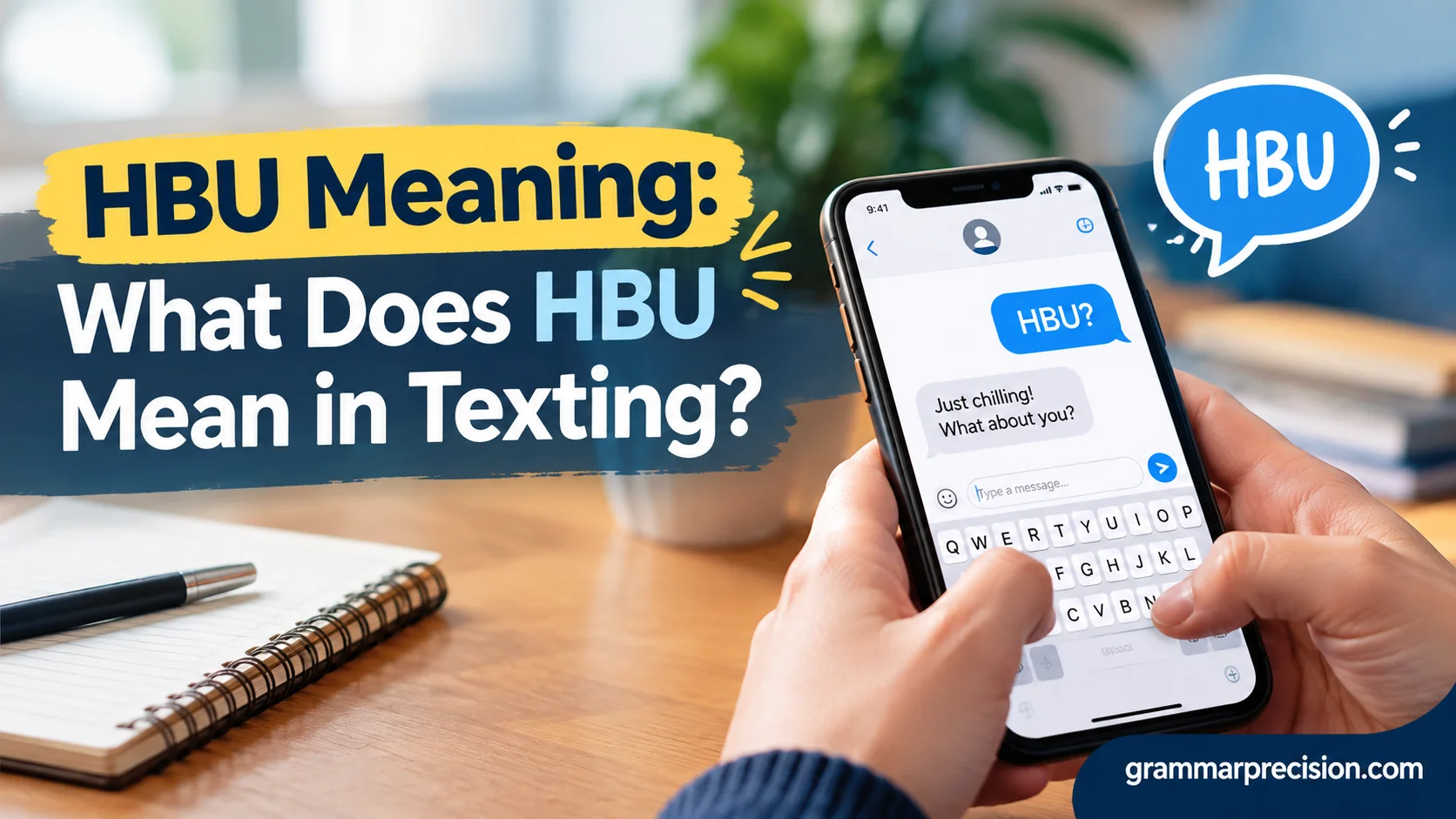
Have you ever received a text that simply says HBU and wondered what it means? HBU Meaning is straightforward: it stands for “How about you?” and commonly appears in casual texting and online conversations. This handy abbreviation keeps texting, social media, and instant messaging quick and natural. You’ll also see it when discussing scheduling, time management, meetings, or a calendar with friends and colleagues.
In this guide, you’ll learn the HBU meaning, correct usage, examples, and common texting contexts. We’ll also explain how HBU fits into business communication, online booking, broadcasting, and project management, where informal abbreviations may require more care. From an English usage and grammar perspective, HBU belongs to casual communication rather than formal writing. US English commonly follows this relaxed texting style, while UK usage can vary by context and style guide. Understanding that distinction helps you communicate with greater clarity and consistency.
What Does HBU Mean?
HBU stands for “How About You?”
The abbreviation takes the first letters of the three words:
| Letter | Word |
| H | How |
| B | About |
| U | You |
In everyday texting, HBU usually works as a conversational handoff. One person answers something, then uses HBU to invite the other person to answer the same question.
For example:
Person A: I’m staying home tonight. HBU?
Person B: I’m meeting some friends.
Here, HBU means “How about you?” It doesn’t introduce a complicated new idea. Instead, it passes the conversational ball back to the other person.
That simple function explains why HBU works so well in quick messages. It saves typing while keeping the exchange balanced.
HBU Meaning in Simple Words
If you want the shortest possible definition, remember this:
HBU = How About You?
It usually means:
- What about you?
- What’s your answer?
- How are things with you?
- What do you think?
- What are your plans?
- How do you feel about it?
The exact interpretation depends on what came immediately before HBU.
For instance, “I’m exhausted today, HBU?” asks about your condition. Meanwhile, “My favorite food is sushi, HBU?” asks about your preference.
What Is the HBU Meaning in Texting?
The HBU meaning in texting is generally the same as the full phrase “How About You?” However, texting gives the abbreviation a distinctly casual feel.
People often use HBU after answering a question or sharing personal information. It allows them to acknowledge the other person while encouraging them to contribute.
Consider these examples:
“I’m good today, hbu?”
“I’m watching a movie. HBU?”
“I’d choose summer. HBU?”
“My weekend was pretty relaxing. HBU?”
In each case, HBU asks the recipient to share something about themselves.
Modern texting encourages this kind of shorthand because digital conversations move quickly. HBU is particularly efficient because three letters replace an entire phrase. Similar abbreviations include WBU, WYD, HRU, IDK, and HMU.
Why Do People Use HBU?
At first glance, HBU seems like nothing more than a shortcut. However, it performs several useful conversational jobs.
It Saves Time
Typing “HBU?” takes considerably less effort than typing “How about you?”
That difference matters during fast-moving conversations. People often use shorthand automatically because the meaning remains obvious from context.
It Keeps Conversations Balanced
Imagine this exchange:
“I just finished my exam. HBU?”
The sender doesn’t simply announce something about themselves. They also give you an opening to respond.
In that sense, HBU acts like a conversation bridge. It connects one person’s experience to another person’s experience.
It Shows Interest
When someone adds HBU after answering you, they’re usually inviting your response.
For example:
“My day was pretty hectic. HBU?”
The sender has answered the implied question and then returned it to you. That creates a natural back-and-forth rather than a one-sided conversation.
It Keeps the Tone Casual
Writing “How about you?” sounds perfectly natural, but HBU feels more relaxed and digital.
That makes it particularly suitable for informal chats with friends, classmates, relatives, or people you already know well.
How to Use HBU Correctly
Using HBU is easy once you understand its conversational role. The simplest pattern is:
Your answer + HBU?
For example:
“I’m feeling much better today. HBU?”
You can also place HBU after information about your plans, preferences, experiences, or opinions.
HBU After Answering a Question
This is probably the most common use.
A: How are you doing?
B: I’m doing great, HBU?
Here, HBU means “How about you?” or “How are you doing?”
HBU When Discussing Plans
HBU can also return a question about future plans.
A: What are you doing this weekend?
B: I’m probably staying home. HBU?
The recipient understands that the sender wants to know their weekend plans.
HBU When Sharing Opinions
You can use HBU after giving an opinion.
“I think the first movie was better. HBU?”
The person isn’t asking about your physical condition. They’re asking whether you share the same opinion.
HBU When Discussing Preferences
HBU can also invite someone to share a preference.
“I’d pick pizza for dinner. HBU?”
Here, the intended question is essentially, “What would you choose?”
The key lesson is simple: HBU inherits meaning from the conversation around it.
HBU Examples in Real Conversations
Seeing HBU in realistic conversations makes its function much clearer.
Everyday Conversation
A: How’s your day going?
B: Pretty good so far. HBU?
A: A little stressful, honestly.
The abbreviation simply returns the original question.
Weekend Plans
A: I’m going hiking Saturday. HBU?
B: I might visit my cousins.
Here, HBU means “What are you doing this weekend?”
Food Preferences
A: I’m craving burgers tonight. HBU?
B: I could definitely go for tacos.
The subject changes, but the conversational function stays the same.
School or Work
A: I finished my project early. HBU?
B: I’m still working on mine.
Again, HBU invites the other person to provide their corresponding update.
Opinion-Based Conversation
A: I actually liked the ending. HBU?
B: I thought it was too predictable.
This example shows why context matters. HBU doesn’t always mean “How are you?” It can mean “What do you think?”
What Does HBU Mean From a Guy or Girl?
People sometimes search for “HBU meaning from a guy” or “HBU meaning from a girl” because they want to know whether the abbreviation carries a romantic message.
Usually, the letters themselves don’t establish romantic intent. HBU simply means “How About You?” The surrounding conversation provides the meaningful clues.
For example:
“I’m going to the concert Friday. HBU?”
That could be completely friendly.
On the other hand:
“I had such a good time talking to you last night. HBU?”
That conversation may feel more personal. Yet the romantic interpretation comes from the surrounding message, not from HBU itself.
HBU in Friendly Conversations
Among friends, HBU is often nothing more than an efficient conversational shortcut.
“I’m ordering pizza. HBU?”
There’s no hidden message. The sender simply wants to know what you’re doing.
HBU in Dating Conversations
Dating conversations can give HBU a warmer or more playful tone.
“I’m free Saturday night. HBU?”
The abbreviation itself remains unchanged. However, the topic makes the message more personal.
HBU in Flirty Texts
A flirty conversation might use HBU as part of a broader exchange:
“I’ve been thinking about our last conversation. HBU?”
Here, the emotional tone comes from the complete sentence.
Don’t read too much into three letters alone. Context beats abbreviation every time.
How to Reply to “HBU?”
When someone texts “HBU?”, the easiest response is to answer the implied question.
You don’t need to create a complicated reply. A natural answer usually works best.
Simple Replies
“I’m doing good too.”
“Pretty good!”
“I’m staying home tonight.”
“Same here.”
“I’m still working.”
Interesting Replies
If you want to keep the conversation moving, add a little detail.
Instead of:
“Good.”
Try:
“Pretty good. I finally finished that project I told you about.”
That gives the other person something to respond to.
Funny Replies
For a casual conversation, humor can work nicely.
“Surviving Monday so far 😂”
“Currently negotiating with my alarm clock.”
“Trying to decide what deserves dinner money.”
The best choice depends on the relationship and the conversation.
Flirty Replies
If the conversation already has a romantic tone, you can answer warmly without forcing it.
“Better now that you texted me.”
“I was hoping you’d ask.”
The important point is context. A playful reply can sound charming in one conversation and awkward in another.
HBU vs. WBU: What’s the Difference?
HBU and WBU are extremely similar.
| Abbreviation | Full Form | Typical Function |
| HBU | How About You? | Returns a question |
| WBU | What About You? | Returns a question |
| HBY | How About You? | Less common variant |
| HRU | How Are You? | Asks about someone’s well-being |
| WYD | What You Doing? | Asks what someone is doing |
In real-world texting, HBU and WBU often overlap. Both can return a question to the other person.
For example:
“I’m staying home tonight. HBU?”
and
“I’m staying home tonight. WBU?”
Both essentially ask for the other person’s plans.
Some people use HBU when echoing a “how” question and WBU when echoing a “what” question. However, casual texters don’t always follow that distinction. Context usually makes the intended meaning clear.
HBU vs. “How About You?”
The difference is mostly about style and setting, not meaning.
| Version | Tone | Best Setting |
| HBU? | Very casual | Texts, DMs, chats |
| How about you? | Casual to neutral | Everyday conversation |
| What about you? | Casual to neutral | Conversation |
| How are you? | Neutral | Greetings and check-ins |
Compare these:
“I’m doing great. HBU?”
“I’m doing great. How about you?”
Both mean the same thing. The first simply uses texting shorthand.
For formal communication, the full phrase usually reads more naturally. Professional emails, academic writing, applications, official documents, and business correspondence generally benefit from standard wording rather than texting abbreviations.
Is HBU Formal or Informal?
HBU is informal.
It belongs to the broader world of digital shorthand and casual messaging. Collins lists hbu as a messaging and social-media abbreviation for “how ’bout you?”
Where HBU Works Well
You can comfortably use HBU in situations such as:
- Text messages with friends
- Casual group chats
- Social media DMs
- Informal conversations
- Gaming chats
- Casual conversations with people you know well
Where HBU Usually Doesn’t Fit
Avoid it in writing that requires a formal or professional tone, including:
- Job applications
- Academic essays
- Formal reports
- Business proposals
- Legal documents
- Professional correspondence
Instead, write “How about you?” or ask a more specific question.
The goal isn’t to eliminate abbreviations. It’s to match your language to your audience.
Is HBU Rude?
No, HBU isn’t inherently rude.
Most of the time, it sounds casual and friendly. However, any short message can feel different depending on the surrounding conversation.
Compare:
“I’m good, HBU?”
with:
“HBU.”
The first feels warmer because the complete message creates a conversational tone. The second may feel abrupt if the conversation already seems tense.
That doesn’t mean the sender intends to be rude. Text messages lack facial expressions, voice tone, and body language. As a result, punctuation and context can influence how short messages feel.
If you’re unsure, look at the person’s broader communication style rather than judging one abbreviation.
Can HBU Be Used in Professional Communication?
Technically, someone could use HBU in a casual workplace chat. However, whether it fits depends heavily on the relationship and communication culture.
For example, a quick message between coworkers who regularly use informal language might include:
“I’m grabbing lunch at noon. HBU?”
That can feel perfectly normal.
A message to a new client might require a different approach:
“I’m available at noon. How about you?”
The second version removes unnecessary ambiguity and maintains a more polished tone.
Audience matters more than the abbreviation itself.
Common Mistakes With HBU
Although HBU is simple, several misunderstandings happen frequently.
Assuming HBU Always Means “How Are You?”
Not necessarily.
“I’m going to the beach tomorrow. HBU?”
Here, HBU asks about plans rather than someone’s health or mood.
Treating HBU as a Formal Acronym
HBU is better understood as texting shorthand. It belongs in informal digital communication rather than formal writing.
Overanalyzing the Sender’s Intent
HBU alone doesn’t prove that someone is flirting, interested, annoyed, or emotionally invested.
Look at the entire exchange.
Replying Without Answering
If someone asks:
“I’m staying home tonight. HBU?”
A response like “Nice” doesn’t actually answer their question.
A more useful response would be:
“I’m probably going out with friends.”
That keeps the conversation moving.
A Quick HBU Conversation Case Study
Consider this exchange:
Alex: “How was your weekend?”
Sam: “Pretty relaxing. I watched a couple of movies and caught up on sleep. HBU?”
Alex: “Mine was busy. I helped my brother move.”
What happened here?
First, Alex asked about Sam’s weekend. Sam answered with specific details. Then Sam used HBU to return the same conversational topic.
Notice that HBU doesn’t repeat the entire question. Context does the heavy lifting.
This is one reason texting abbreviations work so efficiently. Both people understand the omitted words because the previous message supplies the missing context.
HBU Meaning at a Glance
| Question | Answer |
| What does HBU mean? | How About You? |
| What does HBU mean in texting? | A casual way to return a question |
| Is HBU slang? | It’s informal texting shorthand |
| Is HBU rude? | Usually no |
| Can HBU be flirty? | Context can make it feel flirty |
| What is HBU’s full form? | How About You? |
| What is similar to HBU? | WBU, HBY, and other casual abbreviations |
| Should you use HBU professionally? | Usually use the full phrase instead |
FAQs About HBU Meaning
What does HBU mean in text?
HBU means “How About You?” People generally use it after answering or discussing something themselves. It invites the other person to share their corresponding answer, opinion, feeling, experience, or plans.
What does HBU stand for?
HBU stands for How About You? The H represents “How,” B represents “About,” and U represents “You.”
What does HBU mean in chat?
In chat, HBU usually asks the other person to answer the same general question. Its exact meaning depends on the conversation. It could ask about your mood, plans, preferences, opinion, or experience.
Is HBU the same as WBU?
They are very similar. HBU means “How About You?” while WBU means “What About You?” Both commonly return a question to the other person. In casual texting, people often use them interchangeably.
What does HBU mean from a girl?
It means “How About You?” The abbreviation itself doesn’t indicate romantic interest. The surrounding conversation determines whether the message sounds friendly, personal, playful, or flirty.
What does HBU mean from a guy?
It also means “How About You?” The sender may be asking about your plans, feelings, opinion, or situation. Don’t assign a romantic meaning based on HBU alone.
How should you respond to HBU?
Answer the implied question naturally. For example, if someone says, “I’m doing great, HBU?” you might reply, “I’m doing pretty well too.” Add a detail if you want to continue the conversation.
Is HBU appropriate for formal writing?
Generally, no. Use “How about you?” in professional, academic, and formal contexts. HBU works best in casual digital communication.
Conclusion:
Understanding HBU Meaning helps you recognize this common texting abbreviation and use it naturally in casual conversations, messages, and social media without creating confusion or sounding overly formal.
Use HBU when you want to ask someone about themselves after sharing information. Keep it for casual communication, while formal writing requires complete phrases. Knowing the context improves English usage, clarity, grammar, and consistency across conversations.