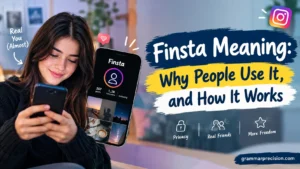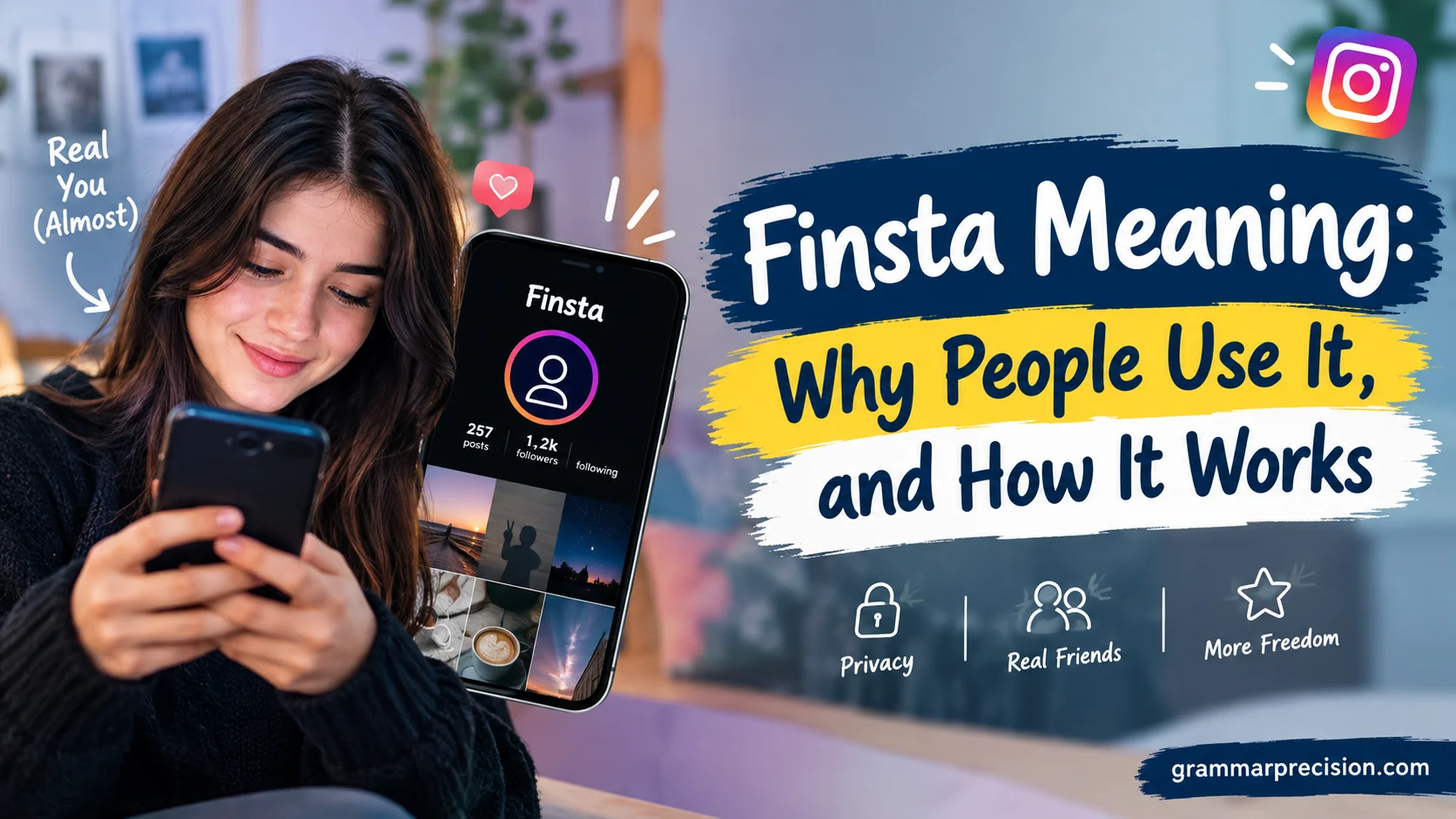
What does Finsta Meaning really reveal about the way people use Instagram today? The term sounds like a simple blend of “fake” and “Instagram,” yet its modern use is more nuanced. A Finsta typically refers to a secondary Instagram account created for close friends, casual posts, and greater audience control.
This article explores its definition, origin, real-world examples, social context, and related terms, while clarifying how Finstas differ from fake, private, spam, burner, and alternative accounts.
Understanding modern online language also requires attention to English usage, grammar, formal writing, and consistency. Unlike terms used in business communication, scheduling, meetings, project management, online booking, broadcasting, or a calendar, social media slang changes quickly with everyday usage.
This guide explains the terminology in clear American English while recognizing that US and UK style guides can differ in spelling, punctuation, and usage preferences. By the end, you’ll understand exactly what Finsta means and when the term fits naturally.
What Does Finsta Mean?
The most common Finsta meaning is a secondary or alternative Instagram account created for a smaller circle of followers. People often use these accounts to share casual photos, jokes, personal updates, awkward moments, and content they wouldn’t post on a highly curated main profile.
The word became popular as social media users began separating different audiences. Your family, coworkers, classmates, close friends, and strangers may all follow your main account. A Finsta can create a narrower social space where those audiences don’t overlap as much.
What Does Finsta Stand For?
Finsta is generally understood as a blend of fake + Instagram. The “fake” part doesn’t automatically mean the account is fraudulent. It traditionally points to an alternative identity or secondary account rather than the user’s primary Instagram profile.
For example:
“I don’t want to put that picture on my main. I’ll post it on my Finsta.”
Here, the speaker isn’t necessarily hiding their identity. They simply want to share the picture with a different audience.
Is Finsta Short for “Fake Instagram”?
Yes, that’s the common word formation. Yet the modern meaning has broadened beyond a literally fake Instagram account.
A Finsta can be:
- A private account for close friends
- A secondary personal profile
- A casual account with a smaller audience
- A place for humor and spontaneous posts
- An alternative account separated from someone’s polished public image
So, Finsta meaning today depends heavily on context.
Finsta Origin and Etymology
The exact path of slang rarely follows a neat timeline. Finsta emerged from the culture of maintaining separate social media identities, particularly as Instagram became a major platform for carefully selected photos and public-facing profiles.
The term combines two familiar words:
| Part | Meaning |
| Fin/Fake | An alternative or less-public identity |
| sta/Instagram | |
| Finsta | A secondary Instagram account or persona |
The idea became especially useful because one account couldn’t always serve every social purpose. A person might want professional-looking photographs on one profile while sharing ridiculous selfies with ten close friends on another.
How Finsta Culture Developed
As Instagram profiles became increasingly curated, users faced a familiar problem: different audiences wanted different versions of the same person.
A college student might have classmates, relatives, teachers, and close friends following one account. Posting an embarrassing inside joke could feel uncomfortable when hundreds of people could see it.
A smaller account solved that social problem.
This wasn’t necessarily about deception. It was often about audience control.
Why Do People Have Finsta Accounts?
The strongest reason people create Finstas is simple: they want to decide who gets to see what.
A main profile often carries social expectations. People may edit photos, rewrite captions, check reactions, and consider how every post affects their image. A secondary account can reduce some of that pressure.
Privacy and Audience Control
A Finsta can give users a smaller audience. Instead of posting for hundreds or thousands of followers, someone might share content with a carefully selected group.
That distinction matters because privacy isn’t only about hiding information. It’s also about choosing the audience and context.
Posting Without Social Pressure
A polished feed can create an invisible standard. Every photo may seem like it needs the right lighting, caption, angle, and timing.
A Finsta can remove some of that performance.
Someone might post:
- A blurry late-night photo
- A strange food combination
- A failed outfit
- An inside joke
- A random thought
- A goofy selfie
- A collection of everyday moments
The point isn’t necessarily to look impressive. It’s to communicate naturally with a smaller group.
Sharing Unfiltered Content
“Unfiltered” doesn’t always mean literally using no photo filter. It usually means less curated.
A main account might show a carefully selected vacation photograph. A Finsta might show the missed train, messy hotel room, terrible coffee, and laughing friends that happened five minutes later.
That contrast explains much of the appeal.
Staying Connected With Close Friends
Some Finstas function almost like digital group chats. The account becomes a shared social space where friends understand the references, jokes, and personalities behind each post.
The audience matters as much as the content.
What Do People Post on Finstas?
There isn’t one official Finsta content category. The account reflects the user’s personality and their relationship with followers.
Common examples include:
- Memes and inside jokes
- Casual selfies
- Everyday updates
- Unpolished photographs
- Personal opinions
- Funny mistakes
- Travel mishaps
- Food pictures
- Behind-the-scenes moments
- Random observations
- Content that feels too niche for a main account
A useful way to understand this is to compare a magazine with a scrapbook. A main Instagram profile may resemble a magazine because every page gets selected carefully. A Finsta often resembles a scrapbook because the value comes from the memories, jokes, and context.
Finsta Examples in Real Conversations
Understanding the word becomes easier when you see it in context.
“I Posted It on My Finsta”
This usually means the person shared something with their smaller or more private audience rather than their main followers.
“Add Me to Your Finsta”
This is a request to be included among the account’s approved followers. It can imply that the account is reserved for people the user knows or trusts.
“That’s Finsta Material”
This phrase can describe something too silly, personal, awkward, or informal for a polished main account.
“Do You Have a Finsta?”
Someone asking this is usually asking whether you maintain a secondary Instagram account.
Example Conversation
Maya: “Are you posting those pictures?”
Jordan: “Not on my main. They’re definitely Finsta material.”
Maya: “Send me the username.”
The phrase works because both people understand the difference between a public-facing account and a smaller social circle.
Finsta vs. Main Instagram Account
The biggest difference usually involves audience, purpose, and presentation.
| Feature | Finsta | Main Instagram Account |
| Audience | Smaller, selected group | Often broader |
| Content | Casual and personal | More curated |
| Tone | Relaxed | Polished or intentional |
| Posting | Often spontaneous | Often planned |
| Identity | Alternative or private persona | Primary online identity |
| Main goal | Connection and expression | Social presence and visibility |
Neither format automatically makes someone more authentic. People simply use them for different communication goals.
Finsta vs. Fake Account
These terms overlap, but they aren’t identical.
A Finsta usually describes a secondary Instagram account. A fake account can mean an account that impersonates another person, uses false information, or exists for deceptive purposes.
For example, imagine someone named Alex creates a private account called “AlexAfterHours” for twenty friends. That’s commonly described as a Finsta.
If another person creates an account pretending to be Alex, that’s an impersonation or fake account, not simply a Finsta.
The distinction is important because the word “fake” in Finsta has a different social meaning.
Finsta vs. Spam Account
A spam account can be a secondary account where someone posts frequently, randomly, or without the polish of their main feed. In everyday speech, people sometimes use “spam” and “Finsta” interchangeably.
Still, there can be a subtle difference.
A Finsta emphasizes the secondary identity and audience. A spam account emphasizes the high-volume or random posting style.
One account can be both.
Finsta vs. Burner Account
A burner account usually emphasizes temporary, anonymous, or disposable use. A Finsta often has a stable group of real-life friends following it.
That difference makes the purpose distinct.
| Term | Typical emphasis |
| Finsta | Secondary personal Instagram |
| Spam account | Frequent or random posting |
| Burner account | Temporary or anonymous use |
| Alt account | Alternative account for another purpose |
| Private account | Restricted access to approved followers |
These categories can overlap, but their meanings aren’t interchangeable in every situation.
Also Read This: Hoda Meaning: Origin, Pronunciation & Symbolism
Finsta vs. Private Instagram Account
This distinction causes plenty of confusion.
A private Instagram account simply restricts who can follow and view the account’s content. It doesn’t necessarily make the account a Finsta.
Someone can have one private account as their only Instagram profile. Another person can have a public main account plus a private Finsta.
So, private describes an access setting, while Finsta describes a type of social use and identity.
What Makes a Finsta Different From a Private Account?
The difference becomes clearer when you separate technology from social purpose.
Instagram’s privacy settings determine who can access an account. Finsta culture determines why someone maintains another account and how they use it.
For instance, a private account with carefully edited travel photographs may still function as someone’s primary profile. A Finsta with fifty close friends may contain chaotic memes and unplanned snapshots.
The setting isn’t the whole story. Context matters.
The Psychology Behind Finsta Culture
Finstas reveal an interesting tension in online communication. People want to express themselves, but they also want control over their audience.
Social media often collapses separate groups into one audience. Your best friend and your boss might technically occupy the same follower list. That’s where self-presentation becomes complicated.
A smaller account can create a clearer social boundary.
Curated Identity vs. Casual Identity
A main profile often becomes a highlight reel. Users choose photographs that represent how they want to be perceived.
A Finsta can support a different identity: less polished, more humorous, more spontaneous, or simply more private.
Neither identity is automatically fake.
People naturally behave differently at work, at dinner with friends, and at home. Social media accounts can reflect those different contexts.
Why Smaller Audiences Feel Different
Audience size changes communication.
When you know that only a trusted group will see a post, you may feel less pressure to explain the joke or perfect the photograph. Familiarity supplies context.
That’s why Finsta culture often revolves around inside jokes, shared memories, and casual interaction.
Case Study: One Person, Two Instagram Audiences
Consider a fictional college student named Sam.
Sam’s main account has classmates, relatives, former teachers, and acquaintances. Sam uses it to share travel photos, graduation updates, and major life events.
Sam’s Finsta has twenty-five close friends.
On the Finsta, Sam posts an unflattering picture from a road trip, a joke about getting lost, and a blurry photo of friends eating at midnight.
Nothing about Sam’s identity has changed. The audience has changed.
That small difference changes what feels comfortable to share.
Is Finsta Culture About Privacy or Authenticity?
It can be about both.
Privacy gives users more control over their audience. Authenticity can make sharing feel less performative. Yet a private audience doesn’t guarantee complete honesty or safety.
A Finsta is still a digital space.
People can screenshot posts, forward messages, save images, or discuss content outside the original group. Therefore, “private” should never be treated as “impossible for others to see.”
Why Privacy Has Limits
Before posting anything sensitive, consider whether you’d be comfortable with it leaving the intended circle.
Good habits include:
- Review your followers regularly.
- Avoid posting sensitive personal information.
- Be cautious with location details.
- Don’t assume screenshots are impossible.
- Remove followers you no longer trust.
- Think before posting something that could affect school or work.
A smaller audience reduces exposure. It doesn’t eliminate it.
Is Finsta Slang Still Relevant Today?
The concept remains useful even as social media language changes.
Instagram has developed features that let users share content with smaller groups, including audience-restricted stories and other privacy controls. As platforms evolve, people don’t necessarily need the same methods they once used to separate audiences.
That creates an interesting shift.
The idea behind Finsta culture can survive even when the slang becomes less common. People still distinguish between public-facing content and posts intended for close friends.
You may also encounter broader terms such as alt account, private account, or spam account.
Language moves quickly online. The behavior can outlive the slang.
Common Finsta Mistakes People Make
Even a casual account benefits from a little common sense.
Treating “Private” as Completely Safe
A private audience is still an audience. Anything shared digitally can potentially travel beyond its original context.
Adding Too Many People
If the account exists for close friends, adding dozens of acquaintances can defeat its original purpose.
Posting Sensitive Information
Personal addresses, financial details, passwords, live locations, or confidential conversations don’t belong on a Finsta.
Confusing Finsta With Anonymity
A Finsta may feel private without being anonymous. Followers may know exactly who owns the account.
FAQs About Finsta Meaning
What does Finsta mean?
Finsta means a secondary or alternative Instagram account, usually maintained for a smaller and more trusted audience. The term comes from “fake Instagram,” although modern Finstas aren’t necessarily fake.
What does Finsta stand for?
Finsta commonly stands for “fake Instagram.” In actual usage, it usually refers to a secondary Instagram account rather than an account created for deception.
Is a Finsta the same as a fake account?
No. A Finsta is generally a secondary personal account. A fake account may involve impersonation or deceptive identity.
Why do people make Finsta accounts?
People often create Finstas to share casual content, control their audience, post humor, and communicate with close friends without the expectations associated with a main profile.
Is a Finsta private?
It often is, but the word itself doesn’t guarantee a particular privacy setting. A Finsta’s defining feature is usually its secondary, limited-audience purpose.
What is Finsta material?
“Finsta material” usually means content that feels too casual, funny, awkward, personal, or random for someone’s main Instagram account.
Is Finsta still a common term?
The term remains recognizable in social media slang, although newer platform features and alternative terms can overlap with the original Finsta concept.
Conclusion:
Finsta Meaning describes a secondary Instagram account designed for smaller audiences, casual sharing, personal expression, and greater control over social interactions.
Unlike a typical public profile, a Finsta often encourages unfiltered content, inside jokes, everyday moments, and relaxed communication among trusted followers.
Although social media language continues changing, the idea behind Finstas remains useful. People still want different digital spaces for different audiences, making Finsta a relevant term in modern online communication.