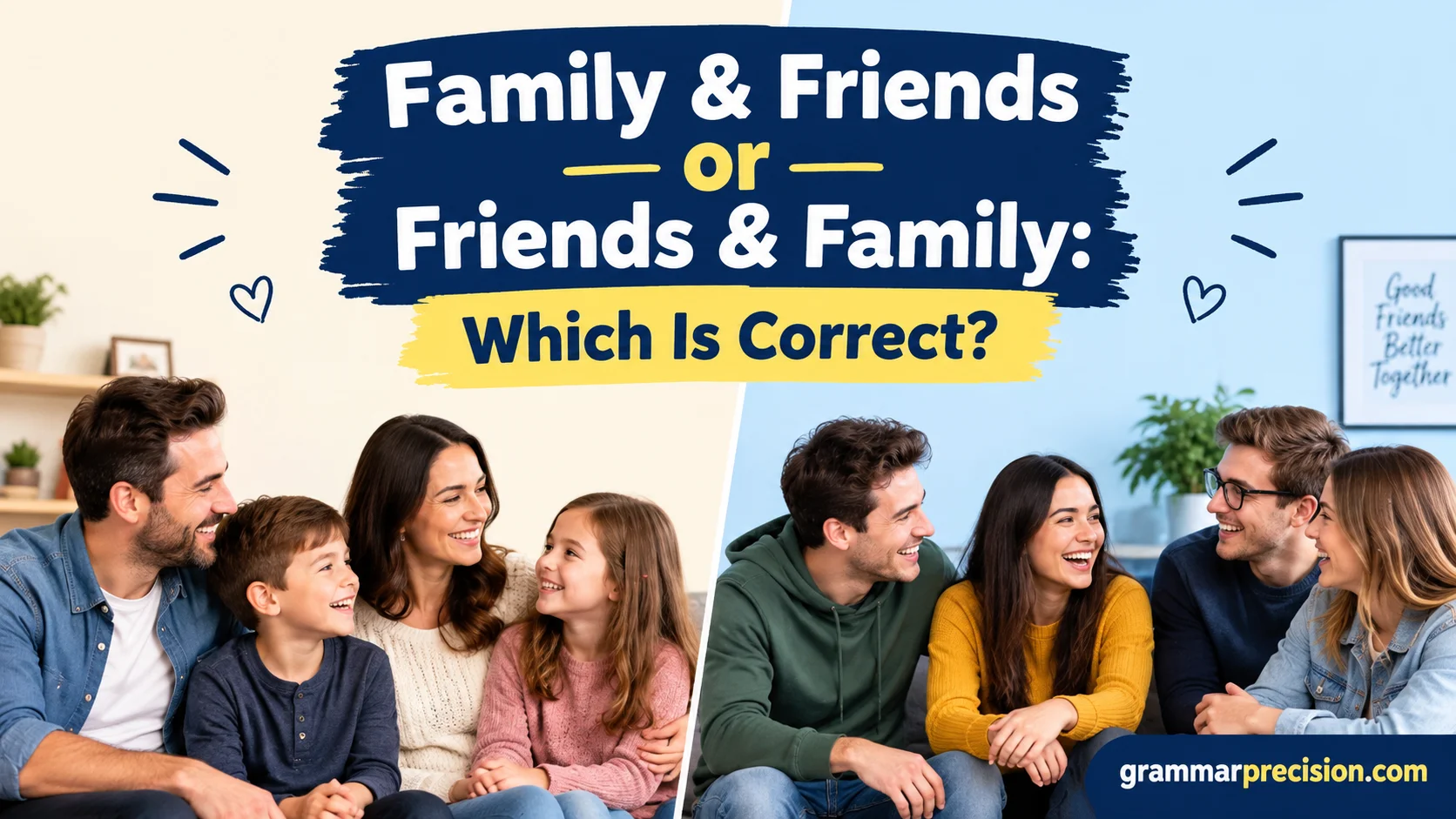
Family & Friends or Friends & Family is a common phrase choice that can create confusion in everyday English. Both expressions are grammatically correct, but they differ slightly in word order, emphasis, and natural usage. Understanding these differences helps you choose the clearest phrase for conversations, invitations, messages, and formal writing.
The phrase Family & Friends places family members first, giving them greater emphasis in the expression. It is widely used in invitations, events, announcements, websites, and social messages. Meanwhile, Friends & Family sounds equally natural and often emphasizes a broader social circle. The choice usually depends on context, audience, personal preference, and intended emphasis rather than grammar.
Although both phrases communicate a similar meaning, usage and context can influence which version sounds more appropriate. Family & Friends may feel more traditional or family-centered, while Friends & Family can sound warmer and more conversational. Native English speakers commonly use both expressions, so neither is automatically wrong. Learning their subtle differences can improve your English vocabulary, writing style, and communication skills.
In this guide, you will learn the meaning, differences, usage, and examples of Family & Friends and Friends & Family. We will also explore which expression sounds more natural in American English, when to use each phrase, and how word order affects emphasis. By understanding these practical English language patterns, you can confidently choose the right expression for emails, invitations, captions, greetings, and everyday communication.
Family & Friends vs. Friends & Family: The Short Answer
Both “Family & Friends” and “Friends & Family” are correct expressions in English. Neither one violates a standard grammar rule simply because the nouns appear in a different order.
The expressions use coordination. In simple terms, coordination allows two nouns or noun phrases to join together as equal elements.
- Family & Friends = family + friends
- Friends & Family = friends + family
- Family and Friends = family + friends
- Friends and Family = friends + family
The meaning remains essentially the same. The difference is mostly which group appears first.
Is One Phrase More Correct?
No. English doesn’t require these two nouns to appear in one fixed order.
Context determines which version sounds most natural. For instance, a business might promote a “friends and family discount” because that wording has become a familiar expression in marketing. Meanwhile, a wedding invitation may use “family and friends” because the writer wants to acknowledge relatives first.
Think of the two expressions as two ways of arranging the same ingredients. The recipe stays almost identical, but the presentation changes.
Understanding the Two Expressions
What Does “Family & Friends” Mean?
“Family & Friends” refers to relatives and people you consider friends. The word family appears first, which can place slightly greater emphasis on relatives.
For example:
“We’re excited to celebrate this milestone with our family and friends.”
Here, the writer isn’t creating a special grammatical distinction. The phrase simply identifies the people attending the celebration.
You might encounter Family & Friends in:
- Wedding invitations
- Birthday announcements
- Holiday greetings
- Funeral notices
- Community events
- Personal messages
- School celebrations
- Graduation announcements
- Social media captions
The phrase often feels warm, personal, and inclusive.
What Does “Friends & Family” Mean?
“Friends & Family” carries essentially the same basic meaning. It refers to friends and relatives as a combined group.
For example:
“We’d love to share this special day with friends and family.”
Again, the sentence doesn’t suggest that friends are more important than relatives. The ordering simply places friends first.
You’ll commonly encounter this version in:
- Retail promotions
- Special discounts
- Marketing campaigns
- Informal announcements
- Social media
- Event promotions
- Community messages
- Casual conversation
The phrase “friends and family” has also become a particularly familiar collocation in American English.
Are “Family & Friends” and “Friends & Family” Both Grammatically Correct?
Yes. Both constructions are grammatically acceptable.
The conjunction “and” connects two coordinated noun phrases. Neither noun needs to come first for the sentence to remain grammatical.
Consider these examples:
- “Family and friends supported her.”
- “Friends and family supported her.”
- “She invited family and friends.”
- “She invited friends and family.”
All four sentences work.
Grammar vs. Conventional Word Order
There’s an important distinction between grammatical correctness and common usage.
A phrase can be grammatically correct while another version sounds more familiar to native speakers. English contains countless expressions where speakers develop preferred patterns through repeated use.
For example, both “salt and pepper” and “pepper and salt” are understandable. Yet “salt and pepper” sounds much more conventional.
The same principle applies here. “Friends and family” and “family and friends” are both correct, but your choice can depend on the setting and the rhythm of the sentence.
Does Word Order Change the Meaning?
Usually, no.
The difference is generally pragmatic rather than semantic. In other words, the basic meaning stays intact while the emphasis or tone may shift.
Compare:
“She invited family and friends.”
with:
“She invited friends and family.”
The first sentence mentions relatives before friends. The second reverses that order. Neither statement tells you that one group matters more.
Still, writers sometimes deliberately put one group first to reflect their priorities, audience, or purpose.
Family & Friends: Detailed Usage Guide
“Family & Friends” works especially well when you want a warm, personal expression.
Imagine a graduation announcement:
“Thank you to our family & friends for supporting me throughout this journey.”
The phrase immediately creates a sense of closeness. It groups two important social circles together.
When “Family & Friends” Works Well
Use this version when:
- You want to mention relatives first.
- You’re writing a personal announcement.
- The audience includes close relatives.
- You want a warm or sentimental tone.
- The phrase appears in a heading or design.
- You’re listing important people at a personal event.
For example:
To Our Family & Friends,
Thank you for making our wedding celebration unforgettable.
This works naturally as an informal heading.
“Family & Friends” Example Sentences
- “Our family and friends helped us prepare for the celebration.”
- “We appreciate all our family and friends who joined us.”
- “The announcement was shared with family and friends.”
- “We couldn’t have reached this goal without our family and friends.”
- “Our family and friends made the holiday extra special.”
Notice that “and” often fits better inside ordinary sentences than the ampersand.
Friends & Family: Detailed Usage Guide
“Friends & Family” is equally valid. It can sound especially natural in casual, promotional, or social contexts.
Consider a store announcing a special sale:
Friends & Family Weekend — 20% Off
Here, the compact ampersand works perfectly because the phrase functions almost like a marketing label.
When “Friends & Family” Works Well
This version can suit:
- Promotional campaigns
- Store discounts
- Restaurant offers
- Social media graphics
- Casual announcements
- Event titles
- Informal invitations
- Community campaigns
For example:
“Our friends and family came together to celebrate.”
That’s completely natural.
Another example:
Friends & Family Sale
This short phrase is easy to scan and works well as a promotional heading.
Friends & Family Example Sentences
- “We’re grateful to our friends and family for their support.”
- “The invitation is open to friends and family.”
- “She spent the weekend with friends and family.”
- “The company hosted a dinner for friends and family.”
- “We’d like to thank our friends and family.”
Family & Friends vs. Friends & Family: Complete Comparison
| Feature | Family & Friends | Friends & Family |
| Grammar | Correct | Correct |
| Basic meaning | Relatives and friends | Friends and relatives |
| Word order | Family first | Friends first |
| Meaning difference | Usually none | Usually none |
| Tone | Warm and personal | Warm and casual |
| Common contexts | Personal events | Promotions and casual contexts |
| Formality | Depends on context | Depends on context |
| Best conjunction | “and” in regular prose | “and” in regular prose |
| Ampersand | Useful in headings/design | Useful in headings/design |
The key takeaway is that word order doesn’t create a new grammatical meaning. Instead, it can influence emphasis and sound.
Why Does the Order Change?
English speakers don’t always arrange coordinated words according to one strict rule. Usage, rhythm, emphasis, tradition, and context can all influence word order.
The Importance of Emphasis
Writers sometimes place the more important or relevant group first.
If a family reunion is the subject, you might naturally write:
“We’re looking forward to seeing family and friends.”
If a business is promoting an offer to its social audience, it might choose:
“Friends & Family Sale.”
Neither choice represents a grammar requirement.
Rhythm and Familiarity
Some combinations simply sound smoother because you’ve heard them repeatedly.
“Friends and family” has a familiar rhythm in American English. The phrase appears frequently in everyday speech, advertisements, announcements, and personal writing.
Likewise, “family and friends” feels completely natural when a writer wants to place family first.
This is one reason language cannot always be reduced to rigid rules. Natural English depends partly on established patterns.
Social and Cultural Conventions
Different organizations and communities may favor one expression.
A charity might say:
“We appreciate the support of family and friends.”
A retailer might advertise:
“Join us for our Friends & Family Sale.”
The difference comes from purpose, not correctness.
“Family and Friends” vs. “Family & Friends”
Here’s another point that often causes confusion: “and” and “&” aren’t interchangeable in every situation.
The word “and” is the normal conjunction in standard prose.
For example:
“We invited family and friends to dinner.”
The ampersand, &, is a typographical symbol commonly used in names, headings, branding, labels, and compact displays.
For example:
Family & Friends Celebration
Both communicate the same basic relationship, but they create different visual impressions.
When Should You Use “And”?
Choose “and” for most complete sentences, especially in formal or polished writing.
Examples:
- “We welcomed family and friends.”
- “She thanked her family and friends.”
- “The event brought family and friends together.”
When Does “&” Work Better?
The ampersand can work well in:
- Headings
- Posters
- Invitations
- Logos
- Business names
- Promotional graphics
- Short labels
- Event titles
For instance:
Friends & Family Brunch
The ampersand keeps the title compact and visually balanced.
Also Read This: Adopted vs. Adoptive: Complete Difference & Common Mistakes
Which Phrase Should You Use in Different Situations?
There isn’t a universal winner. Choose the version that fits your context.
In Formal Writing
Use “family and friends” or “friends and family” rather than relying on the ampersand.
Example:
“The organization thanked family and friends for their generous support.”
The spelled-out conjunction gives the sentence a more polished appearance.
In Invitations
Either order can work.
“We invite family and friends to join us.”
Or:
“Please join us with friends and family for an evening of celebration.”
Choose whichever sounds better with the rest of your invitation.
In Social Media
The ampersand can work nicely because social posts often favor concise, visually appealing wording.
Family & Friends Forever ❤️
Or:
Friends & Family Night!
However, there’s nothing wrong with writing the full word “and.”
In Business Promotions
“Friends & Family” often works particularly well as a promotional label.
Examples include:
- Friends & Family Sale
- Friends & Family Discount
- Friends & Family Weekend
- Friends & Family Special
The phrase is concise and immediately recognizable.
In Speeches
For speeches and spoken language, use “and.”
“I’d like to thank my family and friends for standing beside me.”
The spoken form sounds natural and avoids the visual shorthand of the ampersand.
Which Sounds More Natural in American English?
Both “family and friends” and “friends and family” sound natural in American English.
However, context can make one feel more familiar.
“Friends and family” appears frequently in expressions involving support, gatherings, promotions, and personal relationships.
For example:
“She spent Thanksgiving with friends and family.”
Meanwhile, “family and friends” works naturally when family receives deliberate emphasis.
“The award was celebrated by family and friends.”
There’s no reliable rule saying Americans always prefer one order.
A Simple Naturalness Test
When you’re unsure, read the entire sentence aloud.
Compare:
“We would like to welcome family and friends to our celebration.”
with:
“We would like to welcome friends and family to our celebration.”
Both sound fine. Choose the one that fits your intended emphasis and rhythm.
A Practical Case Study: Choosing the Right Phrase
Imagine a local clothing store wants to advertise a weekend promotion.
The owner considers two headlines:
Family & Friends Sale
and
Friends & Family Sale
Both are grammatically acceptable. Yet “Friends & Family Sale” may feel more familiar as a promotional phrase because businesses commonly use that wording for special customer events.
Now imagine a wedding invitation. The couple writes:
Celebrating With Family & Friends
This version works beautifully because the event centers on personal relationships and emotional connection.
The lesson is simple: context often matters more than word order.
Common Mistakes and Misconceptions
Mistake: Assuming One Version Is Wrong
Some people believe “Friends & Family” is incorrect because they learned that family should come first. That’s not an English grammar rule.
Likewise, “Family & Friends” isn’t automatically better simply because family appears first.
Mistake: Treating Word Order as a Strict Grammar Rule
English has many coordinated expressions whose order depends on convention.
The sequence can influence rhythm and emphasis, but that doesn’t make the reversed version grammatically wrong.
Mistake: Using “&” Everywhere
The ampersand looks neat and compact. Still, it isn’t the best choice for every sentence.
Instead of:
“We appreciate our family & friends.”
standard prose generally reads more naturally as:
“We appreciate our family and friends.”
Save & for situations where its compact style makes sense.
Mistake: Thinking “Friends & Family” Means Friends Matter More
Putting friends first doesn’t necessarily communicate greater importance.
In ordinary English, speakers often choose a familiar word sequence without consciously ranking the groups.
Quick Decision Guide
Use “Family & Friends” when:
- Family deserves first emphasis.
- You’re creating a personal heading.
- You’re designing an invitation or graphic.
- You want a warm, family-centered feel.
Use “Friends & Family” when:
- Friends naturally fit the context first.
- You’re creating a promotional heading.
- You’re writing a casual announcement.
- “Friends & Family” sounds smoother in your sentence.
Use “family and friends” or “friends and family” when:
- You’re writing formal prose.
- You’re composing an email.
- You’re writing an essay.
- You’re preparing a professional document.
- You want standard sentence style.
Examples You Can Use
Here are practical examples showing how both versions work:
- Family and friends gathered for the celebration.
- We invited friends and family to the dinner.
- Thank you to our family and friends for your support.
- The company hosted a Friends & Family event.
- She shared the news with family and friends.
- Everyone from our friends and family joined the party.
- Family & Friends are welcome at the community picnic.
- We couldn’t have done it without our friends and family.
- The store announced its annual Friends & Family Sale.
- The graduation celebration brought family and friends together.
These examples demonstrate an important point: both word orders function naturally.
FAQs:
Is “Family & Friends” grammatically correct?
Yes. Family & Friends is grammatically correct and commonly used in English. It is especially popular when the writer wants to place family first or give family greater emphasis.
Is “Friends & Family” correct English?
Yes, Friends & Family is also correct and natural. It simply reverses the order of the two groups and may place slightly more emphasis on friends.
Which is more common: “Family & Friends” or “Friends & Family”?
Both expressions are widely used. Family & Friends is often preferred in family-centered contexts, while Friends & Family is common in casual, social, and conversational settings.
Can I use “Family & Friends” in a formal invitation?
Yes. Family & Friends can work well in invitations, announcements, and event messages. However, for formal writing, writing “family and friends” instead of using the ampersand may look more polished.
Should I say “Family & Friends” or “Friends & Family”?
There is no single correct choice. Both are acceptable. Choose Family & Friends when family comes first in your intended emphasis, or Friends & Family when you want friends mentioned first.
Conclusion:
Family & Friends or Friends & Family are both correct and natural expressions in English. The best choice depends mainly on context, emphasis, and personal preference. Use either phrase confidently in everyday conversations, invitations, messages, or social writing.
Understanding their subtle difference in word order helps you communicate more naturally and clearly. Choose the version that best fits your audience and enjoy expressing yourself with confidence.