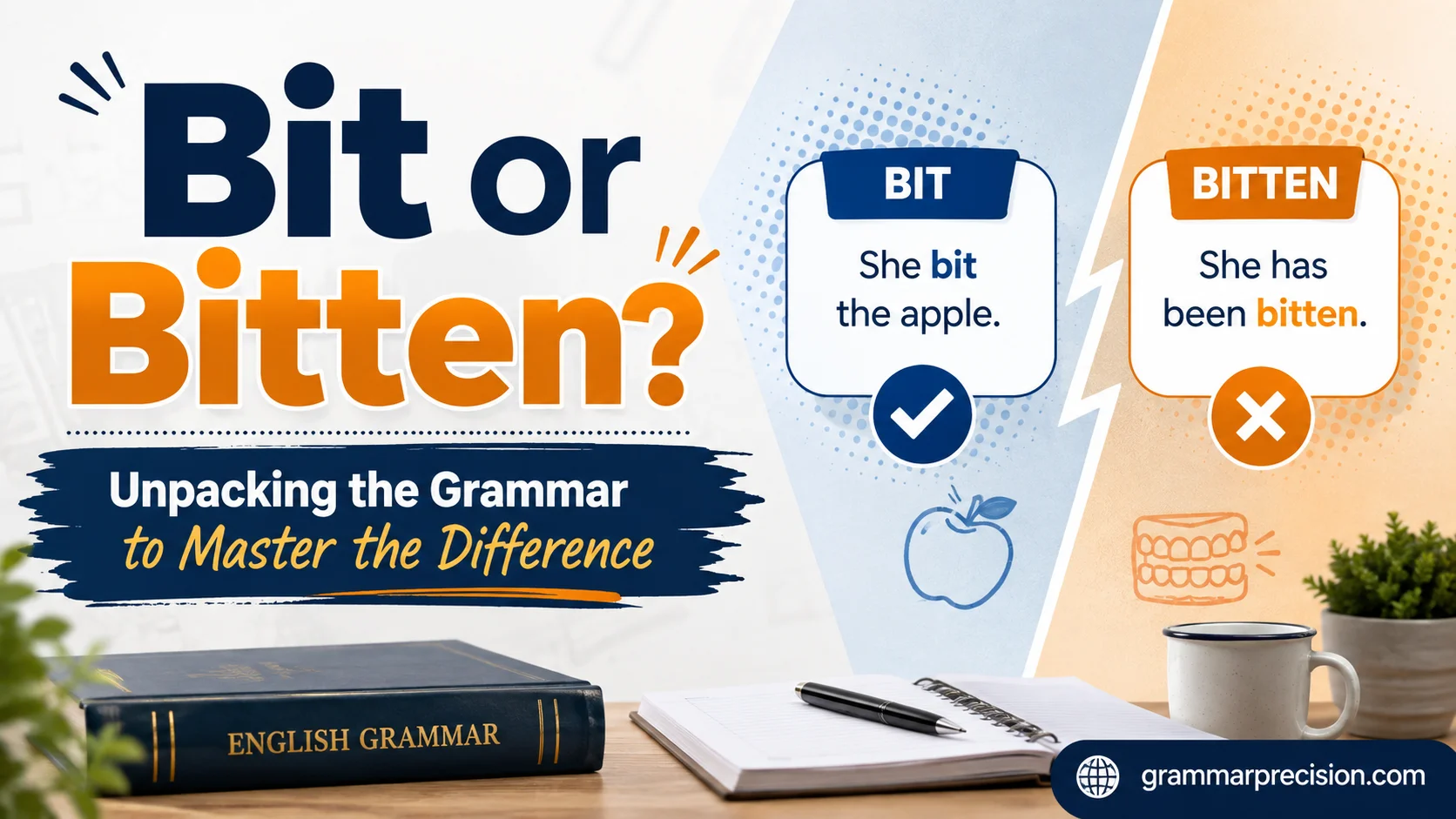
Bit or Bitten can confuse English learners because bite is an irregular verb. Its forms change in the past tense, so choosing the correct word depends on how you build the sentence and which verb form you need.
The past tense of bite is bit. Use bit when you describe an action that happened and finished in the past. For example, “The dog bit the mail carrier yesterday.” Here, bit works as the simple past form of the verb bite.
Bitten is the past participle of bite, so it usually needs a helping verb such as has, have, had, or be. For example, “The dog has bitten him before.” You can also say, “She had been bitten by a dog.” The helping verb makes the structure clear.
A simple way to remember the difference is this: bit stands alone as the simple past, while bitten usually works with a helping verb. If you’re describing one completed action, choose bit. If you’re using a perfect or passive structure, choose bitten.
Bit or Bitten: Quick Answer
The fastest way to remember the difference is this:
| Word | Grammatical form | Typical use | Example |
| bite | Base form | Present, infinitive, after do/did | Dogs sometimes bite. |
| bit | Simple past | A completed action in the past | The dog bit me. |
| bitten | Past participle | Perfect tenses and passive voice | The dog has bitten me. |
So, if you’re talking about a completed event in the past, bit is usually the correct choice.
The dog bit me yesterday.
If you’re using a perfect tense, you need bitten.
The dog has bitten me before.
There’s one more important pattern. In passive sentences, bitten appears after forms of be.
I was bitten by a dog.
The difference becomes much clearer when you pay attention to the verb helping it.
Bit vs Bitten Meaning
Although bit and bitten come from the same verb, they have different grammatical functions.
What Does “Bit” Mean?
Bit is the simple past tense of bite. It describes an action that happened and was completed in the past.
For example:
- The puppy bit my shoe.
- She bit into the apple.
- The mosquito bit him last night.
- He accidentally bit his tongue.
- The horse bit the fence.
Notice something important: bit can stand as the main verb by itself.
You don’t need has, have, or had before it when you’re using simple past tense.
Subject + bit + object
The dog bit the mail carrier.
The action happened in the past. That’s all the sentence needs.
What Does “Bitten” Mean?
Bitten is the past participle of bite. A past participle generally doesn’t work as the simple past tense by itself.
Instead, bitten usually works with a helping verb.
Examples include:
- I have bitten my lip.
- She has bitten into the sandwich.
- They had bitten the bait.
- He was bitten by a spider.
- The child has been bitten before.
This gives you a useful shortcut:
Bit = simple past
Bitten = past participle
Don’t treat bitten as a fancy replacement for bit. The two forms have different grammatical jobs.
Bite, Bit, Bitten: Verb Forms Explained
The verb bite is irregular. That means it doesn’t form its past tense by simply adding -ed.
You don’t say:
❌ The dog bited me.
You say:
✅ The dog bit me.
Its three principal forms are:
| Form | Verb | Example |
| Base | bite | Don’t bite your nails. |
| Simple past | bit | She bit her lip. |
| Past participle | bitten | She has bitten her lip. |
English contains many irregular verbs with different forms. Consider write → wrote → written and eat → ate → eaten. Bite → bit → bitten follows a similar pattern.
That’s why the sentence “I have bitten” sounds correct while “I have bit” doesn’t work in standard English.
What Is the Past Tense of Bite?
The simple past tense of bite is bit.
You use it when you’re describing a completed action at a particular time in the past or when the past event is treated as a finished occurrence.
Examples:
- The dog bit the boy.
- I bit my tongue during lunch.
- She bit the cookie in half.
- The snake bit him several years ago.
- My little brother bit me when we were kids.
Words such as yesterday, last night, last week, two hours ago, and when I was young often appear with simple past constructions.
The bee bit me yesterday.
More precisely, bees sting rather than bite, but the grammatical structure remains the same. The sentence pattern demonstrates how bit functions.
What Is the Past Participle of Bite?
The past participle of bite is bitten.
A past participle often appears with an auxiliary or helping verb. The most common pattern involves the perfect tenses:
have/has/had + bitten
Examples:
- I have bitten my tongue.
- She has bitten the apple.
- We had bitten into the fruit before noticing the problem.
- They have bitten into the wrong piece.
- He had bitten his lip to stay quiet.
The past participle can also appear in passive constructions:
be + bitten
She was bitten by a dog.
Here, the person receiving the action becomes the subject.
Bit or Bitten After “Have”?
This is one of the biggest trouble spots.
After have, has, or had, use bitten, not bit, when bite is the main verb in a perfect construction.
Correct:
I have bitten my tongue.
She has bitten the apple.
They had bitten into the sandwich.
Incorrect in standard English:
❌ I have bit my tongue.
❌ She has bit the apple.
❌ They had bit into the sandwich.
Why? Because have + past participle forms the perfect construction.
The same principle appears with many irregular verbs:
- eat → eaten
- write → written
- break → broken
- speak → spoken
- bite → bitten
A useful memory trick is to connect have with the third form of the verb.
Have/has/had → bitten
Bit or Bitten After “Was” and “Were”?
This question needs a little more care because was and were can appear in different grammatical structures.
In a passive sentence, use bitten:
I was bitten by a dog.
They were bitten by mosquitoes.
Here, was/were + bitten creates a passive construction.
However, was/were can also be part of a continuous structure. You wouldn’t automatically use bitten simply because you see was.
For example:
The dog was biting the toy.
That’s past continuous, not passive voice.
Compare these sentences:
| Sentence | Structure | Meaning |
| The dog bit me. | Simple past | The dog performed the action. |
| The dog was biting me. | Past continuous | The action was in progress. |
| I was bitten by the dog. | Passive | I received the action. |
| I had been bitten before. | Past perfect passive | The biting happened before another past event. |
The key isn’t simply the word was. Look at the whole verb structure.
Bit vs Bitten in Perfect Tenses
Perfect tenses provide one of the clearest places to understand bitten.
Present Perfect
Use:
have/has + bitten
Examples:
- I have bitten my tongue.
- She has bitten into the peach.
- The dog has bitten someone before.
Present perfect often connects a past action with the present.
For example:
I’ve bitten my tongue, and it still hurts.
The biting happened earlier, but its effect matters now.
Past Perfect
Use:
had + bitten
Examples:
- The dog had bitten the man before anyone could stop it.
- She had bitten her lip before answering.
- We had bitten into the fruit when we noticed it was spoiled.
The past perfect places one past event before another past event.
By the time the doctor arrived, the dog had bitten him.
Future Perfect
Use:
will have + bitten
This form is less common in everyday conversation, but it’s grammatically correct.
By then, the puppy will have bitten every toy in the basket.
The action will be completed before a specific future point.
Also Read This: Dealed or Dealt? What’s the Past Tense of Deal?
Bit or Bitten in Passive Voice
Passive voice changes the focus of the sentence.
In an active sentence:
The dog bit Sarah.
The dog performs the action.
In a passive sentence:
Sarah was bitten by the dog.
Sarah receives the action.
This distinction matters because bitten works as the past participle in the passive construction.
Active vs Passive Examples
| Active | Passive |
| The dog bit me. | I was bitten by the dog. |
| The mosquito bit her. | She was bitten by a mosquito. |
| The snake bit him. | He was bitten by a snake. |
The active sentence usually sounds more direct. The passive version makes the person affected by the action more prominent.
Bit or Bitten: Compare These Tricky Sentences
Sometimes the difference becomes obvious only when you place the forms side by side.
“He bit me.”
This is simple past.
The action happened in the past.
He bit me during the argument.
“He has bitten me.”
This is present perfect.
The action happened before now, with some connection to the present.
He has bitten me before.
“He had bitten me.”
This is past perfect.
The biting happened before another past event.
He had bitten me before I realized what happened.
“He was bitten.”
This is passive voice.
The subject received the action.
He was bitten by a dog.
“He has been bitten.”
This combines present perfect with passive voice.
He has been bitten by dogs several times.
These examples show why memorizing isolated words isn’t enough. Grammar determines which form belongs in the sentence.
Common Errors With Bit and Bitten
Even experienced English learners sometimes mix these forms.
Error: “I Have Bit My Tongue”
❌ I have bit my tongue.
✅ I have bitten my tongue.
The word have signals a perfect construction. Therefore, you need the past participle bitten.
Error: “She Bitten the Apple”
❌ She bitten the apple.
✅ She bit the apple.
If you’re using simple past tense, use bit.
Alternatively:
✅ She has bitten the apple.
The helping verb has makes bitten appropriate.
Error: “He Has Bit Me”
❌ He has bit me.
✅ He has bitten me.
Again, has + past participle requires bitten.
Error: “I Was Bit by a Dog”
In standard English, the usual passive form is:
✅ I was bitten by a dog.
Although bit can appear in some informal or dialectal usage, bitten is the standard past participle used in this construction.
A Simple Trick to Remember Bit vs Bitten
Here’s a quick mental test.
Ask yourself:
Is this a simple past action?
If yes, choose bit.
The dog bit me yesterday.
Do you see have, has, or had?
If yes, choose bitten.
The dog has bitten me before.
Is the sentence passive?
If so, bitten will normally be the correct past participle.
I was bitten by a dog.
There’s another helpful pattern:
Bite → Bit → Bitten
Think of it as:
First form → second form → third form
The second form, bit, handles simple past. The third form, bitten, handles perfect and passive constructions.
Bit or Bitten: 20+ Example Sentences
Examples With “Bit”
- The dog bit my hand.
- She bit her lip.
- He bit into the sandwich.
- The puppy bit my shoe.
- I bit my tongue.
- The snake bit the man.
- The child bit the apple.
- The horse bit the fence.
- My brother bit into the cookie.
- The insect bit her yesterday.
- The dog bit him during the game.
Examples With “Bitten”
- I have bitten my tongue.
- She has bitten the apple.
- He has bitten his lip.
- They have bitten into the fruit.
- The dog has bitten someone before.
- She had bitten the sandwich already.
- He had bitten his lip before speaking.
- I was bitten by a mosquito.
- She was bitten by a dog.
- They were bitten by insects.
- He has been bitten before.
- The child had been bitten by the dog.
Notice how bit appears naturally in simple past sentences while bitten usually travels with another verb.
Can “Bit” Be a Noun?
Yes. Bit isn’t only a verb form.
As a noun, bit can mean a small amount, piece, part, or short period.
For example:
Wait a bit.
I need a bit of help.
The machine has a broken bit.
We talked for a bit.
You may also hear common expressions such as:
- a little bit
- a bit of
- quite a bit
- bit by bit
- every bit
These noun uses have nothing to do with the past tense of bite.
For instance:
She waited a bit.
Here, bit doesn’t mean that she performed a biting action. It means a short amount of time.
Context does the heavy lifting.
Common Expressions With “Bit”
Because bit has several meanings, it appears in many everyday expressions.
A Little Bit
Means a small amount.
I’m a little bit tired.
Quite a Bit
Means a fairly large amount.
We’ve learned quite a bit today.
Bit by Bit
Means gradually or in small stages.
Bit by bit, the child gained confidence.
A Bit of
Means a small amount of something.
I need a bit of water.
Every Bit
Often emphasizes that something is fully or equally true.
She is every bit as talented as her sister.
These expressions demonstrate why context matters when interpreting bit.
Bit vs Bitten Cheat Sheet
When you’re in a hurry, this table gives you the answer at a glance.
| Situation | Correct form | Example |
| Base verb | bite | Don’t bite me. |
| Simple present | bite/bites | Dogs sometimes bite. |
| Simple past | bit | The dog bit me. |
| Present perfect | bitten | The dog has bitten me. |
| Past perfect | bitten | The dog had bitten me. |
| Future perfect | bitten | It will have bitten the toy. |
| Passive voice | bitten | I was bitten by a dog. |
| Past continuous | biting | The dog was biting the toy. |
The most useful rule remains simple:
Simple past = bit
Past participle = bitten
Test Yourself: Can You Choose the Right Form?
Try filling in each blank before checking the answers.
- The dog ___ me yesterday.
- She has ___ her tongue.
- He had ___ into the apple.
- I was ___ by a mosquito.
- Don’t ___ your nails.
- They ___ the fruit last night.
- She has been ___ by the dog.
- The puppy was ___ the toy.
- He ___ his lip during the accident.
- We have ___ into the wrong apple.
Answers
- The dog bit me yesterday.
- She has bitten her tongue.
- He had bitten into the apple.
- I was bitten by a mosquito.
- Don’t bite your nails.
- They bit the fruit last night.
- She has been bitten by the dog.
- The puppy was biting the toy.
- He bit his lip during the accident.
- We have bitten into the wrong apple.
The seventh and eighth examples are especially useful because they show how bitten and biting serve completely different grammatical purposes.
FAQs:
What Is the Past Tense of Bite?
The past tense of bite is bit. You use it for an action that happened in the past, such as, “The dog bit my hand yesterday.” It works as the simple past form.
What Is the Past Participle of Bite?
The past participle of bite is bitten. It usually appears with a helping verb, such as have, has, or had. For example, “The dog has bitten him before.”
Is Bitten a Past Tense Word?
No. Bitten is the past participle, not the simple past. The simple past is bit. For example, “She bit the apple” uses the past tense, while “She has bitten the apple” uses the past participle.
Which Is Correct: Bit or Bitten?
Both bit and bitten are correct, but they have different grammatical roles. Use bit for the simple past and bitten with appropriate helping verbs in perfect or passive constructions.
How Can I Remember Bit and Bitten?
Remember this simple pattern: bite – bit – bitten. Use bit when the action happened in the past. Use bitten when another verb, such as has, have, had, or been, supports the sentence.
Conclusion:
Bit or Bitten becomes easier when you remember their grammatical roles. Bit is the simple past form, while bitten is the past participle. Learning this basic pattern can help you avoid common grammar mistakes.
When you describe a completed action in the past, choose bit. For example, “The child bit the cookie.” When you use a perfect or passive structure, choose bitten, as in “The child has bitten the cookie.”
The key is to look at the helping verb and sentence structure. Once you practice bite, bit, and bitten in real sentences, the difference becomes much easier to recognize and use correctly.