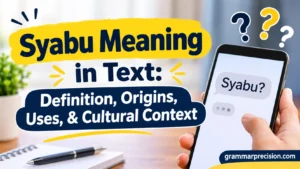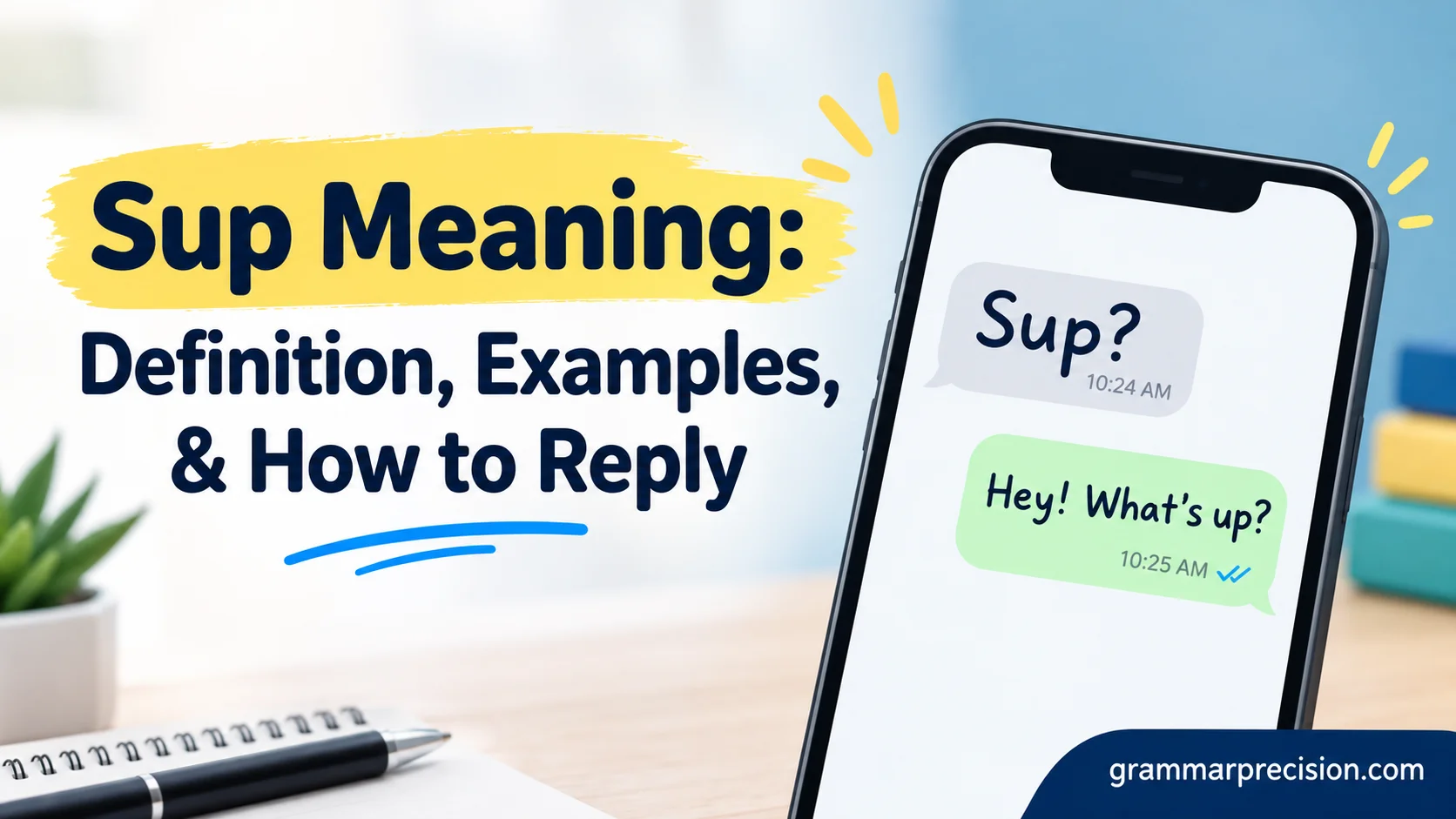
Ever received a casual text saying “sup” and wondered how to respond? Sup Meaning reveals this popular slang expression, its everyday uses, and how it fits naturally into conversations.
Understanding sup in texting helps you communicate confidently with friends, colleagues, and online communities. This guide explains its meaning, origin, examples, and suitable replies while highlighting English usage, grammar, and informal communication.
You’ll also discover when “sup” works in business communication, meetings, and digital conversations. Although casual slang rarely belongs in formal writing, understanding context improves consistency, time management, and everyday interactions, from scheduling discussions to calendar updates, online booking, broadcasting, and project management.
Quick Answer: What Does Sup Mean?
Sup means “what’s up?” It’s an informal greeting people use to ask how someone is doing, what they’re doing, or what’s happening.
For example:
- Person A: Sup?
- Person B: Not much. Just watching a movie. You?
In this exchange, “sup” works as a casual conversation starter rather than a serious question. The sender usually expects a short, friendly response.
Depending on the situation, “sup” can mean:
- Hello: A relaxed way to greet someone.
- What are you doing? A casual question about someone’s current activity.
- How’s it going? A quick way to check in.
- Want to talk? An opening that invites further conversation.
The exact meaning depends on your relationship with the sender and the surrounding conversation.
Sup Meaning: What Does “Sup” Stand For?
The word “sup” comes from “what’s up?”, a common English expression used to greet people or ask about their current situation.
Over time, speakers shortened the expression to “’sup” or “sup” in casual conversation. Texting and online messaging made the shorter version especially convenient because it requires fewer characters.
Unlike formal greetings such as “Good morning” or “How are you doing today?”, “sup” sounds relaxed and familiar.
| Expression | Meaning | Tone |
| Sup? | What’s up? | Very casual |
| What’s up? | How are things? | Casual |
| Hey, how are you? | A greeting and check-in | Friendly |
| Good morning | A polite greeting | Neutral or formal |
| What are you up to? | What are you doing? | Conversational |
Although these expressions overlap, they don’t always communicate exactly the same thing. “Good morning” is mainly a greeting, while “what are you up to?” more directly asks about someone’s activities.
Is Sup a Greeting or a Question?
It can be both. People often use “sup” as a greeting without expecting a detailed answer.
For example, two friends might exchange “Sup?” and “Yo” while walking past each other. Neither person necessarily expects a full conversation.
In a text message, however, “sup?” may invite the other person to explain what they’re doing. A response like “Just finished dinner” gives the sender something to discuss.
Punctuation can also influence how the message feels. “Sup?” looks like a question, while “Sup!” can feel more energetic. Still, punctuation alone doesn’t reveal the sender’s complete intention.
Sup Meaning in Text Messages and Online Chats
In texting, sup is a quick way to start a conversation without choosing a specific topic. It lets someone reach out casually, even when they don’t have anything important to discuss.
For instance, your friend might send “sup” after school because they want to chat. Someone else might use it to see whether you’re available to hang out.
Here are common texting situations:
- Checking in: “Sup? Haven’t talked to you all week.”
- Making plans: “Sup tonight? Wanna grab food?”
- Starting a chat: “Sup bro 😂”
- Reconnecting: “Sup! It’s been forever.”
- Passing time: “Sup, I’m bored lol.”
Notice how the surrounding words help explain the message. A simple “sup” usually opens the door to conversation, while additional details make the sender’s purpose clearer.
Sup Meaning Between Friends
Among friends, “sup” usually feels natural, relaxed, and familiar. You don’t need to prepare a clever response or explain everything you’re doing.
A friend might send it while playing video games, walking home, or relaxing after work. Often, the message simply means, “I’m here if you want to talk.”
Example conversation:
Alex: Sup bro?
Jordan: Not much, just chilling.
Alex: Wanna play some games?
Here, “sup” starts the interaction, and the conversation quickly moves toward a shared activity.
Sup Meaning When Your Crush Texts You
When your crush sends “sup,” you might wonder whether they’re interested in you. The message could signal curiosity, friendliness, or a desire to talk, but “sup” alone doesn’t prove romantic interest.
Look at the broader conversation instead. Does the person ask follow-up questions, remember details about you, or make an effort to keep chatting?
For example:
Crush: Sup?
You: Just listening to music. What about you?
Crush: Same! What kind of music do you like?
The follow-up question creates an opportunity to connect. However, a single greeting doesn’t tell you everything about someone’s feelings.
Sup Meaning When an Ex or Someone You Barely Know Texts You
When an ex sends “sup,” the message might reflect curiosity, friendliness, or a simple attempt to reconnect. You don’t need to assume they want to restart the relationship.
Likewise, someone you barely know might use “sup” because it’s an easy, low-pressure opener.
Consider your history with that person before responding. If you’re comfortable talking, answer naturally. If you prefer distance, a brief reply—or no reply—is also an option.
25 Best Replies to Sup
The best response depends on your mood, relationship, and interest in continuing the conversation. You can keep it short, add humor, or ask a question that encourages the sender to share more.
Friendly Replies to Sup
Use these responses when you want to sound approachable and relaxed.
- “Not much, you?”
- “Hey! What’s up with you?”
- “Just chilling. How about you?”
- “Doing good! What about you?”
- “Nothing much. How’s your day going?”
These replies work well with friends, classmates, and people you know casually.
Funny Replies to Sup
A playful response can turn an ordinary greeting into a more entertaining conversation.
- “The ceiling. 😂”
- “The sky, last time I checked.”
- “My stress levels, apparently.”
- “Just trying to survive Monday.”
- “A whole lot of nothing!”
The first two responses play on the literal meaning of “up.” Use them when the sender appreciates jokes rather than serious answers.
Flirty Replies to Sup
If you like the person and want to add a little charm, try a lighthearted answer.
- “Nothing much until you showed up 😉”
- “Just thinking about someone. Guess who?”
- “Better now that you’re here.”
- “Waiting for you to make my day interesting.”
- “Hey you! What took you so long?”
Flirty replies work best when the other person welcomes that tone. If you aren’t sure, start with something friendly and see how they respond.
Short and Casual Replies to Sup
Sometimes a quick answer is all you need. These options suit everyday chats when you don’t have much to say.
- “Hey!”
- “Yo.”
- “Nm, you?”
- “All good.”
- “Chillin.”
Here, “nm” means “not much.” It’s another common texting abbreviation that fits naturally into a casual exchange.
Replies That Keep the Conversation Going
If you’d like to avoid a conversation ending after one message, answer and add an easy question.
- “Just got home. What are you up to?”
- “Watching a movie. Seen anything good lately?”
- “Finishing some work. How’s your day been?”
- “Thinking about getting food. Got any recommendations?”
- “Nothing exciting yet. Got plans for tonight?”
A useful trick is to give the sender something to respond to. A small detail about your day can make a conversation feel more natural than a one-word answer.
How to Reply to Sup in Different Situations
A good response matches the setting. The same message can feel different when it comes from your best friend, a romantic interest, or someone at work.
| Situation | Suggested reply | Why it works |
| Best friend | “Not much, what’s the plan?” | Encourages friendly conversation |
| Crush | “Hey! Just relaxing. What about you? 😊” | Sounds warm without being intense |
| Coworker | “Hey! Just wrapping up a few things.” | Keeps the tone polite |
| New acquaintance | “Hey, how’s it going?” | Friendly without oversharing |
| Busy moment | “Hey! A little busy right now. Talk later?” | Communicates your availability |
| Someone you don’t know well | “Hey, do we know each other?” | Helps clarify their intention |
What to Say When You’re Busy
You don’t have to ignore someone just because you can’t chat. A brief, honest response acknowledges their message while protecting your time.
For example, say, “Hey! I’m tied up right now, but I’ll message you later.” Only promise to follow up if you genuinely intend to do so.
What to Say When You Don’t Want to Talk
You can remain polite without encouraging a long conversation. Try “Hey, hope you’re doing well” or simply leave the message unanswered if a response isn’t necessary.
Remember, you don’t owe everyone an extended conversation. Your comfort and boundaries matter more than finding the perfect reply.
Sup vs. What’s Up vs. Wassup
These expressions share a similar meaning, but they differ slightly in spelling, style, and how people use them.
| Expression | Meaning | Typical use |
| Sup | Short form of “what’s up?” | Quick texts and casual greetings |
| What’s up? | Greeting or question about someone’s situation | Everyday speech and messages |
| Wassup | Informal, phonetic variation of “what’s up?” | Casual chats and playful greetings |
| WSG | Usually means “what’s good?” | Texting and social media |
| Hey | A general greeting | Casual or professional conversations |
Sup vs. What’s Up
“What’s up?” is the fuller expression, while “sup” is shorter and more informal. Both can greet someone or ask what they’re doing.
For example:
- “What’s up? How was your weekend?”
- “Sup? How was your weekend?”
Both messages communicate roughly the same idea. The second sounds more relaxed and may suit close friends better.
Sup vs. Wassup
“Wassup” represents a casual pronunciation of “what’s up?” It’s often used playfully in messages and conversations.
“Sup” is even shorter, making it convenient for quick greetings. Neither spelling has a major difference in meaning, so your choice mostly depends on personal style.
Sup vs. WSG
WSG usually stands for “what’s good?” Like “sup,” it can function as a greeting or an invitation to chat.
For example:
Friend A: WSG bro?
Friend B: All good. You?
Both expressions are informal. However, “what’s good?” can also ask what’s interesting, enjoyable, or happening in someone’s life.
Sup vs. Hey
“Hey” simply greets someone without directly asking a question. “Sup” carries a stronger suggestion that the sender wants to know how things are going or start a conversation.
You can use either expression with friends. In professional settings, however, “Hi” or “Hello” usually sounds more appropriate.
Sup Meaning on Snapchat, Instagram, TikTok, and WhatsApp
The meaning of “sup” generally stays the same across social media platforms. What changes is the situation in which someone sends it.
Sup on Snapchat
On Snapchat, someone might send “sup” alongside a selfie, a quick photo, or a casual snap. The message may simply invite you to respond.
For example, someone sends a picture of their evening with the caption “sup.” You could answer, “Just relaxing. Where are you?”
Don’t assume every snap signals romantic interest. Many users send casual messages to friends without any deeper intention.
Sup on Instagram
On Instagram, “sup” can appear in direct messages, story replies, or conversations that begin after someone follows you.
If a person replies to your story with “sup,” they may be looking for an opening to talk. You can respond based on the story or ask what they’re doing.
For instance:
Them: Sup?
You: Hey! Just scrolling. Did you see that new post?
A shared interest gives the conversation a natural direction.
Sup on TikTok
TikTok users may use “sup” in private messages or casual conversations after sharing videos. It works as an easy opener when someone wants to connect without writing a long introduction.
A response such as “Hey, that video you sent was hilarious 😂” can move the conversation toward something more specific.
Sup on WhatsApp
On WhatsApp, “sup” often appears in private chats and group conversations. Friends may use it to check who’s available, arrange plans, or start talking after a quiet period.
For example, a group member might write “Sup everyone?” before suggesting a gaming session. In this case, the expression addresses the group rather than one individual.
Is Sup Rude, Flirty, or Friendly?
Sup isn’t inherently rude or flirty. It’s an informal expression whose tone depends on the relationship, conversation, and surrounding messages.
When Sup Sounds Friendly
Among friends, “sup” usually feels relaxed and welcoming. It can be an easy way to reconnect without making the interaction feel formal.
If someone follows it with thoughtful questions or a friendly conversation, that provides more context than the greeting itself.
When Sup Sounds Flirty
A person may use “sup” to start a conversation with someone they find attractive. However, the word itself doesn’t communicate romance.
Look for other clues, such as playful teasing, consistent interest, or an invitation to spend time together. Even then, the clearest understanding comes from how the person communicates over time.
When Sup Sounds Rude
Some people interpret a one-word message as lazy or dismissive, especially if they expect more effort from the sender. Still, brevity doesn’t automatically mean disrespect.
A person might be busy, distracted, or simply accustomed to short messages. If the message bothers you, consider the sender’s usual communication style before drawing conclusions.
When Should You Use Sup—and When Should You Avoid It?
“Sup” works best when you want a relaxed, low-pressure greeting. It’s particularly useful with friends and people who already understand your communication style.
Good situations for using sup:
- Messaging friends or siblings.
- Starting a casual conversation online.
- Checking whether someone is available.
- Reconnecting with a familiar person.
- Chatting in gaming communities or group messages.
However, the expression doesn’t suit every setting.
Avoid using sup when:
- Writing a formal email to a client.
- Contacting a hiring manager about a job.
- Messaging someone who expects professional communication.
- Addressing an unfamiliar person in a serious situation.
- Writing academic assignments or formal documents.
Instead, choose a greeting that matches the occasion. “Hello,” “Good morning,” or “Hi, how are you?” usually works better in professional communication.
Is Sup Appropriate at Work?
It depends on your workplace culture and your relationship with the recipient. A quick “sup” might be perfectly normal between close coworkers who regularly chat informally.
However, it’s less suitable for an initial message to a supervisor, customer, or business contact. When you’re uncertain, start with a polite greeting and adjust your tone once you understand the other person’s preferences.
For example:
- Casual coworker: “Sup? Ready for lunch?”
- Manager: “Hi, do you have a moment to discuss the project?”
- Client: “Hello, I hope you’re doing well.”
Knowing when to switch between casual and formal language is an important communication skill.
Sup Meaning Examples in Real Conversations
Sometimes, seeing “sup” in a real exchange makes its meaning easier to understand. These examples show how the same greeting can lead to different conversations.
Example: Sup Between Friends
Mia: Sup?
Jake: Nothing much, just playing basketball.
Mia: Nice! Can I join?
Here, Mia uses “sup” to start a relaxed conversation. Jake’s response gives her an opportunity to suggest an activity.
Example: Sup in a Flirty Conversation
Noah: Sup, beautiful? 😊
Emma: Hey! Just relaxing. What about you?
Noah: Thinking we should hang out sometime.
The greeting becomes flirty because of the affectionate wording and the follow-up invitation. The word “sup” alone wouldn’t establish that tone.
Example: Sup After a Long Time Apart
Liam: Sup! It’s been ages.
Olivia: I know! How have you been?
Liam: Pretty good. We should catch up soon.
Here, “sup” helps reopen communication without requiring a formal introduction. Both people can move naturally into a longer conversation.
Example: Sup When Someone Wants to Make Plans
Ethan: Sup tonight?
Chris: Nothing planned yet. Why?
Ethan: Wanna grab something to eat?
Notice that “sup tonight?” differs slightly from a standalone greeting. Ethan is probably asking about Chris’s availability, not merely saying hello.
Common Mistakes to Avoid When Using Sup
Although “sup” is simple, a few mistakes can make your messages confusing or awkward.
- Using it in formal writing: Choose “Hello” or “Hi” for professional emails and official communication.
- Assuming romantic interest: A greeting doesn’t prove someone has a crush on you.
- Overthinking the message: Consider the broader conversation instead of analyzing every letter.
- Expecting a detailed answer: Many people use “sup” as a simple greeting and may not expect a long response.
- Sending it without considering context: A friendly opener may feel out of place during a serious conversation.
- Giving a reply that ends the conversation: If you want to keep chatting, add a question or a little detail about your day.
The main rule is straightforward: match your reply to the person and situation. You don’t need a perfect response every time someone says “sup.”
FAQs About Sup Meaning
What does sup mean in texting?
In texting, “sup” usually means “what’s up?” People use it to greet someone, ask how things are going, or start a casual conversation.
What does sup stand for?
“Sup” is a shortened form of “what’s up?” It works as an informal greeting and sometimes as a question about someone’s current activities.
Is sup slang?
Yes. Sup is informal English slang commonly used in spoken conversations, text messages, and online chats. It’s generally appropriate among friends but less suitable for formal communication.
How do you respond to sup?
You can say “Not much, you?”, “Just chilling,” or “Hey, how’s it going?” If you want to keep talking, add a question that invites the other person to respond.
Does sup mean someone likes you?
Not necessarily. Someone might use “sup” because they’re friendly, bored, curious, or interested in starting a conversation. Look at their overall behavior rather than interpreting one message as proof of attraction.
Is sup the same as what’s up?
Yes, they usually communicate the same basic idea. “Sup” is shorter and more informal, while “what’s up?” is the fuller expression.
Is sup rude?
No, “sup” isn’t inherently rude. However, its casual tone might seem inappropriate in formal settings or to someone who prefers more thoughtful greetings.
Can you use sup with your crush?
Yes. You can use “sup” with your crush if casual texting feels natural between you. Just remember that the greeting itself doesn’t communicate romantic interest clearly.
Conclusion:
Understanding Sup Meaning helps you recognize this popular slang in texts, social media, and everyday conversations. It usually means “What’s up?” and works as a casual greeting. Knowing its context helps you respond naturally and communicate confidently with friends.
Whether you’re chatting online or messaging someone new, sup keeps conversations short, friendly, and relaxed. Choose replies that match your relationship and the situation. Avoid using this informal expression in formal writing or professional emails. Understanding English usage, tone, and context helps you communicate clearly and appropriately.