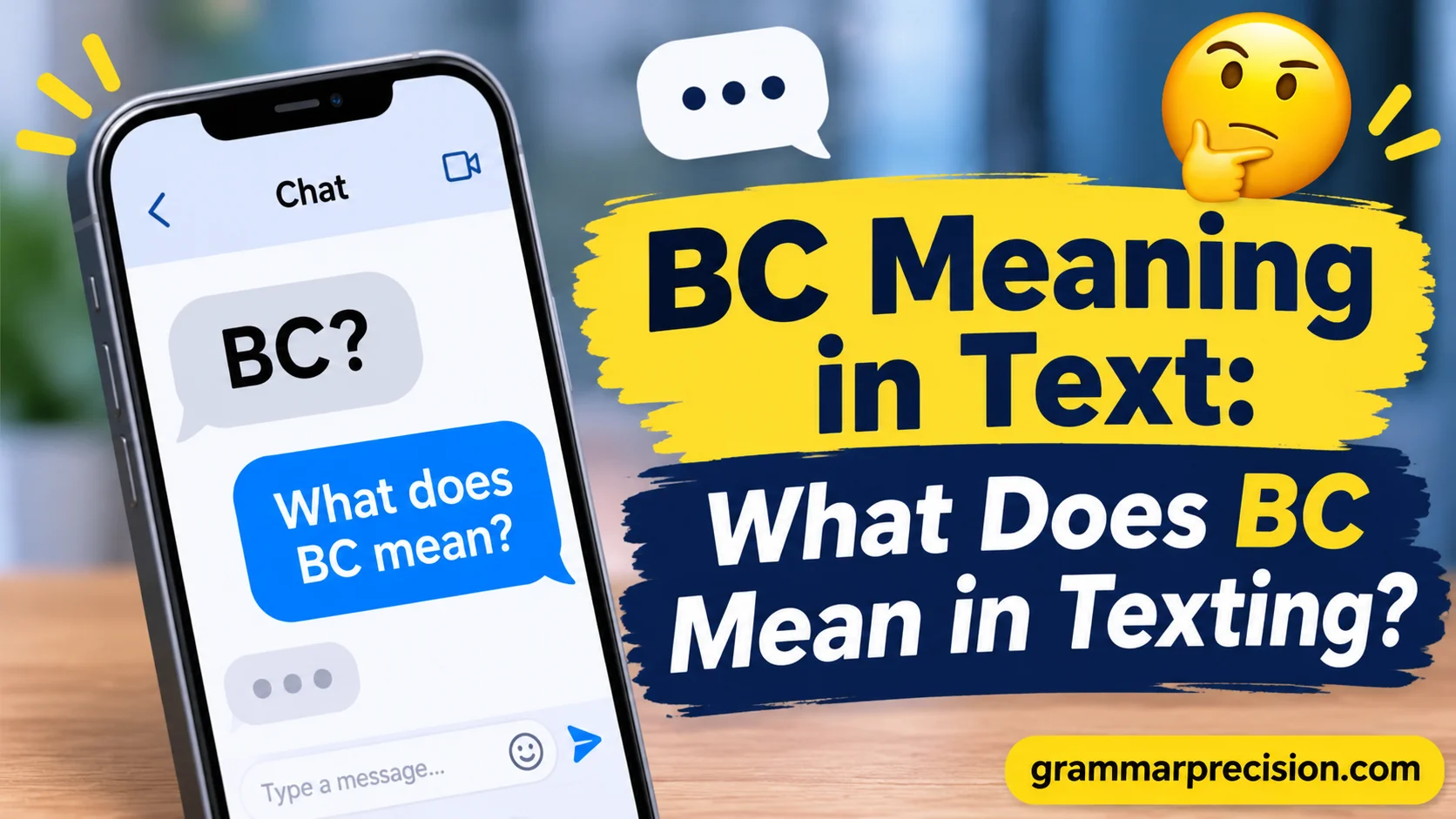
Text messages often turn long sentences into quick expressions. One abbreviation you’ll frequently encounter is BC Meaning in Text, especially across everyday digital conversations.
Understanding BC helps you recognize casual explanations, texting habits, and social media slang. This guide explores its common meaning, practical examples, conversational uses, and differences from similar abbreviations. You’ll also learn when BC suits informal communication and when formal writing requires the complete word instead.
Beyond texting, context shapes how abbreviations work in business communication, scheduling, online booking, meetings, and project management. Discover how English usage, grammar, and consistency help you communicate clearly across different platforms and professional situations.
Quick Answer: What Does BC Mean in Text?
BC means “because” in texting and online conversations. People use it as a casual abbreviation when explaining something or giving a reason.
For example:
- “I’m staying home BC I’m tired.”
- “I didn’t call BC I was busy.”
- “I love this song BC it’s amazing.”
In each example, BC introduces a reason or explanation.
You might see this abbreviation on Snapchat, Instagram, TikTok, WhatsApp, Discord, and regular text messages. It’s informal and works best when you’re chatting with people who understand texting slang.
What Does BC Stand for in Texting?
The most common texting meaning of BC is because. It replaces the full word without changing the sentence’s meaning.
People often shorten everyday words to make digital conversations quicker. BC follows this familiar pattern alongside abbreviations such as IDK, BTW, TBH, and BRB.
For example:
- Full sentence: “I couldn’t attend because I had homework.”
- Shortened sentence: “I couldn’t attend BC I had homework.”
Both sentences communicate the same information. The difference comes down to writing style and convenience.
BC as an Abbreviation for Because
When someone uses BC in a message, they’re usually connecting an action with its reason.
Consider this conversation:
Alex: Why didn’t you come yesterday?
Sam: I couldn’t BC my parents needed help.
Here, Sam uses BC to explain why they missed the event.
You can also place BC in longer messages:
- “I’m learning English BC I want better opportunities.”
- “She bought that dress BC she loved the color.”
- “We canceled the trip BC the weather was terrible.”
Notice how naturally BC fits into everyday sentences. It works just like the complete word “because.”
BC as a Shortened Form of Other Expressions
Although BC usually means because, its interpretation can change with the conversation.
For example, someone discussing ancient history might use BC to mean Before Christ. Meanwhile, a person talking about Canadian travel might use BC for British Columbia.
These meanings aren’t interchangeable.
| Abbreviation | Meaning | Common Context |
| BC | Because | Texting and chatting |
| BC | Before Christ | History and dates |
| BC | British Columbia | Geography and travel |
| BC | Business-related shorthand | Workplace-specific conversations |
The surrounding words usually make the intended meaning clear.
Why People Use BC Instead of Because
Why type eight letters when two will do?
People use BC because it makes casual messages quicker and more compact. It also matches the relaxed tone of modern digital communication.
Here are some common reasons:
- Speed: You can type shorter messages when chatting quickly.
- Convenience: BC fits easily into short sentences.
- Informality: It creates a relaxed conversational tone.
- Familiarity: Many internet users recognize the abbreviation.
- Character limits: Shorter wording can help when space matters.
However, convenience shouldn’t come at the expense of clarity. If someone might misunderstand your message, writing “because” is the safer choice.
How to Use BC in Text Messages
Using BC correctly is simple once you understand its purpose. Treat it like the word because and place it before the explanation.
For example, “I’m excited BC we’re going on vacation” sounds natural in casual texting.
Let’s explore some situations where this abbreviation works particularly well.
Using BC to Explain a Reason
This is the most common way people use BC.
Whenever someone asks why something happened, you can use it to introduce your explanation.
Examples:
- “I left early BC I wasn’t feeling well.”
- “She’s happy BC she passed her exam.”
- “I missed your message BC my phone died.”
- “We ordered pizza BC nobody wanted to cook.”
Each sentence connects an action with its reason.
Using BC to Give an Excuse
People also use BC when explaining why they couldn’t do something.
For example:
Friend: Are you coming to the party?
You: Probably not BC I have work tomorrow.
Other examples include:
- “I can’t play today BC I’m studying.”
- “Sorry I’m late BC traffic was crazy.”
- “I didn’t answer BC I was sleeping.”
- “We couldn’t meet BC something came up.”
In these situations, BC makes explanations sound casual and straightforward.
Using BC in Casual Conversations
You don’t need a serious reason to use BC. People frequently include it in everyday discussions about food, entertainment, hobbies, and personal preferences.
Examples:
- “I like summer BC the days are longer.”
- “This movie is amazing BC the story is interesting.”
- “I’m choosing coffee BC I need energy.”
- “That restaurant is popular BC the food is delicious.”
These messages show how BC fits naturally into relaxed conversations.
Using BC in Quick Replies
Sometimes, you only need a short response rather than a complete explanation.
For example:
Friend: Why are you laughing?
You: BC that video was hilarious!
You might also receive messages such as:
- “BC why not?”
- “BC I said so 😂”
- “BC it’s my favorite.”
- “BC I feel like it.”
These replies are casual and often depend on the conversation’s tone.
BC Meaning on Different Social Media Platforms
BC doesn’t have a completely different meaning on every social media platform. Its common meaning remains “because.”
However, the way people use it can vary depending on the platform and conversation style.
BC Meaning on Snapchat
On Snapchat, BC usually means because. People use it in direct messages, story replies, and quick conversations.
For example:
- “Can’t streak today BC I’m busy.”
- “I sent that snap BC it reminded me of you.”
- “I’m laughing BC your story was funny.”
Snapchat conversations often move quickly. Therefore, shorter expressions like BC fit naturally into its messaging culture.
BC Meaning on Instagram
Instagram users commonly write BC in direct messages, comments, and captions.
Examples:
- “Following you BC your photography is amazing.”
- “I love this outfit BC the colors match.”
- “Posted this BC I wanted to share it.”
The abbreviation keeps casual conversations short without changing their meaning.
BC Meaning on TikTok
TikTok users may include BC in comments, video captions, and private messages.
For example:
- “I watched this BC everyone recommended it.”
- “This trend is funny BC the reactions are priceless.”
- “I’m obsessed with this sound BC it’s catchy.”
Here, BC introduces the reason behind someone’s opinion or reaction.
BC Meaning on WhatsApp
WhatsApp conversations often involve friends, relatives, classmates, and coworkers. People use BC to explain everyday situations quickly.
Examples:
- “I’ll call later BC I’m driving.”
- “We stayed home BC it was raining.”
- “Can’t talk now BC I’m in a meeting.”
The meaning stays the same regardless of whether you’re chatting individually or in a group.
BC Meaning on Discord
Discord users frequently use abbreviations while chatting in gaming servers and online communities.
Examples:
- “I left the match BC my internet stopped working.”
- “That game is difficult BC the enemies are strong.”
- “I’m joining later BC I have homework.”
BC makes quick gaming conversations easier, especially when several people communicate simultaneously.
25 Examples of BC in Text Conversations
The easiest way to understand texting slang is to see it in action. These examples show how BC works in different situations.
BC in Everyday Conversations
- “I’m hungry BC I skipped breakfast.”
- “I stayed home BC it was raining.”
- “She’s smiling BC she got good news.”
- “I’m tired BC I worked all day.”
- “We left early BC the event ended.”
BC Between Friends
- “I called you BC I needed advice.”
- “Let’s meet tomorrow BC today is busy.”
- “I chose this restaurant BC you like it.”
- “I’m laughing BC your joke was hilarious.”
- “I missed the game BC I overslept.”
BC in Romantic Conversations
- “I miss you BC you make me happy.”
- “I’m smiling BC your message made my day.”
- “I stayed awake BC I wanted to talk.”
- “You’re special BC you understand me.”
- “I love this song BC it reminds me of you.”
BC in Funny Text Messages
- “I’m broke BC online shopping won again.”
- “I’m late BC my bed wouldn’t let me go.”
- “I need coffee BC my brain isn’t working.”
- “I ate everything BC self-control disappeared.”
- “I’m avoiding responsibilities BC Monday exists.”
BC in Social Media Comments
- “Love this post BC it’s so relatable.”
- “I followed you BC your content is amazing.”
- “This video deserves more views BC it’s hilarious.”
- “I’m sharing this BC everyone needs to see it.”
- “Saved this BC I’ll definitely need it later.”
These examples demonstrate that BC works in many situations. The main purpose remains the same: explaining a reason.
What Does BC Mean From a Guy or Girl?
When someone sends you BC, the meaning usually doesn’t change based on gender. However, the surrounding conversation can reveal their tone and intention.
Rather than assuming romantic interest, consider the complete message and your existing relationship.
When a Guy Uses BC
If a guy sends BC, he’s most likely using it as a casual replacement for because.
For example:
- “I’m busy BC I have practice.”
- “I texted you BC I wanted to check on you.”
- “I stayed home BC I wasn’t feeling good.”
The third example might sound thoughtful, but BC itself doesn’t indicate romantic interest.
When a Girl Uses BC
A girl might use BC to explain her choices, share opinions, or respond quickly.
Examples:
- “I chose that dress BC it looks cute.”
- “I’m laughing BC you’re so funny.”
- “I didn’t reply BC I was sleeping.”
These messages generally communicate ordinary reasons rather than hidden meanings.
Does BC Have a Flirty Meaning?
BC isn’t inherently flirty. Its meaning depends on the words surrounding it.
Compare these messages:
| Message | Possible Tone |
| “I’m here BC I promised.” | Friendly |
| “I stayed awake BC I wanted to talk to you.” | Affectionate |
| “I smiled BC I saw your message.” | Sweet or flirty |
| “I’m busy BC I have work.” | Neutral |
If someone uses affectionate language or makes an effort to continue conversations, those details may reveal more than the abbreviation itself.
How Context Changes the Meaning of BC
Although BC commonly means because, context determines whether that interpretation makes sense.
Pay attention to where it appears and what the conversation discusses.
BC at the Beginning of a Sentence
People sometimes begin casual replies with BC.
For example:
“BC I thought you already knew!”
This structure works in informal conversation, although formal writing generally benefits from a complete sentence.
BC in the Middle of a Message
This is one of the most common placements.
Examples:
- “I’m staying here BC it’s comfortable.”
- “She bought it BC she liked the design.”
- “We canceled BC nobody was available.”
The abbreviation connects an action with its explanation.
BC as a Standalone Reply
Sometimes, someone might send only “BC” after another person asks why.
For example:
Person A: Why do you like that movie?
Person B: BC it’s funny.
This reply is short but understandable because the previous message provides context.
BC With Emojis and Other Slang
People often combine BC with emojis to communicate emotions.
Examples:
- “I’m crying BC that’s hilarious 😂”
- “I love this BC it’s perfect ❤️”
- “Can’t come BC I’m exhausted 😭”
- “That’s amazing BC you’re talented 🔥”
Emojis add emotional detail while BC continues to mean because.
How to Reply When Someone Uses BC
When someone sends you BC, you don’t need a special response. Simply answer according to the message’s meaning and tone.
Here are some natural approaches.
Friendly Responses
Use these when chatting with friends or acquaintances:
- “Ohh, that makes sense!”
- “Got it. No worries!”
- “Haha, I understand.”
- “That’s fair enough.”
- “Okay, now I get it.”
Funny Responses
If the conversation feels playful, try something humorous:
- “Well, that’s a pretty good reason 😂”
- “You always have an explanation!”
- “Fair enough. Case closed!”
- “Your logic is unbeatable!”
- “Haha, I can’t argue with that.”
Flirty Responses
If you’re already flirting, you can respond warmly:
- “Aww, that’s actually sweet.”
- “Is that your excuse to talk to me? 😉”
- “Well, I’m glad you did.”
- “You just made me smile.”
- “That’s a cute reason, honestly.”
Professional Responses
If someone uses BC in an informal workplace chat, respond clearly:
- “Understood. Thanks for explaining.”
- “That makes sense.”
- “Thanks for letting me know.”
- “No problem. We can reschedule.”
For formal business communication, complete words generally work better.
BC vs. Other Common Texting Abbreviations
Several texting abbreviations look or sound similar to BC. Understanding their differences can prevent confusion.
| Abbreviation | Full Meaning | Example |
| BC | Because | “I’m leaving BC it’s late.” |
| BCS | Because | “I stayed BCS I was waiting.” |
| B/C | Because | “I’m tired B/C I worked.” |
| Cuz | Because | “I’m leaving cuz it’s late.” |
| Coz | Because | “I stayed coz I wanted to.” |
| B4 | Before | “Call me B4 you leave.” |
BC vs. Cuz
Both BC and Cuz can represent because.
However, BC is a shorter abbreviation, while Cuz looks and sounds more like casual spoken language.
Examples:
- “I’m happy BC you came.”
- “I’m happy cuz you came.”
Both communicate the same idea.
BC vs. BCS
BCS can also represent because in informal digital communication.
For example:
“I didn’t go BCS I was tired.”
However, BCS has other possible meanings depending on its context. BC is generally the simpler and more recognizable choice.
BC vs. B/C
B/C is another shortened form of because. The slash separates the letters but doesn’t usually change the intended meaning.
For example:
“I’m staying home B/C it’s raining.”
In casual texting, both BC and B/C can communicate the same explanation.
BC vs. Cuz and Coz
Cuz and Coz are informal spellings of because. They’re common in relaxed messages and online conversations.
The main difference involves appearance and personal preference rather than meaning.
Is BC Formal or Informal?
BC is an informal abbreviation. It works well in everyday conversations but usually doesn’t belong in professional documents.
Knowing when to use it helps you communicate appropriately.
Can You Use BC in Professional Messages?
You can use BC in relaxed workplace chats if your colleagues regularly use texting abbreviations.
For example:
“Can’t join the call BC I’m with a client.”
However, this wording may look unprofessional in formal communication.
A better version would be:
“I can’t join the call because I’m meeting with a client.”
Choose complete words when writing:
- Business emails
- Job applications
- Academic assignments
- Official reports
- Professional proposals
- Formal letters
When Should You Write Because Instead?
Use “because” whenever clarity and professionalism matter more than typing speed.
For example:
| Informal | Formal |
| “I’m late BC traffic was bad.” | “I’m late because traffic was heavy.” |
| “I left BC I felt sick.” | “I left because I felt unwell.” |
| “We canceled BC it rained.” | “We canceled because it rained.” |
The complete word makes your writing easier to understand and more polished.
Common Mistakes to Avoid When Using BC
Although BC is simple, a few mistakes can make messages confusing.
Watch out for these common problems:
- Using BC without context: A reader might misunderstand your intended meaning.
- Using it in formal documents: Shortcuts can make professional writing look careless.
- Assuming it always means because: History and geography use BC differently.
- Overusing abbreviations: Too many shortcuts can make messages difficult to read.
- Confusing BC with B4: BC commonly means because while B4 means before.
- Assuming romantic intentions: BC alone doesn’t indicate flirting or affection.
A useful rule is simple: use BC when your audience understands it and the conversation feels casual.
FAQs About BC Meaning in Text
What Does BC Mean in Texting?
BC usually means “because” in texting. People use it to explain reasons, answer questions, and shorten casual messages.
What Does BC Mean on Snapchat?
On Snapchat, BC generally means because. Users commonly include it in direct messages, story replies, and everyday conversations.
What Does BC Mean From a Guy?
When a guy texts BC, he usually means because. The surrounding message determines whether he’s explaining something casually or expressing affection.
What Does BC Mean From a Girl?
A girl generally uses BC as a shortened form of because. It doesn’t automatically suggest flirting or romantic interest.
Does BC Mean Because or Before Christ?
Both meanings exist. In texting, BC usually means because. In historical dates, BC means Before Christ.
Is BC the Same as B/C?
Yes. In informal texting, both commonly represent because. The main difference is that B/C includes a slash.
Is BC Rude in Texting?
No. BC isn’t inherently rude or disrespectful. However, the complete message and conversation tone can influence how someone interprets it.
Can I Use BC in Formal Writing?
It’s better to avoid BC in formal writing. Use the complete word “because” in professional emails, academic assignments, reports, and official documents.
What Does BC Mean in a Relationship?
BC usually means because, even when couples use it. Any romantic meaning comes from the surrounding message rather than the abbreviation itself.
Should I Write BC or Because?
Use BC for casual conversations and quick messages. Choose because when writing professionally or communicating with someone who might not recognize texting slang.
Conclusion:
BC Meaning in Text is simple once you understand its context. Most people use BC as a shorter way to say “because” in casual conversations. With clear examples and practical explanations, you can recognize its meaning and respond naturally across different messaging platforms.
Whether you’re chatting with friends or reading social media posts, understanding BC improves your everyday communication. Remember to consider the conversation’s context before interpreting abbreviations. Use informal expressions when they fit, but choose complete words in professional messages and formal writing to keep your communication clear and consistent.