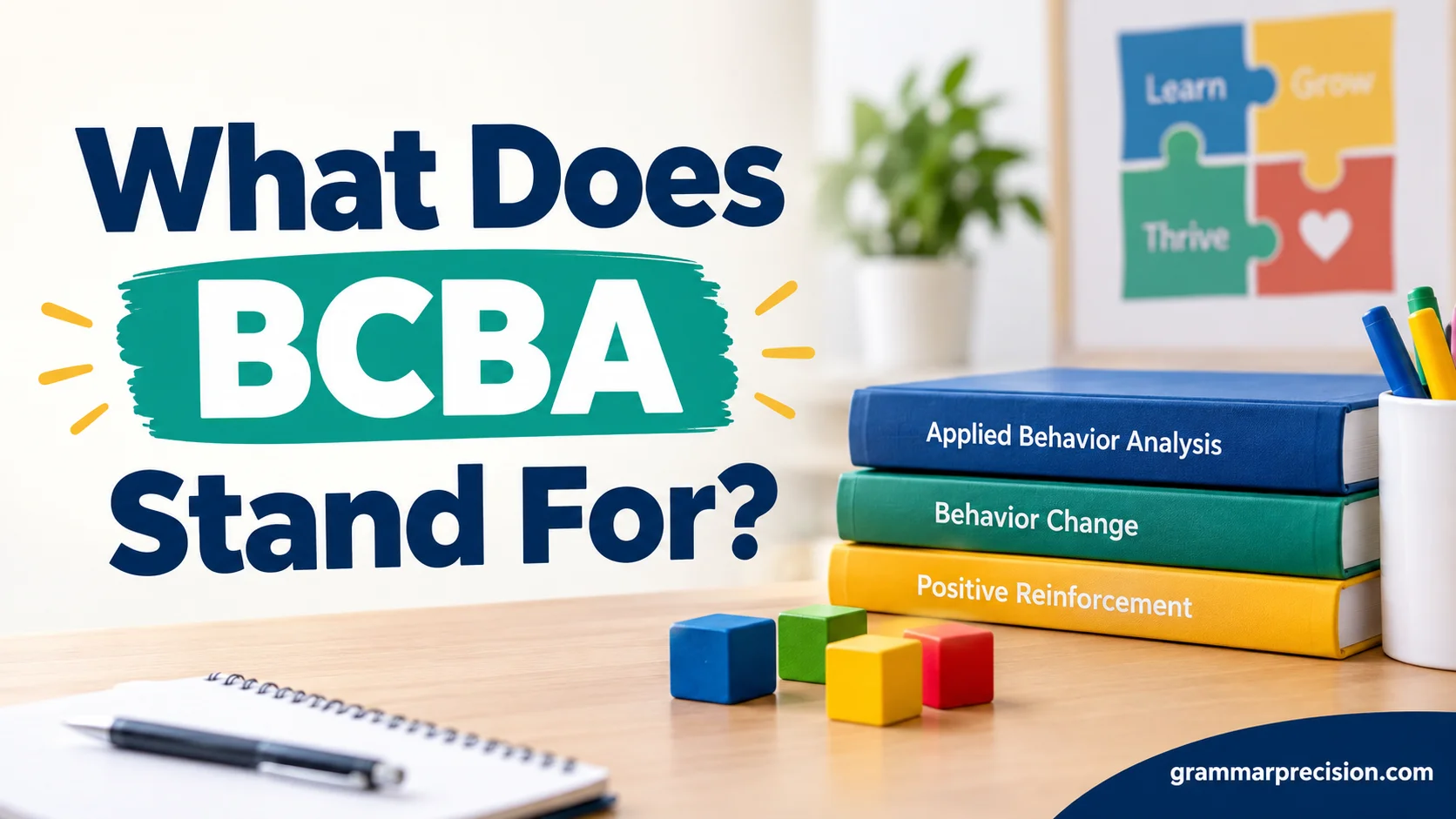
Have you ever seen BCBA in a professional profile, healthcare setting, or service plan and wondered, “What Does BCBA Stand For?” The abbreviation stands for Board Certified Behavior Analyst, a professional credential connected to behavior analysis.
Unlike terms used in scheduling, time management, business communication, online booking, broadcasting, meetings, calendar management, or project management, BCBA identifies a specialized professional role. Understanding its meaning also helps prevent confusion when reading formal documents, service descriptions, or professional communication.
This guide explains what BCBA means, what a Board Certified Behavior Analyst does, and how the credential relates to ABA, RBT, and BCaBA. It also explores certification requirements, professional responsibilities, work settings, and common misconceptions. While English usage, grammar, formal writing, and consistency often vary between US and UK style guides, the meaning of BCBA remains tied to its established professional usage. By the end, you’ll have a clear understanding of the term and its role in behavior analysis.
What Does BCBA Stand For?
BCBA stands for Board Certified Behavior Analyst. The Behavior Analyst Certification Board (BACB) describes a BCBA as a graduate-level professional who can practice independently and supervise certain other behavior-analytic professionals.
In simple terms, a BCBA uses principles of behavior analysis to understand behavior and develop structured ways to teach useful skills or reduce harmful or disruptive patterns.
A BCBA isn’t simply someone who tells another person how to behave. The work relies heavily on observation, measurement, assessment, intervention design, and ongoing data review.
What Is a BCBA in Simple Terms?
Think of a BCBA as a behavioral problem-solver. When a behavior repeatedly appears, the BCBA looks beyond the behavior itself.
For example, suppose a student frequently leaves the classroom during difficult assignments. Rather than immediately treating leaving as the problem, a BCBA might examine when it happens, what happens immediately beforehand, what follows afterward, and what skills the student already has.
That information can guide a plan that teaches a more useful response while addressing the conditions surrounding the behavior.
What Does a BCBA Do?
A BCBA’s daily work varies by setting, client, and specialization. Still, several responsibilities appear across many roles.
Conducting Behavioral Assessments
Assessment gives the BCBA information needed to understand a behavioral pattern. Depending on the situation, this can include interviews, direct observation, record review, skill assessments, and systematic data collection.
The goal isn’t merely to describe what someone does. The BCBA tries to identify relevant environmental variables and determine which skills or conditions may influence the behavior.
Creating Behavior-Change Plans
After gathering information, a BCBA may develop a structured intervention. The plan can target skill development, communication, social behavior, independence, learning, or challenging behavior.
A useful plan should be specific enough that trained team members can implement it consistently. It also needs measurable goals so progress can be evaluated rather than guessed.
Analyzing Data
Data analysis sits near the center of behavior analysis. BCBAs may examine frequency, duration, percentage, rate, or other measurements depending on the behavior and goal.
For example, if a learner completes three independent tasks during baseline and later completes eight, that change provides more useful information than saying the learner “seems better.”
Supervising and Training Others
BCBAs may supervise BCaBAs and RBTs and can train caregivers, educators, or other staff involved in a behavior-analytic program. BACB guidance identifies BCBA responsibilities that include supervising fieldwork and certain credentialed professionals.
That makes communication an important part of the job. A carefully designed intervention won’t accomplish much if the people implementing it don’t understand how or when to use it.
What Is the Connection Between BCBA and ABA?
ABA stands for Applied Behavior Analysis. It refers to a field and approach that applies principles of behavior analysis to socially meaningful behavior.
BCBA refers to a professional credential. ABA refers to the discipline or approach in which many BCBAs practice.
That distinction is easy to remember:
ABA is the field. BCBA is the credentialed professional.
A BCBA may use ABA principles in assessment, intervention, teaching, and data analysis. However, the words aren’t interchangeable.
Why Do People Confuse BCBA and ABA?
The confusion often comes from everyday workplace language. Someone might say, “My child receives ABA,” while another person says, “Our BCBA created the program.” Both statements can describe different parts of the same service arrangement.
ABA describes the service approach or scientific field. The BCBA identifies a qualified professional who may design, oversee, or supervise behavior-analytic services.
What Types of Behavior Can a BCBA Address?
BCBAs aren’t limited to one diagnosis or one age group. Their work can involve skill acquisition, communication, social interaction, daily living, learning, workplace behavior, and challenging behavior.
Common areas can include:
- Communication and language-related skills
- Social and interaction skills
- Academic or learning behaviors
- Self-care and daily living skills
- Independent living skills
- Workplace behaviors
- Safety-related skills
- Challenging or disruptive behaviors
BCBAs frequently work with people with autism and developmental disabilities. They can also work with adults and people in other contexts. Cleveland Clinic notes that BCBA services can extend beyond children with autism to adults and other populations.
How Does a BCBA Create a Behavior Plan?
A behavior plan isn’t supposed to be a random list of rules. It should connect assessment findings to measurable goals and practical intervention strategies.
Define the Target Behavior
First, the behavior needs a clear operational definition. “Acts out” is vague. A description such as “leaves the assigned area without permission” is easier to observe and measure.
Collect Baseline Information
Baseline data show what happens before an intervention begins. Without baseline information, later changes become harder to interpret.
Examine Relevant Variables
The BCBA considers patterns surrounding the behavior. Antecedents, consequences, setting events, communication skills, environmental demands, and available reinforcement can all matter.
Choose and Implement an Intervention
The intervention should match the assessment and the person’s goals. It may involve teaching replacement skills, changing environmental conditions, reinforcing useful behavior, or modifying task demands.
Measure the Results
Finally, the BCBA reviews data. If the intervention isn’t producing the desired outcome, the professional may adjust the plan rather than simply continuing it unchanged.
A Simple Real-World Example
Imagine a child who frequently throws materials when difficult writing tasks begin.
A superficial approach might focus only on stopping the throwing. A behavior-analytic approach asks additional questions: What happens before the behavior? What happens afterward? Can the child request help? Is the task too difficult? Does throwing consistently result in a break?
Suppose data show that throwing occurs most often during lengthy writing assignments. The intervention might teach an appropriate help or break request while gradually building task tolerance and reinforcing successful participation.
The important lesson is simple: behavior becomes useful information when you measure it in context.
Where Do BCBAs Work?
The BCBA profession extends across many environments. A practitioner might work in a clinic one day and collaborate with a school or family another day.
Common settings include:
| Setting | Possible BCBA Responsibilities |
| Schools | Behavior support, skill development, staff collaboration |
| Clinics | Assessment, intervention, supervision |
| Homes | Caregiver training and practical behavior support |
| Community programs | Independence and social skill development |
| Residential services | Daily living and behavioral support |
| Healthcare settings | Behavioral assessment and intervention |
| Workplaces | Organizational and performance-related applications |
How Do You Become a BCBA?
Becoming a BCBA requires more than earning a general bachelor’s degree. The BACB currently lists several eligibility components, including graduate-level education, qualifying behavior-analytic preparation, supervised experience, an application, and successful completion of the certification examination.
Earn the Required Graduate Education
Under the current requirements, BCBA applicants need a qualifying graduate degree. The appropriate educational pathway depends on the certification route and the applicable BACB requirements.
Students should check the current handbook before choosing a program because certification standards are changing.
Complete Qualifying Coursework or Another Approved Pathway
Current pathways include behavior-analytic coursework and other routes recognized by the BACB. Beginning January 1, 2026, Pathway 2 applicants use a Coursework Attestation System rather than the previous VCS process.
That means prospective students should verify that their university pathway can support the documentation needed for certification.
Complete Supervised Experience
Applicants also need qualifying supervised fieldwork. The amount and structure depend on the applicable pathway and current BACB rules.
Supervision matters because academic knowledge alone doesn’t demonstrate practical competence. Fieldwork connects coursework with real professional responsibilities.
Apply and Take the BCBA Examination
Once eligibility requirements are met, candidates apply through their BACB account. Approved candidates take the examination through Pearson VUE.
The current BCBA examination contains 185 total questions, including 175 scored questions and 10 unscored pilot questions, with a four-hour testing period.
What Are the 2026 and 2027 BCBA Requirement Changes?
Certification requirements aren’t frozen in time. The BACB has announced significant changes beginning January 1, 2027. Under the current transition guidance, people seeking review under the existing 2022 requirements must submit a complete application, including payment and required documentation, by December 31, 2026.
The change matters because someone planning a BCBA career in 2026 shouldn’t assume today’s pathway will remain identical.
The BACB has also introduced 2026 changes affecting coursework documentation. Pathway 2 now uses a designated program contact to attest that an applicant’s coursework meets applicable requirements.
For students, the practical takeaway is clear: check the current BACB handbook before enrolling, completing fieldwork, or submitting an application.
BCBA vs. BCaBA vs. RBT
These credentials often appear together, but they represent different professional roles.
| Credential | Full Name | General Level | Typical Role |
| BCBA | Board Certified Behavior Analyst | Graduate level | Independent behavior-analytic practice and supervision |
| BCaBA | Board Certified Assistant Behavior Analyst | Undergraduate level | Behavior-analytic services under supervision |
| RBT | Registered Behavior Technician | Paraprofessional | Direct implementation of behavior-analytic services |
The BACB describes BCaBAs as undergraduate-level professionals who practice under supervision and RBTs as paraprofessionals who assist with behavior-analytic services under close supervision.
BCBA vs. RBT
An RBT generally implements behavior-analytic services under direction and supervision. A BCBA has graduate-level certification and can practice independently within the applicable professional framework.
In a typical service team, the BCBA may design and oversee a program while an RBT implements assigned procedures and records relevant data.
BCBA vs. BCaBA
A BCaBA has an undergraduate-level certification and practices under supervision. A BCBA holds graduate-level certification and can independently practice behavior analysis under the certification framework.
The distinction isn’t simply about job titles. It reflects different education, supervision, and professional responsibilities.
Also Read This: What Does Simp Stand For? Meaning, Definition & History
BCBA vs. Psychologist vs. Therapist
These professions can collaborate, but they aren’t interchangeable.
| Professional | Broad Focus |
| BCBA | Behavior analysis and behavior-analytic intervention |
| Psychologist | Psychological assessment, research, and treatment within their licensed scope |
| Therapist | Mental health or counseling services within their training and license |
| RBT | Direct implementation of assigned behavior-analytic procedures |
A BCBA’s scope depends on certification, state law, employer rules, and other applicable requirements. In some locations, professional licensure may also affect how someone can practice.
For that reason, the credential alone shouldn’t be treated as a complete description of every service a professional can legally provide.
What Skills Does a Successful BCBA Need?
Strong behavior analysts need more than textbook knowledge. Their work combines analysis with communication and practical judgment.
Important skills include:
- Data analysis: Turning observations into useful information.
- Communication: Explaining complex plans in everyday language.
- Observation: Noticing patterns that others may miss.
- Problem-solving: Adjusting interventions when results differ from expectations.
- Documentation: Recording decisions, progress, and relevant clinical information.
- Collaboration: Working with families, teachers, technicians, and other professionals.
- Ethical decision-making: Keeping professional responsibilities and client welfare central.
What Is a BCBA Salary?
BCBA compensation varies substantially by location, experience, employer, specialization, workload, and employment arrangement. Salary figures also change over time, so a single national number can create a false sense of precision.
Rather than treating one salary figure as universal, prospective BCBAs should compare actual job postings in their target location and consider the full compensation package.
Factors worth examining include:
- Base salary
- Caseload expectations
- Billable-hour requirements
- Bonuses
- Health benefits
- Retirement contributions
- Paid time off
- Professional development support
- Remote or hybrid options
Two jobs offering the same salary can have very different workloads. Compensation makes more sense when you examine it alongside responsibilities and working conditions.
Common Misconceptions About BCBAs
Several misunderstandings can make the credential harder to understand.
BCBA Is Not a Degree
BCBA is a professional certification, not the name of an academic degree. A person typically earns an appropriate graduate degree and then meets additional certification requirements.
BCBA and ABA Are Not the Same Thing
ABA describes a field or approach. BCBA describes a credentialed professional.
BCBAs Don’t Only Work With Children
Many people associate BCBAs with pediatric autism services. Those services represent an important area of practice, but behavior analysis can also address adult services, education, organizational behavior, developmental disabilities, and other applications.
Every BCBA Does Not Have the Same Specialty
Certification establishes a professional credential. It doesn’t mean every BCBA has identical experience or expertise.
One practitioner may specialize in school services. Another may focus on adult residential programs. A third may work in organizational settings.
FAQs About BCBA
What does BCBA stand for?
BCBA stands for Board Certified Behavior Analyst. It is a graduate-level professional certification associated with independent behavior-analytic practice and supervision within the applicable professional framework.
Is a BCBA the same as an ABA therapist?
No. ABA is a field and intervention approach, while BCBA identifies a certified professional. A BCBA may design or oversee ABA-based services, while other trained professionals may implement them.
How long does it take to become a BCBA?
There isn’t one universal timeline. The total period depends on undergraduate education, graduate education, qualifying coursework, supervised fieldwork, application processing, exam preparation, and the certification requirements that apply when you apply.
Can a BCBA work with adults?
Yes. BCBAs can work with adults as well as children. The specific population depends on the practitioner’s training, employment setting, professional scope, and client needs.
What is the difference between a BCBA and an RBT?
A BCBA is a graduate-level certified behavior analyst who can practice independently within the certification framework. An RBT is a paraprofessional credential holder who assists with behavior-analytic services under close supervision.
Does a BCBA diagnose autism?
A BCBA’s behavior-analytic role should not automatically be confused with medical or psychological diagnosis. Diagnostic authority depends on professional licensure, training, and applicable law.
Conclusion:
BCBA stands for Board Certified Behavior Analyst, a graduate-level professional credential in behavior analysis. BCBAs assess behavior, analyze data, design interventions, monitor outcomes, and may supervise other behavior-analytic professionals.
The credential also differs clearly from ABA, BCaBA, RBT, psychology, and therapy. Understanding those distinctions makes the field much easier to navigate.
For anyone considering BCBA certification, the most important detail is timing. Requirements are changing, with major updates scheduled for January 1, 2027. Checking the current BACB requirements before choosing coursework or submitting an application can prevent costly surprises.