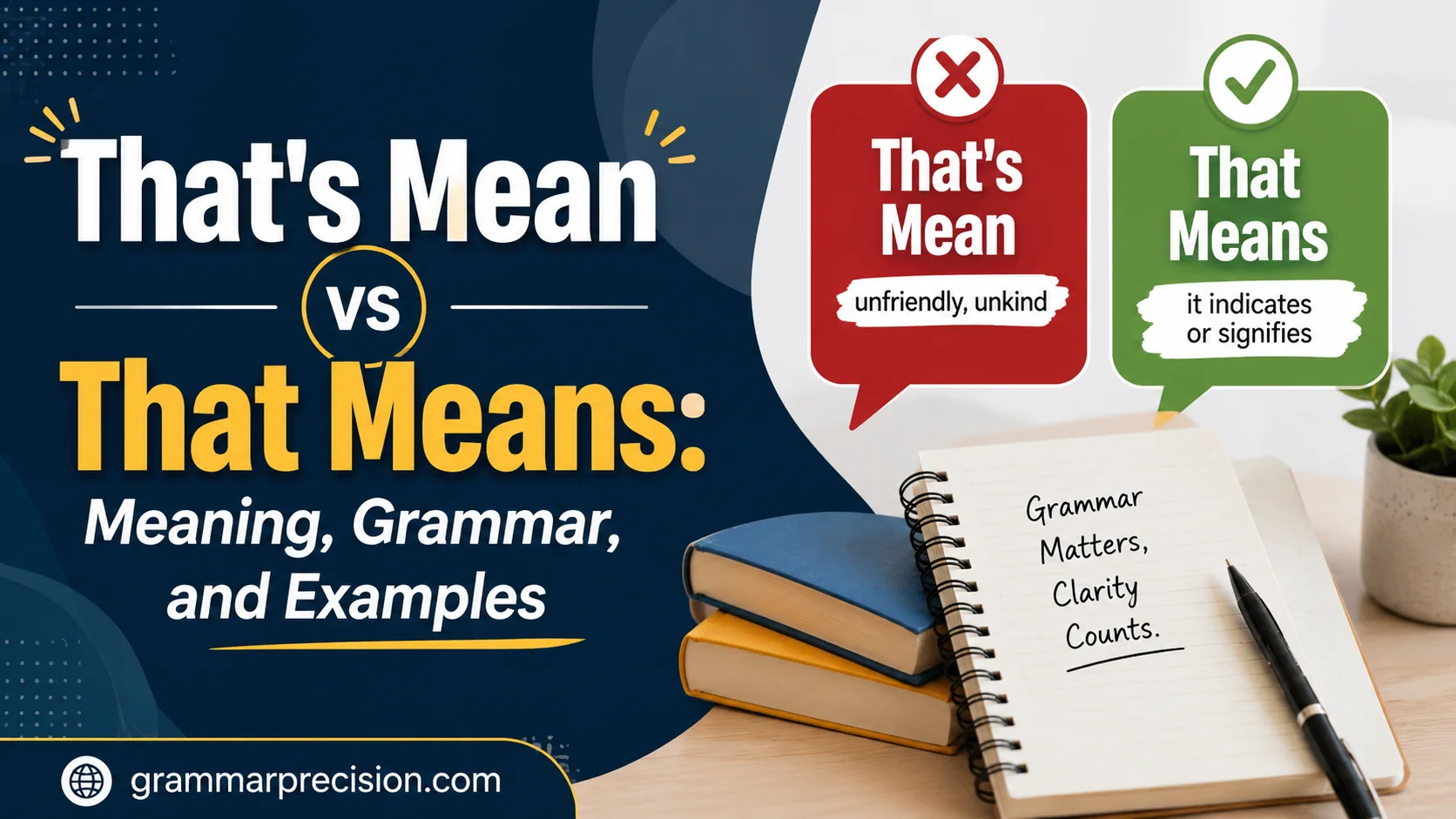
That’s Mean vs That Means can be confusing because both expressions look similar. Learn their meaning, grammar, differences, and correct usage with clear examples.
English often gives one word several jobs, and mean is a perfect example. In “That’s mean,” it describes something unkind, rude, or hurtful. In “That means,” it explains what something indicates, signifies, or implies. Understanding this small grammatical difference can help you write and speak clear, natural English.
Once you know how mean works as an adjective and a verb, choosing the right expression becomes much easier. This guide explains that’s mean vs that means with simple rules, practical examples, common mistakes, and useful grammar tips. You’ll also learn how context, subject-verb agreement, and sentence structure determine which expression fits correctly.
That’s Mean vs That Means at a Glance
The quickest way to understand the difference is to look at what the speaker wants to communicate.
| Expression | Meaning | Grammar | Example |
| That’s mean | That is unkind or hurtful | “Mean” is an adjective | That’s mean to say. |
| That means | That indicates or signifies something | “Means” is a verb | That means we need to leave. |
| That’s means | Incorrect in standard English | Incorrect structure | ❌ That’s means you’re late. |
| That mean | Usually incorrect with singular “that” | Subject-verb agreement error | ❌ That mean something important. |
A useful shortcut is this:
If you mean “That is unkind,” use “that’s mean.” If you mean “That indicates,” use “that means.”
That simple distinction solves most usage questions.
What Does “That’s Mean” Mean?
That’s mean is short for “That is mean.” Here, mean functions as an adjective.
The adjective mean can describe someone or something that is unkind, cruel, nasty, or deliberately hurtful. When you say “That’s mean,” you’re judging an action, comment, joke, or behavior.
For example:
- That’s mean. You shouldn’t have said that.
- That’s mean to laugh at someone when they’re struggling.
- That’s a mean thing to do.
- Wow, that’s mean!
- It was mean of him to ignore her.
Notice what happens grammatically:
That + is + mean
The contraction that’s replaces that is:
That’s mean.
That is mean.
Here, mean doesn’t indicate or explain anything. Instead, it describes something as unkind.
Why “Mean” Is an Adjective Here
Consider this sentence:
That’s mean.
You could replace mean with another adjective:
- That’s rude.
- That’s cruel.
- That’s unkind.
- That’s unfair.
- That’s hurtful.
Because mean works in the same grammatical position as these adjectives, it describes a quality.
This gives you an easy test. If you can replace mean with rude or unkind, that’s mean is probably the expression you need.
Examples of “That’s Mean”
Example 1:
“You told everyone about her secret?”
“Yeah.”
“That’s mean.”
The speaker isn’t explaining what the secret signifies. The speaker is criticizing the behavior.
Example 2:
“Tom laughed when Jake fell.”
“That’s mean.”
Again, mean describes Tom’s behavior.
Example 3:
“That’s mean of you to say.”
Here, the speaker considers the statement unkind or hurtful.
What Does “That Means” Mean?
That means is different because means functions as a verb.
In this expression, mean has the sense of signify, indicate, imply, or result in something.
For example:
That means we have to leave now.
This sentence doesn’t say that “that” is unkind. Instead, it explains the consequence or significance of something.
Consider these examples:
- That means you’re right.
- That means we missed the deadline.
- That means she already knows.
- That means the store is closed.
- That means a lot to me.
In each case, means communicates meaning, significance, implication, or consequence.
Why Does “Mean” Become “Means”?
The word that acts as a singular third-person subject in these sentences.
In the present tense, a singular third-person subject normally takes means, not mean.
Compare:
- I mean
- You mean
- We mean
- They mean
- He means
- She means
- It means
- That means
So:
That means something. ✅
But:
That mean something. ❌
The final -s isn’t optional. It reflects normal subject-verb agreement.
That’s Mean vs That Means: The Core Grammar Difference
The two expressions differ because mean has a different grammatical role.
In that’s mean, mean is an adjective.
In that means, means is a verb.
| Feature | That’s mean | That means |
| Full form | That is mean | That means |
| Role of “mean” | Adjective | Verb |
| Main idea | Unkind or hurtful | Indicates or signifies |
| Can replace with “unkind”? | Yes | No |
| Can replace with “indicates”? | No | Yes |
| Example | That’s mean. | That means we’re late. |
This distinction matters because English often uses the same word in different grammatical roles.
Think of mean as a word with several hats. Its meaning changes depending on the hat it wears.
That’s vs That: Why the Difference Matters
The contraction that’s can create another layer of confusion.
That’s can mean:
- that is
- that has
In “That’s mean,” it means “that is.”
For example:
That’s mean.
That is mean.
However, that means doesn’t contain the verb is. It uses that as the subject and means as the main verb.
Look at the structures:
That’s mean:
That + is + adjective
That means:
That + verb
This tiny grammatical difference completely changes the sentence.
A Simple Substitution Test
When you’re unsure, expand that’s.
If the sentence becomes:
That is unkind.
then that’s mean works.
If you want to say:
That indicates something.
then use that means.
For example:
That’s mean.
→ That is unkind. ✅
That means you’re leaving.
→ That indicates you’re leaving. ✅
That’s means you’re leaving.
→ That is means you’re leaving. ❌
The last version falls apart because it tries to put is and the finite verb means together incorrectly.
Why “That’s Means” Is Incorrect
One of the most common mistakes is writing or saying:
❌ That’s means you’re late.
The problem becomes obvious when you expand the contraction:
That is means you’re late.
English doesn’t use this structure.
You need either:
That means you’re late. ✅
or, if you want to describe something:
That’s mean. ✅
The incorrect version mixes the two patterns.
Compare the Three Forms
That’s mean.
= That is unkind.
That means you’re late.
= That indicates you’re late.
That’s means you’re late.
= Incorrect combination of the two structures.
This error often happens because speakers hear that’s and means together in quick conversation. The sounds can blur, especially when someone speaks rapidly.
Also Read This: Heading To or Heading For: The Simple Rule
“That Mean” vs “That Means”
Another frequent mistake is leaving off the -s:
❌ That mean we should go.
With singular that, the correct form is:
✅ That means we should go.
The same pattern appears elsewhere:
- This means something.
- It means something.
- That means something.
- She means well.
- He means what he says.
However, plural subjects take mean:
- Those things mean a lot.
- These signs mean the road is closed.
- They mean something different.
The rule is straightforward:
Singular third-person subject → means
Plural subject or I/you/we/they → mean
Mean vs Means: Understanding the Verb
The difference between mean and means isn’t limited to the phrase that means. It follows a larger English grammar pattern.
| Subject | Correct form |
| I | mean |
| You | mean |
| We | mean |
| They | mean |
| He | means |
| She | means |
| It | means |
| That | means |
| This | means |
Examples:
- I mean what I said.
- You mean this one?
- They mean well.
- She means no harm.
- It means the same thing.
- That means we need another plan.
The verb mean changes to means with singular third-person subjects in the present tense.
What Does “That Mean” Mean?
Although “that mean” is usually incorrect as a standalone statement, you’ll see mean after certain helping verbs.
For example:
What does that mean?
This sentence is completely correct.
Why? Because does already carries the third-person singular marking. Therefore, the main verb stays in its base form:
What + does + that + mean?
Not:
❌ What does that means?
This same rule appears in many English questions:
- What does that mean? ✅
- What does she mean? ✅
- What does this word mean? ✅
- Why does he mean that? ✅
But in a normal statement:
- That means a lot. ✅
- She means well. ✅
- This means trouble. ✅
A helping verb such as does changes the structure. That’s why learners often encounter both mean and means with the same subject.
The Different Meanings of “Mean”
The word mean is especially tricky because it has several meanings.
Mean = Unkind
That’s mean.
Here, mean is an adjective describing unpleasant or hurtful behavior.
Mean = Signify
What does this word mean?
Here, mean asks about significance or definition.
Mean = Intend
I didn’t mean to hurt you.
Here, mean refers to intention.
Mean = Result or Indicate
That means we need more time.
Here, means indicates a conclusion or consequence.
Mean = Mathematical Average
The mean of 10, 20, and 30 is 20.
Here, mean is a mathematical term referring to an average.
Context acts like a signpost. It tells you which meaning the word carries.
Common Sentence Patterns to Remember
Learning patterns can be easier than memorizing isolated rules.
Pattern: That’s + Adjective
Use that’s when that is introduces an adjective.
- That’s strange.
- That’s kind.
- That’s rude.
- That’s mean.
- That’s unfair.
Pattern: That + Means + Explanation
Use that means when you explain what something indicates.
- That means we’re ready.
- That means you passed.
- That means the answer is wrong.
- That means she already left.
Pattern: What + Does + That + Mean?
Use this structure to ask about meaning.
- What does that mean?
- What does that mean for us?
- What does that mean in English?
These patterns make the distinction much easier to remember.
That’s Mean vs That Means in Real Conversations
Context makes the difference especially clear.
Case Study: A Hurtful Comment
Imagine two friends are talking.
“Did you hear what Mark said about Sarah?”
“Yes. That’s mean.”
The second speaker criticizes Mark’s behavior.
Now change the situation:
“Sarah didn’t come to the meeting.”
“That means she won’t hear the announcement.”
Here, the speaker explains the consequence of Sarah’s absence.
One expression judges behavior. The other interprets information.
Case Study: A Work Situation
Suppose an employee receives this message:
“The office will close at 4 p.m.”
The employee says:
“That means we need to finish the meeting early.”
The phrase that means connects information with a conclusion.
Now imagine someone mocks another employee’s mistake:
“He laughed when she made a mistake.”
“That’s mean.”
Again, the phrase describes behavior.
Common Mistakes and Their Corrections
These errors appear often because the expressions sound similar.
| Incorrect | Correct | Reason |
| ❌ That’s means we’re late. | ✅ That means we’re late. | Don’t combine “is” with “means.” |
| ❌ That mean we’re late. | ✅ That means we’re late. | “That” takes singular “means.” |
| ❌ What does that means? | ✅ What does that mean? | “Does” requires the base verb. |
| ❌ That’s mean we’re late. | ✅ That means we’re late. | The intended meaning requires the verb “means.” |
| ❌ That means! | ✅ That’s mean! | If you’re calling something unkind, use the adjective. |
The fourth example deserves attention because it can sound plausible in conversation. If you say “That’s mean we’re late,” you’re combining two different sentence patterns.
Choose one:
That’s mean.
or:
That means we’re late.
Don’t blend them.
A Quick Trick to Remember That’s Mean vs That Means
Use the unkind test.
Ask yourself:
Am I saying that something is unkind?
If yes, use:
That’s mean.
For example:
“You deleted his project?”
“That’s mean.”
Now use the indicates test.
Ask:
Am I explaining what something indicates or causes?
If yes, use:
That means.
For example:
“The lights are off.”
“That means nobody is home.”
These two tests take only a second. They can save you from most mistakes.
Quick Practice: Choose the Correct Expression
Try completing each sentence before checking the answers.
- “You shouldn’t make fun of her. ______.”
- “The train has already left. ______ we need another way home.”
- “He refused to help after promising he would. ______.”
- “The sign says the road is closed. ______ we need to turn around.”
- “You told everyone my private story? ______.”
Answers
- That’s mean.
- That means
- That’s mean.
- That means
- That’s mean.
The pattern should now feel familiar. That’s mean evaluates behavior. That means explains significance or consequence.
FAQs:
Is “That’s Mean” grammatically correct?
Yes, “That’s mean” is grammatically correct when mean means unkind, rude, cruel, or hurtful. For example, “That’s mean to say” describes someone’s words or behavior as unkind.
What does “That Means” mean?
“That means” means “that indicates,” “that signifies,” or “that implies.” You use it when you want to explain the meaning, result, or consequence of something. For example, “The store is closed. That means we have to come back tomorrow.”
What is the difference between “That’s Mean” and “That Means”?
“That’s mean” describes something as unkind or hurtful, while “that means” explains what something signifies or indicates. For example, “That’s mean!” criticizes someone’s behavior, whereas “That means we’re late” explains a situation.
Is “That’s Means” correct in English?
No, “that’s means” is incorrect in standard English when you want to say “that indicates.” The correct expression is “that means.” For example, say “That means you’re ready,” not “That’s means you’re ready.”
Should you say “What Does That Mean?” or “What Does That Means?”
The correct form is “What does that mean?” The auxiliary verb “does” already carries the singular form, so the main verb stays in its base form, “mean.” Therefore, “What does that means?” is grammatically incorrect.
Conclusion:
Understanding that’s mean vs that means becomes easy when you focus on their different grammatical roles. Use “that’s mean” to describe something unkind or hurtful, while “that means” explains what something indicates or signifies.
Remember that “that’s means” is incorrect in standard English. With these simple rules and examples, you can use both expressions confidently and correctly.