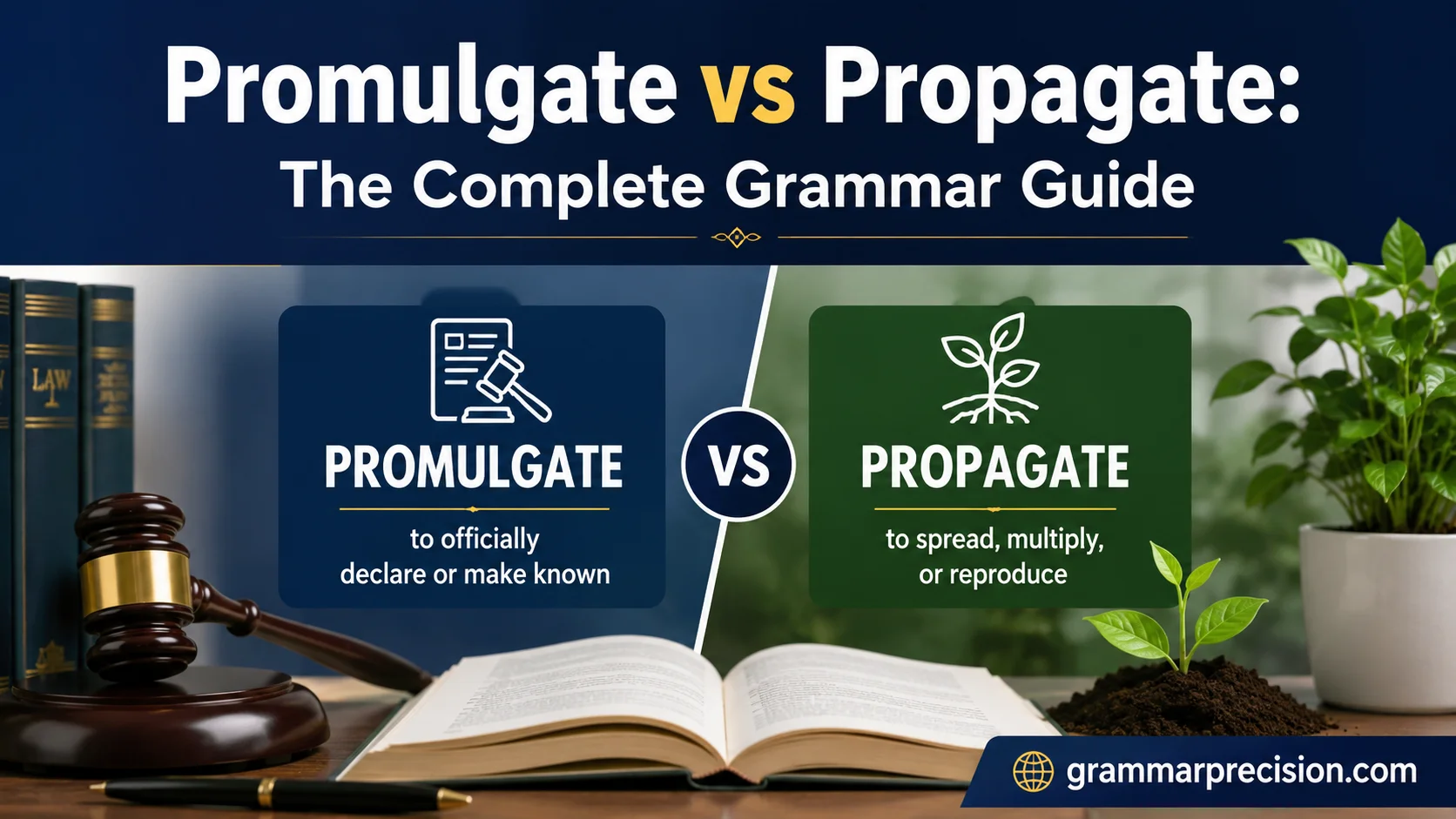
Promulgate vs Propagate often confuses English learners because both involve spreading something, but each has a different purpose. Knowing the difference helps you write more accurately and confidently.
Promulgate is mainly used in official, legal, or formal situations. It means to announce, publish, or declare a law, policy, or regulation so people become aware of it. Governments often promulgate new rules, making them effective through an official declaration and proper communication with citizens.
Propagate, however, focuses on spreading or multiplying something, such as ideas, beliefs, information, plants, or species. Scientists, gardeners, and educators commonly use this word. Choosing the correct term improves your writing, strengthens clarity, and helps you avoid common mistakes in everyday English.
Promulgate vs Propagate: The Quick Difference Explained
Before exploring each word in detail, here is a quick comparison:
| Word | Meaning | Main Idea | Common Uses |
| Promulgate | To officially announce or make something publicly known | Formal release | Laws, rules, policies, regulations |
| Propagate | To spread, promote, reproduce, or transmit something | Expansion and growth | Ideas, beliefs, plants, signals, information |
Think of the difference this way:
Promulgate is about introducing something officially.
Propagate is about spreading something after it exists.
For example:
- A government promulgates a new environmental regulation.
- Citizens and organizations propagate information about that regulation.
The first action creates public awareness through authority. The second action increases reach through distribution.
What Does Promulgate Mean?
The word promulgate means to officially make something known to the public, especially a law, rule, decision, or policy.
When an organization or authority promulgates something, it usually has the power or responsibility to announce it formally.
The word often appears in legal, governmental, and institutional writing because it suggests an official action rather than casual sharing.
Simple Definition of Promulgate
Promulgate = to announce something officially so people know about it.
Imagine a school creating a new attendance policy. The principal does not simply mention it during lunch. Instead, the school publishes the policy, sends notices, and makes sure everyone understands the new rules.
The school has promulgated the policy.
The Origin and History of Promulgate
The word promulgate comes from the Latin word promulgare, which meant “to make publicly known” or “to publish.”
The Latin roots are connected to the idea of bringing information out into the open.
Over time, English adopted the word to describe the official announcement of important information, especially laws and regulations.
Today, you will often see promulgate used by:
- Governments
- Courts
- Regulatory agencies
- Universities
- Professional organizations
- Companies creating formal policies
Common Uses of Promulgate
Although promulgate sounds like a complicated word, its use is actually very specific.
Promulgate Laws and Regulations
The most common use of promulgate appears in legal contexts.
Governments create rules, but those rules do not become effective until they are officially released according to legal procedures.
For example:
“The agency promulgated new safety regulations for commercial vehicles.”
This means the agency officially introduced those regulations.
The agency did not simply discuss the rules. It completed a formal process to make them public.
Promulgate Policies and Procedures
Businesses and organizations also promulgate internal rules.
For example:
“The company promulgated a new workplace security policy.”
This means the company officially announced the policy and expected employees to follow it.
Common examples include:
- Employee handbooks
- Safety procedures
- Compliance rules
- Academic guidelines
Promulgate Official Statements
Governments and institutions may also promulgate:
- Decisions
- Guidelines
- Standards
- Official recommendations
For example:
“The health department promulgated updated vaccination guidelines.”
The important point is that the information comes from an authoritative source.
Examples of Promulgate in Sentences
Seeing the word in context makes its meaning clearer.
| Sentence | Explanation |
| The government promulgated a new tax policy. | The government officially introduced the policy. |
| The university promulgated new admission requirements. | The university formally announced new rules. |
| The organization promulgated ethical standards for members. | The organization made standards officially available. |
| The court promulgated new procedural guidelines. | The court released formal instructions. |
Notice that promulgate usually involves an authority figure or organization.
A random person usually does not promulgate something because the word implies responsibility and official approval.
What Does Propagate Mean?
The word propagate means to spread, promote, reproduce, or transmit something from one place or person to another.
Unlike promulgate, propagation does not require official authority.
Something can propagate naturally, intentionally, or accidentally.
For example:
- Plants propagate by producing new growth.
- Ideas propagate through communication.
- Rumors propagate through social networks.
- Radio waves propagate through space.
The central idea is growth and movement.
The Origin and History of Propagate
The word propagate comes from the Latin word propagare, meaning “to spread” or “to extend.”
Originally, it was strongly connected with agriculture and reproduction.
Gardeners used the idea of propagation when creating new plants from seeds or cuttings.
Over time, the meaning expanded to include the spreading of:
- Information
- Beliefs
- Opinions
- Technology
- Energy waves
Different Meanings of Propagate
One reason propagate can confuse people is that it appears in several fields.
Propagate Ideas and Information
When people share thoughts, messages, or beliefs, those ideas can propagate.
Example:
“Social media platforms allow information to propagate quickly.”
The information moves from one person to thousands or millions of others.
Propagate Plants
In gardening, propagation means creating new plants.
For example:
- A gardener grows a new rose plant from a cutting.
- A farmer spreads seeds across a field.
Example:
“Gardeners propagate herbs by taking small cuttings from mature plants.”
Here, propagate means to reproduce or multiply.
Propagate Signals and Waves
Scientists and engineers use propagate when discussing movement through a medium.
Examples include:
- Radio signals
- Sound waves
- Light waves
Example:
“Radio signals propagate through the atmosphere.”
The signal travels from one location to another.
Examples of Propagate in Sentences
| Sentence | Meaning |
| The organization worked to propagate environmental awareness. | The organization spread awareness. |
| These plants propagate quickly in warm climates. | The plants reproduce and grow. |
| False information can propagate rapidly online. | False information spreads quickly. |
| Sound waves propagate through different materials. | Sound waves travel through materials. |
The common theme is always spreading, multiplying, or moving outward.
Promulgate vs Propagate: The Hidden Difference Most People Miss
Although promulgate and propagate share a connection with spreading information, the real difference comes down to how something spreads and who starts the process.
Many people think these words are interchangeable because both can involve making something known. However, they represent two different stages of communication.
A useful way to remember the difference is:
Promulgate begins the public announcement. Propagate expands the reach.
Imagine a new law about road safety.
First, a government agency creates and officially releases the law. This action is promulgation.
Then, news organizations, social media users, and community groups share information about the law. This action is propagation.
The law was promulgated before it was widely propagated.
Promulgate vs Propagate: A Timeline Explanation
Understanding the sequence makes the difference much easier.
Authority creates a rule or message
↓
Official announcement happens
↓
PROMULGATE
↓
People share, discuss, and spread it
↓
PROPAGATE
The two words can sometimes appear in the same situation, but they describe different actions.
Example:
A government introduces a new recycling policy.
Step 1: The environmental department officially publishes the policy.
→ The department promulgates the policy.
Step 2: Newspapers, websites, and citizens discuss the policy.
→ The information propagates throughout society.
The first word focuses on authority. The second focuses on distribution.
Also Read This: Bored vs Board: The Complete Grammar Guide
Promulgate vs Propagate: Side-by-Side Comparison
| Category | Promulgate | Propagate |
| Core meaning | Officially announce something | Spread something widely |
| Main focus | The beginning of public awareness | The expansion of awareness |
| Requires authority? | Usually yes | No |
| Common fields | Law, government, organizations | Science, communication, biology |
| Tone | Formal | General or technical |
| Example noun | Law, regulation, policy | Idea, rumor, plant, signal |
A simple shortcut:
- If something needs approval before release, think promulgate.
- If something needs movement or growth, think propagate.
Promulgate vs Propagate in Different Fields
These words appear in different professional environments. Understanding those contexts helps you choose the right term naturally.
Government and Law
Legal writing uses promulgate frequently because governments and institutions officially introduce rules.
Examples:
- A government promulgates a constitution.
- A regulatory agency promulgates safety standards.
- A court promulgates procedural rules.
A legal document might say:
“The agency shall promulgate regulations to protect public health.”
This means the agency has the legal responsibility to officially establish and announce those regulations.
On the other hand, the public may later propagate information about those regulations through conversations and media.
Science and Technology
Scientists often use propagate because many things in science involve movement.
Examples:
- Light propagates through space.
- Radio waves propagate through the atmosphere.
- Computer viruses propagate between systems.
In these cases, propagation describes how something travels or reproduces.
For example:
“The signal propagated across the network within seconds.”
The signal did not receive official approval. It simply moved from one location to another.
Education and Academic Writing
Academic writers may use both words depending on the situation.
Example:
“The university promulgated new research guidelines, which later propagated among academic institutions.”
The university officially released the guidelines. Other institutions then adopted and shared them.
Business Communication
Companies also use both terms.
Promulgate Example:
“The company promulgated a new remote work policy.”
The company officially announced the policy.
Propagate Example:
“Employees helped propagate the company’s values through customer interactions.”
Employees spread those values through their actions.
Common Mistakes When Using Promulgate and Propagate
Even experienced writers sometimes confuse these words. The problem usually happens because both words involve communication.
Here are the most common mistakes.
Mistake: Using Propagate for Official Announcements
Incorrect:
“The government propagated a new law.”
This sounds like the government simply spread information about an existing law.
Better:
“The government promulgated a new law.”
The government officially introduced the law.
Mistake: Using Promulgate for Casual Sharing
Incorrect:
“She promulgated her vacation photos online.”
This sentence sounds too formal and unnatural.
Better:
“She shared her vacation photos online.”
or:
“She propagated her travel experiences through her blog.”
Although the second sentence is grammatically possible, “shared” sounds more natural.
Mistake: Assuming They Are Exact Synonyms
The words overlap slightly, but they are not identical.
Consider this comparison:
| Sentence | Correct Word | Reason |
| The ministry announced a new policy. | Promulgate | Official release |
| People shared the policy online. | Propagate | Spread information |
| Farmers created new plants from seeds. | Propagate | Biological reproduction |
| The agency released new regulations. | Promulgate | Formal announcement |
Synonyms of Promulgate and Their Differences
Understanding related words can improve your vocabulary.
| Word | Meaning | Difference From Promulgate |
| Announce | Make information known | More general |
| Declare | State something clearly | Often focuses on a statement |
| Publish | Release information | Does not always imply authority |
| Issue | Officially provide something | Common for documents and statements |
| Proclaim | Announce publicly | Often more dramatic |
Examples:
- A president may proclaim a national holiday.
- A government agency may promulgate regulations.
- A newspaper may publish information.
Synonyms of Propagate and Their Differences
| Word | Meaning | Difference From Propagate |
| Spread | Move something widely | Most general term |
| Distribute | Give something to many people | Focuses on delivery |
| Circulate | Pass from person to person | Often temporary movement |
| Multiply | Increase in number | Focuses on growth |
| Transmit | Send from one place to another | Common in technology |
Examples:
- News can circulate quickly.
- A message can spread online.
- A virus can propagate through a network.
Promulgate vs Propagate Examples: Real-World Case Studies
Case Study: Public Health Guidelines
Imagine a health department creates new safety recommendations.
The department reviews scientific evidence, approves the guidelines, and releases them publicly.
This process involves promulgation.
After the announcement, doctors, journalists, and community leaders share the information.
This process involves propagation.
| Action | Word Used |
| Health department releases guidelines | Promulgate |
| Media shares the guidelines | Propagate |
| Citizens discuss the guidelines | Propagate |
Case Study: Company Policy Changes
A technology company decides to introduce a new cybersecurity policy.
The leadership team officially publishes the policy for employees.
The company promulgates the policy.
Employees then explain the policy to their teams and encourage safer practices.
The message propagates throughout the organization.
Case Study: Plant Growth
A gardener plants a small herb garden.
Instead of buying new plants, the gardener takes cuttings from existing plants.
The gardener is propagating new plants.
However, there is no official announcement or authority involved, so “promulgate” would not fit.
How to Remember Promulgate vs Propagate Easily
Vocabulary becomes easier when you connect words with mental images.
Memory Trick for Promulgate
Think:
Promulgate = Public + Official
Both involve making something known publicly.
Example:
A government putting a new law on an official website.
Memory Trick for Propagate
Think:
Propagate = Progress + Spread
Something moves, grows, or multiplies.
Example:
A plant growing new branches or an idea spreading online.
Quick Test: Promulgate or Propagate?
Choose the correct word.
The government ______ new environmental regulations.
✅ Promulgated
The government officially introduced the regulations.
Social media helped the message ______ worldwide.
✅ Propagate
The message spread widely.
Gardeners often ______ plants using cuttings.
✅ Propagate
The plants reproduce and grow.
The organization ______ a new code of conduct.
✅ Promulgated
The organization officially announced the code.
FAQs:
What is the main difference between Promulgate and Propagate?
Promulgate means to officially announce, declare, or publish a law, rule, or policy. Propagate means to spread or multiply something, such as ideas, beliefs, information, plants, or species. The key difference is that one focuses on official declaration, while the other focuses on distribution or growth.
Can Promulgate and Propagate be used interchangeably?
No. Although both words involve spreading something, they have different meanings. Promulgate is used in formal or legal contexts, while Propagate is used for spreading ideas, knowledge, plants, or beliefs. Using the correct word makes your writing more accurate and natural.
Is Promulgate only used for governments?
No. While governments often promulgate laws and policies, organizations, institutions, and authorities can also promulgate rules, guidelines, or official announcements. The word always carries the idea of making something officially known.
What are common examples of Propagate?
You can propagate plants by growing new ones from cuttings. People also propagate ideas, beliefs, knowledge, and information through communication, education, and media. The word often refers to spreading or reproducing something over time.
How can I remember the difference between Promulgate and Propagate?
Think of Promulgate as making something public and official, such as a law or policy. Think of Propagate as helping something grow, spread, or multiply, like plants, ideas, or messages. This simple trick helps you choose the right word with confidence.
Conclusion:
Understanding Promulgate vs Propagate helps you communicate with greater clarity and precision. Although both words relate to spreading, Promulgate is used for official declarations, while Propagate refers to spreading or reproducing ideas, beliefs, information, or plants. Learning this distinction improves your English writing, reduces common mistakes, and builds lasting confidence in both formal and everyday communication.