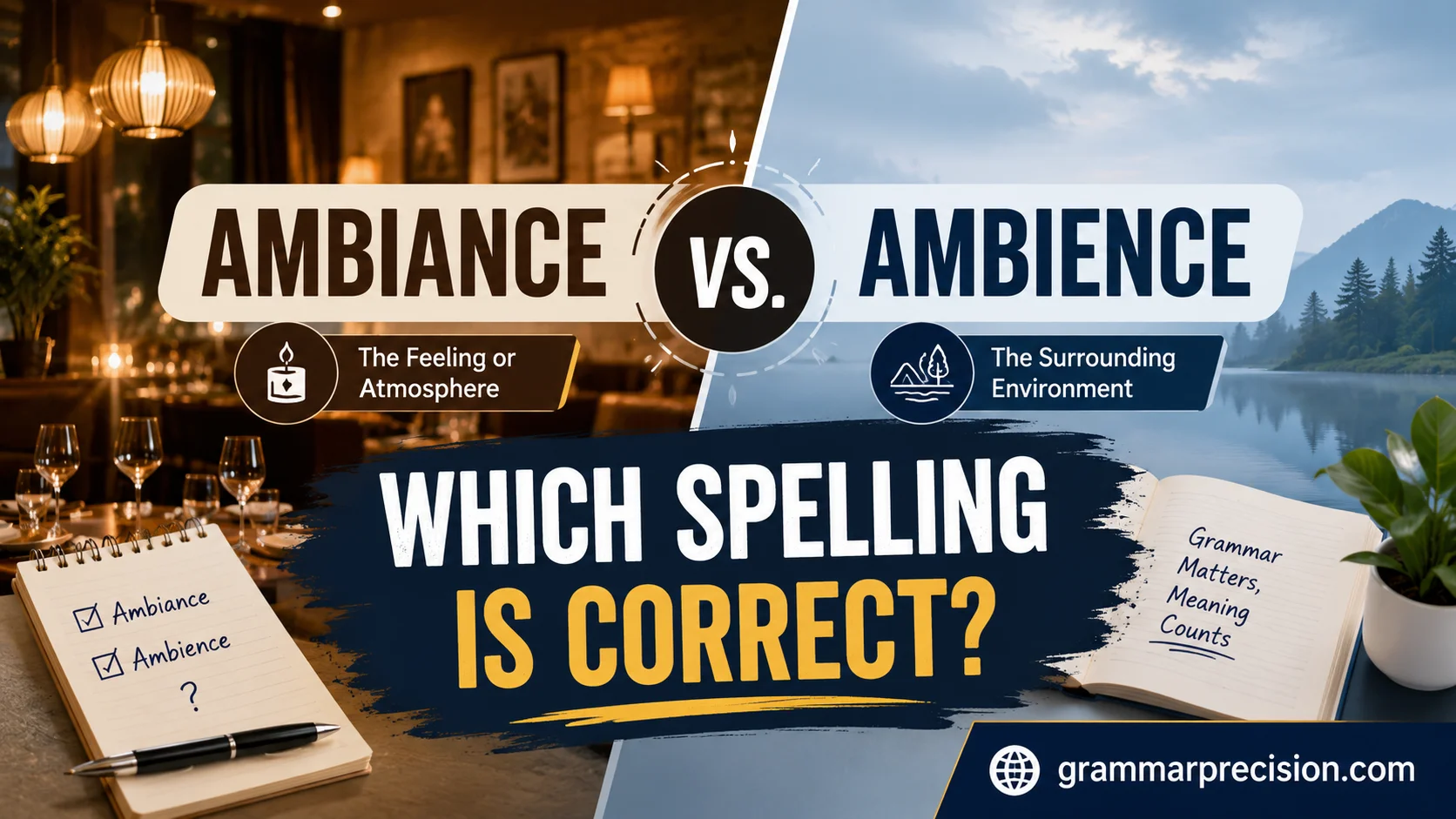
Ambiance vs. Ambience explains why these two spellings describe the same atmosphere, mood, and overall feeling of a place, while their usage differs by region.
When describing a restaurant, ambiance is generally preferred in American English, while ambience is more common in British English. Both spellings describe the environment, setting, and sensory experience created by lighting, colors, aromas, and other details that influence how comfortable and relaxed you feel.
The choice between ambiance and ambience usually depends on your audience and regional language preferences. If you’re writing for American readers, choose ambiance. For British readers, ambience may feel more natural. Either spelling correctly describes the character, mood, and overall experience of a place, including restaurants, rooms, and other settings.
Ambiance vs. Ambience: Which Is Correct?
Both ambiance and ambience are correct English words. They generally mean the same thing: the particular atmosphere, mood, or character created by a place, setting, or situation.
The difference becomes useful when you consider your audience. American dictionaries commonly list ambiance, while ambience is strongly associated with British English.
| Feature | Ambiance | Ambience |
| Meaning | Atmosphere or mood | Atmosphere or mood |
| US English | Common/preferred | Used, but less common |
| British English | Used | Common/preferred |
| Pronunciation | Essentially the same | Essentially the same |
| Part of speech | Noun | Noun |
| Main difference | Spelling | Spelling |
So, if you’re writing for a US audience, choose ambiance. If you’re following British English conventions, ambience is a natural choice.
Quick answer: Ambiance and ambience have the same core meaning. The main distinction is spelling, especially across regional varieties of English.
Ambiance vs. Ambience Meaning
Both words describe something you can sense about an environment without necessarily being able to point to one physical object.
Imagine walking into a quiet café. Soft lighting, gentle music, warm wood, comfortable chairs, and the smell of coffee work together to create a particular feeling. That overall impression is the café’s ambiance or ambience.
The word can describe more than pleasant surroundings. A restaurant may have a lively ambiance. A museum can have a solemn ambience. A hotel might create a luxurious ambiance. In each case, the word refers to the overall atmosphere or character of the setting.
What Does Ambiance Mean?
Ambiance is a noun meaning the character, mood, or atmosphere of a particular place or setting.
For example:
- The restaurant has a romantic ambiance.
- The hotel’s elegant ambiance attracts couples.
- Soft candles created a relaxed ambiance.
- The library has a peaceful ambiance that encourages reading.
The word often appears in descriptions of restaurants, hotels, homes, stores, events, and entertainment venues because those settings deliberately create a certain experience.
What Does Ambience Mean?
Ambience has essentially the same meaning. It refers to the atmosphere or character of a place or environment.
For example:
- The café has a cozy ambience.
- The gallery’s quiet ambience suited the exhibition.
- The garden creates a calming ambience.
- The hotel is known for its sophisticated ambience.
If you replace ambiance with ambience in most sentences, the meaning stays intact. The spelling changes, not the basic idea.
Ambiance vs. Ambience in American English
For American English, ambiance is generally the better default.
You’ll often see it in restaurant reviews, travel writing, marketing copy, interior design descriptions, and lifestyle articles.
For example:
The restaurant combines excellent food with a warm, inviting ambiance.
That sentence sounds completely natural in US English.
American English often favors spelling patterns that differ from British conventions. However, not every word follows a predictable rule. That’s why it’s better to learn the established usage of each word rather than trying to invent a spelling rule.
Is Ambience Wrong in American English?
No. Ambience isn’t simply “wrong” in American English. Readers in the United States will generally understand it without difficulty.
Still, if your goal is consistent US English, ambiance is the more practical choice. This matters especially in formal content, professional writing, educational material, and brand copy where consistency matters.
A useful rule is simple:
Writing for Americans? Prefer ambiance.
Writing for a British audience? Ambience is often the natural choice.
Ambiance vs. Ambience in British English
In British English, ambience is a very familiar spelling. You’ll encounter it in reviews, newspapers, books, websites, and everyday descriptive writing.
For example:
The restaurant is famous for its relaxed ambience.
A British writer could also use ambiance and the word remains understandable and legitimate. However, ambience often fits British spelling conventions more naturally.
This distinction is similar to many other US–UK spelling differences. English developed across different regions and standard varieties sometimes settled on different spellings for the same word.
Ambiance vs. Ambience Pronunciation
One reason this pair can feel confusing is that the spelling difference is much more noticeable than the sound.
In normal English pronunciation, ambiance and ambience are pronounced essentially the same. The exact sound can vary slightly with accent, but changing the final spelling does not normally create a different word pronunciation.
A useful way to think about it is this:
Different spelling ≠ different meaning ≠ different pronunciation.
Both words contain three syllables in common pronunciation:
am-bi-ance
am-bi-ence
The stress generally falls on the first syllable.
If you’re learning English, don’t let the final letters distract you. Listen to the word in context and focus on its meaning.
Examples: Ambiance vs. Ambience in Real Sentences
The easiest way to understand the difference is to see both spellings working in comparable sentences.
| US-style example | British-style example |
| The café has a cozy ambiance. | The café has a cozy ambience. |
| We loved the restaurant’s romantic ambiance. | We loved the restaurant’s romantic ambience. |
| The hotel offers a luxurious ambiance. | The hotel offers a luxurious ambience. |
| Soft music improved the ambiance. | Soft music improved the ambience. |
| The gallery has a peaceful ambiance. | The gallery has a peaceful ambience. |
Notice what stays the same: meaning, grammar, and sentence structure. Only the spelling changes.
More Practical Examples
Restaurant:
The dim lighting gives the restaurant an intimate ambiance.
Hotel:
The hotel combines modern design with a welcoming ambiance.
Wedding:
Candles and flowers created a romantic ambiance throughout the venue.
Home:
Warm lamps can give a living room a comfortable ambiance.
Travel writing:
The old streets have an unforgettable ambiance after sunset.
British English:
The small pub has a friendly ambience that attracts locals.
These examples also reveal an important point: ambiance usually describes the combined effect of several details. It isn’t necessarily one feature.
Also Read This: Compared To vs As Compared To: The Complete Grammar Guide
Ambiance vs. Ambience vs. Atmosphere
If you’re trying to choose the best word, atmosphere deserves attention too.
Atmosphere is broader and often more neutral. It can describe the mood of a place, an event, a social situation, or even a piece of writing. Ambiance and ambience often emphasize the sensory or aesthetic character of a physical setting.
| Word | Main idea | Typical use |
| Ambiance | Overall character or mood | Restaurants, hotels, homes |
| Ambience | Same core meaning as ambiance | British descriptions of settings |
| Atmosphere | General mood or surrounding feeling | Places, events, conversations, writing |
Consider these sentences:
- The restaurant has a romantic ambiance.
- The restaurant has a romantic ambience.
- The restaurant has a romantic atmosphere.
All three work. The first two feel slightly more focused on the distinctive character of the setting. Atmosphere is more widely applicable.
You might describe a tense meeting as having a strange atmosphere. You probably wouldn’t call the meeting’s “ambiance” unless you were intentionally using a more stylistic or playful expression.
Why Do English Speakers Spell It Two Ways?
The story behind the spelling is tied to the history of English and its borrowing from French.
Both forms are connected to French ambiance, which developed from the idea of something surrounding or encompassing. The deeper linguistic history reaches back to Latin ambire, meaning roughly “to go around” or “surround.”
English has borrowed thousands of words from French over the centuries. Once borrowed, words can develop different spelling preferences across English-speaking regions.
That helps explain why ambiance and ambience can coexist without representing two separate concepts.
The spelling difference isn’t a mistake created by modern writers. It reflects the flexible history of English vocabulary.
Common Collocations With Ambiance and Ambience
Learning common word combinations can make your writing sound much more natural.
Positive Ambiance and Ambience
- warm ambiance
- cozy ambiance
- romantic ambiance
- relaxed ambiance
- welcoming ambiance
- elegant ambiance
- peaceful ambiance
- luxurious ambiance
- inviting ambiance
- sophisticated ambiance
You can use the same combinations with ambience:
- warm ambience
- cozy ambience
- romantic ambience
- relaxed ambience
- welcoming ambience
- elegant ambience
These combinations are especially common in restaurant, hospitality, travel, and interior design writing.
Can Ambiance Be Negative?
Absolutely.
The word doesn’t automatically mean “pleasant.” Context determines the mood.
For example:
- The abandoned building had an eerie ambiance.
- The tense ambience made everyone uncomfortable.
- The dark hallway created a mysterious ambiance.
That flexibility makes the word useful for both positive and negative descriptions.
Common Errors With Ambiance and Ambience
Even though the distinction is simple, several mistakes appear regularly.
Treating One Spelling as Incorrect
A common misconception is that ambience is a misspelling of ambiance, or vice versa. It isn’t.
Both forms are established English spellings.
Assuming the Words Have Different Meanings
They don’t normally express two separate meanings. In standard usage, both refer to the atmosphere or character of a place.
Mixing Regional Styles
Switching between US and UK spellings within the same piece can make your writing look inconsistent.
If your article uses color, center, traveled, and other US spellings, ambiance usually fits better.
If you’re following British English, ambience may be the better choice.
Using Ambiance When Atmosphere Is More Natural
Not every sentence needs ambiance. Sometimes atmosphere is clearer.
For example, “The classroom had a tense atmosphere” sounds more natural than forcing ambiance into the sentence.
Why Ambiance Matters in Descriptive Writing
A good description does more than list what a place contains. It helps readers imagine what it feels like to be there. That’s where ambiance or ambience becomes useful.
Compare these descriptions:
- The café has wooden tables, lamps, and plants.
- The café has a warm ambiance with soft lighting, wooden tables, and greenery.
The second version gives those details a shared emotional effect. Instead of seeing separate objects, the reader gets a picture of the whole experience.
This is especially useful in reviews and travel content. Readers often want to know whether a setting feels lively, quiet, romantic, casual, or family-friendly.
A Simple Case Study
Imagine two hotel descriptions.
Version A:
“The hotel has large windows, leather chairs, candles, and soft music.”
Version B:
“The hotel creates a calm, luxurious ambiance through large windows, leather chairs, candles, and soft music.”
Version B connects physical details to the experience. That connection is the real strength of the word.
How to Choose the Right Word Every Time
You don’t need a complicated grammar trick. Use a three-step check.
First, identify your audience. Are you writing primarily for US or UK readers?
Second, choose the regional spelling. US English generally favors ambiance, while British English commonly uses ambience.
Third, stay consistent. Once you choose a style, keep it throughout the article.
For a US-focused website, the simplest editorial rule is:
Use “ambiance” as your default, but recognize “ambience” as a correct variant.
This approach keeps your writing accurate without pretending that regional English differences are errors.
Ambiance vs. Ambience for SEO and Content Writing
When creating online content, spelling should serve the reader first. Search engines can generally understand related variants, but that doesn’t mean you should repeat both forms unnaturally.
If your primary audience uses US English, make ambiance your main spelling. Mention ambience naturally when explaining the regional variation.
Useful related terms include:
- ambiance meaning
- ambience meaning
- ambiance vs ambience
- ambiance American English
- ambience British English
- ambiance pronunciation
- atmosphere vs ambiance
- ambiance in a sentence
The goal isn’t keyword repetition. It’s complete topical coverage. A reader who searches one spelling may still need information about the other.
Ambiance vs. Ambience: A Quick Decision Guide
Still unsure? Use this quick guide.
- US audience: Choose ambiance.
- UK audience: Choose ambience.
- International audience: Either is understandable, but follow your publication’s chosen style.
- Academic or professional writing: Prioritize consistency and the style guide you’re following.
- SEO content: Match the spelling used naturally by your target audience while covering the common variant where useful.
- Speaking: Don’t worry much about the spelling because the pronunciation is essentially the same.
A Final Editing Checklist
Before publishing, run through this quick checklist:
- Audience: Is the content aimed at US or British readers?
- Spelling: Does the chosen form match that audience?
- Meaning: Are you using the word for atmosphere or overall character?
- Context: Would atmosphere sound clearer?
- Consistency: Have you switched between regional spellings?
- Examples: Do your examples show natural usage?
- Readability: Can a reader understand the distinction quickly?
A few seconds of editing can prevent a common spelling distraction.
FAQs:
What is the difference between ambiance and ambience?
Ambiance and ambience have the same meaning. Both describe the atmosphere, mood, or character of a place. The main difference is regional spelling.
Is ambiance or ambience correct?
Both are correct spellings. Ambiance is preferred in American English, while ambience is more commonly used in British English. Your choice can depend on your audience.
Which spelling should I use in American English?
Use ambiance in American English. It’s the more common spelling in the United States and works naturally when describing the atmosphere or environment of a place.
Which spelling is preferred in British English?
Ambience is generally preferred in British English. You’ll often see it used when people describe the mood, setting, or overall character of a restaurant, room, or other place.
Do ambiance and ambience have different pronunciations?
They can have slightly different pronunciations, especially across regional varieties of English. However, the difference is usually minor, and both words carry the same basic meaning.
Conclusion:
Ambiance and ambience are two spellings of the same word, so the meaning doesn’t change. Ambiance is preferred in American English, while ambience is common in British English. Both describe the atmosphere, mood, and character of a place. When choosing between them, consider your audience, regional preference, and the type of English you’re using.