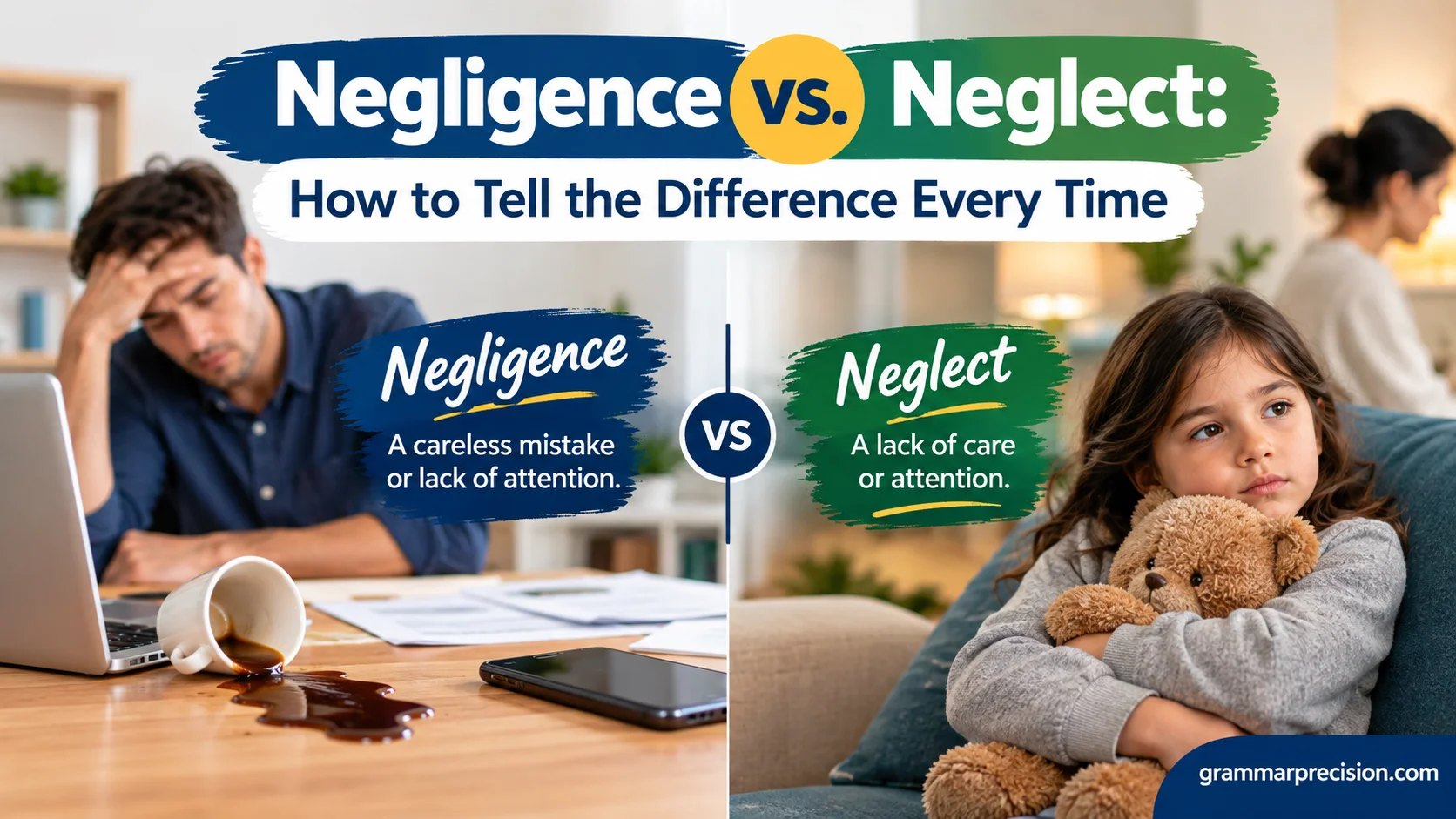
Negligence vs. Neglect can seem confusing because both words describe a failure to give proper care or attention. However, they have different meanings, uses, and legal contexts. Understanding this difference helps you choose the right word in professional writing situations.
Negligence usually refers to a lack of reasonable care that causes harm, loss, or risk. It is common in legal, medical, workplace, and safety contexts. Neglect, however, generally means failing to provide necessary care, attention, or responsibility. Learning how each term works can improve your grammar, vocabulary, communication, and writing accuracy, especially when describing duties, responsibilities, mistakes, or harmful situations clearly in different real-world contexts.
Although negligence and neglect are closely related, they are not always interchangeable. Negligence often focuses on careless behavior and its consequences, while neglect emphasizes an ongoing failure to give proper care or attention. These words may appear in law, parenting, healthcare, education, and everyday communication, so knowing their precise meanings can help you avoid common word-choice mistakes and write more accurately effectively in formal situations.
In this guide, you will learn the meaning, differences, grammar, and examples of negligence and neglect. We will explain when to use each term and show how context changes the meaning. By comparing definitions, sentence examples, and common uses, you can quickly understand which word fits your sentence and communicate your ideas with greater clarity and precision in different situations, including professional and academic writing.
Negligence vs. Neglect at a Glance
Before examining detailed examples, here’s the simplest way to separate the two terms:
| Word | Basic Meaning | Common Focus | Example |
| Negligence | Failure to use reasonable care | Carelessness or improper action | The driver’s negligence caused the accident. |
| Neglect | Failure to provide needed attention or care | Ignoring a person, duty, place, or thing | Years of neglect damaged the house. |
Think of negligence as a failure to take appropriate care when care is expected.
Think of neglect as leaving something unattended when it needs attention.
These ideas can overlap. However, they aren’t interchangeable in every sentence.
What Is Negligence?
Negligence is the failure to exercise the level of care that a reasonable person would normally use in a similar situation.
The word often describes carelessness, inattention, or an improper failure to act. It appears frequently in legal, medical, professional, workplace, driving, and safety-related contexts.
For example:
The accident resulted from the driver’s negligence.
This sentence suggests that the driver failed to behave with reasonable care. Perhaps the driver ignored a traffic signal, drove while distracted, or failed to maintain control of the vehicle.
The important idea isn’t simply that something went wrong. Negligence suggests that someone failed to take reasonable care.
Negligence in Everyday English
You don’t need a courtroom to use the word negligence.
Consider these examples:
- The manager’s negligence created a serious safety risk.
- The company was criticized for negligence in maintaining its equipment.
- His negligence caused several important deadlines to be missed.
- The accident happened because of the contractor’s negligence.
- Leaving electrical wires exposed could be considered negligence.
In each example, someone had a responsibility to exercise care but failed to do so.
Negligence in Legal English
In law, negligence has a more specific meaning than it does in casual conversation.
A typical negligence claim generally involves concepts such as:
- A duty of care
- A failure to meet the required standard of care
- Causation
- Actual or legally recognized harm or damages
For instance, drivers have a duty to operate vehicles with reasonable care. If a driver breaches that duty and causes an injury, the circumstances may support a negligence claim.
However, merely making a mistake doesn’t automatically establish legal negligence. The exact legal standard depends on the jurisdiction and circumstances.
What Is Neglect?
Neglect means failing to give proper care, attention, maintenance, or consideration to someone or something.
Unlike negligence, neglect often emphasizes omission or lack of attention.
You can neglect:
- A child
- A pet
- A responsibility
- A garden
- A building
- Your health
- A friendship
- Important duties
- Household maintenance
- Personal needs
For example:
The old house suffered from years of neglect.
The sentence doesn’t necessarily tell you that someone carelessly caused specific damage. Instead, it tells you that the house wasn’t properly maintained over time.
Neglect as a Verb
Neglect commonly functions as a verb.
Examples include:
- She neglected her garden during the winter.
- He neglected his responsibilities.
- They neglected to check the equipment.
- Don’t neglect your physical and emotional needs.
- The owner neglected the property for years.
The construction neglect to + verb is particularly useful.
For example:
He neglected to lock the door.
Here, neglected to lock means he failed to perform an action that he should have performed.
Neglect as a Noun
Neglect can also function as a noun.
Examples:
- The building fell into neglect.
- The animal showed signs of neglect.
- Years of neglect weakened the structure.
- The garden was damaged by neglect.
The noun often describes an ongoing condition rather than one isolated careless act.
Negligence vs. Neglect: The Defining Difference
Here’s the central distinction:
Negligence emphasizes a failure to use reasonable care, while neglect emphasizes a failure to provide needed attention or care.
That difference may seem small, but it becomes obvious in context.
Imagine a homeowner who never repairs a damaged staircase.
If the focus is on the homeowner’s failure to maintain the property safely, you might describe it as negligence.
If the focus is on the staircase being left unattended for years, neglect sounds more natural.
The same situation can sometimes involve both concepts.
A Simple Mental Picture
Imagine two warning signs.
Negligence:
You should have taken reasonable care, but you didn’t.
Neglect:
You should have paid attention or provided care, but you didn’t.
That’s the easiest mental shortcut.
Scenario: The Dangerous Workplace
Imagine an employee notices that a machine has a damaged safety guard.
The employee knows the machine is dangerous but continues operating it without reporting the problem.
That behavior may be described as negligence because the employee failed to exercise appropriate care in a potentially dangerous situation.
Now imagine a supervisor who repeatedly ignores maintenance requests for months.
The supervisor’s conduct could involve neglect because an important responsibility received inadequate attention.
In a serious workplace incident, the same situation might involve both terms.
Negligence highlights the careless failure to meet a safety standard. Neglect highlights the continuing failure to address the problem.
Scenario: An Uncared-for Garden
Consider a garden that once contained flowers, shrubs, and healthy grass.
The owner stops watering it, removes no weeds, trims nothing, and ignores damaged plants for several years.
What word fits best?
Neglect.
You could say:
The garden deteriorated because of years of neglect.
The sentence emphasizes the garden’s lack of care and attention.
You could use negligence in a different context:
The gardener’s negligence resulted in the loss of several valuable plants.
Now the focus shifts toward a person’s failure to exercise appropriate care.
The distinction is subtle but useful.
Scenario: A Medical Mistake
Medical situations often demonstrate why context matters.
Suppose a healthcare professional fails to follow an appropriate procedure and that failure contributes to a patient’s injury. In an appropriate legal or professional context, people may discuss medical negligence.
By contrast, neglect can describe a failure to provide necessary attention or basic care.
For example:
The patient suffered because essential care was neglected.
The two terms aren’t automatically interchangeable.
Negligence often points toward a standard of care. Neglect often points toward an absence of needed care or attention.
Negligence vs. Neglect Across Everyday Situations
| Situation | More Natural Term | Reason |
| Ignoring property maintenance | Neglect | The property lacks attention |
| Failing to follow safety procedures | Negligence | Reasonable care wasn’t exercised |
| Ignoring an important responsibility | Neglect | A duty wasn’t given attention |
| Carelessly causing an accident | Negligence | Careless conduct caused harm |
| Leaving a garden unattended | Neglect | Maintenance was ignored |
| Failing to maintain safety equipment | Negligence | Proper care was required |
| Ignoring a pet’s basic needs | Neglect | Necessary care wasn’t provided |
| Repeatedly overlooking a known hazard | Negligence or neglect | Context determines the emphasis |
This table reveals an important point: context matters more than the presence of the word “care.”
Negligence vs. Neglect in Legal English
Legal writing gives negligence a particularly important role.
In many legal systems, negligence involves a failure to meet a legally relevant standard of reasonable care. The details vary considerably by jurisdiction and type of case.
For example, a negligence case might examine whether:
- Someone owed another person a duty.
- That person failed to meet the required standard.
- The failure caused the relevant harm.
- The claimant experienced legally recognized damages.
Neglect, meanwhile, can appear in legal contexts involving duties, caregiving, property, child welfare, elder care, or other responsibilities.
Still, legal terminology shouldn’t be treated as identical to ordinary dictionary definitions.
If you’re writing a legal document, the specific jurisdiction and facts matter.
Negligence vs. Neglect in Everyday English
Outside legal settings, the distinction becomes more flexible.
Consider these sentences:
His negligence caused the computer system to fail.
His neglect allowed the computer system to become outdated.
The first sentence focuses on careless failure.
The second emphasizes a lack of attention over time.
That’s a useful pattern:
Negligence often describes how carelessly someone handled a responsibility. Neglect often describes what happens when attention or care is withheld.
Also Read This: Standalone or Stand Alone: Complete Defination
Is Neglect Always Intentional?
No.
Neglect doesn’t always mean deliberate disregard.
Someone may neglect a responsibility because of forgetfulness, distraction, lack of knowledge, competing priorities, or other circumstances.
For example:
She neglected to renew the permit because she forgot the deadline.
The sentence doesn’t necessarily accuse her of intentionally ignoring the permit.
However, context can give neglect a stronger and more serious implication.
Compare:
He neglected the garden for a weekend.
with:
He neglected the garden for ten years.
The second sentence suggests a much deeper and more sustained failure of care.
Is Negligence Always Intentional?
No.
In ordinary English, negligence generally doesn’t require intentional wrongdoing.
Someone can act negligently without intending to cause harm.
For example, a driver may become distracted and cause an accident without wanting anyone to get hurt.
That’s one reason negligence differs from deliberate misconduct.
Intent and care aren’t the same thing. A person can have good intentions yet still fail to exercise reasonable care.
Negligent vs. Neglectful: Are They the Same?
They’re related, but they carry different shades of meaning.
Negligent usually describes someone who fails to exercise proper care.
The technician was negligent when handling the equipment.
Neglectful usually describes someone who fails to provide proper attention or care.
The owner was neglectful toward the property.
The adjective negligent frequently appears in professional and legal contexts.
Neglectful often sounds more personal or descriptive.
Compare These Examples
The contractor was negligent in following safety procedures.
The owner was neglectful of the building’s maintenance.
The first emphasizes a failure to exercise proper care.
The second emphasizes an ongoing lack of attention.
Neglected vs. Negligent: A Common Grammar Trap
These forms can confuse learners because they look closely related.
Neglected describes something that someone failed to care for or give attention to.
The neglected house needed extensive repairs.
Negligent describes a person or organization that failed to exercise proper care.
The negligent contractor ignored important safety requirements.
So remember:
- Neglected → something received insufficient attention.
- Negligent → someone failed to provide appropriate care.
That distinction prevents many awkward sentences.
Related Words You Should Know
Understanding nearby vocabulary makes the difference even clearer.
| Word | Meaning |
| Careless | Not giving enough attention to what you’re doing |
| Inattentive | Failing to pay attention |
| Negligent | Failing to exercise proper care |
| Neglectful | Failing to provide needed attention or care |
| Ignored | Deliberately or unintentionally given no attention |
| Overlooked | Failed to notice or consider something |
| Abandoned | Left behind completely |
| Disregarded | Chosen not to consider or follow something |
These words overlap, but they aren’t perfect substitutes.
For example, abandoned usually suggests a much stronger and more complete act of leaving something behind than neglected.
Negligence vs. Neglect: Example Sentences
Here are practical examples you can use as a reference.
Examples With “Negligence”
- The investigation found evidence of negligence.
- His negligence created an unnecessary safety risk.
- The company was accused of negligence.
- The accident may have resulted from driver negligence.
- The manager’s negligence caused serious problems.
- Proper training can reduce workplace negligence.
Examples With “Neglect”
- The house suffered from years of neglect.
- She neglected her responsibilities.
- Don’t neglect regular maintenance.
- The plants died because of neglect.
- He neglected to mention the important detail.
- The old building had been badly neglected.
Examples Where Both Seem Possible
Some situations genuinely allow either word.
The equipment failed because of negligence.
This emphasizes careless handling or maintenance.
The equipment failed because of neglect.
This emphasizes the failure to maintain or attend to it.
Both can work. The intended emphasis changes.
Common Mistakes to Avoid
A few errors appear repeatedly when writers confuse these terms.
Using “Negligence” for Every Failure to Care
Not every lack of attention needs the word negligence.
The garden died from neglect.
sounds more natural than:
The garden died from negligence.
The second sentence sounds unusual unless the context focuses specifically on someone’s careless responsibility.
Treating “Neglect” as a Legal Synonym for Negligence
The words can overlap in legal discussions, but they don’t automatically carry the same legal meaning.
Legal terminology depends on the facts, applicable law, and jurisdiction.
Confusing “Negligent” With “Neglected”
Remember the grammatical difference.
The negligent employee ignored the warning.
Here, negligent describes the employee.
The neglected equipment became unsafe.
Here, neglected describes the equipment.
Assuming Neglect Always Means Intentional Cruelty
The word can describe serious mistreatment, but it can also describe ordinary failures of attention.
I neglected to reply to the email.
This doesn’t suggest cruelty or abuse. It simply means the reply didn’t happen.
How to Choose the Right Word in Seconds
When you’re unsure, ask yourself two quick questions.
Ask: “Was Proper Care Expected?”
If the sentence focuses on whether someone exercised reasonable or appropriate care, negligence may be the better choice.
The driver’s negligence caused the crash.
Ask: “Was Something Ignored or Left Without Care?”
If the focus is on lack of attention, maintenance, or care, choose neglect.
The property deteriorated through neglect.
Check the Context
Finally, consider the setting.
Legal, professional, medical, and safety contexts often make negligence especially relevant.
Personal care, maintenance, responsibilities, relationships, and unattended things frequently favor neglect.
Context acts like a compass. It points you toward the word that carries the right shade of meaning.
A Quick Memory Trick
Use this simple formula:
Negligence = not enough care.
Neglect = not enough attention or care.
There is overlap between them, but negligence often highlights careless conduct, while neglect often highlights omission or prolonged lack of attention.
If you can remember that contrast, most everyday examples become much easier.
Negligence vs. Neglect: Final Cheat Sheet
| Question | Choose |
| Is the focus on reasonable care? | Negligence |
| Is the focus on careless conduct? | Negligence |
| Is the focus on an expected standard of care? | Negligence |
| Is something being ignored or unattended? | Neglect |
| Is maintenance being skipped? | Neglect |
| Is someone failing to provide needed attention? | Neglect |
| Does the sentence describe a person who failed to exercise care? | Negligent |
| Does it describe something that hasn’t received proper attention? | Neglected |
FAQs:
What is the difference between negligence and neglect?
Negligence usually means failing to use reasonable care, often resulting in harm or risk. Neglect means failing to provide proper care, attention, or responsibility. The correct choice depends on the context.
Is negligence the same as neglect?
No. Although both involve a failure to act properly, negligence often describes careless conduct or lack of reasonable care, while neglect commonly refers to failing to give necessary care or attention.
Can negligence be used in a legal context?
Yes. Negligence is a common legal term used when someone fails to exercise reasonable care and another person suffers harm or loss as a result.
What is an example of neglect?
An example is: “The child suffered from neglect because the necessary care was not provided.” Here, neglect describes a failure to provide appropriate care and attention.
Which word should I use: negligence or neglect?
Use negligence when you mean careless behavior or a failure to meet a reasonable standard of care. Use neglect when you mean a failure to provide needed care, attention, or responsibility.
Conclusion:
Understanding Negligence vs. Neglect becomes easier when you focus on context. Negligence generally describes a lack of reasonable care, while neglect refers to failing to provide necessary care, attention, or responsibility. Although they can overlap, they are not always interchangeable.
Knowing this distinction can improve your grammar, vocabulary, and writing accuracy. When discussing legal, medical, professional, or everyday situations, choose the word that best expresses the specific type of failure or lack of care.
With these clear definitions and examples, you can confidently recognize the difference between negligence and neglect and use both terms correctly in your writing and everyday communication.