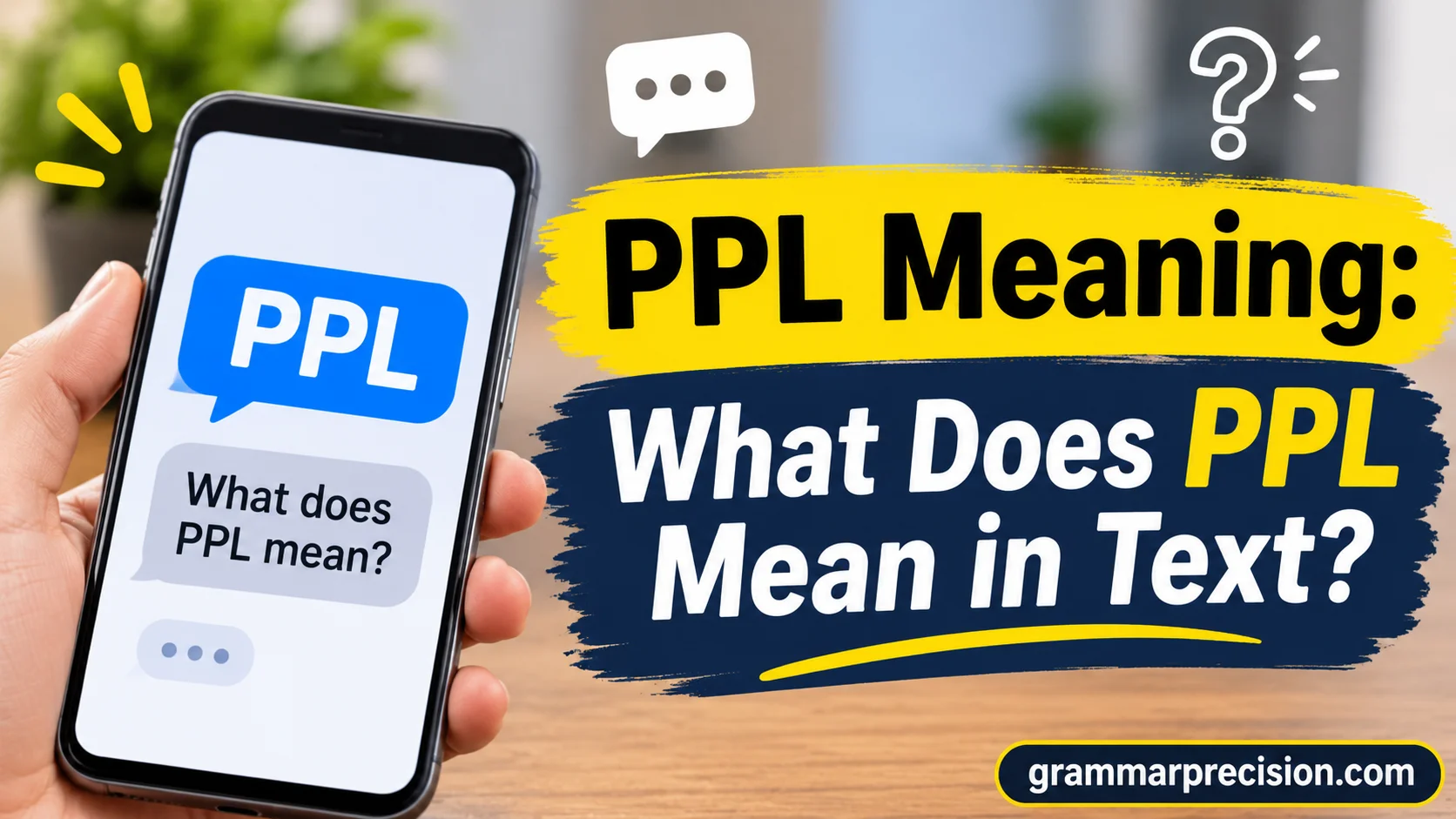
Have you ever seen PPL in a text message or online conversation and wondered what it means? This abbreviation commonly replaces people in everyday digital communication.
Understanding PPL meaning helps you interpret casual messages, social media posts, and online conversations. This article explains its definition, origins, examples, and appropriate usage across different contexts. You’ll also discover when to use PPL instead of the complete word in everyday English.
Beyond texting, clear abbreviations support business communication, time management, and project management. Whether you’re discussing scheduling, online booking, meetings, or broadcasting, context matters. We’ll also explore its relevance to English usage, grammar, formal writing, and consistency.
Quick Answer: What Does PPL Mean?
PPL stands for people. It’s an informal internet abbreviation that replaces the full word in casual communication.
| Detail | Explanation |
| Full form | People |
| Meaning | Individuals or a group of people |
| Category | Internet slang / abbreviation |
| Common use | Texting and social media |
| Tone | Casual and informal |
| Pronunciation | Usually spoken as “people” |
| Formality | Not recommended in formal writing |
For example:
- Full sentence: Some people enjoy spending time outdoors.
- Shortened sentence: Some PPL enjoy spending time outdoors.
Both versions have the same meaning. However, the shortened version feels more relaxed and conversational.
What Does PPL Stand For?
PPL stands for people, a common English noun referring to individuals collectively. It’s one of several shortened expressions that developed through digital communication.
People frequently use abbreviations because typing shorter messages feels quicker and easier. This habit became especially common with mobile phones, instant messaging, and social networking platforms.
The Full Form of PPL
The full form of PPL in everyday texting is people.
It doesn’t represent a complicated phrase or hidden expression. Instead, it simply removes several letters from the original word while keeping its recognizable meaning.
Consider these examples:
- PPL = People
- MSG = Message
- PLZ = Please
- THX = Thanks
- L8R = Later
- BTW = By the way
These abbreviations make digital conversations faster without changing their basic meaning.
Why People Use PPL Instead of People
There are several reasons why internet users prefer PPL over the complete word.
Speed and convenience: Shorter expressions help people type messages quickly, especially during busy conversations.
Character limitations: Some platforms historically restricted message lengths. Abbreviations helped users communicate within those limits.
Casual communication: PPL creates a relaxed tone that fits naturally into conversations between friends.
Internet culture: Online communities regularly develop shortened expressions. PPL has become familiar to many regular internet users.
Typing habits: Once people become comfortable with an abbreviation, they often use it automatically.
However, convenience doesn’t mean every situation needs shortened language. The audience and communication setting still matter.
Is PPL an Abbreviation or Internet Slang?
PPL is best described as an informal abbreviation used as internet slang.
Technically, it shortens the spelling of an existing word rather than creating an entirely new expression.
It’s also commonly called a texting abbreviation because people frequently use it in digital messages.
Unlike some slang expressions, PPL doesn’t usually communicate an emotion, joke, or hidden attitude. It simply replaces the word people.
What Does PPL Mean in Text Messages?
When someone sends PPL in a text message, they’re almost always referring to people.
The abbreviation works in many everyday situations. Someone might use it to discuss friends, coworkers, strangers, family members, or an entire community.
For example:
- “Some PPL are really kind.”
- “How many PPL are coming tonight?”
- “I don’t understand why PPL behave like that.”
- “Good PPL make difficult days easier.”
Each example uses PPL as a shorter replacement for people.
PPL Meaning in Casual Conversations
Casual conversations are where PPL feels most natural.
Friends often use it when discussing plans, sharing opinions, or commenting on everyday situations.
For example:
Friend 1: Are many PPL coming to the party?
Friend 2: Yeah, probably around twenty.
Here, PPL simply means people attending the party.
You might also encounter messages like:
- “I love meeting new PPL.”
- “Some PPL are impossible to understand.”
- “Why do PPL wake up so early?”
- “Those PPL were really helpful.”
The abbreviation keeps the conversation short without changing its meaning.
PPL Meaning When Someone Uses It in a Chat
The meaning becomes clearer when you examine the surrounding sentence.
For instance, consider this message:
“Not all PPL think the same way.”
The sender means that different individuals have different opinions.
Now consider another example:
“Tell PPL about the meeting.”
Here, PPL refers to the individuals who need information about the meeting.
Context provides the meaning. However, in ordinary texting, you generally don’t need to interpret PPL as anything complicated.
Why Friends Use PPL in Texting
Friends often prefer informal language because it makes conversations feel comfortable.
Instead of writing complete sentences every time, they use abbreviations, emojis, and shortened expressions.
For example:
- “PPL are so funny sometimes 😂”
- “I met some amazing PPL today.”
- “Those PPL know how to have fun.”
- “Why are PPL acting weird?”
These messages sound natural in friendly conversations.
However, remember that not everyone understands internet abbreviations. When communicating with someone unfamiliar with texting slang, writing the complete word can prevent confusion.
PPL Meaning on Social Media
Social media has made shortened language part of everyday communication. PPL appears in comments, captions, direct messages, and online discussions.
Although the basic meaning stays the same, the surrounding conversation can change how people interpret it.
PPL Meaning on Snapchat
On Snapchat, PPL means people when users include it in messages, snaps, or stories.
Snapchat encourages quick communication through short messages and disappearing content. Consequently, abbreviations fit naturally into its conversational style.
Examples include:
- “Where are all the PPL tonight?”
- “I don’t trust random PPL.”
- “Met some cool PPL today.”
- “These PPL make me laugh.”
If someone sends, “PPL are coming over,” they’re simply saying people are coming over.
PPL Meaning on Instagram
Instagram users frequently include PPL in comments, captions, and direct messages.
The abbreviation can refer to followers, friends, strangers, or particular communities.
For example:
- “Love seeing positive PPL here.”
- “Some PPL need to relax.”
- “Surround yourself with good PPL.”
- “Tag the PPL who make you smile.”
You might also see PPL in motivational captions or discussions about relationships.
PPL Meaning on TikTok
TikTok users often communicate through short comments and quick replies. PPL fits this style because it keeps messages brief.
For example:
- “Why do PPL do this?”
- “Some PPL are naturally funny.”
- “I know PPL can relate.”
- “These PPL deserve more recognition.”
In TikTok comments, PPL generally refers to people mentioned in the video or discussion.
PPL Meaning on Facebook
Facebook users commonly use PPL when discussing friends, family, communities, and public topics.
For instance:
- “Good PPL make good memories.”
- “Some PPL never change.”
- “I miss those PPL from school.”
- “There are still kind PPL in this world.”
The abbreviation works in comments, Messenger conversations, and casual posts.
PPL Meaning in Gaming Communities
Online gaming communities also use short expressions to communicate quickly.
During multiplayer games, players often need to share information without typing lengthy messages. PPL can refer to teammates, opponents, players, or other members.
Examples:
- “How many PPL are joining?”
- “We need more PPL for this match.”
- “Those PPL are really good players.”
- “Tell other PPL to join our team.”
However, PPL isn’t a special gaming term. It retains its ordinary meaning of people.
How to Use PPL in Everyday Conversations
Understanding an abbreviation is helpful, but knowing when to use it makes communication easier.
PPL works best when you’re speaking casually with people who understand internet slang. You can use it in messages, informal comments, and relaxed online discussions.
PPL in Friendly Messages
When talking with friends, PPL can replace people without changing your message.
Examples:
- “PPL like you make life better.”
- “I enjoy meeting interesting PPL.”
- “Some PPL always bring positive energy.”
- “The best PPL are always supportive.”
These expressions feel relaxed and friendly.
PPL in Group Chats
Group chats often involve several people discussing plans, events, and shared interests.
PPL makes these conversations shorter.
For example:
Alex: How many PPL are coming tomorrow?
Sam: Around fifteen, I think.
Alex: Great! Tell the other PPL to arrive early.
In this conversation, everyone understands that PPL refers to people attending the event.
PPL in Online Discussions
Online discussions cover countless subjects, including entertainment, relationships, education, and personal experiences.
PPL works naturally when discussing groups or communities.
Examples:
- “PPL have different opinions about this movie.”
- “Some PPL prefer working from home.”
- “I wish more PPL understood this issue.”
- “Different PPL have different experiences.”
However, avoid using the abbreviation when a discussion requires formal or carefully written language.
PPL in Workplace Communication
Workplace communication requires more attention to tone and professionalism.
You might understand PPL perfectly, but that doesn’t mean it’s appropriate in every professional message.
For example:
Informal: “Can you ask the PPL to join the meeting?”
Professional: “Can you ask the team members to join the meeting?”
The second version sounds clearer and more polished.
In professional settings, use words such as people, employees, colleagues, participants, or team members, depending on the situation.
30+ Examples of PPL in Text Messages
Examples make internet slang easier to understand because they show how people actually use it.
Below are practical sentences covering different situations.
Friendly and Casual PPL Examples
- “Some PPL are naturally kind.”
- “I love spending time with good PPL.”
- “Those PPL always make me laugh.”
- “Why are PPL so busy lately?”
- “I met some amazing PPL yesterday.”
- “Good PPL are hard to find.”
- “These PPL know how to enjoy life.”
- “I miss the PPL from my old school.”
PPL Examples in Questions
- “How many PPL are coming?”
- “Do PPL still watch that show?”
- “Why do PPL behave this way?”
- “Are those PPL your friends?”
- “What do PPL think about this idea?”
- “Where can I meet interesting PPL?”
- “Do PPL know about the event?”
PPL Examples on Social Media
- “Surround yourself with positive PPL.”
- “Some PPL need to hear this.”
- “Tag the PPL who understand you.”
- “Real PPL always show their support.”
- “These PPL deserve appreciation.”
- “I appreciate the PPL who stayed.”
- “Different PPL have different stories.”
Funny PPL Examples
- “PPL really wake up early for fun?”
- “Some PPL need a coffee before talking.”
- “PPL are confusing sometimes 😂”
- “Why do PPL make simple things complicated?”
- “Some PPL have unlimited energy.”
- “PPL will argue about literally anything.”
- “These PPL should have their own comedy show.”
- “I can’t keep up with these PPL.”
PPL Examples for Invitations and Plans
- “Tell PPL about Saturday’s party.”
- “Let’s invite more PPL next time.”
- “How many PPL can the room accommodate?”
- “I hope all the PPL arrive on time.”
Notice how the abbreviation replaces people in every example. The sentence structure and meaning remain unchanged.
PPL vs. People: What’s the Difference?
PPL and people communicate the same basic meaning. However, their spelling and appropriate usage differ.
People is the standard English word. PPL is its informal shortened version.
| Feature | PPL | People |
| Meaning | People | People |
| Spelling | Abbreviated | Complete |
| Grammar | Informal substitute | Standard noun |
| Text messages | Common | Common |
| Social media | Common | Common |
| Academic writing | Avoid | Appropriate |
| Business emails | Generally avoid | Appropriate |
| Professional documents | Avoid | Appropriate |
When Should You Use PPL?
Use PPL when communicating with friends or participating in casual online conversations.
For example:
“Some PPL really understand me.”
This sentence works naturally in an informal message.
When Should You Use People?
Choose people when writing something that requires standard spelling, clarity, or professionalism.
For example:
“Some people really understand me.”
This version works in emails, articles, essays, reports, and professional discussions.
The main difference isn’t meaning. It’s the level of formality.
Alternative Words and Abbreviations for PPL
English offers several alternatives to people. However, each expression carries slightly different meanings or tones.
Understanding these differences helps you choose the right word.
PPL vs. Peep
PPL means people, while peeps is an informal slang term for friends, familiar individuals, or a group.
For example:
- PPL: “Some PPL enjoy traveling.”
- Peeps: “What’s up, peeps?”
Peeps often sounds warmer and more playful. PPL remains a straightforward abbreviation.
PPL vs. Folks
Folks is a casual word for people. It often creates a friendly, welcoming tone.
Examples:
- “Good PPL make great friends.”
- “Good folks make great friends.”
Both sentences communicate a similar idea. However, folks sounds more conversational in ordinary spoken English.
PPL vs. Guys
Guys commonly refers to a group of people, especially in casual conversation.
For example:
- “Hey guys, are you ready?”
- “Hey PPL, are you ready?”
The first sentence sounds more familiar in many everyday situations. Guys can refer to mixed-gender groups in informal American English.
PPL vs. Everyone
Everyone refers to all the people within a particular group or situation.
For example:
- “PPL enjoyed the celebration.”
- “Everyone enjoyed the celebration.”
These expressions aren’t always interchangeable. PPL can refer to some individuals or an unspecified group, while everyone generally includes the entire relevant group.
Other Useful Alternatives
| Word or expression | Meaning | Typical tone |
| People | Individuals collectively | Neutral |
| PPL | Shortened form of people | Informal |
| Peeps | Friends or familiar people | Playful |
| Folks | People or a group | Friendly |
| Guys | People in a group | Casual |
| Everyone | All individuals in a group | Neutral |
| Individuals | Separate persons | Formal |
| Crowd | A large gathering | Neutral |
| Community | People sharing an interest or location | Neutral |
Is PPL Formal or Informal?
PPL is an informal abbreviation, so it’s best suited to relaxed conversations.
Although many internet users recognize it, the abbreviation doesn’t belong in every type of writing.
Where Is PPL Appropriate?
You can comfortably use PPL in these situations:
- Text messages with friends.
- Casual WhatsApp conversations.
- Instagram and TikTok comments.
- Snapchat messages.
- Online gaming chats.
- Informal group discussions.
- Personal social media captions.
Where Should You Avoid PPL?
Avoid using PPL in situations that require standard English.
Examples include:
- Academic assignments and research papers.
- Business emails and official letters.
- Job applications and resumes.
- Professional reports and presentations.
- Formal announcements.
- Legal and administrative documents.
For example, consider these alternatives:
| Informal version | Professional version |
| PPL are invited. | Everyone is invited. |
| Ask the PPL to attend. | Ask the participants to attend. |
| Many PPL applied. | Many people applied. |
| PPL need more information. | Employees need more information. |
Choosing the right expression helps your writing sound appropriate for its audience.
Common Mistakes to Avoid When Using PPL
PPL looks simple, but a few mistakes can make your messages confusing.
Here are some common problems worth avoiding.
Using PPL in formal writing: The abbreviation can make professional documents appear careless. Write people instead.
Assuming PPL always has the same meaning: Although people is the common texting meaning, other industries may use PPL differently.
Confusing PPL with peeps: Peeps often refers to friends or familiar people. PPL simply abbreviates people.
Using unnecessary abbreviations: Too many shortened expressions can make messages difficult to understand.
Ignoring your audience: Not everyone understands internet slang. Consider your reader before using unfamiliar expressions.
A Practical Case Study: Understanding PPL Through Context
Imagine receiving this message from a friend:
“Some PPL are coming over tonight. Want to join us?”
If you understand PPL as people, the message becomes straightforward.
Now imagine seeing this comment:
“Good PPL make life beautiful.”
The meaning remains clear because PPL replaces people.
These examples demonstrate an important point: context helps you understand abbreviations without overthinking them.
FAQs About PPL Meaning
What Does PPL Mean in Texting?
PPL means people in texting. It’s an informal abbreviation used to make messages shorter and quicker. For example, “Some PPL are really friendly” means “Some people are really friendly.”
What Does PPL Mean on Snapchat?
On Snapchat, PPL generally means people. Users include it in snaps, stories, and private messages when discussing friends, groups, or other individuals.
What Does PPL Mean on Instagram?
PPL means people on Instagram. You’ll commonly see it in comments, captions, and direct messages. For example, “Love these PPL” expresses appreciation for a group.
What Does PPL Mean on TikTok?
On TikTok, PPL usually stands for people. Users write it in comments and discussions to describe individuals or groups mentioned in videos.
Is PPL Short for People?
Yes. PPL is a shortened informal spelling of people. It removes several letters while keeping the original word’s meaning.
Is PPL Rude or Disrespectful?
No. PPL isn’t inherently rude or disrespectful. It’s a neutral abbreviation. However, the surrounding sentence and the sender’s tone determine whether a message sounds friendly, sarcastic, or critical.
Can I Use PPL in Professional Emails?
It’s better to avoid PPL in professional emails. Write people, employees, colleagues, or team members instead. These standard expressions create a clearer and more professional impression.
How Do You Pronounce PPL?
Most people simply read PPL as people rather than pronouncing each letter separately. It’s a written abbreviation rather than a different spoken word.
Does PPL Have Other Meanings?
Yes. PPL can have different meanings in specialized industries, organizations, and technical discussions. However, in everyday texting and social media, people is the most common interpretation.
What Is the Difference Between PPL and Peeps?
PPL is an abbreviation for people, while peeps is informal slang often referring to friends or familiar individuals. Both can describe groups, but peeps usually sounds more playful and personal.
Conclusion:
Understanding PPL meaning makes everyday texting and online conversations easier. This popular abbreviation stands for people and appears frequently across social media, messaging apps, and casual discussions. Use it naturally when communicating informally, but consider your audience and context.
Whether you’re chatting with friends or reading online posts, knowing common abbreviations improves your English communication skills. Remember, PPL works best in casual settings, while people remains the better choice for professional emails, academic writing, and formal communication. Always choose clarity and appropriate language.