Have you ever encountered the word Mamushi Meaning in English while reading about Japan or learning Japanese vocabulary? This unfamiliar term can raise questions about its definition, pronunciation, and proper English usage. This guide explains what mamushi means, what it refers to, and how context shapes its meaning in everyday and formal writing.
More importantly, the article explores mamushi pronunciation, Japanese usage, cultural context, and real-life examples without unnecessary complexity. Although terms such as scheduling, time management, business communication, online booking, broadcasting, meetings, calendar, and project management usually involve different language contexts, accurate grammar, formal writing, and consistency still matter. US English generally favors certain usage conventions, while UK style guides may differ slightly. Understanding these regional preferences helps you communicate clearly and confidently.
What Does Mamushi Mean in English?
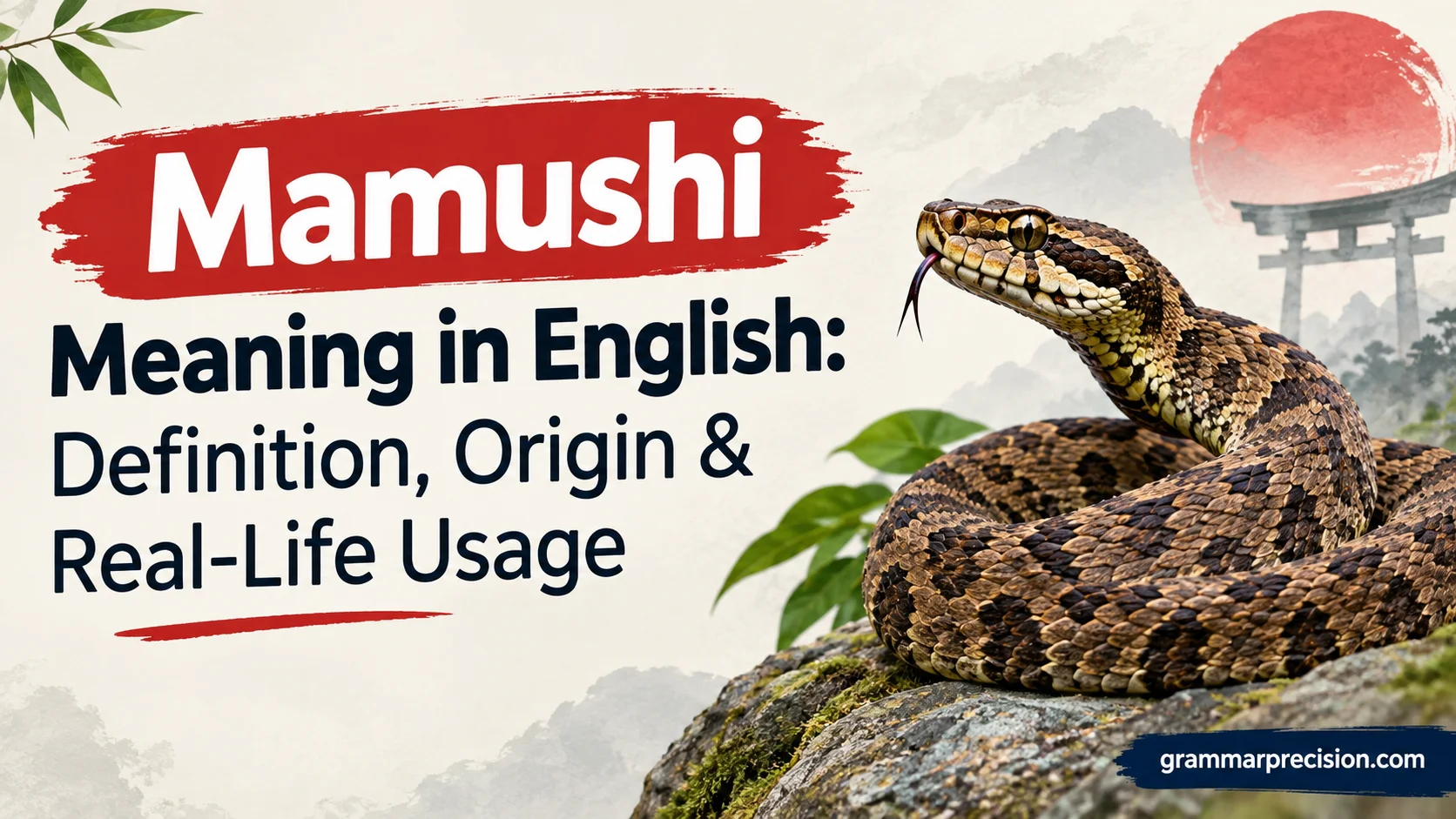
The simplest mamushi meaning in English is a Japanese pit viper, a venomous snake found mainly in Japan and surrounding parts of East Asia.
The word mamushi comes from Japanese: まむし or マムシ. In English writing, mamushi is generally retained as a loanword rather than translated into a completely different name.
In wildlife discussions, you may also see the animal described as the Japanese mamushi, Japanese pit viper, or mamushi snake.
Mamushi Meaning in Japanese
In Japanese, マムシ specifically identifies this type of venomous snake. It isn’t simply another word for “snake.”
Japanese has a broad word for snake, hebi (蛇). Mamushi is much more specific. It identifies a particular venomous snake with distinctive physical and biological characteristics.
That distinction matters when translating Japanese text. Replacing mamushi with the general word “snake” can remove important meaning from the original sentence.
Literal Meaning and English Meaning
Unlike some Japanese terms whose individual characters provide an obvious literal translation, mamushi functions primarily as the established name of the animal.
You can therefore think of the translation in two layers:
| Japanese term | English equivalent | Meaning |
| マムシ | Mamushi | Japanese pit viper |
| 蛇 (hebi) | Snake | General snake |
| ハブ (habu) | Habu | Several venomous pit vipers associated with Japan’s Ryukyu Islands |
So, if someone says mamushi, they aren’t referring to snakes in general. They’re referring to a particular kind of venomous snake.
What Is a Mamushi Snake?
A mamushi snake is a venomous pit viper belonging to the genus Gloydius. The species commonly called the Japanese mamushi is Gloydius blomhoffii.
The snake belongs to the family Viperidae, which includes many venomous vipers around the world. Like other pit vipers, it has specialized sensory structures that help detect heat from potential prey.
Mamushi are relatively small compared with some other venomous snakes. Adults commonly measure around 45–60 centimeters, although larger individuals can occur.
Their compact size can make them deceptively easy to overlook.
Mamushi Appearance and Identification
A mamushi usually has a stout body and a relatively short tail. Its coloration varies, but brown, gray, olive, and reddish-brown tones are common.
Dark markings along the body create a pattern that can help the snake blend into leaves, soil, grass, and woodland surroundings.
Key features include:
- Stocky body
- Triangular, broad head
- Vertical pupils
- Heat-sensing loreal pits between the eyes and nostrils
- Camouflaged brownish or grayish coloration
- Dark body markings
- Relatively short overall length
The camouflage is especially important. A snake that blends into its surroundings can remain hidden from both predators and prey.
Where Does the Mamushi Live?
The Japanese mamushi occurs across much of Japan, including many rural and mountainous areas. It can also occur on some nearby islands and in parts of the broader East Asian region.
Its habitat isn’t limited to deep forests. Mamushi may occur in:
- Grasslands
- Forest edges
- Agricultural areas
- Wet or humid environments
- Mountainous regions
- Rural communities
- Areas around fields and vegetation
This explains why hikers, farmers, and people living in rural areas may encounter the snake.
Why Is Mamushi Significant in Japan?
The mamushi has practical importance because it is a venomous native snake. Encounters therefore matter from a public-safety and wildlife perspective.
At the same time, the animal is part of Japan’s natural environment. Its presence reflects the country’s diverse ecosystems, from lowland agricultural landscapes to mountainous habitats.
For language learners, this creates an interesting point: a single word can carry linguistic, cultural, and ecological meaning at the same time.
How Do You Pronounce Mamushi?
The pronunciation of mamushi is relatively straightforward once you understand Japanese syllable timing.
A simple English approximation is:
mah-moo-shee
The Japanese pronunciation is closer to three evenly timed units:
ma-mu-shi
The final shi sounds broadly like the “she” sound in English.
Japanese Pronunciation Tips
Avoid heavily stressing one syllable as English speakers often do with unfamiliar words.
Instead, keep the syllables relatively even:
ma → mu → shi
Japanese pronunciation also relies on rhythm and timing differently from English. So while “mah-MOO-shee” may help an English speaker remember the word, a more natural Japanese pronunciation keeps the sequence balanced.
Common Pronunciation Mistakes
Several mistakes can make the word sound less natural:
- Giving excessive stress to “mu”
- Pronouncing the final shi as “sigh”
- Compressing the three syllables into two
- Treating the word like an English compound
For ordinary English conversation, mah-moo-shee provides a useful approximation.
Mamushi in Japanese Culture and Language
The mamushi meaning in English becomes more interesting when you look beyond the dictionary.
Japan has a long history of close interaction between people and wildlife. Venomous snakes naturally became part of local knowledge, rural experience, traditional medicine, and folklore.
The mamushi has also appeared in Japanese cultural references and traditional terminology. Its significance isn’t identical everywhere, though. Local experiences and historical practices can shape how communities view the animal.
Traditional References
Historically, people recognized venomous snakes not simply as abstract wildlife but as animals that could affect daily life.
Rural workers, travelers, and people collecting plants or working outdoors needed to understand where snakes might occur. Knowledge about recognizing and avoiding venomous species therefore had practical value.
The mamushi’s reputation also appears in traditional Japanese expressions and cultural references.
However, modern readers should distinguish historical beliefs from scientifically established facts. Traditional descriptions can tell us about culture without necessarily proving a medical or biological claim.
Mamushi in Modern Japanese Society
Today, mamushi can appear in several contexts:
- Wildlife education
- News reports
- Hiking and outdoor safety
- Japanese-language textbooks
- Zoology
- Local environmental information
- Discussions of snakebite
A Japanese speaker encountering the word will generally understand that it identifies a particular venomous snake rather than a generic reptile.
Mamushi Meaning in Different Contexts
Context can change how you should interpret the word.
Mamushi in Wildlife Discussions
In wildlife writing, mamushi normally refers directly to the animal.
Example:
Researchers documented mamushi in a forested area.
Here, the word functions as a species-related common name.
Mamushi in Travel and Hiking Contexts
Travel articles may mention mamushi when discussing outdoor safety in Japan.
Example:
Hikers should remain alert for mamushi in grassy areas.
The word carries a practical warning because the snake is venomous.
Mamushi in Japanese Language Learning
For Japanese learners, the word provides a useful example of species-specific vocabulary.
Knowing hebi means “snake” doesn’t automatically mean you know the names of individual snake types. Mamushi adds that extra level of precision.
Mamushi in English Writing
English writers sometimes use mamushi because the Japanese term is culturally and geographically specific.
Depending on the audience, you can clarify it on first use:
The mamushi, or Japanese pit viper, is a venomous snake found in Japan.
Afterward, simply using mamushi may be enough.
Mamushi Example Sentences
Examples make the mamushi meaning in English easier to understand in context.
Simple Examples
- The mamushi is a venomous snake native to Japan.
- We learned about the mamushi during our wildlife lesson.
- The guide warned hikers about mamushi in the area.
- A mamushi can be difficult to notice because of its camouflage.
- Mamushi are part of Japan’s native snake fauna.
Conversational Examples
“What kind of snake is that?”
“It looks like a mamushi.”
Another example:
“Why are you being careful near the tall grass?”
“Mamushi can live in areas like this, so I’m watching where I step.”
These examples show that the word can fit naturally into everyday English when the conversation concerns Japanese wildlife.
Formal and Informational Examples
The Japanese mamushi belongs to the viper family and possesses venom-delivery structures typical of pit vipers.
Researchers study mamushi populations to better understand their ecology and interactions with human communities.
Formal contexts usually pair the Japanese name with a scientific or English description.
Mamushi vs. Other Japanese Snake Names
One of the easiest ways to misunderstand mamushi is to treat every venomous Japanese snake as the same animal.
Japan has several snake species, including other venomous pit vipers.
| Term | General meaning | Main context |
| Mamushi | Japanese pit viper | Widespread across much of Japan |
| Habu | Common name for several pit vipers | Particularly associated with the Ryukyu Islands |
| Himehabu | A smaller pit viper species | Ryukyu Islands |
| Hebo | Japanese common name associated with certain snakes | Regional usage |
| Hebi | Snake | General Japanese term |
The important point is simple: mamushi and habu aren’t interchangeable names.
Mamushi vs. Habu
Both are venomous pit vipers, but they represent different groups and geographic associations.
The word habu is strongly associated with the Ryukyu Islands, including Okinawa. Mamushi, meanwhile, has a much broader distribution across Japan.
So if an English translation turns both words into simply “poisonous snake,” it may lose useful information.
Also Read This: KYS Meaning: Full Definition and Social Media Context
Is Mamushi Poisonous or Venomous?
This is a common terminology question.
The more accurate scientific term for a snake that injects toxins through specialized structures is venomous, not poisonous.
A useful rule is:
- Venomous animals inject toxins through a bite or sting.
- Poisonous organisms cause harm when their toxins are eaten, absorbed, or otherwise introduced without active injection.
Because mamushi deliver venom through their bite, “venomous snake” is the appropriate description.
Why the Distinction Matters
You may hear people casually call a mamushi “poisonous.” In everyday speech, people often use the terms interchangeably.
In scientific, medical, and educational writing, however, venomous provides greater precision.
This distinction also applies to many other snakes, including rattlesnakes, cobras, and vipers.
Can You Use “Mamushi” in English?
Yes. English can use mamushi as a loanword, particularly when discussing Japanese wildlife or culture.
However, context matters.
For a general audience, the clearest first mention might be:
The mamushi, a Japanese pit viper, is a venomous snake found in Japan.
This approach gives readers both the local term and the familiar English description.
After that introduction, you can use mamushi without repeatedly explaining it.
When “Mamushi Snake” Makes Sense
The phrase mamushi snake can be useful for readers unfamiliar with the Japanese word.
It also appears naturally in search queries because people often combine an unfamiliar animal name with the general word “snake.”
From a language perspective, however, mamushi already identifies the animal. The added word “snake” mainly improves clarity for English readers.
Common Misunderstandings About Mamushi
Several misconceptions can arise when people encounter the term for the first time.
Mamushi Doesn’t Mean Every Japanese Snake
Mamushi identifies a specific venomous snake. It doesn’t translate simply as “Japanese snake.”
Mamushi Isn’t the Same as Habu
Both are venomous pit vipers, but they’re different groups with different geographic associations.
Mamushi Isn’t Just a Generic English Word
The term comes from Japanese and is commonly retained in English-language wildlife discussions.
“Poisonous” Isn’t the Most Precise Description
Venomous accurately describes how mamushi deliver their toxins.
Interesting Facts About Mamushi
Here are several facts that make the mamushi meaning in English easier to remember:
- Mamushi is the Japanese name for a venomous pit viper.
- The species commonly called the Japanese mamushi is Gloydius blomhoffii.
- Mamushi belong to the Viperidae family.
- They possess heat-sensing pit organs, a characteristic feature of pit vipers.
- Their coloration helps them blend into natural surroundings.
- They occur across broad areas of Japan.
- They can inhabit grasslands, forests, agricultural areas, and mountain environments.
- The word mamushi is more specific than the general Japanese word hebi, meaning snake.
- English-language writing often uses mamushi alongside Japanese pit viper for clarity.
- Mamushi are relevant to both Japanese language and wildlife studies.
A Quick Mamushi Meaning Cheat Sheet
| Question | Answer |
| What does mamushi mean in English? | Japanese pit viper |
| Is mamushi Japanese? | Yes, it is a Japanese common name |
| What is the scientific name? | Gloydius blomhoffii |
| Is it venomous? | Yes |
| How do you pronounce mamushi? | Roughly “mah-moo-shee” |
| Does mamushi mean snake? | No, it identifies a specific snake |
| What is the general Japanese word for snake? | Hebi |
| Is mamushi the same as habu? | No |
| Where is mamushi found? | Mainly in Japan and parts of nearby East Asia |
| What family does it belong to? | Viperidae |
FAQs About Mamushi
What does mamushi mean in English?
Mamushi refers to a venomous pit viper native to Japan. In English, it is commonly described as the Japanese mamushi or Japanese pit viper.
How do you pronounce mamushi?
Mamushi is commonly pronounced “mah-moo-shee.” The Japanese pronunciation follows a clear three-syllable rhythm: ma-mu-shi, with each syllable spoken distinctly.
Is a mamushi poisonous or venomous?
A mamushi is venomous, not poisonous. It injects venom through a bite, so “venomous” is the scientifically accurate term when describing this snake.
Where are mamushi snakes found?
Mamushi snakes live mainly in Japan, where they can inhabit grasslands, forests, agricultural areas, mountain regions, and other suitable rural environments.
What is the difference between mamushi and habu?
Mamushi and habu are different venomous snakes associated with Japan. Mamushi occurs widely across Japan, while habu commonly refers to pit vipers found particularly in the Ryukyu Islands and Okinawa.
Conclusion:
Understanding Mamushi Meaning in English makes Japanese wildlife terms easier to recognize, pronounce, and use correctly in English conversations, articles, and educational writing.
The word mamushi usually identifies a Japanese venomous pit viper. Learning its pronunciation, habitat, cultural context, and English usage helps you understand references without confusing it with other Japanese snakes.
Whether you’re studying Japanese vocabulary or improving your English usage, context matters. Remember that mamushi names a specific snake, while terms such as hebi have broader meanings. This distinction keeps your writing accurate, natural, and clear.