“Involved With or Involved In” can seem confusing, but both phrases have clear uses. Understanding their meaning, grammar, and context helps you choose the right expression correctly with confidence.
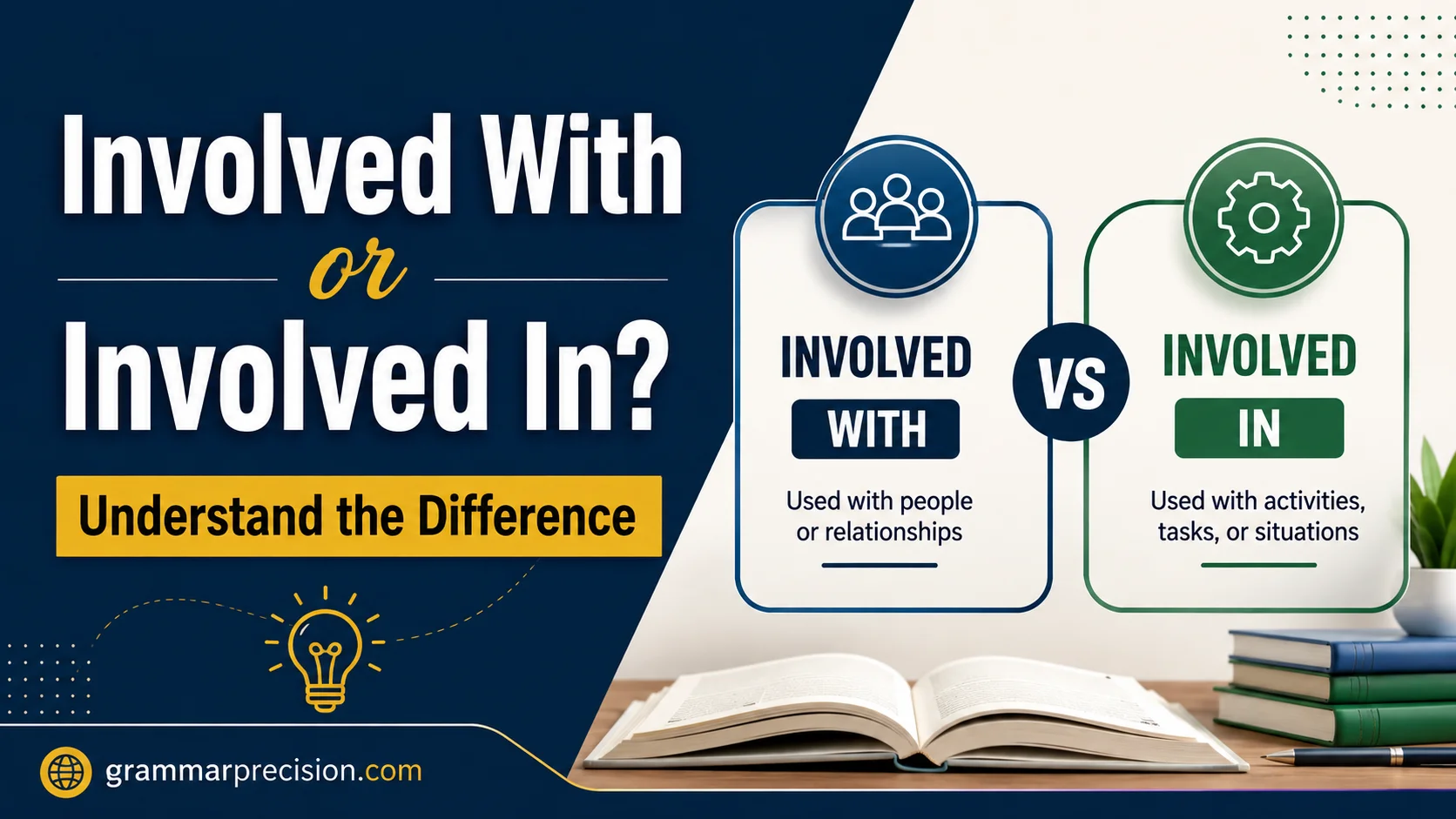
When you say someone is involved in something, you usually mean they actively participate in an activity, project, or situation. Involved with often focuses on a person, group, organization, or relationship. Learning this simple difference makes your English more accurate, natural, and easy to understand in communication and writing.
This guide explains Involved With or Involved In with clear rules and practical examples. You’ll learn when to use each phrase in everyday English, formal writing, and professional contexts. By the end, you’ll know which preposition fits naturally and avoid common grammar mistakes that can affect clarity and meaning in your writing with confidence today.
Is It Involved With or Involved In?
Both “involved with” and “involved in” are grammatically correct. Neither phrase is automatically right or wrong. Your choice depends on the meaning and the noun that follows.
A useful starting point is this:
Involved in usually points toward participation, activity, or being part of a situation.
Involved with often points toward connection, association, attention, or a relationship.
Cambridge recognizes be involved with something as meaning taking part in something or being part of it. It also specifically uses involved with someone for a romantic relationship.
The simplest comparison looks like this:
| Phrase | Typical focus | Example |
| Involved in | Participation or direct engagement | She is involved in the research. |
| Involved with | Connection or association | She is involved with the organization. |
| Involved with someone | Personal or romantic relationship | He is involved with Sarah. |
| Involved in a situation | Participation or connection to an event | He was involved in the accident. |
Think of in as putting someone inside the activity and with as highlighting who or what they’re connected to. This isn’t an unbreakable rule, but it’s an excellent guide.
What Does “Involved In” Mean?
Involved in generally describes participation in something. The subject isn’t merely aware of the activity. They usually have some role, responsibility, interest, or connection to what is happening.
For example:
- She is involved in the marketing campaign.
- They are involved in community service.
- He was involved in the investigation.
- We are involved in planning the event.
- Several engineers were involved in developing the software.
The phrase works especially well with activities, processes, projects, events, decisions, disputes, and situations.
Involved In With Activities and Projects
When someone actively participates in a project, involved in is usually the natural choice.
Maria is involved in the company’s new product launch.
This tells us Maria has a role in the launch. Perhaps she handles marketing, coordinates staff, or helps develop the product.
Likewise:
The students are involved in a science project.
The students aren’t simply connected to the project from a distance. They’re participating in it.
Involved In With Processes
The phrase also works naturally with processes and ongoing actions.
- involved in decision-making
- involved in production
- involved in negotiations
- involved in training
- involved in research
- involved in planning
Notice the pattern:
be + involved in + noun/gerund
For example:
The HR team is involved in training new employees.
The gerund training functions as the object of the preposition in.
Involved In With Events and Situations
You can also use involved in for events or situations.
- involved in an accident
- involved in an argument
- involved in a dispute
- involved in a discussion
- involved in a conflict
- involved in an investigation
Consider:
Three vehicles were involved in the accident.
Here, involved in identifies the vehicles connected to the event. It doesn’t necessarily say that the drivers caused the accident. That distinction matters.
Similarly:
The manager was involved in the negotiations.
The sentence tells us the manager participated in the negotiations. It doesn’t tell us exactly what the manager did.
What Does “Involved With” Mean?
Involved with often emphasizes a relationship or connection between a person and another person, group, organization, or area of activity.
For example:
- She is involved with a nonprofit organization.
- He works closely with people involved with the project.
- They have been involved with the community for years.
- She is romantically involved with someone.
- He became involved with a local political group.
Interestingly, involved with can also mean active participation. Cambridge gives examples involving animal rights, community projects, organizations, and groups. So the popular rule that “involved in is always for activities while involved with is only for people” is too rigid.
The better approach is to look at the relationship being emphasized.
Involved In vs. Involved With: The Key Difference
The clearest distinction is participation versus connection.
Imagine a large theater production.
If you say:
Alex is involved in the production.
You’re emphasizing Alex’s participation. Maybe Alex acts, directs, writes, or manages the stage.
Now consider:
Alex is involved with the theater company.
The focus shifts. You’re highlighting Alex’s relationship or association with the company.
Here’s another comparison:
| Sentence | What it emphasizes |
| She is involved in the campaign. | She participates in the campaign. |
| She is involved with the campaign. | She has a connection or association with it. |
| He is involved in the business. | He participates in running or operating it. |
| He is involved with the business. | He has a connection to the business. |
| They are involved in research. | They actively participate in research. |
| They are involved with researchers. | They have a relationship or association with researchers. |
The distinction isn’t always dramatic. Sometimes native speakers can choose either preposition without creating a major change in meaning. English prepositions are often guided by usage, context, and emphasis, not mathematical formulas.
A Simple Meaning Map for Involved In and Involved With
You can visualize the difference like this:
INVOLVED
|
+————-+————-+
| |
INVOLVED IN INVOLVED WITH
| |
Participation Connection
Activity Association
Process People
Event Groups
Situation Organizations
Project Relationships
The diagram gives you a useful mental shortcut.
When the sentence answers “What are you participating in?”, involved in will often fit.
When it answers “Who or what are you connected with?”, involved with may be more appropriate.
Again, context gets the final vote.
Common Collocations With Involved In
Learning common word combinations can make the choice much easier because fluent English relies heavily on established patterns.
Common combinations include:
- involved in a project
- involved in research
- involved in an activity
- involved in a process
- involved in planning
- involved in decision-making
- involved in an investigation
- involved in an accident
- involved in a dispute
- involved in a discussion
- involved in a campaign
- involved in negotiations
- involved in community work
- involved in education
- involved in business
For example:
The scientists were deeply involved in research.
She became involved in planning the conference.
Several employees were involved in the decision-making process.
These examples all emphasize participation or engagement.
Common Collocations With Involved With
You will also encounter many established combinations with involved with.
Common examples include:
- involved with a person
- involved with a company
- involved with an organization
- involved with a charity
- involved with a community
- involved with a group
- involved with clients
- involved with a team
- involved with local businesses
- involved with professional organizations
For instance:
She has been involved with the charity for ten years.
Here, the phrase describes an ongoing relationship with the charity. She might volunteer, organize events, raise money, or serve in another capacity.
Cambridge’s examples show that involved with can describe substantial participation rather than merely casual association.
When Both Involved In and Involved With Are Possible
This is where the topic gets interesting.
Sometimes both prepositions work, but the emphasis changes slightly.
Consider:
She is involved in the company.
This can suggest that she has an active role in the company’s operations, management, or business activities.
Now:
She is involved with the company.
This more readily suggests an association or relationship with the company. She could work with it, advise it, collaborate with it, or have another connection.
The difference becomes clearer with a project:
I’m involved in the project.
This strongly suggests active participation.
I’m involved with the project.
This can also be natural, but it may sound broader. The speaker has a connection with the project without necessarily emphasizing a hands-on role.
Language references and usage discussions likewise note that the distinction can be subtle when the same noun follows both prepositions.
A Practical Case Study
Imagine a software company launching a new application.
Situation A:
David is involved in the development of the app.
David writes code, tests features, or manages development tasks. He’s inside the process.
Situation B:
David is involved with the company developing the app.
David may be a consultant, investor, partner, or outside specialist. He’s connected to the company, but the sentence doesn’t tell us that he works directly on the app.
One tiny preposition changes the lens.
Also Read This: Is Done or Has Been Done? A Clear Guide to the Difference
Involved With a Person: Why “With” Matters
When you’re talking about a personal relationship, involved with is usually the natural expression.
She is involved with Daniel.
Depending on context, this could mean they have a romantic relationship or another close connection.
Cambridge specifically identifies involved with someone as a phrase used for a romantic relationship.
Compare:
She is involved in Daniel.
That doesn’t express the intended relationship. It sounds grammatically incomplete or simply wrong in ordinary English.
Instead, you could say:
She is involved with Daniel.
Or:
She is involved in a relationship with Daniel.
The second construction combines both ideas. Involved in a relationship describes participation in the relationship, while with Daniel identifies the other person.
Involved In or Involved With a Company?
Both can be correct.
The choice depends on what you’re trying to say.
Use “Involved In” for an Active Role
She is involved in the company’s operations.
This suggests she participates directly in the operations.
He is involved in the company’s expansion plans.
His role relates directly to the planning process.
Use “Involved With” for a Broader Connection
She is involved with the company.
This statement is less specific. It establishes a connection without explaining exactly what she does.
Maybe she’s a consultant. Maybe she’s a partner. Maybe she works with the company occasionally.
The phrase leaves the nature of the connection open.
Involved In or Involved With a Project?
Both can occur, although involved in a project is often the clearest choice when you mean active participation.
The designers are involved in the project.
This tells readers that the designers are part of the project’s work.
The designers are involved with the project.
This can also work when the writer wants to emphasize their association with it rather than their precise role.
If you’re writing formal business communication, involved in is often the sharper choice when you mean direct participation.
Involved In and Negative Situations
One fascinating feature of involved in is its frequent appearance in negative or controversial contexts.
You may see:
- involved in a crime
- involved in a scandal
- involved in fraud
- involved in a conflict
- involved in a dispute
- involved in illegal activity
- involved in an investigation
Consider:
The company was involved in a legal dispute.
This doesn’t necessarily mean the company behaved improperly. It simply says the company was connected to or participated in the dispute.
Likewise:
The suspect was involved in the investigation.
This could mean investigators questioned the person or the person played some role. Context determines the precise meaning.
Don’t automatically read involved in as an accusation.
Common Mistakes With Involved
The biggest errors usually come from treating prepositions as interchangeable everywhere.
Mistake: “Involved On”
Involved on isn’t the standard construction when you mean participation in a project or activity. Usage references generally identify involved in and involved with as the normal choices.
Instead of:
She is involved on the project.
Use:
She is involved in the project.
However, don’t confuse this with other legitimate phrases such as working on the project or serving on a committee. The preposition depends on the entire expression.
Mistake: “Involved Into”
Involved into isn’t the standard form for this meaning.
Use:
He became involved in the project.
Not:
He became involved into the project.
The verb involve doesn’t follow the same pattern as verbs that describe physical movement.
Mistake: “I Involved In”
Another common error is forgetting the form of be.
Don’t write:
I involved in the project.
Write:
I am involved in the project.
Or:
I was involved in the project.
The adjective or past-participial form involved normally needs the appropriate form of be in this construction.
Involved In vs. Involved With: Quick Decision Guide
When you’re unsure, ask yourself a few questions.
Are you emphasizing participation in an activity, process, or situation?
Use involved in.
She is involved in organizing the conference.
Are you emphasizing a relationship or connection with someone?
Use involved with.
She is involved with her new business partner.
Are you talking about a romantic relationship?
Use involved with.
He is involved with someone from his college.
Are you describing a direct role in a project?
Usually choose involved in.
They are involved in the development process.
Are you describing a broader connection with an organization?
Involved with may be the better fit.
She has been involved with the organization for years.
Involved In vs. Involved With: 25 Examples
Here are practical examples that show how the two phrases work in different contexts.
Examples With Involved In
- She is involved in the research.
- He is involved in the planning process.
- They became involved in community service.
- We are involved in a new project.
- The team is involved in negotiations.
- She was involved in the accident.
- He became involved in the dispute.
- Several employees were involved in the investigation.
- They are deeply involved in education.
- I don’t want to get involved in their argument.
- The engineers were involved in developing the system.
- Students should become involved in extracurricular activities.
Examples With Involved With
- She is involved with a local charity.
- He is involved with several community groups.
- They are involved with the organization.
- She became involved with a technology company.
- He is romantically involved with her.
- I’m not involved with that business.
- She has been involved with the project for years.
- They work closely with people involved with the organization.
- He became involved with a group of artists.
- She is heavily involved with local education programs.
- I don’t want to get involved with those people.
- The company is involved with several nonprofit initiatives.
- He has been involved with the community since college.
Notice something important: some nouns can comfortably follow either preposition. That’s why memorizing a rigid noun list won’t solve every problem. Meaning remains the deciding factor.
A Useful Memory Trick
Here’s a simple way to remember the distinction:
IN = inside the activity.
WITH = connected with the person, group, or organization.
Imagine a basketball game.
If you say:
She is involved in the game.
You picture her participating in the game.
If you say:
She is involved with the team.
You picture her connection with the team.
That mental image makes the difference easier to remember than a long grammar rule.
FAQs:
What is the difference between “involved in” and “involved with”?
Involved in usually means actively participating in an activity, project, event, or situation. Involved with often refers to a connection or association with a person, group, organization, or relationship. However, the exact meaning can depend on the context.
Is “involved in” grammatically correct?
Yes, involved in is grammatically correct and very common in English. You can use it when someone actively takes part in something. For example, “She is involved in a community project” means she actively participates in that project.
Is “involved with” grammatically correct?
Yes, involved with is also correct. It commonly describes a person’s association, connection, or relationship with someone or something. For example, “He is involved with a local charity” means he has a connection or association with that organization.
Can I use “involved in” and “involved with” interchangeably?
Not always. Although they can sometimes have similar meanings, they often create a different sense or emphasis. Involved in generally highlights participation, while involved with often emphasizes association or connection. Choose the phrase that best matches your intended meaning.
Which is better: “involved with” or “involved in”?
Neither phrase is always better. The correct choice depends on the noun and context. Use involved in for participation in activities or situations, and use involved with when emphasizing a connection, association, or relationship.
Conclusion:
Understanding Involved With or Involved In becomes easier when you focus on the intended meaning. Use involved in for active participation in an activity, project, or situation.
Use involved with for a connection, association, or relationship with someone or something. Choosing the right preposition makes your English clearer, more natural, and grammatically accurate.