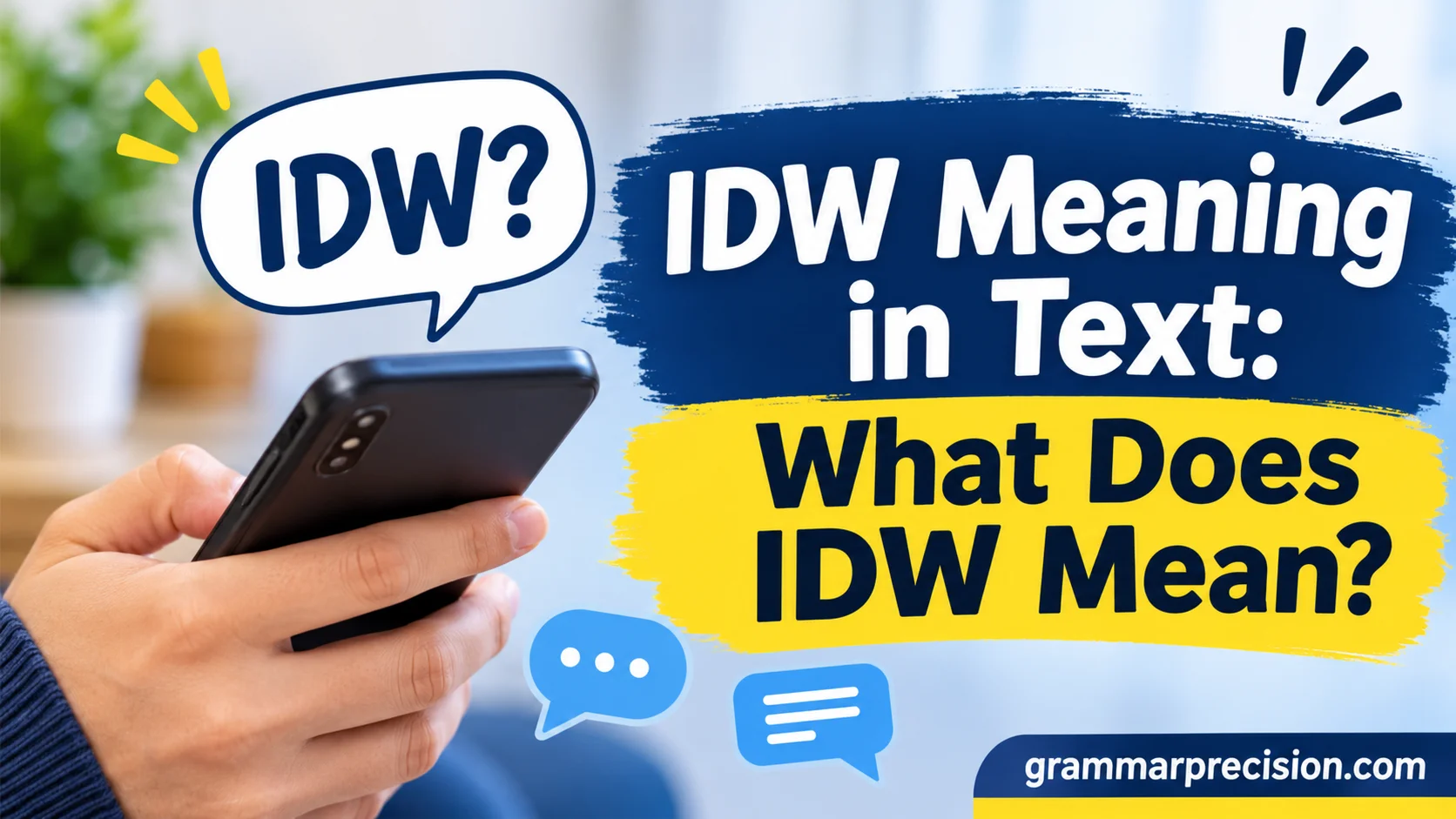
Ever received an IDW meaning message and wondered what someone really wants to say? This common texting abbreviation expresses preferences, disinterest, and unwillingness in everyday digital conversations.
Understanding IDW goes beyond its definition. From Snapchat messages and Instagram chats to casual conversations, context determines its tone and intention. This guide explores its full meaning, practical examples, common responses, and differences from similar internet slang.
You’ll also learn how digital communication, English usage, and informal grammar influence texting habits. Whether you’re chatting with friends or handling business communication, knowing when to use abbreviations matters. We’ll explain why clarity and consistency make everyday messages easier to understand.
Quick Answer: What Does IDW Mean?
IDW stands for “I Don’t Want” in texting and online communication. It’s a casual abbreviation people use when they don’t want something or aren’t interested in doing a particular activity.
For example:
- Friend: Do you want to watch a movie tonight?
- You: IDW. I’m too tired.
In this conversation, IDW communicates that the person doesn’t want to watch a movie.
Here are the essential details:
| Category | Meaning |
| Abbreviation | IDW |
| Full form | I Don’t Want |
| Communication style | Informal |
| Common usage | Text messages and social media |
| Main purpose | Expressing unwillingness or disinterest |
| Tone | Casual, neutral, or sometimes dismissive |
| Suitable for professional writing | Generally no |
You can use IDW when chatting with friends or people who understand internet slang. However, writing the complete phrase often sounds more polite in professional conversations.
What Does IDW Stand For in Texting?
The abbreviation IDW combines three letters from the phrase “I Don’t Want.”
Each letter represents part of the original expression:
- I: The person expressing a preference or feeling.
- D: The contraction “Don’t.”
- W: The word “Want.”
Together, these letters create a shorter way to communicate a lack of desire.
People often choose abbreviations because they make digital conversations faster. Instead of typing a complete sentence, you can communicate your thoughts with just three letters.
For example:
Without IDW:
“I don’t want to go shopping today because I’m exhausted.”
With IDW:
“IDW to go shopping today. I’m exhausted.”
Both messages communicate the same basic idea. However, the second version feels more casual and conversational.
Why Do People Use IDW Instead of Full Sentences?
Short-form communication has become a normal part of everyday digital conversations. People often prefer quick expressions that communicate their thoughts immediately.
Here are several reasons someone might use IDW:
- Saving time: Typing three letters takes less effort than writing a complete phrase.
- Casual communication: Abbreviations create a relaxed atmosphere between friends.
- Expressing preferences: IDW quickly communicates that someone isn’t interested.
- Following texting trends: Internet slang makes conversations feel familiar and informal.
- Maintaining conversational flow: Short replies help people respond quickly without interrupting discussions.
For instance, imagine your friend asks whether you want pizza. You could simply reply, “IDW pizza tonight.”
There’s no need for a lengthy explanation unless the conversation requires one.
IDW Meaning in Different Contexts
Although IDW generally means “I Don’t Want,” its emotional meaning depends on context.
The same abbreviation can communicate a simple preference, a firm refusal, or temporary frustration. Understanding the situation makes a significant difference.
IDW Meaning in Text Messages
Text messages are among the most common places where people use IDW.
Friends, family members, and partners may use it when discussing plans, activities, food, entertainment, or personal preferences.
Consider these examples:
- “IDW to wake up early tomorrow.”
- “IDW another cup of coffee.”
- “IDW to discuss this right now.”
- “IDW going outside in this weather.”
Each message expresses a different preference. However, the central meaning remains the same.
Example conversation:
- Alex: Are you coming to the gym?
- Sam: IDW today. My muscles are still sore.
- Alex: No problem. Get some rest!
Here, Sam uses IDW to decline an invitation without creating an argument.
IDW Meaning on Snapchat
On Snapchat, IDW can appear in private messages, group conversations, and replies to snaps.
People generally use it to communicate preferences quickly. Since Snapchat encourages casual interactions, abbreviations fit naturally into its messaging style.
For example:
- Friend: Want to send me a snap?
- You: IDW taking pictures right now.
Another example:
- Friend: Let’s make a TikTok together.
- You: IDW lol. I’m not in the mood.
The abbreviation doesn’t automatically suggest anger or hostility. The surrounding words and relationship determine the intended tone.
IDW Meaning on Instagram
Instagram users frequently communicate through direct messages, comments, and group chats.
IDW can make these conversations shorter and more relaxed.
For example:
- “IDW buying anything from that store.”
- “IDW watching another episode.”
- “IDW talking about yesterday’s drama.”
Someone might also use the abbreviation when responding to a suggestion in a group chat.
However, remember that short messages sometimes sound harsher than intended. Adding a friendly explanation can make your meaning clearer.
IDW Meaning on TikTok
TikTok conversations often include short expressions, trending phrases, and internet abbreviations.
You might encounter IDW in comments, captions, or conversations about viral challenges.
For example:
- “IDW trying that challenge.”
- “IDW watching sad videos today.”
- “IDW getting involved in this argument.”
In these situations, IDW communicates personal preference or unwillingness.
Its meaning doesn’t change simply because someone uses it on TikTok rather than through regular texting.
IDW Meaning on WhatsApp and Group Chats
WhatsApp conversations often involve friends, relatives, classmates, and coworkers.
People may use IDW when discussing group activities or making plans.
For example:
- Friend: Should we order burgers?
- You: IDW burgers today. Let’s get something lighter.
In a group chat, IDW can help someone express a preference without writing a long explanation.
However, consider your audience before using slang. Not everyone understands texting abbreviations.
How to Use IDW in Everyday Conversations
Knowing what IDW means is only the beginning. You should also understand how people use it naturally.
The abbreviation works best in informal situations where everyone understands casual internet language.
Expressing a Lack of Interest
One common use of IDW involves showing that something doesn’t interest you.
For example:
- “IDW watching that horror movie.”
- “IDW playing video games tonight.”
- “IDW following celebrity gossip.”
These messages communicate personal disinterest without requiring additional explanation.
Politely Declining an Invitation
You can use IDW when declining invitations from friends or people you’re comfortable with.
For example:
- Friend: Want to come shopping?
- You: IDW going today. Maybe next weekend?
Although IDW communicates your decision, adding a friendly alternative makes the response warmer.
Instead of simply rejecting the invitation, you show that you’re still interested in spending time together.
Sharing Personal Preferences
People also use IDW to express their choices.
For example:
- “IDW spicy food.”
- “IDW drinking coffee after dinner.”
- “IDW spending money on unnecessary things.”
These expressions communicate individual preferences rather than criticism.
Showing Frustration or Disinterest
Sometimes, IDW communicates stronger emotions.
For example:
- “IDW hearing another excuse.”
- “IDW arguing about this anymore.”
- “IDW dealing with unnecessary drama.”
In these situations, the abbreviation can sound frustrated or dismissive.
The words surrounding IDW provide important clues about someone’s emotional state.
15+ IDW Text Message Examples With Meanings
Examples make texting abbreviations easier to understand. Below are realistic situations showing how people use IDW in everyday conversations.
| Text message | Intended meaning |
| IDW to go outside. | I don’t want to go outside. |
| IDW pizza tonight. | I don’t want pizza tonight. |
| IDW to argue. | I don’t want to argue. |
| IDW another movie. | I don’t want another movie. |
| IDW waking up early. | I don’t want to wake up early. |
| IDW to talk right now. | I don’t want to talk right now. |
| IDW that responsibility. | I don’t want that responsibility. |
| IDW going alone. | I don’t want to go alone. |
| IDW to waste time. | I don’t want to waste time. |
| IDW buying expensive clothes. | I don’t want to buy expensive clothes. |
| IDW studying tonight. | I don’t want to study tonight. |
| IDW getting involved. | I don’t want to get involved. |
| IDW another headache. | I don’t want another headache. |
| IDW watching spoilers. | I don’t want to watch spoilers. |
| IDW changing my plans. | I don’t want to change my plans. |
| IDW dealing with this today. | I don’t want to deal with this today. |
| IDW eating out. | I don’t want to eat at a restaurant. |
| IDW sharing personal information. | I don’t want to share personal information. |
Real-Life Case Study: Understanding IDW Through Context
Imagine two friends discussing their weekend plans.
Conversation A:
- Mia: We’re going hiking tomorrow. Want to join?
- Emma: IDW hiking. The weather looks terrible.
- Mia: Fair enough. Maybe we’ll do something indoors.
Emma uses IDW to express a personal preference. Her response isn’t necessarily rude.
Conversation B:
- Ryan: Can we discuss what happened yesterday?
- Jake: IDW talking about it anymore.
- Ryan: Okay. Let me know when you’re ready.
Here, IDW communicates a stronger boundary. Jake doesn’t want to continue the discussion.
The important lesson: IDW doesn’t carry one fixed emotional tone. Context, timing, and relationships influence how readers interpret it.
Is IDW Rude or Disrespectful?
IDW isn’t automatically rude. However, the way you use it can influence how someone interprets your message.
A short response sometimes feels cold because it doesn’t provide much emotional context.
Consider these examples:
Neutral response:
“IDW watching a movie tonight. I’m feeling tired.”
This message communicates a simple preference and provides an explanation.
Potentially dismissive response:
“IDW. Stop asking.”
The second message sounds more direct and possibly irritated.
The difference isn’t the abbreviation itself. It’s the surrounding language and attitude.
How to Make IDW Sound More Polite
If you want to decline something without hurting someone’s feelings, try adding a friendly explanation.
For example:
- Instead of “IDW going,” say “IDW going tonight, but thanks for inviting me!”
- Instead of “IDW talking,” say “IDW talking about this right now. Can we discuss it later?”
- Instead of “IDW eating that,” say “IDW eating that today. Maybe I’ll try something else.”
These small changes make your intentions easier to understand.
What Does IDW Mean From a Girl or Guy?
You might wonder whether IDW has a different meaning when a girl or guy sends it.
Generally, IDW means “I Don’t Want” regardless of the sender’s gender. The abbreviation doesn’t have a separate male or female definition.
However, the conversation’s subject can influence its meaning.
When a Girl Sends IDW
A girl might use IDW when expressing preferences, declining invitations, or setting boundaries.
Examples:
- “IDW going out tonight.”
- “IDW discussing my personal life.”
- “IDW watching that show again.”
If someone sends IDW while discussing a relationship, don’t automatically assume she’s angry or uninterested in you.
Read the entire conversation before making conclusions.
When a Guy Sends IDW
A guy might use the abbreviation in similar situations.
Examples:
- “IDW playing tonight.”
- “IDW getting into trouble.”
- “IDW talking about work after hours.”
The abbreviation communicates unwillingness rather than revealing someone’s personality or intentions.
Does Gender Change the Meaning of IDW?
No. The standard meaning remains the same.
What matters more is:
- The subject of the conversation.
- The relationship between the people.
- The sender’s previous messages.
- The tone of the surrounding discussion.
- Whether the sender provides an explanation.
A single abbreviation rarely tells you everything someone wants to communicate.
How to Tell Whether IDW Is Playful, Serious, or Rude
Understanding someone’s tone can prevent unnecessary misunderstandings.
Since text messages lack facial expressions and vocal cues, readers must interpret meaning through context.
Here are some useful clues:
| Tone | Example | Possible interpretation |
| Playful | IDW lol 😂 | Casual refusal or joking disinterest |
| Neutral | IDW going today. | Simple personal preference |
| Serious | IDW discussing this again. | Firm unwillingness |
| Frustrated | IDW dealing with this anymore! | Irritation or emotional exhaustion |
| Dismissive | IDW. Leave me alone. | Strong rejection or frustration |
Emojis, punctuation, and additional explanations can help clarify the intended message.
Still, avoid assuming someone’s emotional state based on three letters alone.
How to Respond When Someone Texts IDW
Your response should depend on the situation. Sometimes, a simple acknowledgment works perfectly. Other situations require a little more understanding.
Here are several natural ways to respond.
Friendly Responses
Use these when someone casually declines an invitation.
- “No worries!”
- “That’s completely fine.”
- “Maybe another time?”
- “All good. We can do something else.”
Funny Responses
If you’re chatting with a close friend, humor can keep the conversation light.
- “Haha, fair enough!”
- “Your loss! 😂”
- “Okay, I’ll survive somehow.”
- “Not feeling it today, huh?”
Understanding Responses
When someone seems tired or uncomfortable, acknowledge their feelings.
- “I understand. Take your time.”
- “That’s okay. You don’t have to.”
- “No pressure at all.”
- “We can talk whenever you’re ready.”
Responses When Someone Seems Upset
If IDW appears in a tense conversation, avoid escalating the situation.
Try these responses:
- “Okay, I won’t push you.”
- “I can see you’re frustrated.”
- “Let’s discuss this later.”
- “I respect your decision.”
Remember: You don’t need to challenge every refusal. Sometimes, respecting someone’s preference is the best response.
IDW vs. Similar Texting Abbreviations
Internet slang contains many abbreviations that look similar but communicate different ideas.
Understanding these differences helps you avoid confusing one expression with another.
| Abbreviation | Full form | Meaning |
| IDW | I Don’t Want | Expresses unwillingness |
| IDK | I Don’t Know | Expresses uncertainty |
| IDC | I Don’t Care | Expresses indifference |
| IMO | In My Opinion | Introduces a personal viewpoint |
| IDTS | I Don’t Think So | Expresses disagreement or doubt |
| IKR | I Know, Right? | Shows agreement |
| NVM | Never Mind | Withdraws or dismisses something |
IDW vs. IDK
These abbreviations look similar but have completely different meanings.
- IDW: I Don’t Want.
- IDK: I Don’t Know.
Example:
- Friend: Do you want to order Chinese food?
- You: IDW.
This means you don’t want Chinese food.
However:
- Friend: What should we order?
- You: IDK.
This means you don’t know what to choose.
IDW vs. IDC
IDW and IDC can sometimes appear in similar conversations. However, they express different attitudes.
- IDW: Communicates that you don’t want something.
- IDC: Communicates that something doesn’t matter to you.
For example:
“IDW watching television” means you don’t want to watch television.
“IDC what we watch” means you don’t care which program someone chooses.
IDW vs. IMO
These abbreviations serve entirely different purposes.
- IDW: I Don’t Want.
- IMO: In My Opinion.
People use IMO when sharing personal thoughts or viewpoints.
For example, “IMO, this movie is excellent.”
IDW communicates unwillingness rather than an opinion.
Common Mistakes People Make When Interpreting IDW
Even familiar texting abbreviations can create confusion when people overlook context.
Here are some mistakes worth avoiding:
- Assuming IDW means IDK: The two abbreviations communicate different ideas.
- Treating every refusal as anger: Someone might simply have a different preference.
- Ignoring surrounding messages: Earlier messages often explain the intended meaning.
- Assuming gender changes the definition: IDW has the same standard meaning regardless of gender.
- Taking short replies personally: A brief response doesn’t always indicate disrespect.
- Using IDW in every situation: Formal communication usually requires complete sentences.
The best approach is simple: understand the conversation before interpreting the abbreviation.
Is IDW Appropriate for Professional Conversations?
Generally, IDW isn’t suitable for formal communication.
Although coworkers might understand the abbreviation, using it in professional messages can sound too casual or abrupt.
For example:
Informal:
“IDW attending the meeting tomorrow.”
Professional:
“I won’t be able to attend tomorrow’s meeting.”
The second sentence sounds clearer and more respectful.
Here are some situations where you should avoid IDW:
- Business emails.
- Job applications.
- Client communications.
- Formal workplace discussions.
- Academic assignments.
- Official announcements.
Instead, use complete expressions that communicate your preferences politely.
| Informal expression | Professional alternative |
| IDW to attend. | I won’t be able to attend. |
| IDW doing that. | I’d prefer not to do that. |
| IDW discussing this. | I’d rather discuss this later. |
| IDW changing plans. | I would prefer to keep the current plans. |
| IDW taking responsibility. | I’m unable to take on that responsibility. |
Choosing appropriate language helps you communicate clearly without sounding dismissive.
FAQs About IDW Meaning
What Does IDW Mean in Texting?
IDW means “I Don’t Want” in texting. People use it to express unwillingness, disinterest, or personal preferences during casual conversations.
What Does IDW Mean on Snapchat?
On Snapchat, IDW generally means “I Don’t Want.” Users send it in private messages and group chats when declining suggestions or expressing preferences.
What Does IDW Mean From a Girl?
When a girl sends IDW, she generally means “I Don’t Want.” The specific meaning depends on what you’re discussing and the surrounding conversation.
What Does IDW Mean From a Guy?
When a guy uses IDW, he usually communicates that he doesn’t want something. It can express a preference, refusal, or lack of interest.
Is IDW the Same as IDK?
No. IDW means “I Don’t Want,” whereas IDK means “I Don’t Know.” One expresses unwillingness, while the other expresses uncertainty.
Is IDW Rude?
Not necessarily. IDW can sound neutral or casual. However, adding harsh language or using it during an argument might make the message seem dismissive.
Can I Use IDW in Professional Messages?
It’s better to avoid IDW in professional communication. Use complete expressions such as “I would prefer not to” or “I won’t be able to.”
What Is the Difference Between IDW and IDC?
IDW means “I Don’t Want,” while IDC means “I Don’t Care.” The first expresses unwillingness, and the second communicates indifference.
How Should I Reply to IDW?
You can respond with “No worries,” “That’s fine,” or “Maybe another time.” If someone seems upset, acknowledge their feelings and avoid pressuring them.
Does IDW Have More Than One Meaning?
Its common texting meaning is “I Don’t Want.” However, abbreviations can have other meanings in specialized communities or particular contexts. Always consider the conversation before interpreting unfamiliar usage.
Conclusion:
Understanding the IDW meaning helps you navigate everyday texting and social media conversations with confidence. This abbreviation stands for “I Don’t Want” and expresses preferences, disinterest, or unwillingness. Recognizing its context helps you understand messages without unnecessary confusion or misunderstandings.
Whether someone uses IDW on Snapchat, Instagram, WhatsApp, or regular text messages, its meaning and tone depend on the conversation. Use it naturally with friends, choose polite alternatives when necessary, and avoid excessive slang in professional communication. Understanding texting abbreviations makes digital conversations clearer, smoother, and more meaningful.