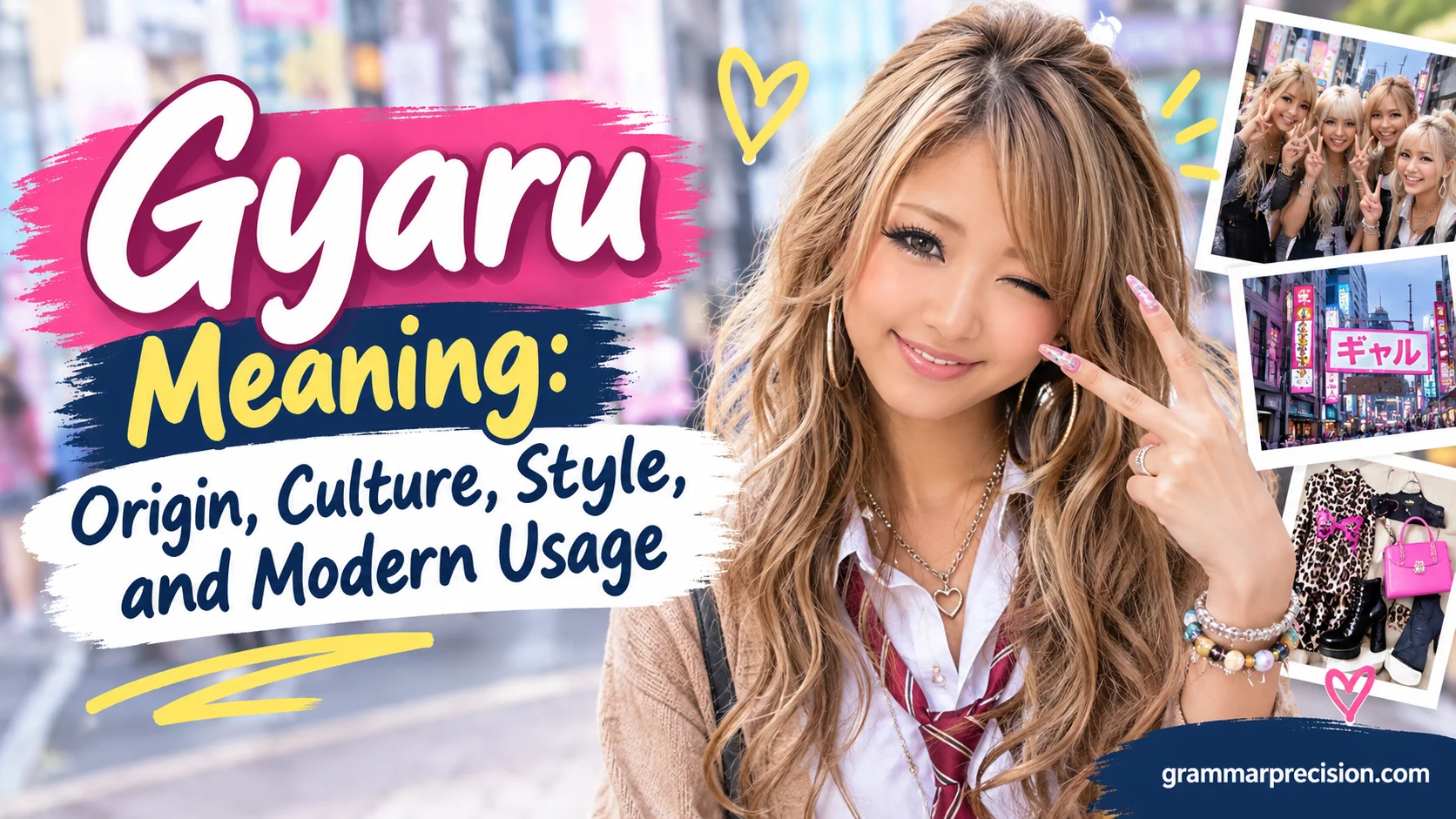
What exactly does Gyaru Meaning reveal about Japanese language and youth culture? At first glance, gyaru may seem like a simple fashion term, but its story reaches much further. This guide explores its Japanese origin, cultural meaning, fashion styles, slang, beauty trends, and modern usage.
You’ll also see how context shapes English usage, especially when discussing identity, media, communication, and everyday language. Although scheduling, time management, online booking, meetings, calendar planning, and project management may seem unrelated, precise terminology matters in every form of communication.
Beyond definition, this article examines how gyaru culture evolved across different eras and why the term still appears in modern conversations. You’ll learn about major gyaru styles, Japanese youth culture, media representation, and common misconceptions surrounding the word. The discussion also considers grammar, formal writing, broadcasting, and consistency when using culturally specific terms in English.
Style guides and regional preferences can differ between US and UK English, so clear usage helps prevent confusion. Whether you encountered gyaru through anime, fashion, social media, or Japanese pop culture, this guide gives you the context needed to understand the term accurately.
What Does Gyaru Mean?
In simple terms, gyaru means a Japanese youth fashion and cultural identity associated with bold beauty, expressive style, and social individuality. The word is a Japanese rendering of “gal,” but its modern cultural meaning goes far beyond the English source.
The term can describe an aesthetic, a person, a fashion community, or a broader subculture. Context matters. Someone might use gyaru to discuss clothing, makeup, slang, a fictional character, or an entire cultural movement.
Unlike a narrow fashion label, gyaru has never had one permanent uniform. Styles have shifted dramatically across decades. Some versions emphasize tanning and dramatic makeup, while others favor elegant, feminine, glamorous, or contemporary looks.
Gyaru Meaning in Japanese
The Japanese spelling is ギャル. It is written in katakana, the script commonly used for many foreign-derived words. The pronunciation resembles “gyah-roo,” although natural Japanese pronunciation does not perfectly match English spelling.
The important point is cultural rather than phonetic. Japanese speakers may understand ギャル through associations that an English dictionary definition of “gal” cannot fully capture.
Where Did the Word Gyaru Come From?
The history of gyaru meaning begins before the famous Shibuya styles of the 1990s. The Japanese word developed from the English “gal” and was already circulating in Japanese popular culture decades earlier. Historical accounts place an early commercial use of “gyaru” in Japan in the 1970s, after which the word gradually gained broader youth-culture associations.
By the late twentieth century, “gal” could describe young women who were fashionable, socially active, and less concerned with traditional expectations. That earlier meaning matters because modern gyaru did not appear from nowhere.
The 1990s transformed the word. Young women in Tokyo, particularly around Shibuya, developed recognizable styles that became increasingly visible through street culture and magazines. Academic research describes kogaru as an important trendsetting group because these young consumers had fashion resources, social networks, and increasingly rapid ways to exchange information.
The Rise of Gyaru Culture in Shibuya
Shibuya became one of the most important stages for gyaru culture. The neighborhood offered shops, entertainment, transportation, magazines, and dense youth networks. Shibuya 109 became especially associated with the movement.
Street fashion mattered because trends could move from individuals into magazines and then back onto the streets. This created a feedback loop. Young women saw a look, adapted it, photographed it, and influenced the next trend.
The late 1990s were especially important. Contemporary documentation of Shibuya in 1999 describes large numbers of young women gathering around Centre Gai and shopping at Shibuya 109. The same period saw “gal” culture spreading beyond Tokyo.
Kogyaru and the Early Gyaru Look
Kogyaru, often shortened from a term referring to high school students, became one of the most recognizable early forms of gyaru culture. Common visual elements included altered school uniforms, loose socks, dyed hair, makeup, and tanning.
The style was not simply about clothes. It represented a youth identity built around friendship, leisure, fashion, and visibility.
Academic research also shows why kogyaru became influential. Young women had access to disposable income, leisure time, communication networks, and media that helped trends travel quickly.
The Gyaru Timeline at a Glance
Understanding the timeline makes the evolution of gyaru meaning easier to follow.
- 1970s: The Japanese use of “gyaru” develops from the English “gal.”
- 1980s: “Gal” increasingly describes fashionable, socially active young women.
- Early 1990s: Kogyaru emerges around Shibuya and gains visibility through youth fashion.
- Late 1990s: Ganguro and related styles push tanning, hair, makeup, and footwear further.
- Around 1999: Gyaru magazines and street models spread trends across Japan.
- 2000s: Manba, Hime Gyaru, Agejo, and Onee Gyaru diversify the scene.
- 2010s: The culture becomes less centralized as online communities expand.
- 2020s: Digital communities and Y2K revivals bring renewed attention to historical styles.
A contemporary description of Shibuya captures the linguistic journey neatly: “The word ‘gal’ … came straight from casual American vernacular.”
The timeline shows why calling gyaru a single “look” misses the point. Each era added new visual codes, vocabulary, media, and communities.
How Gyaru Challenged Traditional Beauty Standards
One of the most fascinating parts of gyaru culture is its relationship with beauty.
Traditional Japanese beauty ideals often emphasized pale skin, dark hair, understated makeup, and restrained presentation. Gyaru styles frequently pushed in the opposite direction. Hair could become lighter. Makeup became more visible. Clothing became more expressive. Some styles emphasized deeply tanned skin.
This contrast made gyaru visually striking. It also helped turn appearance into a form of personal agency.
However, it would be too simplistic to describe every gyaru as a deliberate political rebellion. People participate in fashion for many reasons. Friendship, enjoyment, confidence, experimentation, admiration for celebrities, and community can all matter.
Major Types of Gyaru
Gyaru is an umbrella rather than a single aesthetic. Its many substyles show how flexible the culture became.
| Gyaru style | Distinctive features | General association |
| Kogyaru | School-inspired fashion, loose socks, youthful styling | 1990s youth culture |
| Ganguro | Deep tan, bleached hair, dramatic makeup | Late 1990s |
| Yamanba | Highly exaggerated makeup and styling | Early 2000s |
| Manba | Extreme eye makeup, colorful details, bold styling | 2000s |
| Hime Gyaru | Princess-like clothing, curls, ornate accessories | Glamorous 2000s fashion |
| Onee Gyaru | More mature, polished, feminine appearance | Adult-oriented gyaru |
| Agejo | Glamorous, feminine, nightlife-influenced styling | 2000s |
| Gyaru-o | Male-associated gyaru fashion and culture | Late 1990s onward |
These categories overlap. A person may borrow elements from several styles rather than follow one rigid formula.
Ganguro Gyaru
Ganguro became one of the most famous gyaru-related styles during the late 1990s. It emphasized tanning, bleached or lightened hair, dramatic makeup, and conspicuous footwear.
Its extreme appearance challenged mainstream beauty conventions. Ganguro became particularly associated with Shibuya and reached peak visibility around the turn of the millennium.
Importantly, ganguro is not synonymous with gyaru. It represents one historical branch within the wider gyaru landscape.
Hime Gyaru and Elegant Gyaru
Hime gyaru moved in a very different direction. Instead of emphasizing an intensely rebellious street appearance, it drew on princess imagery, elaborate hairstyles, feminine dresses, bows, lace, and polished accessories.
Onee gyaru similarly developed a more mature aesthetic. These variations demonstrate an important truth: gyaru can be glamorous without being extreme.
Gyaru-o
Gyaru culture also developed male-associated forms. Gyaru-o became linked with dyed hair, tans, nightlife, bold clothing, and Shibuya’s male youth scene.
The emergence of gyaruo shows that the broader culture influenced more than one gender. It also demonstrates how fashion communities can develop parallel identities rather than simple copies of an original style.
Gyaru Makeup, Hair, and Fashion Explained
The visual language of gyaru has several recurring elements, although no single checklist applies to everyone.
Makeup often emphasizes the eyes. Depending on the style, people may use eyeliner, false eyelashes, enlarged-looking eye makeup, contouring, and carefully shaped brows.
Hair has historically ranged from brown and honey tones to much lighter shades. Volume, curls, waves, and dramatic styling can also feature prominently.
Fashion varies widely. Mini skirts, fitted silhouettes, platform shoes, decorative accessories, denim, glamorous dresses, and colorful pieces have all appeared across different eras.
Nails can become another canvas for creativity. Length, decoration, rhinestones, patterns, and coordinated colors can reinforce an overall gyaru look.
The result is less like wearing a uniform and more like building a visual character.
What Is Gyaru-Go?
Language adds another layer to gyaru meaning. The term gyaru-go refers to speech and slang associated with gyaru culture.
Subcultures often develop distinctive vocabulary because language strengthens group identity. Expressions can signal familiarity with a community, create humor, or make ordinary conversation feel more playful.
Gyaru-go should not be treated as a separate Japanese language. It is better understood as a changing collection of expressions and speech habits associated with gyaru communities and their media environment.
Because slang changes quickly, older expressions can sound dated. This is one reason modern gyaru language may differ from the speech associated with the 1990s or 2000s.
Gyaru in Magazines, Music, Anime, and Manga
Media helped turn gyaru from a local street trend into a nationally recognizable phenomenon.
Magazines such as egg, Popteen, and other youth publications gave readers images, styling ideas, interviews, and trend information. Street models became influential because they appeared to embody the culture rather than merely advertise it.
Music also mattered. Artists such as Namie Amuro became strongly associated with styles that influenced young women’s fashion and beauty choices during the 1990s. Research on Japanese street fashion identifies her as an important figure in the broader Shibuya gyaru aesthetic.
Anime and manga later popularized the visual idea of the “gyaru girl.” Yet fictional gyaru characters can compress a complex culture into a few recognizable traits: tanned skin, dyed hair, outgoing behavior, fashionable clothing, and slang.
That shortcut can be entertaining, but it isn’t a complete definition.
Also Read This: 1234 Angel Number Meaning: Love, Career & Money
Gyaru Stereotypes vs. Reality
Gyaru has attracted plenty of stereotypes over the decades. Some arose from media coverage rather than from the people participating in the culture.
| Stereotype | More useful way to understand it |
| Gyaru means “promiscuous girl” | The word’s cultural meaning is much broader than sexuality |
| Every gyaru has dark skin | Tanning is associated with some styles, not all |
| Gyaru is only about clothing | Language, community, media, and identity also matter |
| Gyaru disappeared after the 2000s | The culture changed and fragmented rather than simply vanishing |
| All gyaru look alike | Numerous substyles developed different aesthetics |
| Anime gyaru perfectly represents reality | Fiction often exaggerates recognizable traits |
Historical scholarship is particularly useful here because 1990s media sometimes connected kogyaru with sensational stories about sexuality and compensated dating. Those associations became part of public discourse, but they shouldn’t be treated as the definition of gyaru itself.
Gyaru and Japanese Beauty Culture
The beauty question deserves special attention because it explains why gyaru became culturally noticeable.
When a subculture deliberately changes highly visible features—skin tone, hair color, eye makeup, clothing silhouette—it creates a recognizable boundary between mainstream and alternative style.
Gyaru therefore offered a way to experiment with appearance. For some participants, the transformation could feel theatrical. For others, it could simply be fun.
This is where the culture becomes more interesting than a fashion checklist. Gyaru turns styling into communication. Your makeup, hair, clothes, and accessories can tell people what communities, eras, and aesthetics you value.
Is Gyaru Still Popular Today?
Gyaru has changed considerably since its late-1990s peak. The old image of a single dominant Shibuya style no longer captures the entire scene.
Instead, contemporary communities are more fragmented. Different people combine historical references with current fashion, social media aesthetics, and personal preferences. Online communities also allow enthusiasts outside Japan to learn about and participate in gyaru-inspired fashion.
A useful way to understand the modern movement is through revival rather than simple survival. Earlier styles can return because younger audiences discover archived magazines, photographs, music, and fashion through digital platforms.
The result is a culture that can look backward and forward at the same time.
Gyaru Outside Japan
International interest has expanded the meaning of gyaru even further.
Fans outside Japan may study historical substyles, recreate makeup techniques, collect vintage references, or develop their own interpretations. Social platforms make it possible for niche communities to exchange styling knowledge without living in Tokyo.
However, learning about gyaru works best when its history remains visible. Copying surface features without understanding their context can reduce a complicated subculture to a costume.
A better approach is curiosity: learn the terminology, study different eras, understand the differences among styles, and recognize that gyaru communities aren’t monolithic.
Why Gyaru Matters Beyond Fashion
The lasting importance of gyaru comes from its ability to connect appearance, identity, language, media, and community.
Its history shows how young consumers can influence fashion rather than merely follow designers. It also demonstrates how magazines and communication networks can accelerate trends.
Most importantly, gyaru reminds us that fashion can function like a language. A hairstyle can signal an era. Makeup can identify a substyle. Slang can create belonging. A shopping district can become a cultural landmark.
That combination explains why gyaru remains an important subject in discussions of Japanese youth culture.
Gyaru Meaning: A Quick Reference Guide
| Question | Short answer |
| What does gyaru mean? | A Japanese term associated with “gal” and a broad youth fashion subculture |
| What does gyaru mean in Japanese? | ギャル, a Japanese rendering of “gal” |
| Where did gyaru culture grow? | Shibuya in Tokyo became a major center |
| When did modern gyaru emerge? | Its recognizable modern form developed during the 1990s |
| Is ganguro the same as gyaru? | No. Ganguro is one gyaru-related style |
| What is gyaru-go? | Slang and speech associated with gyaru culture |
| Is gyaru still around? | Yes, although contemporary participation is more diverse and decentralized |
| Is gyaru only for women? | The culture has also included male-associated forms such as gyaruo |
FAQs About Gyaru Meaning
What does gyaru mean in English?
Gyaru comes from the English word “gal,” but its Japanese cultural meaning is more specific. It can refer to a person, aesthetic, fashion community, or youth subculture associated with expressive style.
Is gyaru a Japanese word?
Yes. ギャル (gyaru) is a Japanese word written in katakana. Its linguistic origin comes from English “gal,” but Japanese usage developed its own cultural associations.
What is the difference between gyaru and ganguro?
Gyaru is the broader cultural category. Ganguro is one historical style within that broader culture, known especially for deep tanning, lightened hair, and dramatic makeup.
Is gyaru still popular?
Gyaru remains present, although its contemporary form is more varied than the highly visible late-1990s and early-2000s scene. Modern communities combine established aesthetics with newer fashion and digital culture.
What is a gyaru girl?
A “gyaru girl” generally refers to a woman who identifies with gyaru fashion or culture. The exact appearance can differ greatly because gyaru includes many styles.
Conclusion:
The gyaru meaning goes far beyond “Japanese girl” or “bold fashion.” The word began as a Japanese adaptation of “gal,” then developed into a distinctive cultural identity shaped by Shibuya street life, youth media, beauty experimentation, slang, and changing fashion.
From kogyaru and ganguro to hime gyaru, onee gyaru, gyaruo, and contemporary interpretations, the culture has never stood still. Its most enduring feature may be that flexibility itself. Gyaru shows how young people can transform fashion into a vivid language of identity, friendship, creativity, and self-expression.