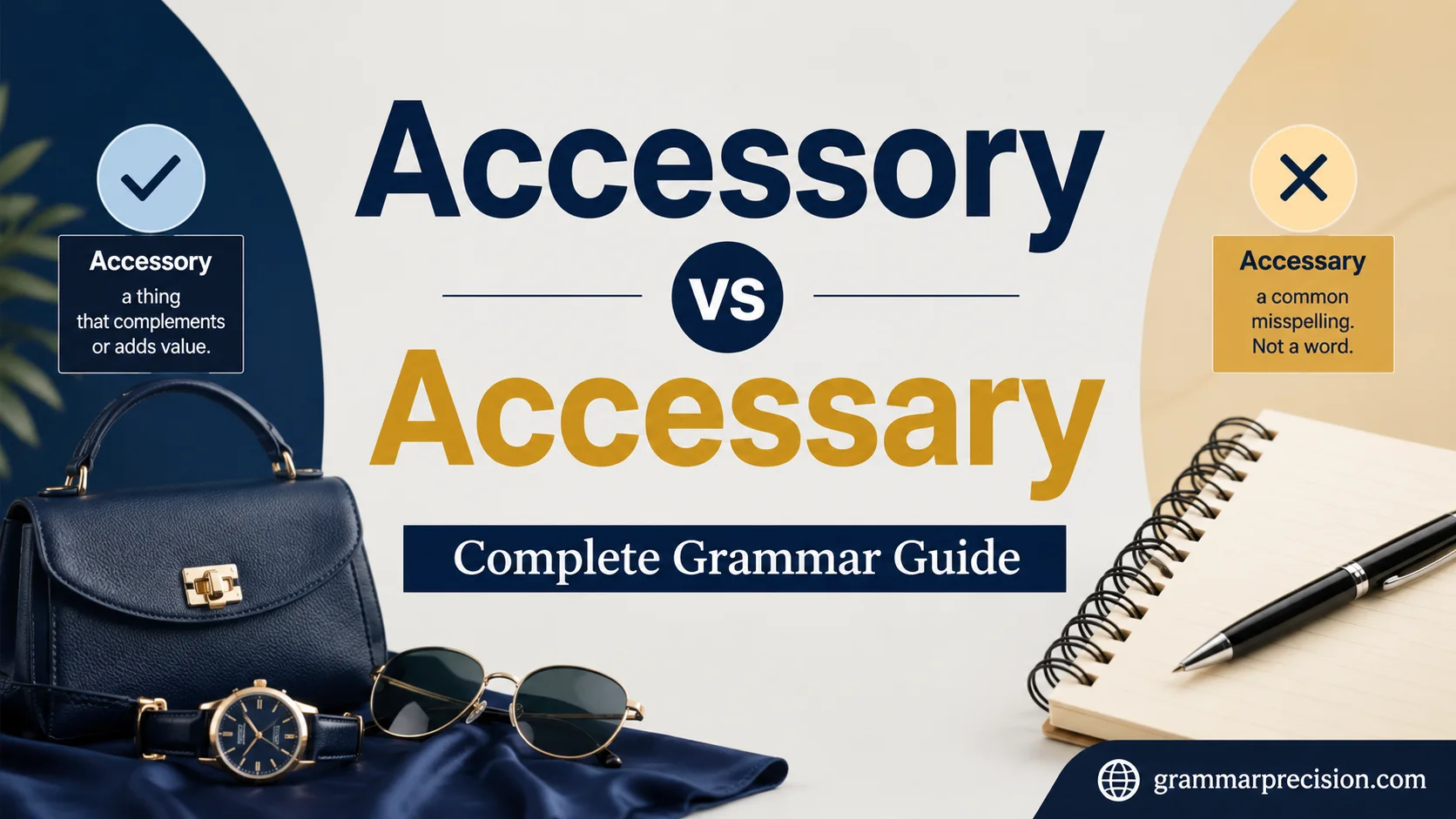
Accessory vs Accessary is a common grammar confusion. This guide explains their meanings, uses, and differences with simple examples to help you choose the right word.
An accessory means an additional item that improves or completes something. It is often used for fashion items like a purse, scarf, or jewellery. The word can also describe technology devices that support another product. The plural form is accessories, and the verb form is accessorize.
An accessary is mainly a legal term related to a crime. It describes someone who helps or supports a perpetrator but is not directly present during the criminal act. In legal contexts, accessories and accomplices have different roles depending on their involvement in the crime.
Accessory vs Accessary: Quick Difference Table
Before exploring the details, here is a quick comparison of these confusing words:
| Word | Meaning | Common Usage | Example |
| Accessory | An additional item that improves appearance, function, or usefulness | Everyday English, fashion, technology, business | My laptop accessory stopped working. |
| Accessary | A person involved in helping someone commit a crime | Mostly legal language | The suspect was charged as an accessary. |
The easiest way to remember the difference is:
Accessory = an extra thing.
Accessary = a person connected to a crime.
In normal conversations, shopping, writing, and daily communication, you will almost always need accessory.
What Does Accessory Mean?
The word accessory is one of the most commonly used words in modern English. It describes something additional that supports, improves, or completes something else.
An accessory usually isn’t the main part of something. Instead, it adds value.
Think about your smartphone. The phone itself is the main device, but a charger, protective case, wireless earbuds, or car mount are accessories because they support the phone’s use.
The same idea applies to many areas of life.
Accessory as a Noun
As a noun, accessory means an extra item added to another thing.
Here are some common examples:
- A necklace is a fashion accessory.
- A keyboard can be a computer accessory.
- A roof rack is a car accessory.
- A tripod is a camera accessory.
The word often describes something optional rather than essential.
For example:
“A smartphone can work without a case, but a protective case is a useful accessory.”
The phone needs its internal components to function. The case simply provides extra protection.
Common Types of Accessories
The word accessory appears in many industries and situations.
| Category | Examples of Accessories |
| Fashion | Watches, handbags, scarves, jewelry, belts |
| Technology | Chargers, headphones, keyboards, phone cases |
| Automotive | Floor mats, seat covers, navigation systems |
| Photography | Lenses, camera bags, lighting equipment |
| Home | Decorative items, lamps, furniture additions |
Accessories often reflect personal choices. Two people may own the same basic product but choose completely different accessories based on their needs, style, or lifestyle.
For example, two people may have the same smartphone model. One person buys a rugged case because they travel often. Another chooses a stylish case because appearance matters more to them.
The phone stays the same, but the accessories make the experience different.
Accessory as an Adjective
Many people know accessory as a noun, but it can also work as an adjective.
When used as an adjective, accessory means something additional, secondary, or connected to the main thing.
Examples:
- Accessory equipment
- Accessory muscles
- Accessory buildings
- Accessory parts
In these cases, the word describes something that supports another object or system.
For example:
“The machine requires several accessory parts to operate efficiently.”
The accessory parts are not the central machine components, but they help improve performance.
Another example:
“The designer created an accessory collection for the main fashion line.”
The collection supports the primary fashion line rather than replacing it.
What Does Accessary Mean?
The word accessary is real, but it is far less common than accessory.
In modern English, accessary mainly appears in legal writing. It refers to someone who helps another person commit a crime or assists after the crime happens.
Although the word looks like a spelling mistake, it has a legitimate meaning.
However, because it is rarely used outside legal discussions, many people never encounter it.
Accessary in Criminal Law
An accessary is a person who participates in a crime indirectly rather than committing the main criminal act themselves.
For example, imagine someone plans a robbery but does not enter the building. Instead, they provide information, tools, or assistance.
That person may be considered an accessary.
Legal systems often divide accessaries into two categories:
| Type | Meaning | Example |
| Accessary before the fact | Someone who helps plan or prepare a crime | Providing tools before a robbery |
| Accessary after the fact | Someone who helps a criminal avoid punishment afterward | Hiding evidence or helping someone escape |
The exact legal definitions can vary depending on the country and legal system. In many modern legal contexts, terms like accomplice or aiding and abetting are used more often.
Why Do People Confuse Accessory and Accessary?
The confusion between accessory vs accessary happens for several reasons.
They Look Almost Identical
The only spelling difference is one letter:
- Accessory → -sory
- Accessary → -sary
When people see these words quickly, their brains often treat them as the same word.
English contains many examples where small spelling changes create completely different meanings.
For example:
| Word Pair | Difference |
| Principal vs Principle | Leader vs rule or belief |
| Stationary vs Stationery | Not moving vs writing materials |
| Affect vs Effect | Influence vs result |
Accessory and accessary follow the same pattern.
They Have Similar Origins
Both words developed from the Latin word accessorius, meaning “additional” or “belonging to something else.”
Over time, English adapted the word into different forms.
The everyday meaning developed into accessory, while the legal meaning remained associated with accessary.
Most People Only Hear “Accessory”
Because accessory is used constantly in daily life, it becomes the familiar spelling.
People talk about:
- Fashion accessories
- Car accessories
- Phone accessories
- Gaming accessories
But they rarely discuss legal accessaries outside courtrooms, law books, or crime-related reports.
Accessory vs Accessary Pronunciation Guide
Pronunciation can create additional confusion because both words sound very similar.
Accessory Pronunciation
Accessory is commonly pronounced:
ak-SESS-uh-ree
Example:
“She bought a new accessory for her outfit.”
Accessary Pronunciation
Accessary is generally pronounced:
ak-SESS-uh-ree
In many cases, the pronunciation is identical or nearly identical.
That means you cannot always identify the correct word by sound alone. You need to understand the meaning and context.
This is why spelling and vocabulary knowledge matter.
A sentence about fashion requires accessory. A sentence about criminal law may require accessary.
The History Behind Accessory and Accessary
The story behind accessory vs accessary begins with the development of the English language itself. English has borrowed thousands of words from other languages, especially Latin and French. Many confusing word pairs exist because a single older word developed into multiple meanings over centuries.
Both accessory and accessary come from the Latin word accessorius, which means “additional,” “belonging to,” or “connected with something else.”
The original idea behind the word was simple: something that is connected to or added onto another thing.
Over time, English speakers began using the word in different situations.
One meaning focused on additional objects, which eventually became today’s common word:
Accessory = an extra item or addition.
Another meaning developed in legal settings:
Accessary = someone connected to a criminal act.
This difference shows how language changes naturally. A word can start with one general idea and later split into specialized meanings.
How Accessory Became a Common Everyday Word
The word accessory became popular because people frequently needed ways to describe additional objects.
As society developed new products and industries, the word expanded into many areas:
- Fashion
- Technology
- Automotive products
- Home design
- Sports equipment
For example, when smartphones became popular in the early 2000s, the technology industry created thousands of related products. Phone cases, charging stations, wireless earbuds, and screen protectors all became known as accessories.
Today, “accessory” is used so often that most people rarely think about its original meaning.
How Accessary Became a Legal Term
The word accessary survived mainly because of its connection to law.
Historically, English legal systems needed specific terms to describe different levels of involvement in crimes. A person who committed the crime was different from someone who helped before or after it happened.
The term accessary became part of this legal vocabulary.
However, modern legal language has changed. Many legal professionals now prefer clearer terms such as:
- Accomplice
- Criminal assistant
- Aiding and abetting
- Person who assisted in an offense
Because of this shift, accessary has become uncommon in everyday writing.
Also Read This: Couple of Hours vs Couple Hours: The Complete Grammar Guide
Accessory vs Accessary vs Accomplice: Understanding the Difference
Many people confuse accessary with accomplice because both relate to criminal involvement. However, they are not always identical.
Understanding these differences helps you use each word correctly.
| Word | Meaning | Common Context |
| Accessory | An additional item or object | Everyday conversations |
| Accessary | A person connected to a crime | Legal language |
| Accomplice | A person who participates in a crime | Law and general discussion |
Let’s look at examples.
Accessory Example
“She purchased a camera accessory before her photography trip.”
The word refers to an object that supports another item.
Accessary Example
“The investigation revealed that he was an accessary to the crime.”
The word refers to a person involved in criminal activity.
Accomplice Example
“The police arrested the accomplice who helped organize the robbery.”
An accomplice usually plays a more direct role in the crime.
Although the terms overlap, they are not interchangeable.
Calling a phone charger an “accessary” would be incorrect. Calling a criminal helper an “accessory” in ordinary writing may also create confusion because readers may think you mean an object.
Accessory vs Accessary Examples in Sentences
The best way to understand these words is through real examples.
Correct Examples of Accessory
Fashion Examples
✅ Her necklace was the perfect accessory for the evening dress.
The necklace adds style to the outfit.
✅ A good handbag can be both practical and fashionable.
The handbag functions as an accessory.
Technology Examples
✅ I bought a new laptop accessory to improve my workspace.
The accessory supports the laptop.
✅ Wireless headphones are popular smartphone accessories.
The headphones add extra functionality.
Automotive Examples
✅ The company sells original accessories for its latest car model.
The products improve or customize the vehicle.
Home Examples
✅ Decorative pillows are simple accessories that change the look of a room.
The pillows add style but are not essential.
Correct Examples of Accessary
Because accessary is rare, examples usually appear in legal contexts.
✅ The court found that he acted as an accessary after the crime.
The person helped after the crime occurred.
✅ The suspect was accused of being an accessary before the fact.
The person helped prepare for the crime.
These examples show why context matters.
Common Mistakes When Using Accessory and Accessary
Even native English speakers sometimes make mistakes with these words because they look so similar.
Here are the most common errors.
Writing Accessary When You Mean Accessory
This is the most frequent mistake.
Incorrect:
❌ “She bought a new fashion accessary.”
Correct:
✅ “She bought a new fashion accessory.”
Why?
Fashion items are additional objects, so accessory is the correct word.
Using Accessory for a Person Involved in a Crime
Incorrect:
❌ “The police charged him as an accessory to the robbery.”
This sentence may confuse readers because accessory usually refers to an object.
Better:
✅ “The police charged him as an accessary to the robbery.”
Or, in modern legal language:
✅ “The police charged him as an accomplice.”
Assuming Accessary Is Always a Spelling Mistake
Some writers believe “accessary” does not exist.
That is incorrect.
Accessary is a valid English word, but it has limited use.
A dictionary recognizes it because it has a specific legal meaning.
The mistake happens when people use it in situations where accessory is needed.
Easy Memory Tricks to Remember Accessory vs Accessary
Remembering the difference becomes much easier with simple associations.
Trick One: Think About Objects
If you can hold it, buy it, wear it, or attach it, it is probably an:
Accessory
Examples:
- Watch
- Phone case
- Keyboard
- Camera lens
Think:
Accessory = Added item
Trick Two: Think About Crime
If the word describes a person connected to illegal activity, think:
Accessary = Associated with a crime
The extra “a” can remind you of:
A = accused person
This is not a formal grammar rule, but memory tricks can help you recall uncommon words.
Accessory and Accessary in Different Industries
The meaning of a word often becomes clearer when you see how professionals use it.
Fashion Industry
In fashion, accessory is one of the most common terms.
Fashion accessories include:
- Jewelry
- Watches
- Sunglasses
- Hats
- Scarves
- Handbags
- Belts
A fashion accessory can completely change the appearance of an outfit.
For example, a simple black dress can create different styles depending on whether someone adds a pearl necklace, colorful handbag, or leather belt.
Technology Industry
Technology companies frequently use the word accessory.
Examples include:
- Computer accessories
- Gaming accessories
- Smartphone accessories
- Audio accessories
A gaming console may be complete by itself, but controllers, headsets, and charging docks improve the experience.
Automotive Industry
Car manufacturers often sell accessories designed for customization.
Examples:
- Floor mats
- Roof boxes
- Seat covers
- Entertainment systems
These additions improve comfort, appearance, or convenience.
Legal Industry
Unlike accessory, accessary remains connected to legal discussions.
However, modern legal writing often avoids this older term because clearer alternatives exist.
A Simple Comparison Diagram: Accessory vs Accessary
Accessory vs Accessary
|
——————————–
| |
Accessory Accessary
| |
Extra object Person connected
| to a crime
|
Examples:
– Phone case
– Jewelry
– Laptop charger
– Car equipment
This simple distinction solves most confusion.
Writing Tips to Avoid Confusing Accessory and Accessary
Good writing depends on choosing the right word for the situation.
Follow these tips:
Understand Meaning Before Spelling
Many people focus only on spelling. However, meaning comes first.
Ask yourself:
“Am I describing an object or a person?”
- Object → Accessory
- Criminal involvement → Accessary
Use Context Clues
The surrounding words usually reveal the correct choice.
Examples:
“Fashion ___”
The answer is clearly accessory.
“Criminal ___”
The answer may be accessary.
Avoid Using Rare Words Unless Necessary
Because accessary is uncommon, using it outside legal contexts may make your writing harder to understand.
Clear writing usually favors familiar words.
For example:
Instead of:
“He was an accessary after the offense.”
Many modern readers may understand:
“He helped the criminal after the offense.”
The second sentence communicates the idea more directly.
FAQs:
What is the difference between Accessory and Accessary?
Accessory refers to an extra item that improves or completes something, such as a fashion item or technology device. Accessary is a legal term used for someone who helps another person commit a crime but may not be present at the crime scene.
Is Accessary just another spelling of Accessory?
Yes, accessary is an alternative spelling of accessory, but their meanings are different in modern usage. Accessory is commonly used for everyday objects, while accessary mainly appears in legal contexts related to criminal activities.
Can an accessory be related to fashion?
Yes, an accessory is often connected with fashion. Items like a purse, scarf, watch, or jewellery are called accessories because they enhance or complete an outfit.
What does accessary mean in law?
In law, an accessary is a person who aids, supports, or assists a perpetrator in committing a crime. The accessary may help before or after the crime but is not always the person who directly performs the criminal act.
Why do people confuse Accessory and Accessary?
People confuse these words because they have similar spelling and pronunciation. Both words come from the Late Latin word accessorius, but their meanings developed differently, with accessory becoming common in daily language and accessary remaining connected to legal meanings.
Conclusion:
Understanding the difference between Accessory vs Accessary helps you avoid common grammar mistakes. An accessory usually means an extra item that improves something, while an accessary refers to a person involved in a crime. Although their spellings are similar, their meanings, uses, and contexts make them clearly different.