You Is or You Are? can seem confusing, but the correct choice becomes easy when you understand how you are works in everyday spoken English and clear sentences in practice.
Many English learners and native speakers confuse you’re and your because both words sound alike. You’re means you are, while your shows possession. When writing an email, text, or sentence, replace you’re with you are. If the sentence still makes sense, your choice is grammatically correct and clear and natural for you in practice.
A useful practical check can prevent this common mistake. Read the sentence aloud, then notice whether you are fits naturally. For example, “You’re ready” means “You are ready,” while “your book” shows possession. This simple method improves clarity, grammar accuracy, and professionalism, helping the correct usage become second nature in everyday English and writing skills.
You Is or You Are? Here’s the Answer
The answer is straightforward:
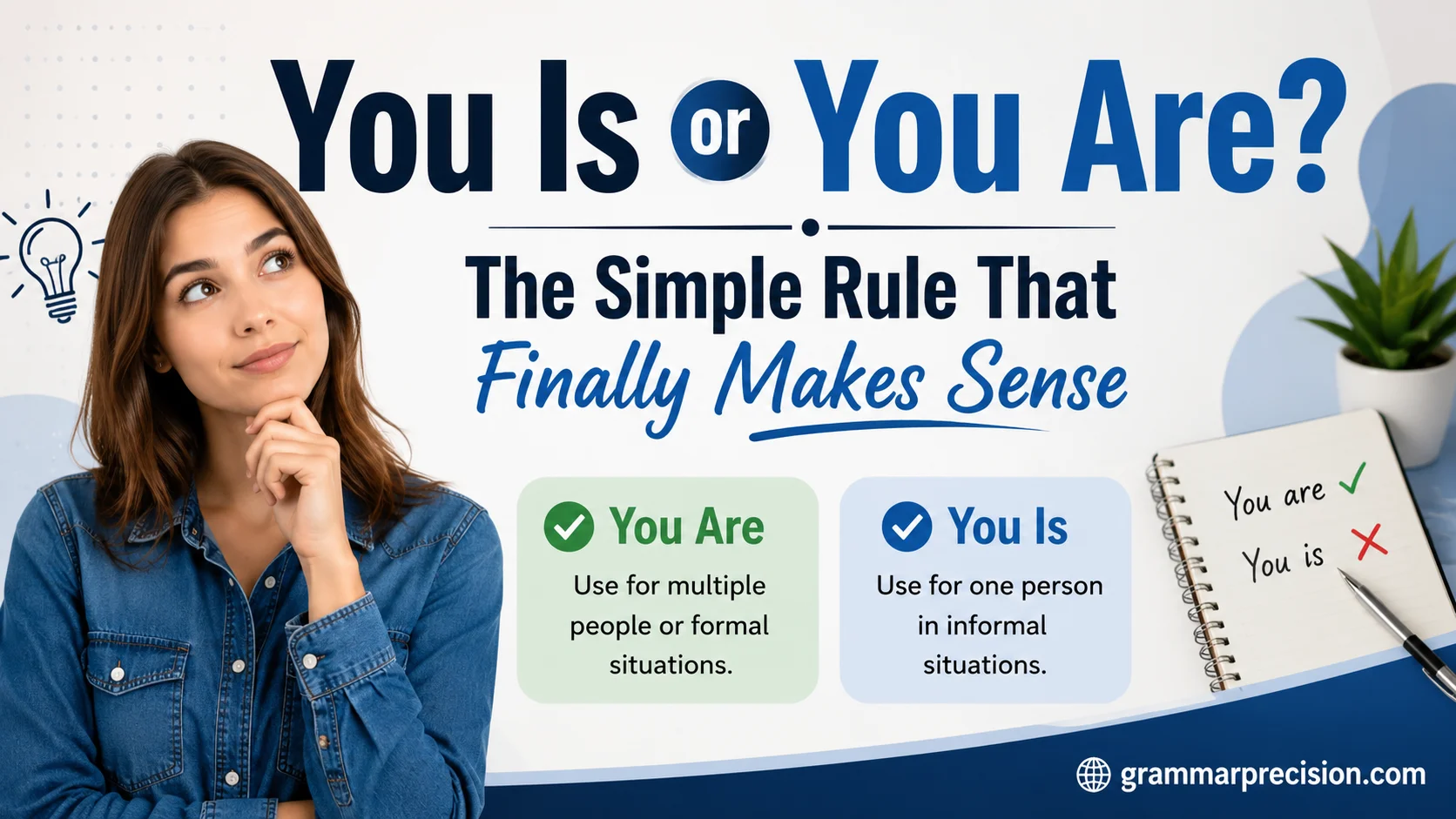
You are is correct in standard English.
You is is generally incorrect in standard English.
Consider these examples:
- You are very kind. ✅
- You are my best friend. ✅
- You are late today. ✅
- You is very kind. ❌
- You is my best friend. ❌
- You is late today. ❌
Notice something important: “you are” works whether you’re speaking to one person or multiple people.
Talking to One Person
When you address a single person, use you are:
You are a talented writer.
You are my closest friend.
You are responsible for this project.
Although each sentence addresses only one person, are remains the correct verb.
Talking to Several People
The same structure applies when you address a group:
You are excellent students.
You are welcome to join us.
You are all invited to dinner.
So, whether you means one person or twenty people, the verb remains are.
That’s one of the quirks of English grammar. It doesn’t always behave as logically as you might expect.
Why “You Is” Feels Tempting
The biggest source of confusion comes from comparing you with other pronouns.
Look at these sentences:
- He is ready.
- She is ready.
- It is ready.
- You are ready.
At first glance, the pattern seems inconsistent. If you refers to one person, why doesn’t it take is?
The answer lies in the special grammar of the second-person pronoun you.
English doesn’t choose the verb solely according to whether the person is singular or plural. Some pronouns have fixed verb patterns. You is one of them.
The same pattern appears in questions:
Are you ready?
Not:
Is you ready?
Likewise, negative sentences use are:
You are not wrong.
Not:
You is not wrong.
The form remains stable regardless of whether you identifies one person or a group.
The One Rule You Need to Remember
Here’s the easiest rule:
Use “you are” with you, whether you means one person or more than one person.
Think of are as the grammatical partner of you.
| Subject | Correct form of “be” | Example |
| I | am | I am ready. |
| You | are | You are ready. |
| He | is | He is ready. |
| She | is | She is ready. |
| It | is | It is ready. |
| We | are | We are ready. |
| They | are | They are ready. |
This table makes the pattern easier to see.
I takes am.
He, she, and it take is.
You, we, and they take are.
Once you memorize this pattern, choosing between “you is or you are” becomes almost automatic.
Is “You Are” Singular or Plural?
Here’s where things get particularly interesting.
You can be singular or plural.
For example:
You are my brother.
Here, you refers to one person.
Now compare it with:
You are my brothers.
Here, you refers to more than one person.
The subject changes in number, but the verb doesn’t change.
| Meaning of “you” | Example | Verb |
| Singular | You are my neighbor. | are |
| Plural | You are my neighbors. | are |
| Singular | You are responsible. | are |
| Plural | You are responsible. | are |
This is one reason English learners often find you are confusing.
In some languages, singular and plural forms of “you” have different grammar. English sometimes adds words such as you all, you guys, or you two to make the number clearer.
However, the standard verb remains are.
You Is vs. You Are: Side-by-Side Examples
Seeing the forms next to each other can make the rule much clearer.
| Incorrect in standard English | Correct | Why |
| You is happy. | You are happy. | You takes are. |
| You is my friend. | You are my friend. | Standard subject-verb agreement. |
| You is ready. | You are ready. | Are follows you. |
| You is late. | You are late. | You + are is the standard pattern. |
| You is responsible. | You are responsible. | The verb must agree with you. |
| You is correct. | You are correct. | Are is required. |
The mistake often happens when someone mentally substitutes he or she for you.
For instance:
She is ready.
Because she is singular, is makes sense.
But:
You are ready.
The pronoun you has a different verb pattern.
Common Situations Where You’ll Use “You Are”
The phrase you are appears in countless everyday sentences. Learning these patterns can help you recognize correct usage naturally.
Describing Someone
Use you are when describing a person’s qualities or characteristics.
You are patient.
You are very creative.
You are incredibly thoughtful.
These sentences use are because the subject is you.
Talking About Identity
You also use you are to identify someone or explain their role.
You are the new manager.
You are my neighbor.
You are the person I called yesterday.
The structure is simple:
You + are + noun or noun phrase
Describing Feelings
When discussing someone’s emotional state, you are remains correct.
You are happy.
You are nervous.
You are excited about the trip.
You are upset about what happened.
The same rule applies even when the adjective changes.
Discussing Location
Use you are to describe where someone is.
You are at home.
You are in the right place.
You are near the entrance.
You are already at the airport.
Again, the verb doesn’t change because you can refer to one person or several people.
Talking About Actions
The phrase also appears in continuous verb forms:
You are working hard.
You are learning quickly.
You are making good progress.
Here, are functions as an auxiliary verb that helps form the present continuous tense.
That distinction matters. The word are isn’t always the main verb. Sometimes it helps another verb express an ongoing action.
Also Read This: In Route or En Route? Discover the Correct Phrase and Why It Matters
What Happens When You Change the Sentence?
The basic you are rule remains stable across several sentence structures.
Positive Sentences
A positive sentence simply states something about the person or group.
You are correct.
You are doing well.
You are ready for the test.
Negative Statements
Add not after are:
You are not late.
You are not responsible for that mistake.
You are not alone.
The contraction aren’t can also appear in informal writing and everyday speech:
You aren’t late.
You aren’t wrong.
You aren’t ready yet.
Questions
Questions often place are before you:
Are you ready?
Are you coming with us?
Are you feeling better?
This is another useful test. If you’re asking a question, standard English uses are you, not is you.
Short Answers
The same structure appears in short replies:
“Are you tired?”
“Yes, I am.”
Interestingly, the answer uses I am because the speaker has changed the subject from you to I.
Another example:
“Are you ready?”
“Yes, you are.”
The second sentence still uses you are.
You Are vs. You’re: What’s the Difference?
You’re is simply the contraction of you are.
Therefore:
You are correct.
and:
You’re correct.
mean exactly the same thing.
The main difference involves style and context.
You are often feels slightly more formal or emphatic:
You are absolutely right.
You’re sounds more natural in casual conversation:
You’re absolutely right.
Both are grammatically correct.
When Should You Use “You Are”?
Use the full form when you want to sound more formal or place emphasis on the words.
For example:
You are responsible for submitting the report.
The full form can also create emphasis:
You are the person I need to speak with.
When Should You Use “You’re”?
Use you’re frequently in conversational writing, messages, informal emails, and dialogue.
You’re doing a great job.
You’re going to love this movie.
You’re probably wondering what happens next.
One important warning: you’re and your are not interchangeable.
Your vs. You’re vs. You Are
This trio causes far more confusion than you is vs. you are.
You’re means you are.
Your shows possession or association.
Compare:
You’re very helpful.
This means:
You are very helpful.
Now look at:
Your advice was helpful.
Here, your indicates that the advice belongs to or is associated with you.
A quick substitution test can solve many mistakes.
If you can replace the word with you are, use you’re.
You’re going to win.
Replace it:
You are going to win.
The sentence still works.
But:
Your going to win.
Replace your with you are:
You are going to win.
Although that sentence makes sense, the original sentence changes meaning because your cannot perform the same grammatical job as you’re. The correct sentence is You’re going to win.
Compare these examples:
| Word | Meaning | Example |
| You are | Full form | You are kind. |
| You’re | Contraction | You’re kind. |
| Your | Possessive determiner | Your kindness matters. |
A tiny apostrophe can completely change the grammar.
Is “You Is” Ever Acceptable?
In standard written English, you should generally avoid you is.
However, you may encounter the phrase in specific contexts. Language isn’t always as tidy as a grammar textbook suggests.
Dialect and Nonstandard Speech
Some English dialects and varieties use verb patterns that differ from standardized grammar. A speaker may say you is as part of a particular regional, cultural, or social variety.
That doesn’t automatically mean the speaker doesn’t understand grammar. Rather, it reflects a different grammatical system or speech pattern.
Standard English, however, uses you are.
Music and Lyrics
Songwriters sometimes deliberately bend grammar to create a particular rhythm, rhyme, voice, or character.
A lyric containing you is doesn’t establish a new standard grammar rule.
Creative writing works similarly. Authors may intentionally use nonstandard grammar to make dialogue sound authentic.
Character Dialogue
Imagine a novelist creating a character whose speech differs from formal standard English.
The character might say:
“You is the one who started this.”
A writer could use that construction deliberately to represent the character’s speech.
That doesn’t mean the sentence should appear in a formal essay.
Formal Writing
For academic papers, professional emails, business documents, school assignments, and standard articles, use:
You are
Avoid:
You is
unless you’re directly quoting a source and preserving its original wording.
A Quick Case Study: One Person, Same Verb
Consider a teacher speaking to a student:
You are ready for the exam.
Now imagine the teacher addressing an entire class:
You are ready for the exam.
The audience changes from one person to many. Yet are remains unchanged.
This demonstrates the unusual but useful feature of you.
The verb doesn’t tell us whether you is singular or plural. Instead, the surrounding context provides that information.
For example:
You are my sister.
The singular noun sister clarifies that you refers to one person.
Now:
You are my sisters.
The plural noun sisters shows that you refers to multiple people.
The grammar stays constant. The context does the heavy lifting.
The History Behind “You Are”
There’s also a historical reason the pattern feels unusual.
Modern English developed from earlier forms of English in which pronouns and verb forms were more complicated. Older stages of the language distinguished between singular and plural forms of the second person more clearly.
Over time, you became widely used as the ordinary second-person pronoun. It eventually replaced older singular forms in many contexts.
The result is a system that can look unusual to modern learners:
- you can refer to one person;
- you can refer to multiple people;
- you still takes are.
So the pattern isn’t a random grammatical accident. It reflects centuries of change in English pronouns and verb usage.
English has simplified many older distinctions while preserving some irregular-looking patterns.
“You Are” Compared With Other Forms of “Be”
The verb be changes form depending on the subject and tense.
In the present tense:
- I am
- you are
- he is
- she is
- it is
- we are
- they are
In the past tense:
- I was
- you were
- he was
- she was
- it was
- we were
- they were
Notice the important change:
You are happy today.
becomes:
You were happy yesterday.
So although you takes are in the present tense, it takes were in the past.
This gives you a useful pattern to remember:
You are → present
You were → past
Common Mistakes With “You Is or You Are”
These mistakes appear frequently among English learners.
Mistake: You Is
❌ You is very talented.
✅ You are very talented.
Mistake: Is You
❌ Is you ready?
✅ Are you ready?
Mistake: You Is Not
❌ You is not responsible.
✅ You are not responsible.
Mistake: You’re and Your
❌ Your going to enjoy this.
✅ You’re going to enjoy this.
Mistake: Assuming Singular Means “Is”
❌ You is my teacher.
The fact that you refers to one teacher doesn’t change the verb.
✅ You are my teacher.
The easiest solution is to memorize you + are as a fixed pair.
A Simple Memory Trick
If you keep forgetting whether to use is or are, remember this short pattern:
I am. You are. He is. She is. It is. We are. They are.
You don’t need to analyze the sentence every time.
Treat you are like a matched pair, similar to I am.
Another useful trick is to turn the sentence into a question.
Suppose you’re unsure about:
You ___ ready.
Turn it into:
___ you ready?
The natural form is:
Are you ready?
That immediately points you toward are.
Quick Reference: You Is or You Are
| Question | Answer |
| Is “you are” correct? | Yes. |
| Is “you is” standard English? | No. |
| Can “you” be singular? | Yes. |
| Can “you” be plural? | Yes. |
| Does singular “you” take “is”? | No. |
| Does “you” take “are”? | Yes. |
| Is “you’re” short for “you are”? | Yes. |
| Is “your” the same as “you’re”? | No. |
| Can “you is” appear in dialogue? | Yes, when deliberately representing nonstandard speech. |
| Should formal writing use “you is”? | No, use “you are”. |
FAQs:
What is correct: “You is” or “You are”?
The correct form is “you are.” The phrase “you is” is grammatically incorrect in standard English. Use you are when describing a state, action, or condition. For example, “You are happy” and “You are learning.” You can also use the contraction “you’re,” which means “you are.”
Why is “you is” incorrect?
“You is” is incorrect because you takes the verb are, not is. The verb “to be” changes according to the subject. We say “I am,” “you are,” “he is,” and “they are.” Therefore, when the subject is you, always use are in standard English.
Is “you’re” the same as “you are”?
Yes. “You’re” is the contraction of “you are.” Both forms have the same meaning, but their usage can differ slightly by context. Use you’re in casual writing and conversation, while you are may provide more emphasis or sound more formal. For example, “You’re correct” means “You are correct.”
How can I remember “you are” is correct?
Try a simple replacement test. Whenever you see you’re, replace it with you are. If the sentence still makes sense, you’re is probably correct. For example, “You’re ready” becomes “You are ready.” However, if you want to show possession, use your, as in “your phone” or “your book.”
What is the difference between “your” and “you’re”?
Your is a possessive adjective that shows something belongs to or relates to you. You’re is a contraction meaning you are. For example, “Your car is clean” shows possession, while “You’re driving carefully” means “You are driving carefully.” Remembering this difference can improve your grammar accuracy and writing clarity.
Conclusion:
Understanding “you is or you are” becomes much easier once you remember one simple rule: use “you are” with you. The contraction “you’re” has the same meaning, while “your” shows possession. Use the replacement test whenever you feel unsure. With regular practice, this small grammar rule can become second nature, making your everyday writing more clear, accurate, and professional.