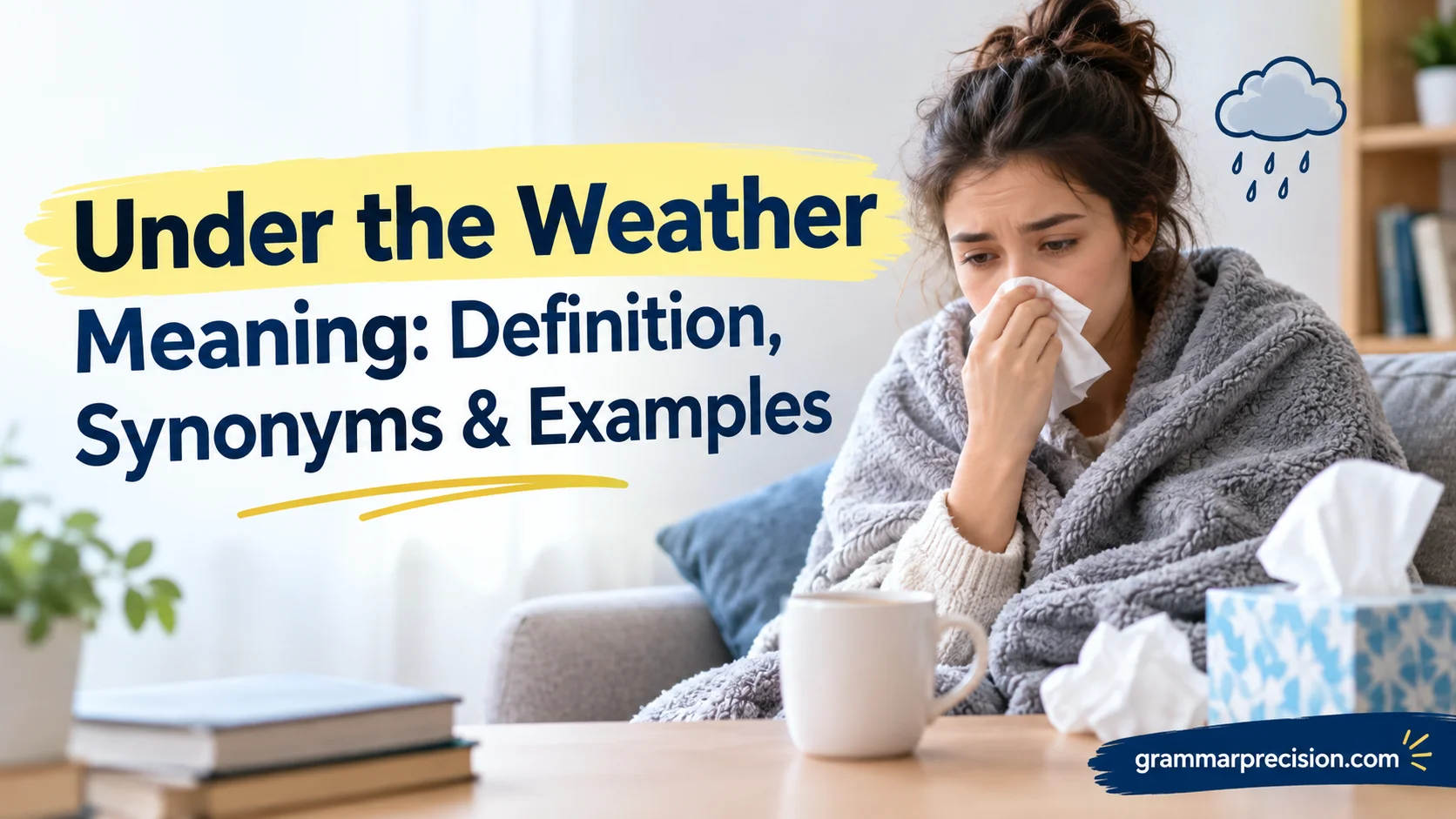
Have you ever heard someone say they’re “under the weather” and wondered what they actually meant? The Under the Weather Meaning has nothing to do with literally standing beneath rain or clouds. It’s a common English idiom for feeling sick, unwell, or not quite yourself. In this guide, you’ll discover its definition, origin, pronunciation, synonyms, sentence examples, and everyday usage. You’ll also see how context shapes its meaning in English usage, grammar, formal writing, business communication, and casual conversations.
Whether you’re writing an email, planning meetings, managing a calendar, or handling scheduling and time management, choosing the right expression matters. The same principle applies to online booking, broadcasting, and project management, where clear language prevents confusion. This article also explores how the phrase works in different situations and how it compares with similar expressions. While US English commonly favors certain conversational patterns, UK English may show different preferences in vocabulary and style. Understanding these regional and style-guide differences can help you communicate with greater clarity, consistency, and confidence.
Under the Weather Meaning at a Glance
| Feature | Explanation |
| Meaning | Feeling ill or not feeling well |
| Type | Idiom |
| Tone | Informal and conversational |
| Typical use | Mild or temporary illness |
| Common phrase | “I’m feeling under the weather.” |
| Literal meaning | Being physically beneath the weather |
| Best contexts | Conversations, texts, casual workplace speech |
| Formal alternative | “I’m feeling unwell.” |
The expression can describe anything from a developing cold to general fatigue. It doesn’t identify a specific illness.
For example, if you have a headache and feel tired, you might say you’re under the weather. You don’t necessarily need to tell someone whether you have a cold, fever, allergies, or another minor problem.
What Does “Under the Weather” Mean?
“Under the weather” means feeling physically unwell, sick, weak, or below your normal level of health.
The expression normally suggests that the person isn’t seriously ill. Instead, they feel somewhat off. That subtle distinction makes the idiom especially common in everyday conversation.
Consider these examples:
- I’m feeling under the weather today.
- Sarah has been under the weather all week.
- I think Tom is a little under the weather.
- I was under the weather, so I stayed home.
In each sentence, the speaker communicates illness without naming a particular condition.
The phrase can also soften the statement. Saying “I’m under the weather” often sounds less blunt than saying “I’m sick.” It gives the listener useful information while leaving the medical details private.
What Does “Feeling Under the Weather” Mean?
“Feeling under the weather” means feeling somewhat sick or physically uncomfortable.
The word feeling makes the expression particularly natural because it focuses on your current condition.
For example:
“I’m feeling a little under the weather, so I might skip dinner tonight.”
Here, the speaker probably feels ill enough to rest but doesn’t necessarily have a serious health problem.
Words such as a little, slightly, and a bit often appear with the expression. They reinforce the idea of mild discomfort.
Is “Under the Weather” an Idiom?
Yes. “Under the weather” is an idiom because its overall meaning doesn’t come directly from the individual words.
Literally, everyone is technically under the weather. Unless you’re on the moon, the atmosphere is above you. However, that’s not what the expression communicates.
Idioms work through established cultural meaning. For example:
- Break the ice means to make people feel more comfortable.
- Hit the sack means to go to bed.
- Spill the beans means to reveal information.
- Under the weather means to feel unwell.
The words create an image, but the established expression carries the real meaning.
That distinction matters for English learners. Translating the phrase word for word can produce a strange interpretation. Instead, learn under the weather as one complete expression.
Under the Weather Meaning in Different Contexts
The idiom works particularly well in casual situations because it sounds friendly and understated.
In Everyday Conversation
This is where the expression feels most natural.
“You don’t look like yourself today.”
“Yeah, I’m a little under the weather.”
It can refer to a cold, tiredness, mild stomach trouble, a headache, or another temporary problem.
In Text Messages
The phrase also works naturally in texts.
“Can’t make it tonight. Feeling under the weather.”
That’s short, polite, and clear. You don’t need to provide a long explanation.
At Work
You can use the idiom in casual workplace conversations.
“I’m feeling under the weather today, but I should be fine tomorrow.”
However, formal workplace communication often benefits from more direct wording.
For example, an email to a manager might sound more professional as:
“I’m feeling unwell today and need to take the day off.”
The idiom isn’t wrong. The choice depends on the level of formality.
On Social Media
People sometimes use the phrase when explaining why they haven’t been active.
“I’ve been a little under the weather lately. Hopefully, I’ll be back soon.”
It sounds relaxed and avoids unnecessary medical detail.
Under the Weather Examples
Seeing the expression in different sentence patterns makes its meaning much easier to understand.
Simple Examples
- I’m under the weather today.
- She looks a little under the weather.
- He has been under the weather lately.
- We stayed home because Mom was under the weather.
- I felt under the weather after the trip.
- Jake isn’t feeling well because he’s under the weather.
- She called in sick because she was under the weather.
- I’m a bit under the weather this morning.
Conversational Examples
A: Are you coming to the game tonight?
B: Probably not. I’m feeling under the weather.
A: You seem quiet today. Everything okay?
B: I’m just a little under the weather.
A: Why did Emma leave early?
B: She was feeling under the weather.
Workplace Examples
- I’m feeling under the weather, so I’ll work from home today.
- Mark has been under the weather since Monday.
- I may need to leave early because I’m feeling under the weather.
- She was under the weather but still attended the meeting.
Notice that these examples don’t specify an illness. That’s one of the phrase’s biggest advantages.
How to Use “Under the Weather” Grammatically
Although the expression is idiomatic, its grammar is straightforward.
The most common pattern is:
Subject + be + under the weather
Examples include:
- I am under the weather.
- She is under the weather.
- They are under the weather.
- He was under the weather yesterday.
You can also place feeling before the expression:
- I’m feeling under the weather.
- She’s feeling under the weather.
- They were feeling under the weather.
Using Different Tenses
The phrase can work with several verb tenses.
Present:
“I’m under the weather today.”
Past:
“I was under the weather yesterday.”
Present perfect:
“She has been under the weather all week.”
Past perfect:
“He had been under the weather before the trip.”
The idiom itself doesn’t change. The verb changes according to the time you’re describing.
Under the Weather Synonyms and Alternatives
Sometimes you need a different expression. Fortunately, English gives you plenty of choices.
| Expression | Tone | Typical Meaning |
| Feeling sick | Neutral | Feeling physically ill |
| Feeling unwell | Neutral/formal | Not feeling healthy |
| Not feeling well | Neutral | General illness |
| Feeling lousy | Casual | Feeling quite bad |
| Feeling rough | Casual | Feeling physically poor |
| Feeling off | Casual | Not feeling normal |
| Out of sorts | Casual | Feeling physically or emotionally unusual |
The best synonym depends on your audience.
If you’re talking to a friend, “I’m feeling lousy” may sound perfectly natural. In a professional email, “I’m feeling unwell” usually fits better.
Under the Weather vs. Feeling Sick
These expressions overlap, but they aren’t identical in tone.
“I’m sick” is more direct. It clearly tells someone that you’re ill.
“I’m under the weather” sounds softer and less specific.
Compare these:
“I’m sick. I can’t come to work.”
“I’m feeling under the weather. I may need to rest today.”
The second sentence leaves more room for interpretation. The illness could be minor, temporary, or simply uncomfortable.
That’s why the idiom often works well when you want to communicate without oversharing.
Under the Weather vs. Feeling Unwell
“Feeling unwell” has almost the same basic meaning but carries a more neutral or formal tone.
| Phrase | Formality | Style |
| Under the weather | Low | Conversational |
| Feeling sick | Medium | Direct |
| Not feeling well | Medium | Natural and broad |
| Feeling unwell | Medium-high | Polite and professional |
For example, a friend might ask:
“What’s wrong?”
You could answer:
“I’m just under the weather.”
At work, especially in a formal message, this may be preferable:
“I’m feeling unwell and won’t be able to attend today.”
Neither option is incorrect. Context determines the better choice.
Why Do People Say “Under the Weather”?
The origin of under the weather is more interesting than the modern meaning suggests.
The expression appears in English from the early nineteenth century. Etymonline records “under the weather” in 1803 with an earlier sense connected to being in difficulty, while the familiar sense of being indisposed appears around 1810.
The phrase is generally associated with nautical language. On ships, “weather” could refer to conditions involving wind and exposure. Related nautical expressions described locations or parts of a vessel in relation to the wind.
However, the popular explanation isn’t as certain as many websites make it sound.
The Famous Sailor Theory
A common story says that sailors who became seasick were sent below deck to escape rough weather. Because they were physically below the exposed deck, they supposedly ended up “under the weather.”
It’s an appealing explanation. It paints an instant picture: rough waves above, an ill sailor below.
But historical evidence doesn’t firmly prove that this exact scenario created the modern idiom. Phrase research points to nautical expressions such as “under the weather shore” and related terms while noting that the exact path into the illness meaning is more complicated.
What We Can Say With Confidence
The safest explanation is that the phrase has strong nautical associations and developed into a general expression for difficulty or illness in the early 1800s.
That’s more accurate than presenting one colorful sailor story as settled fact.
Historical usage also shows that the phrase once had a broader range of meanings. Early examples could refer to hardship or being in difficulties rather than simply having a cold.
Over time, the health-related sense became the dominant modern meaning.
What Does “A Little Under the Weather” Mean?
Adding “a little” makes the expression sound even milder.
“I’m under the weather.”
This suggests you’re not feeling well.
“I’m a little under the weather.”
This suggests that the problem is probably mild.
Other modifiers work similarly:
- a bit under the weather
- slightly under the weather
- feeling a little under the weather
- feeling somewhat under the weather
These phrases are useful when you want to avoid making your condition sound dramatic.
For instance:
“I’m a bit under the weather, but I’ll be back at work tomorrow.”
That sentence suggests a temporary issue rather than a major health crisis.
Can “Under the Weather” Describe Emotions?
Usually, “under the weather” refers to physical illness or poor health.
However, speakers sometimes use it loosely when someone appears generally low or not themselves. Context can make the meaning broader.
Still, if you specifically mean sadness, stress, or emotional distress, another phrase may communicate your meaning more precisely.
For example:
- I’m feeling down.
- I’m not myself today.
- I’m having a rough day.
- I’m feeling emotionally drained.
So, don’t automatically use under the weather for every negative mood. Its core meaning remains physical unwellness.
Is “Under the Weather” Formal or Informal?
Under the weather is informal. Cambridge explicitly labels the idiom as informal.
That makes it excellent for:
- Conversations
- Text messages
- Friendly emails
- Casual workplace discussions
- Social media
- Everyday speech
It isn’t necessarily inappropriate at work. However, formal communication often favors clearer alternatives.
Casual
“I’m feeling under the weather today.”
Professional
“I’m feeling unwell today and need to take the day off.”
Very Formal
“I’m unable to attend today due to illness.”
The underlying message stays the same. Only the register changes.
What Should You Say When Someone Is Under the Weather?
When someone tells you they’re feeling unwell, a simple response works best.
You could say:
- “I’m sorry to hear that.”
- “Hope you feel better soon.”
- “Take care of yourself.”
- “Get some rest.”
- “Don’t worry about tonight. Rest up.”
- “Let me know if you need anything.”
In a workplace setting, keep your response supportive but practical:
“Hope you feel better soon. We can catch up on anything you miss.”
That sounds warmer than simply saying, “Okay.”
Common Mistakes With “Under the Weather”
Even familiar idioms can cause awkward sentences. Here are the mistakes worth avoiding.
Treating It Literally
Don’t assume the phrase means someone is physically standing beneath bad weather.
❌ “I stayed under the weather because it was raining.”
That sentence uses the words literally rather than using the idiom.
Using It for Severe Illness
The expression generally sounds mild and understated.
If someone has a serious medical emergency, “under the weather” may sound far too casual or vague.
Instead, use a direct description appropriate to the situation.
Changing the Expression Unnecessarily
The standard form is:
under the weather
Avoid strange variations such as:
❌ “below the weather”
❌ “beneath the weather”
Those may be understandable literally, but they aren’t the established idiom.
Assuming It Names a Specific Illness
The phrase doesn’t tell you whether someone has a cold, flu, headache, allergies, or another condition.
It simply communicates that the person doesn’t feel well.
Under the Weather: Quick Comparison
| Phrase | Meaning | Tone | Example |
| Under the weather | Feeling somewhat ill | Informal | “I’m under the weather today.” |
| Feeling sick | Feeling ill | Neutral | “I’m feeling sick.” |
| Feeling unwell | Not feeling healthy | Formal/neutral | “She’s feeling unwell.” |
| Feeling lousy | Feeling quite bad | Casual | “I feel lousy today.” |
| Feeling off | Not feeling normal | Casual | “I’ve been feeling off.” |
| Out of sorts | Feeling unusual or unsettled | Casual | “I’m a little out of sorts.” |
This comparison shows why idioms matter. Two phrases can share a definition while carrying different levels of formality, intensity, and personality.
Final Takeaway: Under the Weather Meaning
The under the weather meaning is simple: feeling ill, slightly sick, or not quite yourself physically. It is an informal English idiom that works especially well in everyday conversation, texts, and casual workplace speech.
The expression usually suggests a mild or temporary problem rather than a serious illness. Its history reaches back to early nineteenth-century English, with strong nautical associations, although the exact origin story remains less certain than the popular sailor explanation suggests.
If you want a softer way to say you’re sick, “I’m under the weather” is a natural choice. When the situation calls for greater formality, switch to “I’m feeling unwell” or “I’m not feeling well.” Once you understand that difference, you’ll know exactly when this colorful idiom fits.
FAQs About Under the Weather Meaning
What does “under the weather” mean?
“Under the weather” means feeling ill, slightly sick, or generally unwell. It usually describes a mild or temporary health problem and sounds informal.
Is “under the weather” an idiom?
Yes. “Under the weather” is an English idiom because its intended meaning isn’t literal. The phrase means feeling unwell rather than physically being beneath weather.
Is “under the weather” formal or informal?
It is informal. You can use it in conversations, texts, casual emails, and relaxed workplace discussions. For formal communication, “feeling unwell” usually sounds more appropriate.
What is another word for “under the weather”?
Depending on the context, alternatives include feeling sick, feeling unwell, not feeling well, feeling lousy, feeling rough, and feeling off. Each option carries a slightly different tone.
Why do people say “under the weather”?
The phrase is strongly linked to nautical language from the early nineteenth century. Several explanations connect it with sailors and exposure to rough weather, but the precise origin remains debated. The expression eventually developed its modern meaning of feeling ill.
Can you use “under the weather” at work?
Yes, especially in casual conversation with coworkers. However, formal emails and official messages usually sound better with phrases such as “I’m feeling unwell” or “I’m not feeling well.”
Conclusion:
Understanding the Under the Weather Meaning helps you use this common idiom naturally. It describes feeling slightly sick or unwell, especially in casual conversations, texts, and everyday communication.
Remember, “under the weather” is informal and usually suggests a mild illness. For formal writing or professional communication, choose “feeling unwell” or “not feeling well.” Understanding these differences improves your English usage, clarity, and confidence.