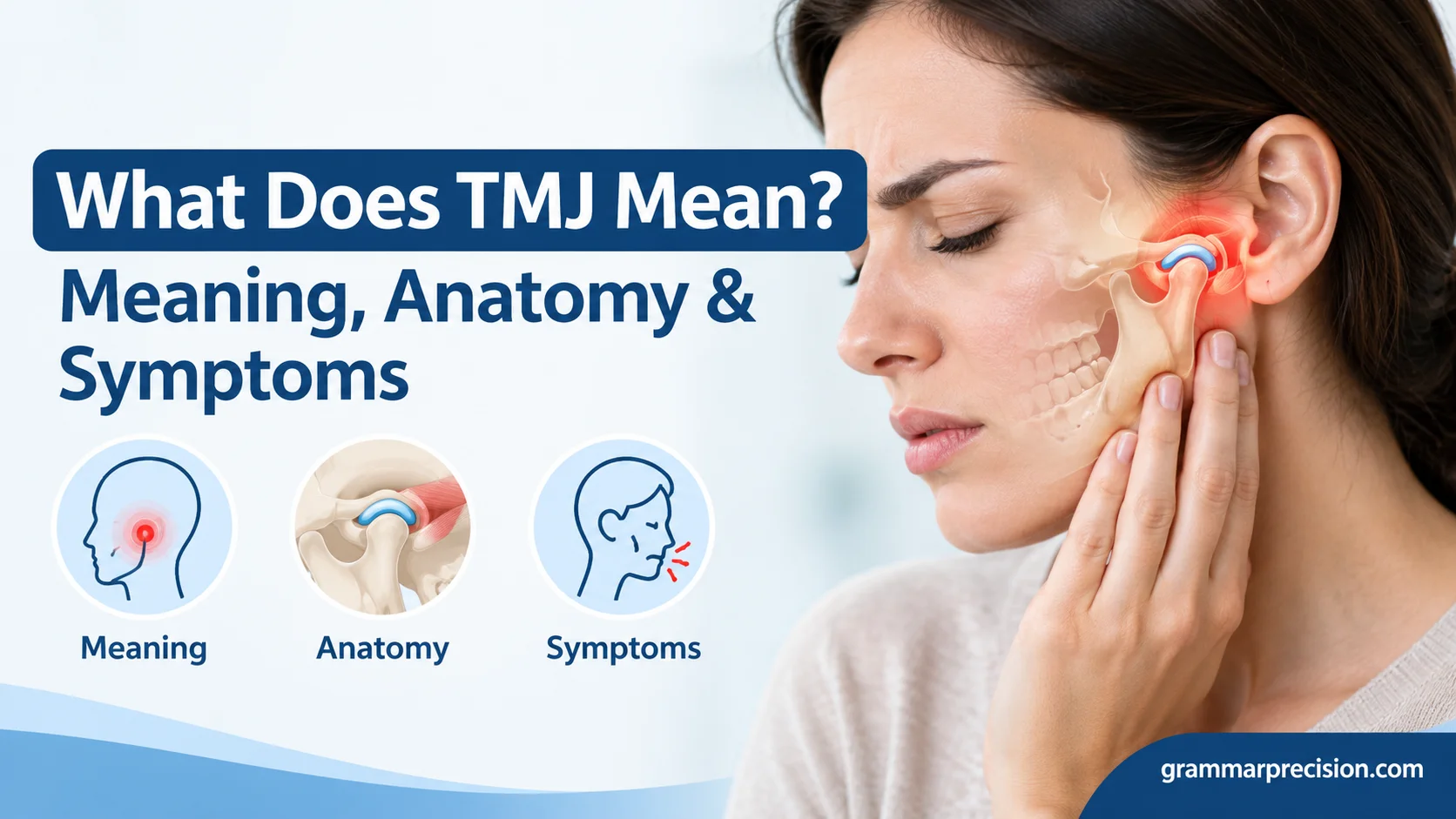
Have you ever seen TMJ in a medical article and wondered, “What does TMJ mean?” The acronym stands for temporomandibular joint, the paired joints connecting your lower jaw to your skull. This article explains the TMJ meaning, its function, common symptoms, and the difference between TMJ and TMD. While terms like scheduling, time management, business communication, and online booking belong to different contexts, clear English usage still matters when you encounter abbreviations in professional or everyday writing.
As you explore the topic, you’ll learn how the TMJ supports chewing, speaking, swallowing, and jaw movement, plus what can cause related discomfort. The guide also covers practical terminology, medical context, and common misconceptions with clear examples. Although grammar, formal writing, consistency, meetings, calendar, project management, and broadcasting may seem unrelated, style guides and regional preferences show why precise wording matters. US English commonly favors straightforward terminology, while UK usage may vary slightly in spelling and style.
What Does TMJ Mean?
TMJ means temporomandibular joint. The name sounds complicated, but its meaning becomes clearer when you break it down.
- Temporo- refers to the temporal bone of the skull.
- Mandibular refers to the mandible, or lower jawbone.
- Joint means the place where bones meet and move.
Your two TMJs work together whenever your jaw moves. Unlike a basic hinge, each joint combines hinging and sliding movements. A small cartilage-covered disc sits inside the joint and helps cushion movement.
| Term | Meaning | What It Describes |
| TMJ | Temporomandibular joint | The jaw joint itself |
| TMD | Temporomandibular disorder | Conditions affecting the joint, muscles, or related tissues |
| Bruxism | Teeth grinding or clenching | A behavior that can contribute to jaw symptoms |
| TMJ pain | Pain around the jaw joint or muscles | A symptom rather than one specific diagnosis |
So, if you’re searching “what does TMJ stand for?”, the answer is temporomandibular joint. If you’re talking about pain or dysfunction, TMD is generally the more precise medical term.
Where Is the TMJ Located?
You can locate your TMJ without any special equipment.
Place your fingertips just in front of your ears. Then slowly open and close your mouth. You should feel movement beneath your fingers as the jaw joints move.
Each TMJ connects the mandible with the temporal bone of the skull. The joint contains several structures that work together, including bone surfaces, cartilage, connective tissues, muscles, and an articular disc.
The joint’s unusual design allows your lower jaw to move in several directions. You can open and close your mouth, move your jaw forward and backward, and shift it from side to side.
That’s why the TMJ plays such a big role in everyday activities. You use it hundreds or even thousands of times during ordinary eating and speaking.
How Does the TMJ Work?
The TMJ acts somewhat like a hinge combined with a sliding track.
When you begin opening your mouth, the jaw rotates within the joint. As you open farther, the lower jaw also moves forward. The joint’s disc helps the surfaces move smoothly during this process.
Several muscles control these movements. The major chewing muscles include the masseter, temporalis, and pterygoid muscles. Together, they create the force required to bite, chew, speak, and move the jaw.
What Does the TMJ Help You Do?
Your TMJs support several everyday functions:
- Chewing food
- Speaking clearly
- Swallowing
- Yawning
- Laughing
- Opening and closing your mouth
- Moving your jaw forward and backward
- Moving your jaw from side to side
Because the jaw moves constantly, even a small problem can become surprisingly noticeable.
What Is the Difference Between TMJ and TMD?
This is one of the most important points to understand.
TMJ is the name of the joint. TMD is the name for disorders involving that joint and related structures.
NIDCR describes TMDs as a group of more than 30 conditions. These conditions broadly involve the jaw joints, chewing muscles, and headaches associated with TMD. A person can also have more than one TMD condition at the same time.
TMJ vs. TMD at a Glance
| Feature | TMJ | TMD |
| Full term | Temporomandibular joint | Temporomandibular disorders |
| What it means | A body structure | A group of conditions |
| Normally present? | Yes | No |
| Can it cause symptoms? | The joint can be involved in symptoms | Yes |
| Refers to pain? | Not necessarily | Often involves pain or dysfunction |
In everyday conversation, people commonly say “I have TMJ” when they mean “I have a TMJ disorder.” Healthcare professionals may use TMD when discussing the actual condition.
What Are Common TMJ Symptoms?
Not every jaw sound means something is wrong. In fact, painless clicking or popping can occur normally and often doesn’t require treatment.
Problems become more concerning when sounds occur alongside pain, restricted movement, or other symptoms.
Common TMD symptoms include:
- Jaw pain or tenderness
- Pain around one or both jaw joints
- Facial pain
- Neck discomfort
- Headaches
- Ear-area aching
- Pain while chewing
- Jaw stiffness
- Difficulty opening your mouth
- Jaw locking
- Painful clicking or popping
- Grating sensations
- Changes in how your teeth meet
Some people also report ringing in the ears, dizziness, or hearing-related symptoms. However, these symptoms can have many possible causes, so they don’t automatically prove that TMD is responsible.
Is Jaw Clicking Always a TMJ Problem?
No.
A click by itself isn’t necessarily a medical problem. If your jaw clicks but doesn’t hurt and moves normally, treatment may not be necessary.
The bigger warning sign is painful clicking combined with limited movement or locking.
That distinction can prevent unnecessary worry. A noisy jaw isn’t automatically a damaged jaw.
What Causes TMJ Problems?
There isn’t one universal cause of TMD. In many cases, several factors interact.
NIDCR notes that injury can cause some TMDs, while the exact cause remains unclear in many other cases. Research points toward a combination of biological factors, genetics, psychological stress, and individual pain responses.
Teeth Grinding and Jaw Clenching
Bruxism involves grinding or clenching your teeth. It can place repeated stress on the chewing muscles and jaw structures.
Some people grind their teeth during sleep without realizing it. Others clench during stressful situations while working, driving, studying, or concentrating.
Stress and Muscle Tension
Stress doesn’t automatically cause TMD. However, it can influence behaviors such as jaw clenching and may affect how your nervous system processes pain.
That creates a frustrating cycle:
Stress → clenching → muscle tension → pain → more tension.
Breaking that cycle may help reduce symptoms for some people.
Jaw Injury
A blow to the jaw can injure the joint, surrounding tissues, or muscles. Certain TMDs may develop after trauma.
Even then, the resulting symptoms can vary significantly from one person to another.
Arthritis
Arthritis can affect the TMJ just as it can affect other joints. Osteoarthritis, for example, can damage joint structures and contribute to pain and stiffness.
Repetitive Jaw Habits
Certain habits can overwork the jaw muscles. Examples include:
- Frequent gum chewing
- Nail biting
- Chewing pens or pencils
- Constant jaw clenching
- Repeatedly opening the mouth extremely wide
These behaviors don’t guarantee that you’ll develop TMD. They can, however, aggravate existing symptoms.
Does Your Bite Cause TMJ Disorders?
This topic deserves special attention because older explanations often oversimplify it.
Research does not support the idea that a “bad bite” or orthodontic treatment such as braces automatically causes TMD. NIDCR specifically notes that evidence does not support that commonly repeated claim.
That doesn’t mean your dental history never matters. It means you shouldn’t assume that changing your bite will automatically solve jaw pain.
Irreversible dental procedures should therefore receive careful consideration, especially when someone recommends them solely to treat TMD.
Can TMJ Cause Ear Pain and Headaches?
Yes, TMD can be associated with ear-area pain and headaches, although those symptoms don’t prove that TMD caused them.
The TMJ sits immediately in front of the ear. The surrounding muscles and nerves also interact with nearby facial structures. As a result, discomfort may seem to spread beyond the exact location of the joint.
For example, imagine waking with a sore jaw after grinding your teeth overnight. The discomfort might feel like facial pressure rather than obvious joint pain. That pattern can make the original source difficult to recognize.
How Common Are TMJ Disorders?
TMDs aren’t rare.
NIDCR estimates that TMD affects about 5% of U.S. adults, although prevalence varies depending on the population studied and how researchers define and measure the condition. Other NIDCR materials estimate that 5% to 10% of the U.S. population has some form of TMD.
NIDCR also reports that TMDs occur about twice as often in women as in men, with particularly high occurrence among women ages 35 to 44.
| Fact | Current evidence |
| Estimated U.S. prevalence | About 5% of adults in some estimates |
| Broader estimate | About 5%–10% of the U.S. population |
| Sex difference | About twice as common in women |
| Number of recognized conditions | More than 30 TMD conditions |
| Typical course | Can be temporary or chronic |
These figures shouldn’t be treated as a diagnosis. Prevalence changes depending on the study design and definition used.
How Are TMJ Disorders Diagnosed?
There isn’t one universal test that identifies every TMD.
A dentist or physician usually starts by discussing your symptoms and examining your jaw. They may check how far your mouth opens, listen for clicking, feel the jaw muscles, and look for tenderness.
They may ask:
- When did the pain begin?
- Does chewing make it worse?
- Does the jaw lock?
- Do you grind or clench your teeth?
- Does pain spread to your face or neck?
- Do you experience headaches?
- Have you experienced a jaw injury?
Imaging isn’t always necessary. When clinicians suspect a structural problem, they may use dental X-rays, CT scans, or MRI. MRI can provide information about the joint disc and surrounding soft tissues.
Because facial and jaw pain can have many causes, healthcare professionals may also need to rule out other conditions.
How Are TMJ Disorders Treated?
Treatment depends on the specific problem.
The encouraging part is that many TMD symptoms improve without aggressive treatment. NIDCR recommends starting with conservative approaches and being cautious about treatments that permanently alter the teeth, bite, or jaw joint.
Simple TMJ Self-Care
Early management may include:
- Eating softer foods temporarily
- Cutting food into smaller pieces
- Avoiding gum chewing
- Reducing jaw clenching
- Avoiding nail biting
- Using heat or cold when appropriate
- Following gentle jaw exercises recommended by a professional
- Practicing relaxation techniques
Physical Therapy
Physical therapy can help some people restore jaw movement and reduce pain.
A qualified therapist may use stretching, strengthening exercises, manual techniques, massage, or other approaches. NIDCR notes that manual therapy may improve function and reduce pain for some TMD patients.
Medications
Healthcare professionals may recommend pain relievers or anti-inflammatory medicines for suitable patients.
Other prescription medications may sometimes play a role. However, the best option depends on the individual’s symptoms, medical history, and other medications.
Don’t treat medication lists as a DIY treatment plan. A healthcare professional can help determine what’s appropriate and safe.
Mouthguards and Oral Appliances
A dentist may recommend an intraoral appliance in selected cases. These devices can protect teeth and may help address habits such as clenching.
However, evidence for their effect on TMD pain isn’t equally strong for every patient. NIDCR recommends avoiding appliances designed to permanently change your bite.
Surgery and Advanced Procedures
Surgery isn’t usually the first step.
NIDCR recommends trying simpler approaches first because many TMD problems improve without invasive treatment. Procedures such as arthrocentesis, arthroscopy, or open surgery may have specific roles in carefully selected cases.
Permanent procedures deserve particular caution because they can permanently change the joint or bite.
What Should You Avoid If Your Jaw Hurts?
When your jaw feels irritated, don’t make it work harder than necessary.
Consider limiting:
- Chewing gum
- Hard or very chewy foods
- Nail biting
- Pen chewing
- Excessive clenching
- Very wide yawning
- Large bites
- Repeated jaw movements
Instead, give the muscles a temporary break. Think of it like an overworked calf muscle after a long hike. Constantly testing it won’t necessarily make it recover faster.
A Simple TMJ Symptom Case Study
Consider a hypothetical example.
Alex wakes up with jaw soreness several mornings each week. During the day, Alex notices frequent clenching while working. There’s also occasional clicking when opening the mouth, but no locking.
A sensible first step wouldn’t involve immediately changing Alex’s teeth or considering surgery. A dental or medical evaluation could identify possible contributing factors. Meanwhile, reducing clenching, avoiding excessive chewing, and using conservative care may help.
Now consider a different scenario.
Jordan develops sudden severe jaw pain after an injury and cannot fully open the mouth. That situation deserves professional assessment rather than casual home treatment.
The lesson is simple: the symptom pattern matters as much as the word “TMJ.”
When Should You See a Doctor or Dentist?
Consider professional evaluation if jaw pain persists, interferes with eating, or repeatedly returns.
You should seek prompt medical attention if you suddenly cannot open or close your jaw normally, especially after an injury.
A healthcare professional can also help distinguish TMD from dental problems, ear conditions, nerve pain, headaches, and other causes of facial discomfort.
TMJ Myths vs. Facts
| Myth | Fact |
| Every jaw click means you have TMD. | Painless clicking can be common and may not require treatment. |
| TMJ means a specific disease. | TMJ is the joint; TMD describes disorders involving it or related structures. |
| Braces automatically cause TMD. | Current evidence doesn’t support that claim. |
| Surgery is the best treatment for severe symptoms. | Conservative treatment generally comes first. |
| Every jaw pain problem has one clear cause. | TMD can involve several biological, behavioral, and psychological factors. |
| A mouthguard fixes every TMJ problem. | Oral appliances may help selected patients, but results vary. |
FAQs About TMJ
What does TMJ mean medically?
TMJ means temporomandibular joint. It refers to the paired joints connecting your lower jaw to your skull. These joints help you chew, speak, swallow, and move your jaw.
What does TMJ stand for?
TMJ stands for temporomandibular joint. You have one TMJ on each side of your face near your ears.
Is TMJ the same as TMD?
No. TMJ is the joint itself, while TMD means temporomandibular disorders. TMD covers a broad group of conditions affecting the jaw joints, chewing muscles, and related structures.
Can TMJ cause headaches?
TMD can be associated with headaches. However, headaches have many possible causes. A healthcare professional can help determine whether your jaw symptoms are contributing to them.
Can TMJ cause ear pain?
Yes, some people with TMD experience aching around the ear. Because several conditions can cause ear discomfort, persistent symptoms deserve proper evaluation.
Can TMJ problems go away on their own?
Yes. Many TMD symptoms are temporary and improve without aggressive treatment. Some cases become chronic, however, so persistent or severe symptoms should receive professional attention.
What is the best treatment for TMJ?
There isn’t one treatment that works for every TMD. Conservative options such as self-management, dietary changes, physical therapy, and appropriate medication often come before invasive procedures. Treatment should match the specific condition.
Conclusion:
Understanding what does TMJ mean helps you recognize the temporomandibular joint, its functions, symptoms, and connection to TMD. Clear terminology makes jaw-related information easier to understand and discuss with healthcare professionals.
Knowing the difference between TMJ and TMD can prevent confusion when researching jaw pain. Pay attention to persistent symptoms, painful clicking, stiffness, or limited movement. If these problems continue, seek professional evaluation for accurate diagnosis and appropriate treatment.