e.g. vs. i.e. often confuses writers because both abbreviations look similar. Understanding their differences helps you write clearer, more accurate, and professional sentences with confidence.
Many people mistakenly use e.g. and i.e. as if they have the same meaning, but each serves a different purpose. e.g. introduces examples, while i.e. provides a clarification or restates an idea. Learning this distinction improves your grammar, strengthens your writing, and prevents common mistakes in academic, business, and everyday communication.
If you’ve ever paused while writing to decide between e.g. vs. i.e., this guide is for you. You’ll discover their meanings, grammar rules, punctuation, practical examples, and simple memory tricks that make choosing the correct abbreviation easy. By the end, you’ll use both terms with confidence and accuracy in every piece of writing.
What Are e.g. and i.e.?
Both e.g. and i.e. are Latin abbreviations that appear frequently in English writing. They save space while helping writers introduce examples or clarify information.
Many people think they can be used interchangeably. They can’t.
Here’s the simplest way to remember the difference:
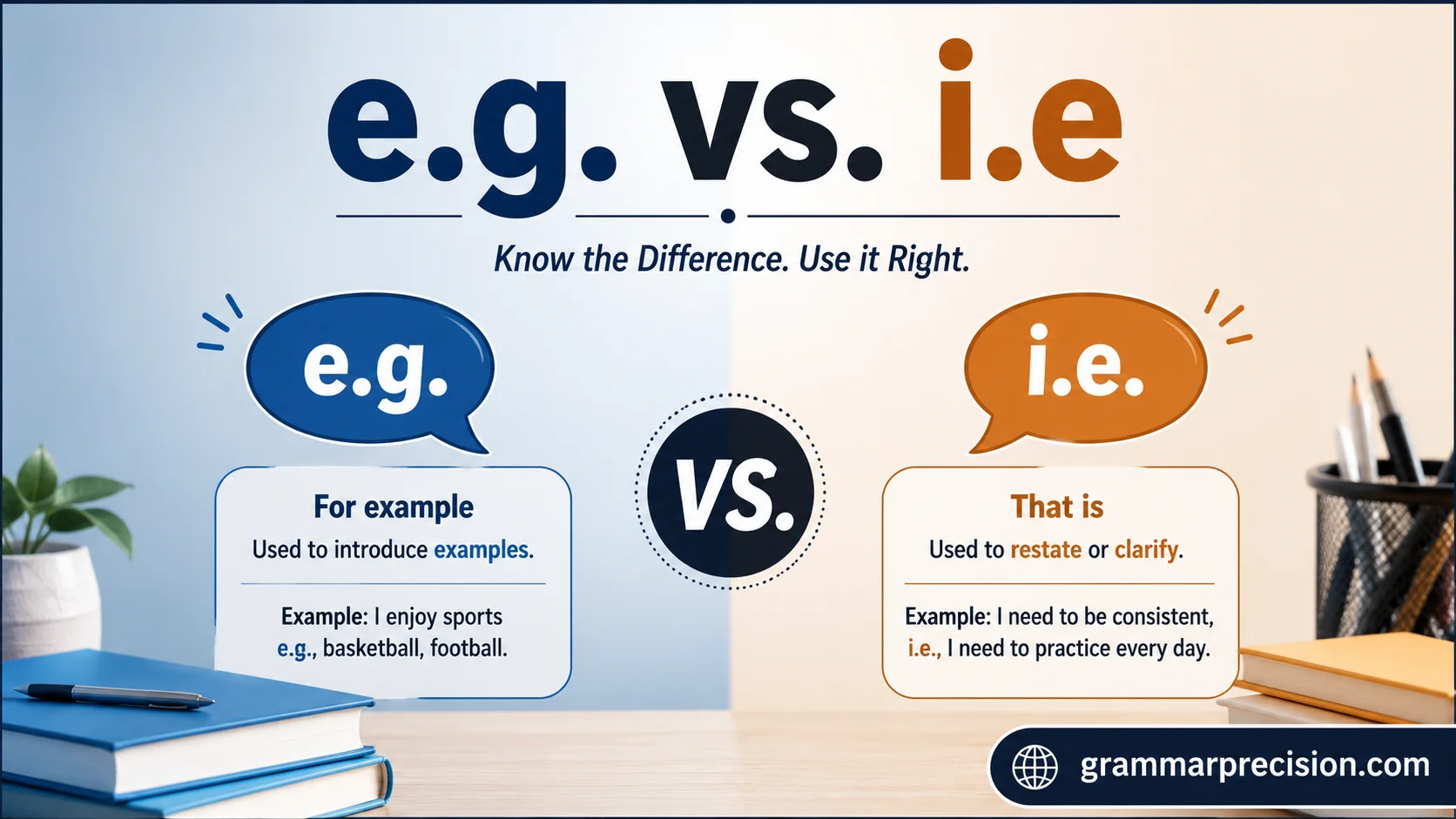
- e.g. = for example
- i.e. = in other words or that is
That one distinction solves most of the confusion.
| Abbreviation | Latin Phrase | English Meaning | Purpose |
| e.g. | exempli gratia | for example | Introduces examples |
| i.e. | id est | that is / in other words | Explains or restates something |
Why Do So Many People Confuse e.g. and i.e.?
The confusion comes from several reasons.
First, both abbreviations come from Latin. Most English speakers never study Latin, so the original meanings aren’t obvious.
Second, they look remarkably similar. Each contains two letters separated by periods, which makes them easy to mix up during writing.
Finally, many websites explain them briefly without showing enough real-life examples. As a result, readers memorize definitions but don’t know how to apply them.
Here’s a simple analogy.
Imagine you’re talking about fruit.
If you say:
I like tropical fruits, e.g., mangoes and pineapples.
You’re giving examples.
Now consider this sentence:
I only like one tropical fruit, i.e., mangoes.
Here you’re clarifying exactly which fruit you mean.
One sentence lists possibilities. The other identifies the specific answer.
What Does e.g. Mean?
The abbreviation e.g. comes from the Latin phrase exempli gratia, which translates to for the sake of example.
In modern English, it simply means:
For example
Whenever you want to introduce one or more examples—but not a complete list—use e.g.
When Should You Use e.g.?
Use e.g. when:
- Giving examples
- Suggesting possibilities
- Listing sample items
- Mentioning some, but not all, options
Notice that the list following e.g. doesn’t have to be complete.
Examples
✅ I enjoy outdoor activities, e.g., hiking, kayaking, and cycling.
✅ Several countries, e.g., Canada, Japan, and Brazil, attended the conference.
✅ Add healthy snacks, e.g., almonds, yogurt, or fruit.
In each sentence, more examples could easily be added.
Everyday Examples of e.g.
At Work
Please attach supporting documents, e.g., invoices or receipts.
At School
Read classic novels, e.g., To Kill a Mockingbird and 1984.
At Home
Plant herbs, e.g., basil, parsley, and mint.
In Blogging
Use visuals, e.g., charts, screenshots, and infographics.
Common Signal Words That Pair Well with e.g.
You’ll often see e.g. after phrases like:
- Such as
- Including
- Like
- For instance
- Examples include
Although you shouldn’t combine for example and e.g. together because they mean the same thing.
Incorrect:
For example, e.g., apples.
Correct:
e.g., apples.
or
For example, apples.
What Does i.e. Mean?
The abbreviation i.e. comes from the Latin phrase id est.
It means:
- That is
- In other words
- To put it differently
Unlike e.g., i.e. doesn’t introduce examples.
Instead, it explains, clarifies, or defines exactly what you mean.
Think of it as replacing vague language with something more precise.
When Should You Use i.e.?
Use i.e. when you want to:
- Clarify an idea
- Restate information
- Define something
- Remove ambiguity
Examples
✅ The meeting starts at noon, i.e., 12:00 p.m.
✅ She lives in the Windy City, i.e., Chicago.
✅ The assignment requires original work, i.e., no copied content.
Each sentence gives one exact explanation—not examples.
Everyday Examples of i.e.
Submit your application before Friday, i.e., July 18.
Business
The shipment includes one premium model, i.e., the Deluxe Edition.
Education
Students must cite scholarly sources, i.e., peer-reviewed journals.
Technology
Update your browser, i.e., install the latest available version.
e.g. vs. i.e.: The Key Difference
This is the section most readers search for.
Here’s the easiest explanation.
| e.g. | i.e. |
| Means for example | Means that is |
| Introduces examples | Introduces explanations |
| List is incomplete | Statement is complete |
| Shows possibilities | Gives the exact meaning |
Compare these sentences.
Using e.g.
Bring something to read, e.g., a novel or magazine.
You could also bring a newspaper, comic book, or textbook.
Those were only examples.
Using i.e.
Bring your favorite novel, i.e., The Great Gatsby.
Now the sentence identifies exactly which novel.
There are no alternatives.
Quick Test
Ask yourself one question.
Can I replace the abbreviation with “for example”?
If yes…
Use e.g.
If not, ask another question.
Can I replace it with “that is” or “in other words”?
If yes…
Use i.e.
This simple test works almost every time.
Comparison Table: e.g. vs. i.e.
| Feature | e.g. | i.e. |
| Full Latin phrase | Exempli gratia | Id est |
| English meaning | For example | That is |
| Purpose | Gives examples | Clarifies meaning |
| Complete list? | No | Yes |
| Introduces | Sample items | Exact explanation |
| Reader expectation | More possibilities exist | This is the precise meaning |
| Common replacement | For example | In other words |
Easy Memory Tricks You’ll Never Forget
Many grammar guides stop after defining the abbreviations. A few memorable tricks make them stick.
Trick One: Think of the First Letter
- e = example
- i = in other words
That’s all many writers need.
Trick Two: Picture a Classroom
A teacher says:
“Some mammals, e.g., whales and dolphins.”
The teacher gives examples.
Later the teacher says:
“Marine mammals, i.e., mammals that live in the ocean.”
Now the teacher explains the meaning.
Trick Three: The Door Analogy
Imagine a door.
e.g. opens the door to several possibilities.
i.e. closes the door because it identifies exactly what you mean.
Trick Four: The Restaurant Method
“I love Italian dishes, e.g., pizza and lasagna.”
Many dishes qualify.
“My favorite Italian dish is pizza, i.e., Margherita pizza.”
Only one specific dish remains.
Decision Tree: Which One Should You Use?
Are you giving examples?
│
YES
│
Use e.g.
│
▼
Are you explaining exactly what you mean?
│
YES
│
Use i.e.
Whenever you’re unsure, walk through these two questions before writing.
Real-Life Examples Across Different Types of Writing
Understanding grammar rules is one thing. Applying them in real situations makes the lesson stick. The next section explores how e.g. and i.e. appear in emails, essays, business writing, academic papers, and everyday communication while highlighting the subtle differences that strong writers notice.
e.g. vs. i.e. in Emails
Emails should be clear and concise. Choosing the correct abbreviation helps your message sound professional and avoids confusion.
Correct Examples
✅ Please upload the required documents, e.g., your passport, driver’s license, or national ID.
Here, you’re listing examples of acceptable documents. Other forms of identification may also work.
✅ The meeting has been moved to the afternoon, i.e., 2:00 p.m.
In this sentence, you’re giving the exact meeting time rather than a sample.
Incorrect Example
❌ Please bring office supplies, i.e., pens and notebooks.
This implies that pens and notebooks are the only office supplies you should bring.
If you meant they are just examples, write:
✅ Please bring office supplies, e.g., pens and notebooks.
e.g. vs. i.e. in Academic Writing
Academic writing values precision above everything else. That’s why professors and journal editors expect writers to understand these abbreviations.
Using e.g.
Researchers often introduce examples without listing every possibility.
Example:
Several renewable energy sources, e.g., solar, wind, and geothermal power, continue to grow worldwide.
The sentence doesn’t claim these are the only renewable energy sources.
Using i.e.
Researchers also define technical terms.
Example:
Photosynthesis requires chlorophyll, i.e., the green pigment that captures sunlight.
The phrase after i.e. explains exactly what chlorophyll is.
e.g. vs. i.e. in Business Writing
Clear communication prevents expensive misunderstandings.
Imagine sending this message:
Submit financial reports, i.e., quarterly statements.
Readers might assume only quarterly statements are required.
If you actually accept multiple report types, write:
Submit financial reports, e.g., quarterly statements, balance sheets, and income reports.
One small abbreviation changes the entire meaning.
e.g. vs. i.e. in Technical Documentation
Software documentation relies heavily on precise wording.
Example Using e.g.
Supported browsers include e.g., Chrome, Firefox, and Safari.
The software may support additional browsers.
Example Using i.e.
Install the latest LTS version, i.e., Version 24.04.
Only one version satisfies the requirement.
e.g. vs. i.e. in Everyday Conversation
Although these abbreviations mostly appear in writing, people often say their English equivalents aloud.
Instead of saying:
“e.g.”
People naturally say:
“For example…”
Instead of saying:
“i.e.”
People usually say:
“That is…” or “In other words…”
Thinking this way can help you choose the correct abbreviation while writing.
Common Mistakes People Make
Even experienced writers occasionally misuse e.g. and i.e.. Here are the mistakes editors encounter most often.
Using e.g. When You Mean i.e.
❌ My hometown, e.g., Seattle, is famous for coffee.
This sentence sounds as though Seattle is just one possible hometown.
✅ My hometown, i.e., Seattle, is famous for coffee.
Seattle is the exact hometown.
Using i.e. Instead of e.g.
❌ Healthy snacks, i.e., apples, bananas, and almonds.
This suggests those are the only healthy snacks.
If they’re simply examples, write:
✅ Healthy snacks, e.g., apples, bananas, and almonds.
Writing Both Together
Some writers produce sentences like this:
❌ For example, e.g., dogs.
or
❌ That is, i.e., tomorrow.
Both are redundant because each phrase already contains the same meaning.
Choose one.
Assuming They’re Interchangeable
They’re not.
Here’s a comparison.
| Sentence | Correct? | Why |
| Several pets, e.g., cats and dogs | ✅ | Examples |
| Several pets, i.e., cats and dogs | ❌ | Implies only cats and dogs are pets |
| The capital of France, i.e., Paris | ✅ | Exact clarification |
| The capital of France, e.g., Paris | ❌ | Paris isn’t an example of the capital—it is the capital |
Forgetting Punctuation
In American English, you’ll often see commas around these abbreviations when they interrupt a sentence.
Example:
Many streaming services, e.g., Netflix and Hulu, offer original programming.
Similarly:
The conference begins tomorrow, i.e., Monday morning.
Always follow your required style guide because punctuation conventions vary slightly.
Punctuation Rules for e.g. and i.e.
Many writers understand the meanings but hesitate over punctuation. Fortunately, the rules are straightforward.
Rule 1: Use Periods
Traditional American English writes both abbreviations with periods.
- e.g.
- i.e.
Although some modern publications omit the periods, keeping them is still the safest choice unless your style guide says otherwise.
Rule 2: Use a Comma After the Abbreviation
When e.g. or i.e. appears in the middle of a sentence, place a comma after it.
Correct:
We visited several museums, e.g., the Metropolitan Museum of Art.
Correct:
She accepted one position, i.e., the marketing manager role.
Rule 3: Set Them Off with Commas
When the abbreviation interrupts a sentence, commas usually appear before and after it.
Example:
My favorite desserts, e.g., cheesecake and brownies, disappear quickly at family gatherings.
Rule 4: Parentheses Work Well
Technical documents often place these abbreviations inside parentheses.
Example:
Several vegetables (e.g., carrots, spinach, and broccoli) contain essential nutrients.
This style keeps the sentence clean and easy to scan.
Also Read This: Bourgeois vs. Bourgeoisie: The Complete Guide
e.g. vs. “For Example”
Many writers wonder whether they should simply write for example instead of e.g.
The answer depends on your audience.
| Situation | Better Choice |
| Blog posts | For example |
| Casual writing | For example |
| Academic papers | Either |
| Business reports | Either |
| Scientific journals | Often e.g. |
Why “For Example” Is Often Better
Plain English improves readability.
Compare these versions.
Several programming languages, e.g., Python and JavaScript, dominate web development.
Now read this.
Several programming languages, for example, Python and JavaScript, dominate web development.
The second sentence feels more conversational and easier for many readers.
For general audiences, spelling it out is often the stronger choice.
i.e. vs. “In Other Words”
The same idea applies to i.e.
Instead of using Latin abbreviations, many modern writers simply write:
- that is
- in other words
- meaning
- specifically
Example:
Original:
The office closes early, i.e., at 3:00 p.m.
Plain English:
The office closes early, in other words, at 3:00 p.m.
Both are correct.
The second version simply sounds more natural to many readers.
British vs. American English
The meanings of e.g. and i.e. stay the same in both varieties of English. However, punctuation preferences sometimes differ.
| American English | British English |
| Frequently uses commas after the abbreviation | Commas may be omitted in some publications |
| Periods are standard | Periods are also common, though some publishers prefer different house styles |
| Follows AP, Chicago, APA, or MLA rules | Follows publisher-specific style guides |
No matter which variety you write, consistency matters more than personal preference.
What Major Style Guides Recommend
Professional writers don’t rely on guesswork. They follow established style guides.
Here’s what the most common ones generally recommend.
| Style Guide | Recommendation |
| APA | Use e.g. and i.e. with commas after the abbreviation in parenthetical material. |
| MLA | Prefer plain English in running text unless abbreviations improve clarity. |
| Chicago Manual of Style | Accepts both abbreviations and emphasizes consistent punctuation. |
| AP Style | Often recommends spelling out for example and that is for news writing to improve readability. |
If you’re writing for a school, employer, or publisher, always check their preferred style guide before submitting your work.
A Quick Cheat Sheet
Sometimes you don’t need a long explanation—you just need a fast reminder.
| If You Want To… | Use |
| Give examples | e.g. |
| Explain something | i.e. |
| Mean “for example” | e.g. |
| Mean “that is” | i.e. |
| List possible options | e.g. |
| Identify one exact thing | i.e. |
Print this table or bookmark it. It can save you from making the same mistake again.
Case Study: How One Small Mistake Changed the Meaning
Imagine a project manager sends this email:
Bring safety equipment, i.e., helmets and gloves.
Several employees leave their protective goggles and reflective vests behind because the email implies only helmets and gloves are required.
Now compare the revised version:
Bring safety equipment, e.g., helmets and gloves.
The meaning changes immediately. Employees understand that helmets and gloves are examples, not the complete list.
A single abbreviation made the instructions clearer and prevented confusion. That’s why understanding e.g. and i.e. isn’t just about grammar—it’s about effective communication.
Real-World Sentence Examples
Reading grammar rules is helpful, but seeing them in action makes the difference easier to understand. Below are examples from everyday situations. Pay close attention to whether the sentence introduces examples or clarifies a specific idea.
Education
✅ Students should read classic literature, e.g., Pride and Prejudice, The Great Gatsby, and Jane Eyre.
Here, the novels are examples of classic literature.
✅ Students must complete the final assignment, i.e., the research paper due on Friday.
This sentence identifies one specific assignment.
Business
✅ Our company offers several employee benefits, e.g., health insurance, paid vacation, and retirement plans.
These benefits are examples, not a complete list.
✅ The annual meeting will take place in our headquarters, i.e., the New York office.
The second phrase explains the exact location.
Technology
✅ Popular programming languages include e.g., Python, JavaScript, and Go.
The list is incomplete.
✅ Install the recommended operating system, i.e., Windows 11 Pro.
Only one operating system satisfies the instruction.
Health
✅ Eat more nutrient-rich foods, e.g., spinach, salmon, berries, and nuts.
These are examples of healthy foods.
✅ Avoid processed sugar, i.e., foods with added refined sugar.
The phrase defines exactly what processed sugar means.
Travel
✅ Visit European cities, e.g., Paris, Rome, and Amsterdam.
These cities are only examples.
✅ Our destination is the City of Light, i.e., Paris.
The phrase identifies exactly which city is meant.
Examples of Incorrect Usage (and How to Fix Them)
Understanding mistakes is one of the fastest ways to improve your writing.
| Incorrect Sentence | Why It’s Wrong | Correct Version |
| I own one pet, e.g., a Labrador. | A Labrador isn’t an example if it’s your only pet. | I own one pet, i.e., a Labrador. |
| Bring office supplies, i.e., pens and markers. | Pens and markers are examples, not the complete list. | Bring office supplies, e.g., pens and markers. |
| Several countries, i.e., Canada and Mexico. | Canada and Mexico are examples of countries. | Several countries, e.g., Canada and Mexico. |
| My favorite author, e.g., Stephen King. | Stephen King isn’t an example if he’s the favorite author. | My favorite author, i.e., Stephen King. |
A quick review like this can help you catch errors before you publish or send your writing.
Editor’s Checklist Before You Publish
Professional editors often run through a simple checklist when reviewing grammar.
Before you use e.g. or i.e., ask yourself these questions:
- Am I giving examples?
- Yes → Use e.g.
- Am I explaining exactly what I mean?
- Yes → Use i.e.
- Can I replace it with “for example”?
- If yes, e.g. is correct.
- Can I replace it with “that is” or “in other words”?
- If yes, use i.e.
- Did I use the correct punctuation?
- Would writing the phrase in plain English improve readability?
Following this checklist takes less than a minute and helps eliminate one of the most common grammar mistakes.
Quick Practice Quiz
Test your understanding before moving on.
Question 1
Choose the correct abbreviation.
We sell several laptops, _____ Dell, Lenovo, and HP.
Answer: e.g.
Question 2
The meeting starts at noon, _____ 12:00 p.m.
Answer: i.e.
Question 3
Several streaming platforms, _____ Netflix and Disney+, produce original content.
Answer: e.g.
Question 4
The largest planet in our solar system, _____ Jupiter, has dozens of moons.
Answer: i.e.
Question 5
Healthy drinks include _____ water, green tea, and fresh juice.
Answer: e.g.
Question 6
The project deadline has changed, _____ next Monday.
Answer: i.e.
If you answered all six correctly, you’ve mastered the basic difference between e.g. and i.e.
FAQs:
What is the main difference between e.g. and i.e.?
The main difference is that e.g. means “for example” and introduces one or more examples, while i.e. means “that is” or “in other words” and clarifies or explains something more precisely. Choosing the correct abbreviation makes your writing clearer and more accurate.
Can e.g. and i.e. be used interchangeably?
No, they cannot. Although they look similar, they have different meanings and serve different purposes. Use e.g. when giving examples and i.e. when providing an explanation or exact definition. Mixing them up can confuse your readers.
Should I write for example instead of e.g.?
Yes, in many cases you can. Writing “for example” is often easier for general readers to understand, especially in blogs and everyday writing. However, e.g. is still widely accepted in academic, technical, and professional documents.
Do I always need commas with e.g. and i.e.?
In American English, it is common to place a comma after e.g. and i.e. when they appear within a sentence. Some style guides also recommend using commas before and after the abbreviation when it interrupts the flow of a sentence. Always follow the style guide required for your writing.
How can I easily remember when to use e.g. or i.e.?
A simple memory trick is to remember that e.g. = example and i.e. = in other words. If you’re listing examples, use e.g.. If you’re explaining exactly what you mean or restating an idea, use i.e.. This quick rule helps you choose the correct abbreviation every time.
Conclusion:
Understanding e.g. vs. i.e. is a small grammar skill that makes a big difference in the quality of your writing. While e.g. introduces examples, i.e. provides an exact explanation or clarification. Using the correct abbreviation improves clarity, strengthens professional communication, and helps readers understand your message without confusion. Keep the simple memory trick in mind—e.g. = example and i.e. = in other words—and you’ll confidently choose the right abbreviation in academic, business, and everyday writing.